Aug 27, 2026
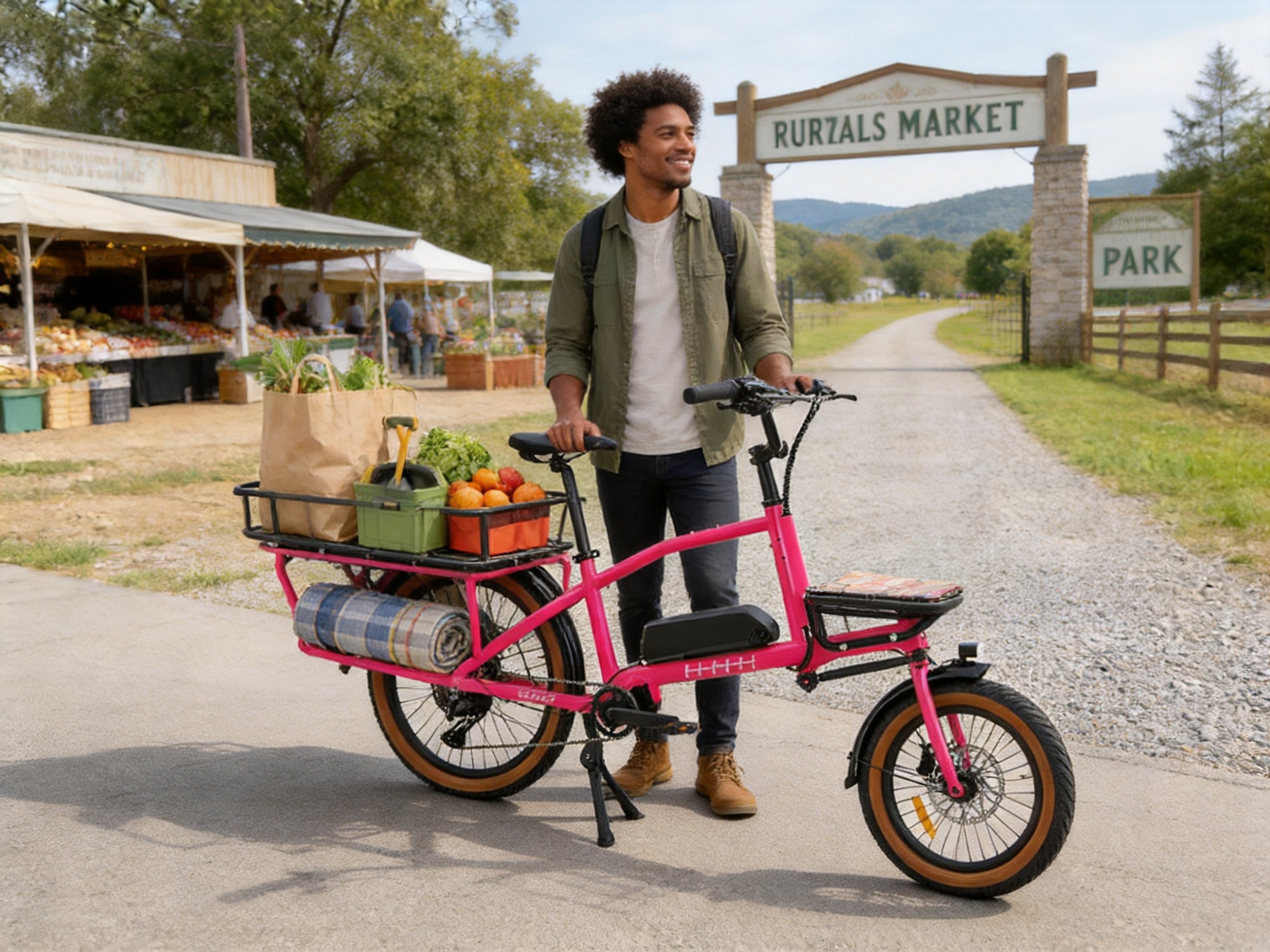
For riders who want to move beyond ordinary commuting, an adventure cargo bike must do more than carry a small bag or a few groceries. It needs to transport bulky equipment, remain stable on imperfect surfaces, climb with a meaningful load, stop confidently in changing weather, and survive repeated use over long distances. The Atmose Model V ESV1 Adventure Cargo Bike with Oversized Front Camping Rack is designed around precisely that combination of requirements.
This is a cargo bike for people who see practical transportation and outdoor exploration as part of the same lifestyle. Its front storage platform is considerably more purposeful than a conventional bicycle basket. The rack is designed around camping equipment, fishing gear, coolers, tools, and other large items that are difficult to carry on a standard bicycle. At the same time, the bike uses a mid-drive motor, an 11-speed Shimano Cues transmission, hydraulic disc brakes, puncture-resistant tires, and a 170-kilogram maximum load rating to support demanding journeys.
The Model V belongs to a growing category of cargo bicycles that compete not only with other electric cargo bikes, but also with compact cars, utility trailers, recreational bicycles, and traditional touring bicycles. Its strongest distinction is the way it combines substantial front-loading capacity with the dimensions and rideability of a bicycle. Instead of requiring a separate trailer for every outing, the rider can use the integrated front folding basket to organize and carry essential equipment directly on the bike.
Many cargo bikes are optimized for one dominant purpose. Some are designed for carrying children, others for groceries, business deliveries, or urban errands. The Model V takes a different approach. It is built for outdoor users who may need to carry equipment over uneven roads, gravel tracks, forest paths, campsite approaches, and rural lanes.
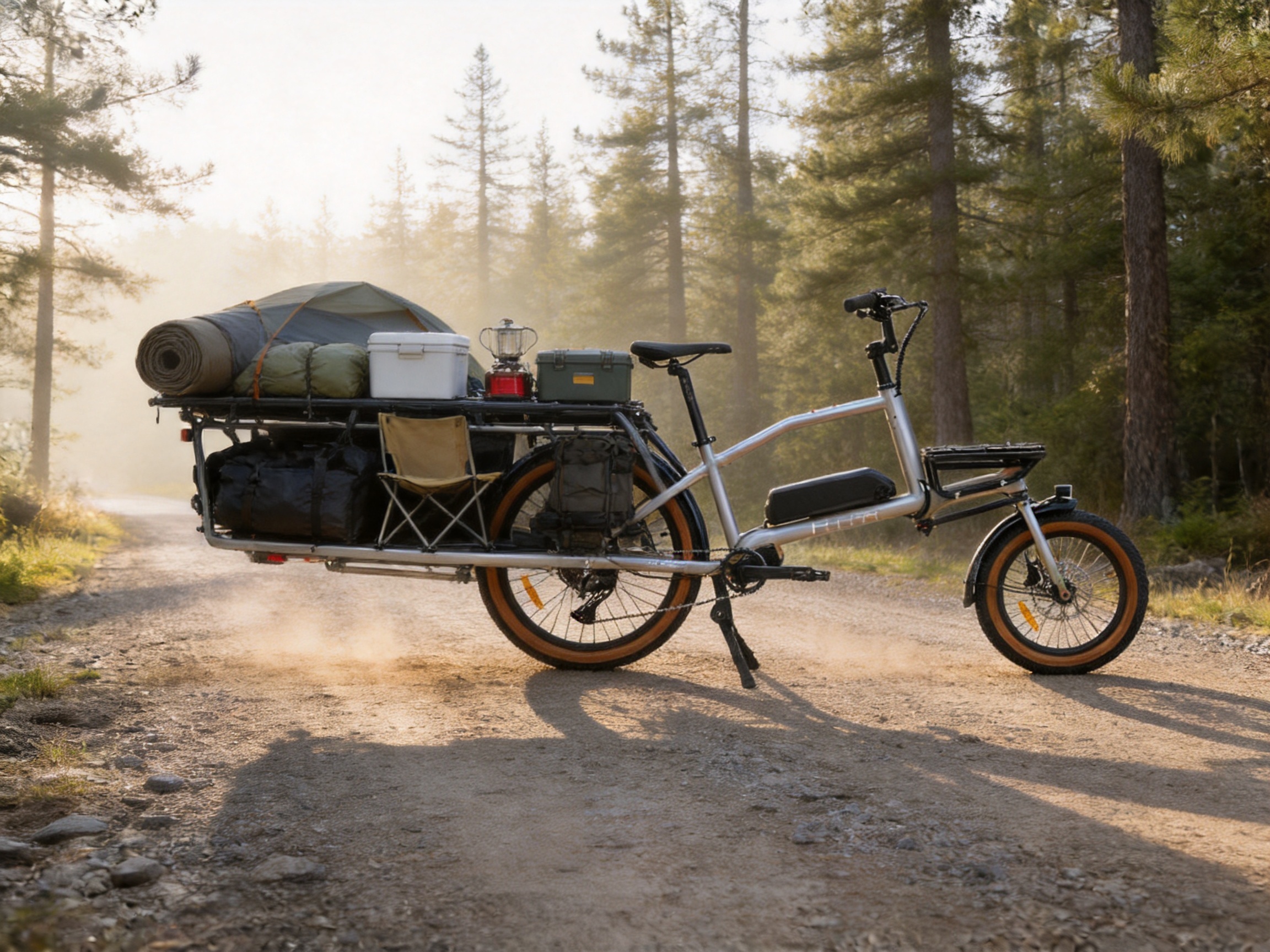
The product concept is straightforward: increase useful carrying capacity without making the bike dependent on a separate trailer or a complicated collection of accessories. The oversized front storage deck keeps the load in front of the rider and relatively low, helping the rider see and manage the cargo while maintaining a practical center of gravity. This layout is particularly useful for large but moderately dense objects such as tents, folding chairs, sleeping bags, coolers, camping boxes, and fishing equipment.
The front folding basket measures approximately 470 millimeters in length, 470 millimeters in width, and 375 millimeters in height. These dimensions give the rider a generous loading area for equipment that cannot be comfortably placed in a conventional rear pannier. The folding function also improves storage convenience when the bike is parked or transported.
Adventure riding frequently involves changing conditions. A route may begin on smooth pavement, continue onto compact gravel, and finish on a muddy or uneven access trail. For this reason, the Model V combines a utility-oriented frame with components intended to support control and reliability in variable environments. Its 6061 T4T6 aluminum alloy frame offers a practical balance between structural strength, weight management, and resistance to everyday corrosion.
The design is not limited to recreational use. A rider could use the same platform for farmers’ market shopping, garden work, equipment transport, mobile maintenance tasks, or weekend travel. This flexibility is one of the bike’s most important competitive advantages: the vehicle can change roles without requiring a completely different frame or cargo system.

Atmose Model V ESV1 Adventure Cargo Bike with Oversized Front Camping Rack
The front rack is the feature that most clearly separates the Model V from an ordinary electric bicycle. Standard bicycles often rely on a small handlebar basket or narrow rear rack. Those solutions work for light personal items, but they become restrictive when the load is large, irregularly shaped, or needed for a multi-day trip.
The Model V’s front folding basket provides a broader and more stable cargo area. Its width allows equipment to be arranged side by side rather than stacked high. This matters because tall or poorly distributed cargo can interfere with visibility, steering, and balance. Keeping items lower and spreading them across the deck makes it easier to create a predictable loading arrangement.
For camping, the platform can accommodate a tent bag, sleeping system, cooking equipment, and compact outdoor furniture. For fishing, it can carry a cooler, tackle box, folding seat, and protective clothing. For photography or field research, it can transport cases and tripods that would be awkward on a traditional bicycle. For maintenance work, it can hold hand tools, supplies, and replacement parts.
The rack also supports a more organized approach to loading. Instead of placing everything into one oversized backpack, riders can distribute the weight between the front cargo area and other compatible storage solutions. This can reduce shoulder strain and make frequently used items easier to access during a journey.
A large front cargo area does require responsible loading. The stated maximum load rating for the bike is 170 kilograms, but this figure should be understood as the total permitted load rather than the cargo allowance alone. The combined weight of the rider, cargo, accessories, and other equipment must remain within the manufacturer’s limits. Heavy items should be secured, centered as much as possible, and kept low on the platform.
Compared with a trailer, the integrated front rack offers several practical benefits. The bike remains a single maneuverable vehicle, the rider does not need to manage a separate coupling system, and the cargo is visible from the riding position. A trailer may still be preferable for extremely long objects or very high-volume loads, but for camping equipment and general outdoor supplies, the integrated design is more convenient and immediately usable.
Cargo placement influences how a bicycle accelerates, corners, climbs, and stops. A high load can increase the feeling of top-heaviness, while a load placed far behind the rear axle can reduce front-wheel traction. The Model V’s front deck is intended to keep bulky equipment in a forward, low-positioned area, helping the rider maintain awareness of the cargo and preserve a more balanced handling profile.
Riders should still test the bike gradually when carrying a new type of load. A bicycle that feels light and responsive when empty will react differently when loaded with a cooler, camping box, or other dense object. Secure straps, even weight distribution, and a short practice ride are important parts of safe cargo-bike operation.
Adventure routes rarely remain flat. Even a moderate incline becomes more demanding when the bicycle is carrying a rider and a full load of equipment. The Model V uses a Starunion CM2503 mid-drive power system rated at 250 watts. A mid-drive motor places its power near the bicycle’s crankset rather than directly inside a wheel, allowing the motor to work through the bicycle’s gearing.
This arrangement is particularly appropriate for a cargo bike intended for hills. When paired with the 11-speed transmission, the motor can benefit from lower gears during climbs. The rider can select a suitable gear for the terrain instead of relying on a single fixed motor ratio. This can make the system more adaptable when the route changes between flat roads, gradual slopes, and steeper sections.
The 250-watt rating places the power system within a familiar European-style power category for electrically assisted bicycles, although local regulations determine how the bike may be used, where it may be ridden, and whether registration or other requirements apply. Users should always verify the rules in their jurisdiction before riding on public roads or trails.
A mid-drive system also helps preserve the riding character of a bicycle. Rather than simply pushing from a hub, the motor works alongside the rider’s pedaling input and selected gear. This can be valuable on technical or uneven surfaces where control, cadence, and traction matter as much as maximum speed.
For an adventure cargo bike, usable torque is more important than an impressive top-speed figure. The goal is not to race while carrying outdoor equipment. The goal is to climb steadily, maintain control, and reduce fatigue over a complete journey. The Model V’s high-torque orientation is therefore aligned with its intended use: carrying weight over changing terrain.
The bike is equipped with a Samsung 36-volt, 15-amp-hour lithium battery listed at 540 watt-hours. Battery capacity is an important part of the product’s touring and utility potential. A 540-watt-hour battery provides a meaningful energy reserve for commuting, errands, and outdoor rides, but actual range depends on many factors.
Rider weight, cargo weight, temperature, tire pressure, wind, terrain, assist level, stopping frequency, and riding technique all influence energy consumption. A heavily loaded bike climbing a series of steep trails will use energy much faster than a lightly loaded bike traveling on level pavement. Riders planning long expeditions should calculate conservatively and consider charging opportunities.
The use of a Samsung battery cell platform is a notable component choice because battery consistency and quality are central to the ownership experience of an electric bicycle. However, battery care remains essential. The battery should be charged with the appropriate charger, kept away from extreme heat and moisture, and stored according to the manufacturer’s instructions when the bike will not be used for an extended period.
For touring, riders may also benefit from planning routes around available electrical outlets or carrying a suitable charging strategy. The large front rack can be useful for transporting a charger and other small travel equipment, provided that these items are protected from rain and securely packed.
The Model V uses an 11-speed Shimano Cues drivetrain. A wide-range gear system gives the rider more control over cadence and effort, especially when the total system weight changes according to the load. The same bicycle may feel very different when carrying only a small day bag compared with a full camping setup.
Lower gears make climbing more manageable by allowing the rider and motor to turn the crank at a useful cadence. Higher gears support efficient progress on flatter roads and downhill sections. The multiple ratios also help riders adapt to gradual changes in slope instead of making large jumps in effort between gears.
Shimano Cues is positioned as a practical drivetrain family for utility, trekking, and everyday riding applications. Its presence suits the Model V’s purpose because an adventure cargo bike needs components that can be serviced and understood by bicycle technicians in many markets. Broad service familiarity can be an advantage compared with a highly proprietary drivetrain that requires specialized parts or training.
Drivetrain maintenance is particularly important on a cargo bike. Carrying additional weight increases the demand placed on the chain, cassette, derailleur, and chainring. Riders should clean the drivetrain after muddy rides, lubricate it appropriately, inspect the chain for wear, and avoid shifting under excessive pedal force whenever possible.
The bike is fitted with Tektro hydraulic disc brakes. Braking performance is one of the most important considerations for a loaded bicycle. A greater total weight requires more energy to control, and downhill riding can intensify heat and wear at the braking system.
Hydraulic disc brakes transmit braking force through fluid rather than a traditional mechanical cable. This design can provide smooth lever action, consistent modulation, and strong stopping performance when properly maintained. Disc brakes also remain effective in conditions where rim brakes may be affected by water, mud, or debris on the wheel rim.
These characteristics are well suited to outdoor travel. Wet roads, loose gravel, and muddy access paths can reduce available traction, making progressive brake control essential. The rider should avoid abrupt braking on slippery surfaces and should apply both brakes in a controlled manner while keeping the bike stable.
Brake performance depends on correct setup and regular inspection. Brake pads gradually wear, hydraulic systems require appropriate servicing, and rotors must remain clean and undamaged. After transporting the bicycle or riding through deep mud, the rider should check the wheels, calipers, rotors, and levers before the next trip.
Compared with basic rim brakes commonly found on low-cost utility bicycles, hydraulic disc brakes offer a clear advantage for a heavy, electrically assisted cargo bike. They are better aligned with higher total loads, repeated descents, and changing weather. This does not remove the need for cautious riding, but it gives the rider a more capable braking platform.
The Model V uses wide punch-proof tires in a front 18-by-2.4-inch configuration and a rear 24-by-2.4-inch configuration. The relatively wide tire profile supports the bike’s cargo and adventure character by providing a larger contact area than a narrow road tire.
Wide tires can improve comfort by allowing the bike to absorb some small surface irregularities. They may also provide useful traction on compact gravel and imperfect pavement. The stated puncture-resistant construction adds another layer of practicality for riders traveling away from immediate access to a repair shop.
No bicycle tire is completely immune to punctures. Sharp debris, incorrect pressure, heavy impacts, and worn tread can still cause problems. Riders should maintain recommended tire pressure, inspect the tread and sidewalls, and carry a basic repair kit or replacement tube during remote trips.
The differing front and rear wheel sizes are part of the bike’s compact cargo-bike architecture. The smaller front wheel helps support the front cargo area while keeping the overall design manageable. The larger rear wheel contributes to efficient rolling and supports the rider’s position over the main drive area. Together, the wheel configuration is intended to balance cargo capacity, maneuverability, and stability.
Riding technique remains important on loose surfaces. Riders should reduce speed before corners, avoid sudden steering movements, and keep the load secured. When the bike is heavily loaded, a smooth line and predictable control are more valuable than aggressive maneuvering.
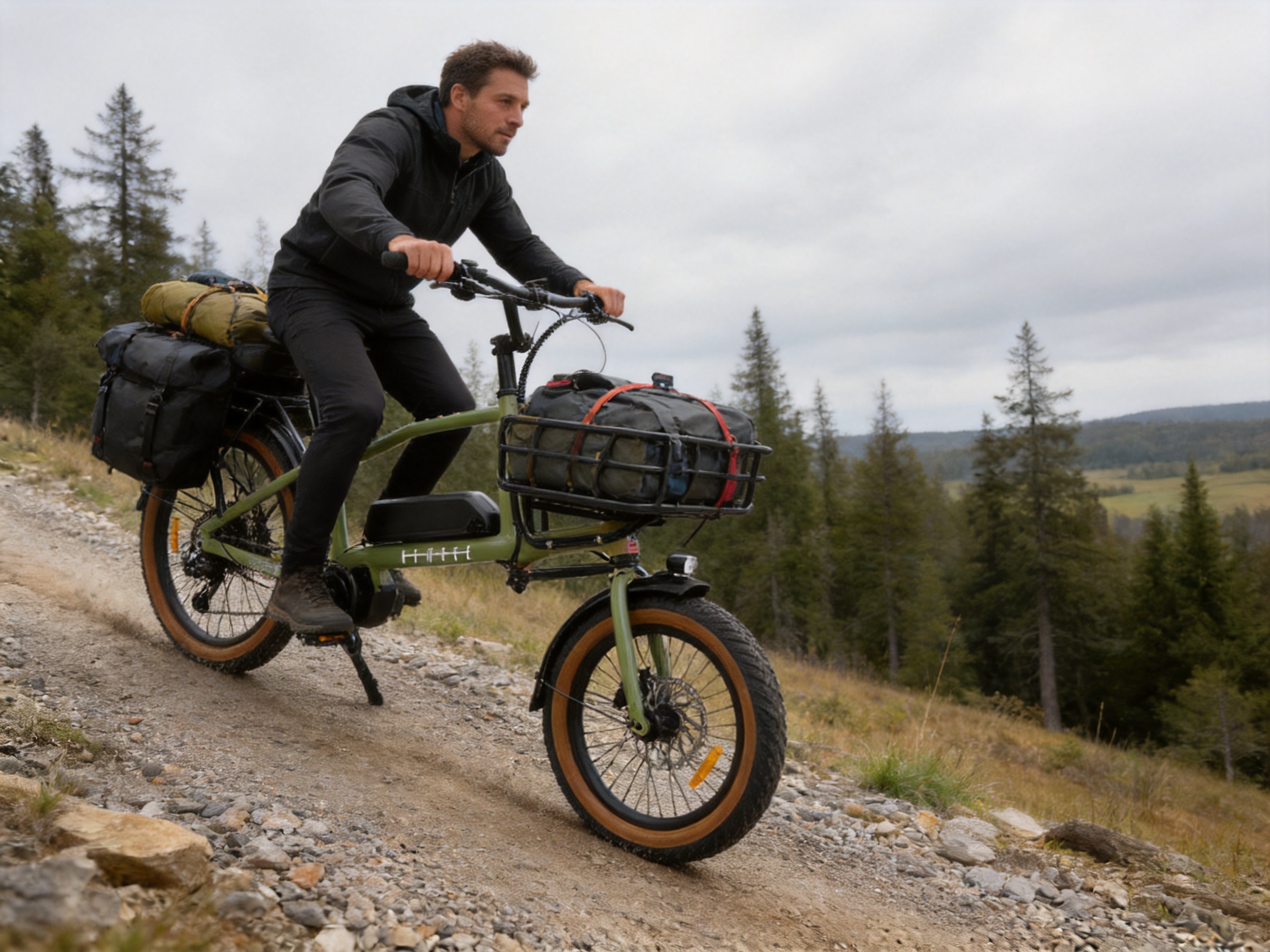
The frame is made from 6061 T4T6 aluminum alloy. Aluminum is widely used in modern bicycles because it offers a useful combination of strength, relatively low density, corrosion resistance, and manufacturing flexibility. For a cargo bike, frame design must account for more than the rider’s weight. It must also manage the forces created by cargo, motor assistance, braking, steering, and repeated use on uneven terrain.
The T4T6 designation refers to heat-treatment conditions associated with aluminum alloy processing. The exact engineering performance of the finished frame depends on tube dimensions, joint design, weld quality, heat-treatment control, surface finishing, and testing. The material specification is therefore one part of the frame’s overall performance rather than a complete description by itself.
The listed maximum load is 170 kilograms. This is a substantial capacity for a bicycle and supports the Model V’s positioning as a serious utility platform. A high load rating is especially relevant for adventure users because equipment can accumulate quickly. A tent, sleeping system, cooking gear, water, food, tools, clothing, and safety equipment can weigh far more than the contents of a typical commuter backpack.
Load capacity should always be used responsibly. Cargo must be fixed so it cannot shift during cornering or braking. The rider should not exceed the manufacturer’s stated limits, and the bike should be checked for loose fasteners, unusual noises, frame damage, and wheel alignment after demanding trips.
The listed bike dimensions are approximately 1,910 millimeters in length, 750 millimeters in width, and 1,060 millimeters in height. These measurements place the bike within a practical range for a full-size cargo bicycle while keeping the width manageable for many urban routes, storage areas, and cycle paths.
A 750-millimeter width can be an important consideration for access through gates, doorways, paths, and storage spaces. Riders should measure their own garage, elevator, shed, or apartment entrance before purchase, especially if the bicycle will be stored indoors.
The overall length provides room for the front cargo structure without creating the extreme footprint associated with some long-tail or box-style cargo bicycles. This can help when making tight turns, parking near a campsite, or navigating narrow access roads. Nevertheless, a loaded cargo bike will always require more stopping distance and turning space than a standard bicycle.
The folding front basket contributes to storage flexibility. When folded, it may reduce the obstruction created by the front cargo platform, although users should confirm the exact folded dimensions and folding procedure. A folding component should never be treated as an invitation to overload the mechanism. Cargo should be removed or secured according to the operating instructions before folding.
The Model V competes in a market that includes conventional electric cargo bikes, long-tail cargo bikes, front-loader bicycles, utility e-bikes, and bicycle-and-trailer combinations. Its advantages are most apparent when the buyer wants a single vehicle for both everyday transport and outdoor exploration.
Many standard e-bikes can carry a small pannier or rear rack bag, but they are not designed for bulky camping gear. The Model V’s oversized front basket is integrated into the product concept rather than added as an afterthought. This makes it better suited to irregular, box-shaped, or high-volume items.
The combination of a mid-drive motor and 11-speed drivetrain gives the bike a useful mechanical advantage on climbs. Some lower-cost cargo bicycles rely on simpler gearing or a hub motor configuration that may not provide the same gear-linked adaptability on steep terrain. The Model V is designed around loaded climbing rather than flat-road cruising alone.
Hydraulic disc brakes and puncture-resistant wide tires are valuable for riders who expect to encounter mud, wet roads, gravel, or remote surfaces. These components support a more confident experience than entry-level bicycle equipment intended primarily for dry, flat commuting.
The 170-kilogram maximum load rating gives the product a broad practical envelope. It can support a wide range of rider sizes and equipment combinations, although every load must remain within the official limits and be distributed safely.
The Model V can serve as a commuter, shopping bike, touring vehicle, campsite transporter, recreational trail bike, and light-duty utility carrier. This multi-role character may offer better value than owning separate bicycles for errands and adventure riding.
The Shimano drivetrain and Tektro braking system are recognizable component platforms in the bicycle industry. Access to technicians familiar with these systems can simplify routine maintenance and repairs, particularly for owners who travel or live away from the original seller.
The company’s stated background provides useful context for understanding the Model V. The brand originated in California and was developed by MOTIV, an established American beach cruiser brand with industry experience. The company also describes an international design and research-and-development team based in Paris, combining American product thinking with European design aesthetics.
This international development structure can be valuable when creating a product that must balance lifestyle appeal, utility, regulations, and practical engineering. American product culture often emphasizes approachable use and recreational freedom, while European bicycle design frequently places strong attention on compact urban dimensions, everyday functionality, and integrated transport solutions. The Model V reflects elements of both priorities.
The company reports that Cameron Perstein and Guojie Shen founded ATMOSE BIKES INC. in Long Beach, California, in 2023, followed by the establishment of ATMOSE SASU in France in 2026. It also identifies manufacturing expertise, a mature supply chain, and continuous innovation as foundations of its product development approach.
Although the supplied materials do not specify individual factory processes, certifications, laboratory test results, or production tolerances, several aspects of the product reveal the importance of coordinated manufacturing. A cargo bicycle with a large front platform, mid-drive system, hydraulic brakes, and high load rating requires the frame, fork, steering system, wheels, drivetrain, electrical system, and cargo structure to work together as one integrated product.
Advanced manufacturing strength in this context is not limited to the production of one component. It includes product architecture, supplier coordination, material selection, welding and finishing control, assembly consistency, electrical integration, inspection, packaging, and after-sales support. A mature supply chain can help a company source specialized components, maintain repeatability, and manage replacement parts more effectively than a small-scale product assembled without a coordinated system.
The aluminum frame must be formed, joined, aligned, finished, and inspected with sufficient consistency for the bicycle’s intended load. Cargo-bike frames experience repeated forces at the head tube, bottom bracket, rear axle, rack mounting areas, and steering interfaces. The larger the cargo platform and the heavier the expected load, the more important dimensional accuracy and joint consistency become.
Good manufacturing practice includes controlling tube alignment, welding quality, heat-affected areas, surface treatment, and final inspection. The supplied information identifies the alloy and heat-treatment designation but does not publish the company’s specific welding method or inspection protocol. Buyers seeking detailed technical validation should request the relevant documentation directly from the manufacturer or authorized dealer.
Electric cargo-bike manufacturing also requires careful integration of the battery, motor, wiring, controls, sensors, and frame interfaces. The listed Samsung battery and Starunion mid-drive system must be installed so that wiring is protected from vibration, moisture, abrasion, and accidental impact. Battery mounting should be secure while still allowing removal for charging or servicing.
Electrical integration is particularly important on an adventure-oriented bicycle because outdoor riding may expose the system to dust, splash water, temperature changes, and repeated vibration. The product description emphasizes reliability and longevity, but users should consult the official operating and maintenance guidance for the precise environmental limitations of the electrical components.
A cargo bike cannot be evaluated by looking at the motor alone. The motor must match the drivetrain, the brakes must match the total load, the tires must suit the frame and wheel sizes, and the cargo platform must work with the steering geometry. The Model V’s specification combines these systems in a manner consistent with its intended role.
Quality control may include incoming component checks, frame alignment inspection, torque verification, brake adjustment, drivetrain setup, electrical testing, and final road testing. The provided materials do not list every inspection stage, but a product with multiple integrated subsystems requires this kind of coordinated assembly to deliver consistent results.
The company’s stated emphasis on continuous innovation also suggests that product development is treated as an ongoing process rather than a one-time design exercise. Feedback from riders, dealers, service technicians, and international markets can help identify opportunities for improvements in accessories, fit, cargo organization, software, maintenance, and component selection.
The most obvious use case is a weekend camping trip. The front rack can hold a compact tent, sleeping bag, stove, cookware, food, and personal items. The rider may distribute dense objects between the front platform and additional rear storage to keep the bicycle balanced.
An electric assist system is especially useful when touring with camping gear because the rider may be carrying several days’ worth of equipment. The battery can reduce fatigue on hills and allow the rider to reserve physical energy for exploring after reaching the campsite.
Fishing equipment often includes long, awkward, or fragile items. A wide cargo area can be more useful than a narrow pannier because it accommodates a tackle box and cooler together. Rods and other long equipment must be secured carefully and should never interfere with steering, braking, wheel rotation, or the rider’s visibility.
The Model V can also function as a light-duty work bike for gardens, allotments, small farms, and rural properties. Soil, hand tools, seedlings, feed, and maintenance supplies can be carried without starting a motor vehicle for every short task. The electric system can make repeated trips less tiring while preserving the quiet and low-impact character of bicycle transport.
Even riders who rarely leave the city may benefit from the oversized front basket. Grocery boxes, reusable bags, household supplies, and market purchases can be loaded directly into the cargo area. The bike may replace some short car journeys, reducing parking difficulties and making local travel more active.
Tradespeople, photographers, event workers, maintenance staff, and mobile service providers may use the platform for carrying tools and equipment. The maximum load rating gives the bike a useful margin for professional supplies, although commercial users should consider insurance, local regulations, route conditions, and the need for weatherproof storage.
Before carrying a full load, riders should become familiar with the bicycle while it is empty. Practice starts, stops, turns, gear changes, and tight maneuvers in a safe area. Add cargo gradually and test the handling after each increase.
Place heavy objects low and near the center of the front platform. Use straps or suitable containers to prevent movement. Avoid placing loose items near the front wheel, steering joints, brake cables, chain, or motor components. Soft items should be protected from rain, while rigid containers should be padded if they contain fragile equipment.
Check tire pressure before each loaded trip. Underinflated tires may feel comfortable but can increase rolling resistance, reduce handling precision, and raise the risk of rim damage. Overinflated tires can reduce grip on rough or loose surfaces. Follow the tire and bicycle manufacturer’s recommended pressure range.
Use lower gears before beginning a steep climb rather than waiting until the drivetrain is under maximum pressure. On descents, reduce speed early and use both brakes progressively. Do not assume that the motor or wide tires eliminate the need for careful control.
After a muddy or dusty ride, clean the bicycle with appropriate methods. Avoid directing high-pressure water at bearings, electrical connectors, the display, battery interfaces, or motor seals. Inspect the chain, brake rotors, tire tread, rack fasteners, and cargo mounting points.
The value of an adventure cargo bike depends on more than its initial specification. It also depends on how easily the owner can maintain it, obtain service, and adapt it to changing needs. The Model V’s use of established drivetrain and brake component families may support practical servicing, while the robust frame and large cargo area can extend the bike’s usefulness across multiple activities.
Routine maintenance should include checking fasteners, lubricating the chain, inspecting brake pads, monitoring tire condition, verifying wheel security, and examining the cargo platform for damage or looseness. Electrical connectors and battery contacts should remain clean and dry. Any change in motor noise, battery behavior, braking feel, steering resistance, or frame movement should be investigated promptly.
The battery is a consumable component whose useful life depends on charging habits, storage temperature, use frequency, and total cycles. Riders should avoid leaving a depleted battery unused for long periods and should follow the recommended charging procedure. A replacement battery strategy should also be considered when planning long-term ownership.
From a sustainability perspective, a versatile cargo bike can reduce the need for several types of short vehicle trips. It may replace some journeys that would otherwise require a car, especially when the destination is within practical cycling distance. Its usefulness increases when the rider can use it for commuting, shopping, recreation, and work instead of purchasing a specialized bicycle for each purpose.
Specification |
Model V ESV1 Detail |
Practical Importance |
Frame |
6061 T4T6 aluminum alloy |
Balances structural utility, corrosion resistance, and manageable weight |
Battery |
Samsung 36V, 15Ah, 540Wh lithium battery |
Provides a substantial energy reserve for assisted transport and touring |
Maximum load |
170 kilograms |
Supports rider and equipment combinations suitable for cargo use |
Motor |
Starunion CM2503 mid-drive, 250W |
Works with the bicycle’s gears and is suited to loaded climbs |
Drivetrain |
Shimano 11-speed Cues |
Offers a broad range of ratios for hills, flats, and changing loads |
Front basket |
470 × 470 × 375 millimeters, folding design |
Creates a large loading area for camping, fishing, and utility equipment |
Tires |
Front 18 × 2.4, rear 24 × 2.4, puncture-resistant |
Supports traction, comfort, and practical mixed-surface riding |
Brakes |
Tektro hydraulic disc brakes |
Provides controlled stopping for wet conditions and heavier loads |
Overall dimensions |
Approximately 1910 × 750 × 1060 millimeters |
Offers cargo capacity while remaining manageable for many urban spaces |
The Model V is a strong candidate for riders who want a single electric cargo bike to cover both practical transport and outdoor recreation. It is particularly suitable for people who regularly carry bulky equipment, travel on hilly routes, value hydraulic braking, and prefer an integrated front cargo solution over a separate trailer.
It may be less suitable for riders who only need a lightweight bicycle for short, flat commutes or who have limited storage space. The features that make it useful for adventure—large cargo capacity, high load capability, wide tires, and a robust structure—also mean that it is more substantial than a minimalist city e-bike.
Buyers should also consider their local legal requirements. Electric-bike classifications, permitted motor output, assisted-speed limits, equipment rules, and access to trails vary by country and region. The bike’s 250-watt motor rating may fit certain regulatory categories, but the owner remains responsible for confirming local compliance.
The Model V ESV1 is designed as an adventure-oriented electric cargo bike. Its central purpose is to carry bulky outdoor equipment while providing electric assistance for longer distances, hills, and mixed-surface routes.
The listed front folding basket measures approximately 470 millimeters long, 470 millimeters wide, and 375 millimeters high. It is intended for items such as tents, coolers, fishing equipment, camping supplies, tools, and shopping goods.
The maximum load refers to the combined permitted load of the rider, cargo, accessories, and other carried equipment. It should not be interpreted as 170 kilograms of cargo in addition to the rider. Users should follow the official manual and avoid exceeding the stated limit.
The bike uses a 250-watt Starunion CM2503 mid-drive motor and an 11-speed Shimano Cues drivetrain. This combination is intended to provide useful assistance on climbs because the motor can work through the bicycle’s selected gear. Actual climbing performance depends on rider weight, cargo, gradient, surface, battery charge, and assist settings.
The battery is listed at 540 watt-hours, but a precise range cannot be guaranteed from capacity alone. Terrain, total weight, temperature, wind, tire pressure, riding speed, and assist level all affect consumption. Riders should plan conservatively for loaded or mountainous trips.
The 2.4-inch puncture-resistant tires are intended to support mixed-surface riding and provide a practical balance of traction and comfort. They are appropriate for suitable gravel and outdoor access routes, but the bike should not be treated as a technical mountain bike unless the manufacturer specifically approves that use.
Hydraulic disc brakes can provide strong, progressive stopping control for a heavier bicycle. Their performance is also well suited to wet or muddy conditions. Brake pads, rotors, and hydraulic components still require regular inspection and maintenance.
Yes. The product information identifies the front basket as a folding basket. Owners should follow the correct folding procedure, remove or secure cargo first, and avoid forcing or overloading the folding mechanism.
Yes. Although it is designed for adventure use, its large front cargo area, electric assistance, manageable listed width, and multi-speed drivetrain also make it useful for groceries, commuting, equipment transport, and everyday errands.
The Model V is built around cargo capacity rather than only personal transportation. Its oversized front basket, 170-kilogram maximum load rating, wide tires, mid-drive system, and hydraulic brakes are intended to support heavier and more varied use than a conventional electric bicycle.
The supplied company information describes American origins, Paris-based design and research-and-development capabilities, manufacturing expertise, a mature supply chain, and continuous innovation. The materials do not provide detailed factory certifications or specific production test results. Buyers requiring such documentation should request it directly.
Owners should monitor tire pressure, brake-pad wear, rotor condition, chain lubrication, drivetrain wear, wheel security, cargo-rack fasteners, battery contacts, and electrical connections. After riding in mud or rain, the bicycle should be cleaned and inspected using methods appropriate for electric components.
No single bicycle can replace a car for every journey. However, the Model V may replace many short trips involving shopping, commuting, outdoor equipment, or local deliveries. Its usefulness depends on distance, weather, terrain, cargo requirements, local infrastructure, and the rider’s physical and practical needs.
The Model V ESV1 is a purpose-built adventure cargo bike that places carrying capability at the center of the riding experience. Its oversized front folding basket gives it an immediate advantage over ordinary electric bicycles, while the 170-kilogram maximum load rating supports serious utility. The mid-drive motor and 11-speed drivetrain are well matched to loaded and hilly journeys, and the hydraulic disc brakes and puncture-resistant tires address important safety and reliability concerns for mixed conditions.
The bike’s competitive strength comes from integration. It is not simply an electric bicycle with a rack attached. The frame, cargo platform, motor, gearing, tires, and brakes are selected around the demands of carrying equipment beyond the city. That makes it relevant to campers, anglers, gardeners, commuters, mobile workers, and families seeking a versatile transport tool.
The company’s California origin, Paris design and research-and-development presence, manufacturing experience, supply-chain foundation, and stated commitment to continuous innovation provide a broader platform for developing this type of product. While detailed factory certifications and testing procedures are not included in the supplied information, the product specification demonstrates an intentional approach to structural utility, component coordination, and practical outdoor use.
For buyers seeking a compact but capable cargo vehicle, the decisive question is not simply how fast the bike can travel. It is whether the bike can carry the right equipment, climb the routes that matter, stop reliably, remain serviceable, and adapt to different parts of the owner’s life. The Model V is designed to answer those requirements with a combination of cargo volume, electric assistance, durable components, and flexible everyday usefulness.
1. Product specification sheet for the Model V ESV1 Adventure Cargo Bike, including frame, battery, motor, drivetrain, tire, brake, dimension, and cargo-basket information.
2. Technical information supplied for the 6061 T4T6 aluminum alloy frame and 170-kilogram maximum load rating.
3. Component information supplied for the Samsung 36V 15Ah lithium battery and Starunion CM2503 250W mid-drive power system.
4. Component information supplied for the Shimano 11-speed Cues drivetrain and Tektro hydraulic disc-brake system.
5. Company information describing the brand’s California origins, Paris-based design and research-and-development team, manufacturing expertise, supply-chain capabilities, and product-development philosophy.
6. General bicycle engineering principles concerning cargo distribution, mid-drive gearing, hydraulic braking, tire pressure, battery care, and mixed-surface riding safety.
Nov 27, 2026
Nov 25, 2026
Nov 21, 2026


info@atmosecargobike.com

200 rue de la Croix Nivert 75015 Paris

Custom Electric Bakfiets
 English
 Français
 Deutsch