Nov 25, 2026
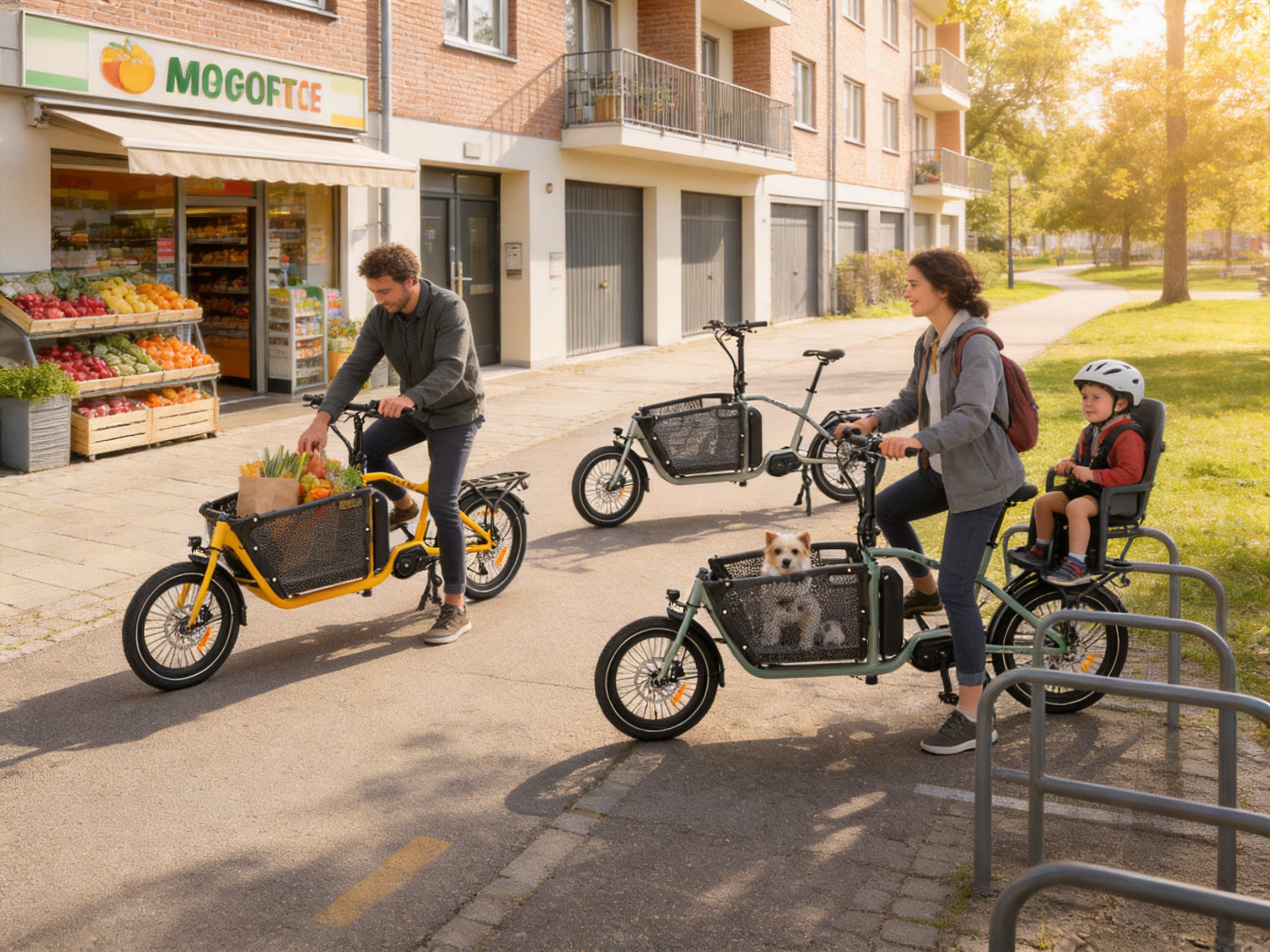
Urban families increasingly need a practical alternative to the private car. School runs, grocery shopping, visits to the veterinarian, commuting, and short leisure trips can place heavy demands on a household’s transportation system. A conventional bicycle may be too limited for children, pets, shopping, or changing weather, while a car can be expensive, difficult to park, and inefficient for short journeys.
The ESP3 electric family cargo bike is designed to occupy the space between an ordinary bicycle and a family car. It combines a front cargo platform, electric mid-drive assistance, hydraulic disc brakes, wide puncture-resistant tires, and a long-range battery system. Its purpose is not simply to carry more weight than a standard bicycle. It is intended to make routine family transport more predictable, more comfortable, and more manageable for riders who may not have extensive experience with cargo bicycles.
The bike belongs to the family cargo bike category, but its design also supports grocery transport, pet carrying, daily commuting, and light urban utility work. The front folding basket can accommodate everyday goods, child or pet equipment, and additional accessories. When folded, the front section becomes more compact, which can be valuable when storing the bike or navigating tighter spaces.
Atmose SASU presents the ESP3 as part of a broader cargo-bike program developed for modern families, urban commuters, commercial users, and outdoor riders. The company combines American product thinking with European design and research-and-development activity in Paris. This combination is relevant because cargo bikes must balance several competing requirements: carrying capacity, maneuverability, stability, comfort, electrical performance, serviceability, and visual appeal.
This article examines the ESP3 in detail. It explains its technical configuration, practical advantages, safety-oriented construction, manufacturing strengths, expected use cases, competitive position, maintenance considerations, and suitability for distributors and end users.
The ESP3 is a front-loading electric cargo bike with a compact overall width and a relatively short footprint for a family-oriented model. Its listed dimensions are approximately 2,130 millimeters long, 680 millimeters wide, and 1,130 millimeters high. The narrow 680-millimeter width is important in daily use. It can make the bike easier to guide through urban streets, gates, cycle lanes, storage areas, and residential access points than wider box-bike designs.
The front cargo basket measures approximately 645 millimeters by 620 millimeters at the top and 500 millimeters by 390 millimeters at the bottom. The basket supports a stated load of up to 35 kilograms. This capacity is suitable for grocery bags, school supplies, pet equipment, small parcels, and selected child-carrying configurations when the appropriate certified seating accessories are installed.
Power comes from a Bafang M430 mid-drive motor paired with a 36-volt, 15-amp-hour Samsung lithium battery rated at 540 watt-hours. The supplied specification identifies the motor as a 36-volt, 250-watt unit. Additional product information describes output of up to 500 watts and maximum torque of up to 110 newton-meters. Because motor ratings can vary according to regional regulations, software settings, peak output, and market configuration, distributors should confirm the exact homologation and performance specification for their destination market.
The bike uses a Shimano nine-speed Sora speed system. This gives the rider a broad range of mechanical gearing for low-speed climbing, normal urban riding, and more efficient pedaling on flatter roads. Tektro hydraulic disc brakes provide braking assistance at both ends of the bike, while the wide 18-inch front and 20-inch rear 2.4-inch tires are designed to increase comfort, traction, and stability.
The published materials state that the Samsung battery can provide a range of up to 80 kilometers. Actual range depends on rider weight, cargo weight, terrain, wind, temperature, tire pressure, assistance level, traffic conditions, and riding style. Nevertheless, a 540-watt-hour battery is a substantial energy reserve for routine urban journeys and repeated school or shopping trips.
| Specification | ESP3 Configuration | Practical Significance |
|---|---|---|
| Frame | 6061 T4T6 aluminum alloy | Lightweight structural material with good strength and corrosion resistance when properly processed and finished |
| Battery | Samsung 36V 15Ah lithium battery, 540Wh | Supports extended daily use and repeated short trips between charges |
| Drive system | Bafang M430 mid-drive, 36V 250W listed rating | Centralized motor position and torque assistance for hills and loaded riding |
| Maximum basket load | 35kg | Suitable for groceries, equipment, pet supplies, and approved passenger accessories |
| Transmission | Shimano nine-speed Sora | Provides gearing flexibility for different gradients and riding conditions |
| Brakes | Tektro hydraulic disc brakes | Strong, progressive braking with reduced hand effort compared with many mechanical systems |
| Front tires | 18-inch by 2.4-inch puncture-resistant tires | Wide contact patch for comfort, grip, and low-speed confidence |
| Rear tire | 20-inch by 2.4-inch puncture-resistant tire | Compact rear geometry with additional cushioning and traction |
| Overall size | 2,130mm long by 680mm wide by 1,130mm high | Balances carrying capacity with urban maneuverability |
| Claimed maximum range | Up to 80km | Useful for daily transportation, subject to conditions and riding mode |
The primary advantage of the ESP3 is that its cargo area is positioned in front of the rider. This configuration allows the rider to maintain visual contact with children, pets, or valuable goods during a journey. A rear rack or trailer can carry cargo, but it generally places the load behind the rider and outside the natural field of view. A front cargo layout provides a more direct sense of awareness and control.
For families, visibility is particularly important. Parents can check whether a child is seated correctly, whether a rain cover has shifted, or whether a pet is becoming unsettled. This does not replace the need for properly installed restraints and responsible supervision, but it can improve the rider’s ability to monitor the cargo area while moving.
The basket is described as foldable and can become approximately 365 millimeters wide when folded. This compact mode offers several advantages. It may simplify storage in a garage or apartment entrance, reduce the bike’s occupied space in a service area, and make the bike less cumbersome when the front cargo section is not needed. It also demonstrates that the design is intended to support changing daily requirements rather than a single fixed carrying task.
A family cargo bike must carry more than a simple numerical load. It must accommodate irregular shapes, soft bags, school equipment, animal carriers, rain protection, and safety accessories. The ESP3’s front area is designed to work with child seats and rain covers, allowing the bike to be configured for different family routines. Families can use one setup for the school run, another for grocery shopping, and another for carrying a dog or other small pet.
Compared with a standard bicycle fitted with panniers, the ESP3 offers greater volume, better visual access to the front load, and a more stable platform for bulky items. Compared with a bicycle trailer, it avoids the additional length and articulation point of a separate towed unit. Compared with a small car, it can provide lower operating costs and easier access to congested urban destinations, although it cannot replace a car for every weather condition, distance, or passenger requirement.
Safety is one of the most important differentiators in a family cargo bike. A product used to carry children or pets must be engineered for predictable handling, durable structural performance, controlled braking, and secure cargo retention. The ESP3 materials state that the frame has passed 300,000-cycle fatigue tests and references TUV and EN17860 safety certifications. These claims should be supported by current documentation for the specific model and market, but they indicate that structural durability and passenger safety are central to the product’s positioning.
Fatigue testing is especially relevant for cargo bicycles because the frame experiences repeated loading rather than a single static force. Each acceleration, braking event, curb transition, pothole, and change in cargo weight contributes to cumulative stress. A 300,000-cycle fatigue test is intended to evaluate the frame’s resistance to repeated loading over time. The value of such testing depends on the test method, load level, fixture arrangement, acceptance criteria, and whether the tested frame matches the production configuration.
The use of 6061 T4T6 aluminum alloy provides a balance between weight and structural performance. Aluminum allows the frame to be lighter than many comparable steel constructions, while appropriate heat treatment and forming processes can support the stiffness required for a cargo platform. The designation T4T6 indicates different stages of solution treatment and artificial aging or related heat-treatment conditions. In professional production, these processes must be controlled carefully because welding and subsequent heat exposure can affect local material properties.
The ESP3 also benefits from a low-speed stability approach. Wide tires, a centralized motor, and an optimized cargo-bike frame geometry can help reduce nervous handling when the bike is loaded. This is important for first-time cargo riders. A conventional bicycle may respond quickly to steering inputs, whereas a cargo bike must remain composed when the load is positioned ahead of the rider. Predictable steering and controlled weight distribution are more valuable than an aggressive, highly responsive riding character.
Hydraulic disc brakes are another important safety component. Hydraulic systems generally offer smooth modulation and lower hand effort than many cable-operated brakes. This can be helpful when the bicycle is carrying a heavy load or when the rider must brake repeatedly in urban traffic. Effective braking still depends on correct setup, pad condition, rotor condition, tire grip, and rider technique. The presence of hydraulic brakes does not eliminate the need for regular inspection.
The wide 2.4-inch tires contribute to stability by increasing the contact patch and providing additional air volume. This can improve comfort over uneven road surfaces and provide greater confidence when crossing painted lines, shallow drainage channels, or lightly rough paths. Puncture-resistant construction is also useful for family transportation, where an unexpected flat tire can disrupt a school or work schedule.
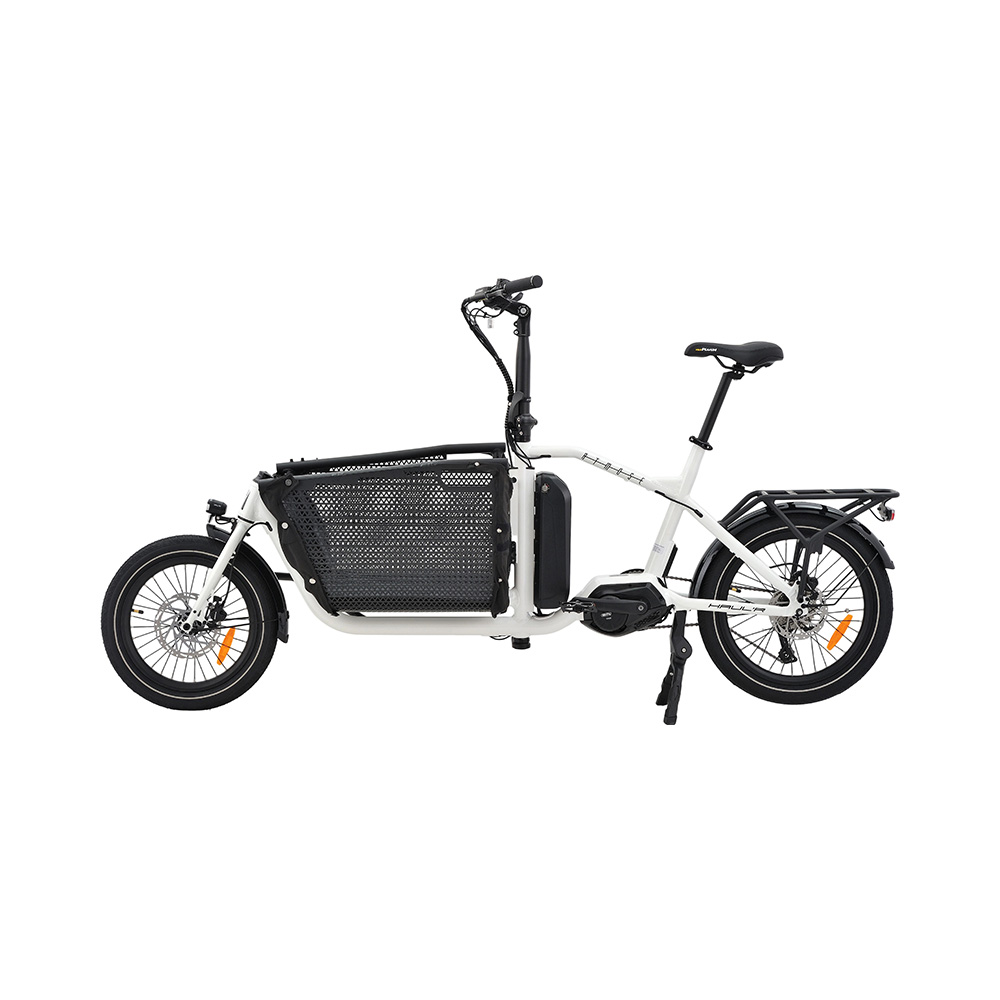
Atmose Model P ESP3 Electric Family Cargo Bike for Kids and Pet Transport
Carrying a child, pet, or groceries changes the physical demands of cycling. A route that feels easy on an unloaded bicycle may become difficult when the total system weight increases. The ESP3 uses a mid-drive motor to help address this challenge. Unlike a hub motor, which applies power directly at the wheel, a mid-drive motor transfers assistance through the bicycle’s drivetrain. This arrangement allows the motor to benefit from the selected mechanical gear.
When climbing a hill with a heavy load, the rider can select a lower gear and allow the motor to operate more effectively. On flatter ground, a higher gear can support efficient cruising. This interaction between electric assistance and mechanical gearing is one of the principal advantages of a mid-drive system for cargo use. It can produce a more natural climbing response and maintain better weight distribution than a large rear hub motor.
The Bafang M430 is described as delivering high torque, with product information citing up to 110 newton-meters. High torque is valuable when starting from a stop, climbing an incline, or accelerating with a loaded front basket. It can reduce the physical effort required from the rider and make the bike more approachable for users who are not accustomed to heavy cargo cycles.
A mid-drive system also places the motor near the center of the bicycle. Centralizing mass can help the bike feel more balanced than a design with a heavy motor positioned at one end. This is particularly useful on a front-loading cargo bike, where the basket and its contents already add weight ahead of the rider. A balanced power unit can contribute to more predictable steering and easier handling when walking or maneuvering the bike at low speed.
The system’s listed 36-volt, 250-watt rating is compatible with many European electric bicycle regulations, subject to the complete legal configuration of the product. At the same time, the product information mentions peak output of 500 watts. These figures are not necessarily contradictory because nominal and peak output describe different operating conditions. However, market-specific documentation should clearly state the legal continuous rating, assistance cutoff speed, control software, and certification status.
The 540-watt-hour Samsung lithium battery is one of the ESP3’s strongest practical features. Battery capacity is important for cargo bikes because the motor may work harder than it would on a lightweight commuter bicycle. A loaded bike, frequent starts, hills, cold temperatures, and high assistance levels can all increase energy consumption.
A battery of this size can support extended daily use, especially when journeys are divided into several short trips. A family might complete a school drop-off, continue to a workplace, make a grocery stop, and return home without needing to recharge between each leg. The stated range of up to 80 kilometers gives the bike a useful operating reserve, although riders should plan conservatively rather than treating the maximum range as a guaranteed distance.
Range is affected by the total system weight, including rider, passengers, cargo, accessories, and the bicycle itself. Tire pressure also matters. Underinflated tires can increase rolling resistance, while overinflated tires may reduce comfort and grip. Frequent acceleration and high assistance settings consume more energy than steady riding at moderate speed. Strong headwinds, steep routes, wet surfaces, and low temperatures can reduce the distance available from a single charge.
For distributors, the battery system is also a commercial consideration. Samsung cells can support customer confidence, but the complete battery pack includes more than the cells. The battery-management system, enclosure, connectors, charger, thermal protection, assembly quality, and service procedures all influence safety and long-term performance. A responsible supply program should include battery documentation, charging instructions, storage guidance, warranty procedures, and replacement availability.
Families should charge the battery in a dry, ventilated location using the approved charger. The battery should not be exposed to extreme heat, impact, water intrusion, or unauthorized modification. When the bicycle is stored for an extended period, the battery should be maintained according to the manufacturer’s recommended state of charge and temperature range.
The ESP3’s value depends not only on its component list but also on how the complete bicycle is engineered and produced. Cargo-bike performance is the result of integration. A powerful motor cannot compensate for poor load distribution, and a strong frame cannot deliver a safe ride if the steering, braking, electrical system, and accessories are not coordinated.
The use of 6061 T4T6 aluminum alloy suggests a material strategy focused on achieving structural strength without creating unnecessary weight. In a professional manufacturing process, frame tubes and formed sections must be selected according to load paths, weld locations, steering forces, and mounting requirements. Welding accuracy is particularly important for a front cargo bike because small alignment errors can affect steering, braking, wheel tracking, and accessory fit.
Heat treatment is another area in which process control matters. Aluminum alloy frames require appropriate control of material condition, welding, heat exposure, surface preparation, and finishing. Consistent welding penetration, clean joints, appropriate fixtures, and dimensional inspection help reduce variation between production units. Post-weld inspection can identify issues such as incomplete fusion, porosity, undercutting, distortion, or unexpected deformation.
The stated 300,000-cycle fatigue testing provides evidence of a durability-oriented engineering approach. Fatigue testing is more meaningful than a simple static load test for a bicycle intended for frequent family use. The test program should be connected to realistic load cases, including rider weight, basket load, braking forces, uneven surfaces, and repeated service conditions. For wholesale buyers, test reports and certification files can help verify that the production model corresponds to the tested configuration.
Atmose’s company information describes an established manufacturing network, mature supply-chain relationships, and an international design and research-and-development team. This structure can provide several advantages. Product development can draw on design expertise, engineering evaluation, supplier coordination, and market-specific compliance work. A mature supply chain may also support more stable access to motors, batteries, transmissions, brakes, tires, and replacement components.
The company’s development history combines an American origin with a French design and research-and-development presence. The American background contributes experience in practical, lifestyle-oriented bicycle products, while the European team is positioned close to dense urban markets where cargo-bike requirements are especially demanding. The result is a product philosophy centered on “Fun & Practical,” combining usability with a more refined appearance than many purely utilitarian cargo cycles.
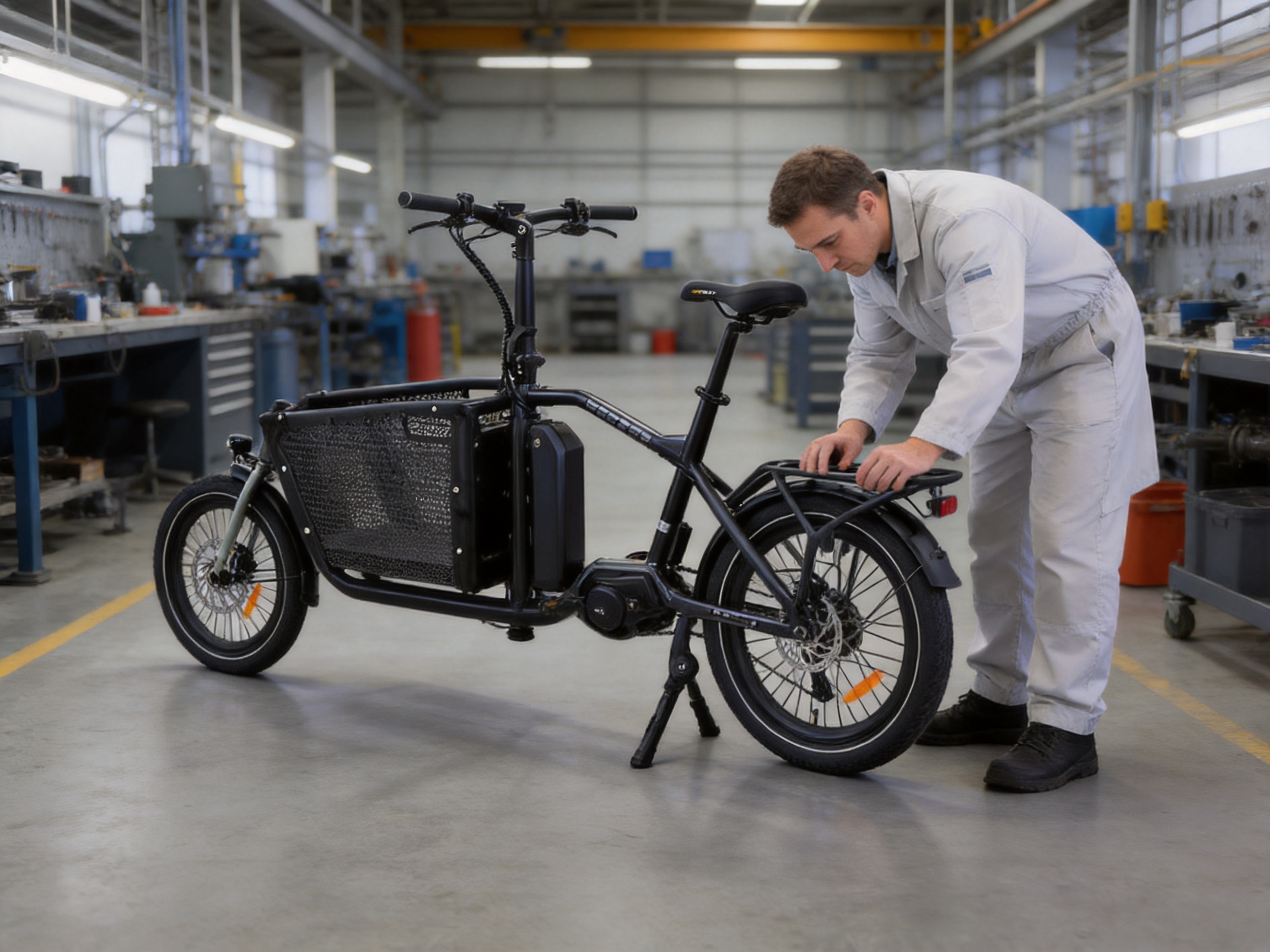
Advanced manufacturing should not be understood only as the use of expensive components. It also includes repeatable assembly, inspection checkpoints, traceability, correct torque settings, battery verification, wheel alignment, brake bleeding, electrical testing, and final road or roller evaluation. These procedures are particularly important for a bicycle intended to carry passengers. A manufacturer’s strength is demonstrated when design intent is consistently reproduced in every production unit.
For professional buyers, important quality-assurance questions include whether frames are batch-traceable, whether welds receive documented inspection, how battery packs are tested, whether motors and displays are programmed for the destination market, and how end-of-line checks are recorded. Clear answers to these questions can distinguish a reliable cargo-bike supplier from a company that simply assembles components without a complete quality system.
A standard bicycle is lighter and often more agile, but it is not designed to carry large, unstable, or bulky loads. Panniers can transport groceries, yet they do not provide the same front-facing volume or passenger compatibility as the ESP3. A standard bicycle also places greater physical demands on the rider when carrying weight uphill.
The ESP3 provides a dedicated cargo structure, high-torque electric assistance, wide tires, and hydraulic brakes. These features make it better suited to family transport and heavy daily utility use. The trade-off is additional weight and size, but that is an intentional consequence of its carrying capability.
Rear-loading cargo bikes can offer excellent carrying volume, especially for older children or larger loads. However, the cargo is positioned behind the rider, which can reduce direct visibility. The ESP3’s front basket allows a parent to see the passenger or pet and maintain a more immediate connection with the load.
The front-loading format can also make everyday interactions easier. A child can be helped into the front compartment while the rider stands beside the bike, and groceries can be loaded without reaching over the saddle. For families who prioritize supervision and communication, this layout has a meaningful advantage.
A trailer can be removed when not needed, but it adds length, a coupling mechanism, and another set of wheels. It may be more difficult to maneuver in narrow spaces, reverse, store, or secure. The ESP3 integrates the cargo area into the bicycle itself, creating a more unified handling experience.
The integrated design also allows the motor, frame, braking system, and cargo structure to be engineered together. A trailer may carry substantial weight, but the towing bicycle and coupling must be carefully matched. With the ESP3, the cargo platform is part of the original product architecture.
A cargo e-bike cannot match a car’s weather protection, high-speed capability, or long-distance carrying capacity. However, for short urban trips, it can be faster door-to-door because it avoids parking searches and can use bicycle infrastructure where permitted. It also consumes less energy and may reduce fuel, maintenance, parking, and congestion costs.
The ESP3 is particularly competitive for journeys that are too long for walking but too short to justify starting a car. School routes, local shopping, park visits, and neighborhood appointments are examples. The bike also supports a more active daily routine, although users must evaluate local traffic conditions, weather, storage, and legal requirements.
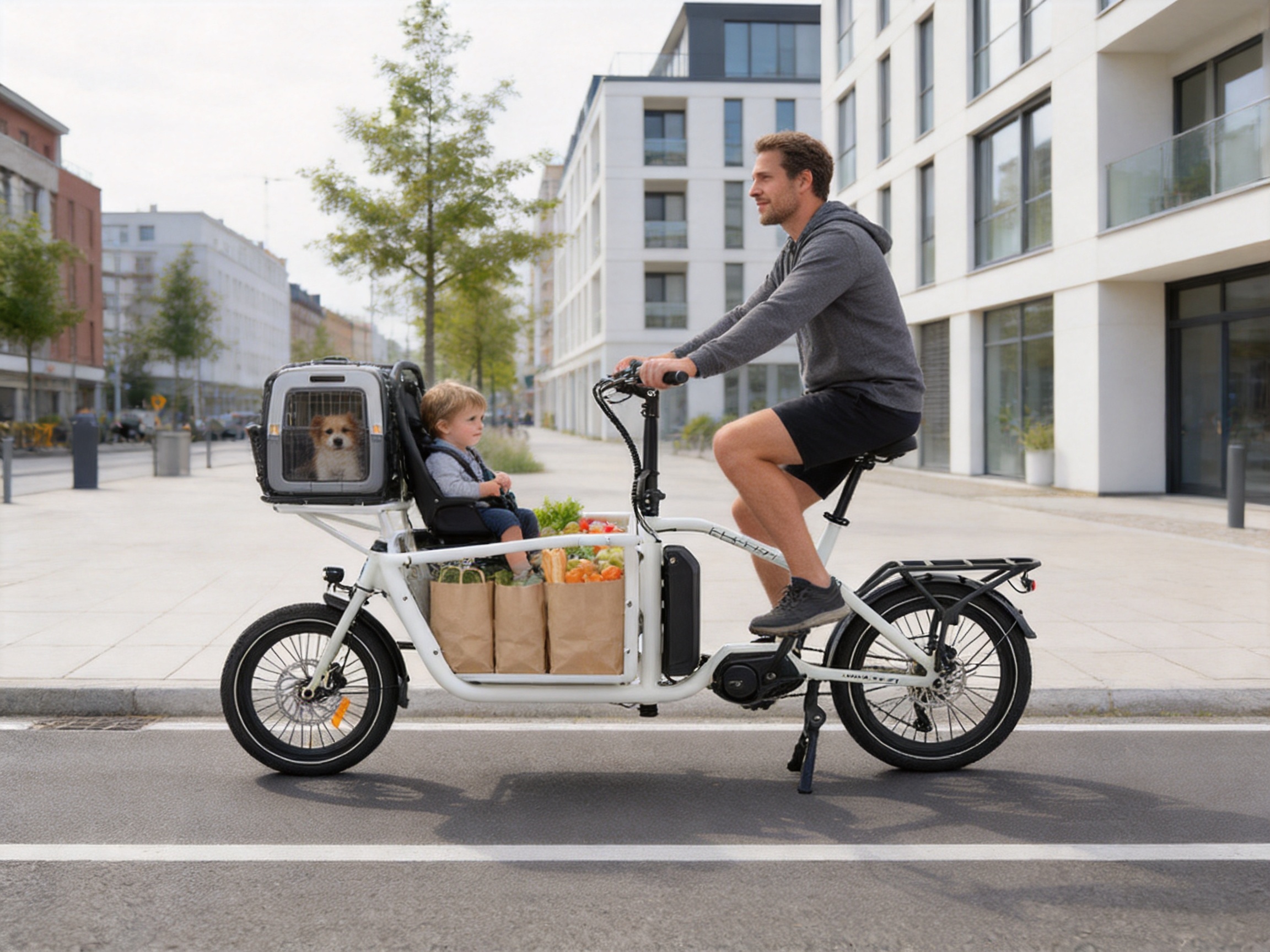
Ride quality is determined by more than saddle padding. The frame geometry, wheel sizes, tire volume, steering response, drivetrain, brake feel, and cargo position all influence the experience. The ESP3 uses a smaller front wheel and a compact rear wheel, a layout commonly associated with cargo-bike maneuverability and a lower front cargo platform.
The 18-inch front wheel can help keep the cargo area at a practical height while retaining a stable tire footprint. The 20-inch rear wheel supports the rider and drivetrain in a compact configuration. Both tires are 2.4 inches wide, which provides additional air volume for absorbing small road imperfections.
Stability is essential when starting, stopping, or turning with a load. An inexperienced rider may initially feel that a cargo bike responds differently from a normal bicycle. The ESP3’s geometry is intended to help create a confident handling experience, but users should still practice in an open area before carrying children or pets. Practice should include low-speed turns, controlled stops, starting on an incline, walking the bike, and negotiating tight spaces.
The Shimano nine-speed Sora drivetrain gives the rider control over cadence and climbing effort. Lower gears can be selected before a hill, while higher gears can be used once the bike reaches a steady pace. Correct gear selection reduces stress on the rider and allows the mid-drive motor to operate more effectively.
Comfort also depends on correct setup. Saddle height, handlebar position, tire pressure, brake lever reach, and accessory installation should be adjusted for the rider. If several family members use the bike, the setup may need to be checked each time. A professional dealer can help establish the correct fit and verify that the bike remains stable with the intended accessories installed.
The ESP3 is suited to school and nursery trips when the correct child seats, restraints, foot protection, and weather accessories are installed. The front cargo location allows the rider to keep children within view and can make conversation easier during the journey. Families should always follow the accessory manufacturer’s age, height, weight, and installation requirements.
The front basket can carry shopping bags, fresh produce, household supplies, and other everyday items. A dedicated cargo basket is often more convenient than balancing bags on a rear rack or placing them in a backpack. The low and central position of the basket can also reduce the risk of swinging loads, provided the cargo is distributed evenly and secured properly.
Small dogs and other pets can benefit from a front cargo arrangement because the rider can observe them throughout the trip. A pet carrier, harness, protective mat, and suitable enclosure should be selected according to the animal’s size and behavior. Pets should never be allowed to jump out, interfere with steering, or move unpredictably in the cargo area.
For commuters, the ESP3 provides the ability to combine personal transportation with practical carrying capacity. A rider can carry a work bag, lunch, rain gear, shopping, or a laptop enclosure without placing everything on the back. The electric system can reduce the physical effort of arriving at work, especially on hilly routes.
The bike may also be relevant to small businesses, local delivery services, hospitality operators, campuses, and community organizations. The front basket can be adapted for supplies, tools, or compact deliveries. Commercial users should assess the intended payload, daily distance, charging routine, security requirements, and local regulations before selecting the bike for fleet use.
Payload figures require careful interpretation. The product information lists a maximum of 145 kilograms for the rider and 35 kilograms for the basket. These figures add to 180 kilograms, while the product description refers to a total load of 175 kilograms. This difference should be clarified with the manufacturer or distributor before final commercial specification. Buyers should not assume that the arithmetic sum of component ratings automatically defines a permitted gross vehicle weight.
The actual permitted load may also depend on accessories, axle ratings, wheel specifications, frame certification, local regulations, and whether the load is carried by an adult rider or passenger configuration. The basket’s 35-kilogram capacity should not be interpreted as permission to place 35 kilograms of unrestrained weight in any child-carrying setup.
Loads should be distributed evenly and placed as low as practical. Heavy objects should be secured so they cannot slide, bounce, or interfere with steering. The rider should test the bike after loading, checking that the front wheel turns freely, the brakes operate correctly, and the cargo does not contact the tires or moving parts.
Families should use only compatible accessories. Child seats, belts, footboards, rain covers, and pet carriers must be securely mounted and inspected frequently. Improvised seating or unapproved modifications can change the center of gravity and compromise structural safety.
A cargo bike used frequently should follow a preventive maintenance schedule. Before each ride, the user should check tire pressure, brake operation, wheel security, steering movement, battery attachment, cargo restraint, and visible frame condition. A short inspection can identify problems before they become safety issues.
Hydraulic brake pads and rotors wear over time. Contaminated pads, bent rotors, or reduced lever pressure require immediate attention. The chain should be cleaned and lubricated according to riding conditions, while the cassette, chainring, derailleur, and shift cable or housing should be inspected during routine service.
Wide tires improve comfort but still require correct inflation. Puncture-resistant tires reduce risk but do not make punctures impossible. Tire sidewalls should be inspected for cuts, bulges, and excessive wear. Wheels should be checked for loose spokes, rim damage, and correct alignment.
The battery should be kept clean and dry, and its mounting interface should be checked for secure engagement. Electrical connectors should not be pulled by their wires or exposed unnecessarily to water. Any unusual heat, smell, swelling, charging behavior, or sudden range reduction should be treated as a reason to stop using the battery and seek qualified service.
For distributors, serviceability is a major product advantage. A cargo bike becomes more valuable when replacement brake pads, tires, chains, chargers, batteries, displays, and electrical components can be supplied consistently. Atmose’s stated mature supply-chain experience and international business orientation may support distributor programs, but each buyer should confirm regional stock, technical training, warranty response, and spare-parts lead times.
The ESP3 has a broad customer profile. It can be marketed to families, pet owners, commuters, environmentally conscious households, local businesses, and buyers seeking an alternative to short car trips. This broad application range can reduce reliance on a single market segment.
Its specification also combines recognizable component names with practical cargo features. Samsung battery cells, a Bafang mid-drive motor, Shimano gearing, and Tektro hydraulic brakes can help retailers explain the product to customers who value established suppliers. The front basket, folding function, wide tires, and child- and pet-compatible design provide visible benefits that can be demonstrated in a showroom.
The product’s safety-oriented positioning is suitable for premium family mobility. Frame fatigue testing, referenced TUV and EN17860 certification, hydraulic braking, and stable geometry can form the foundation of a responsible sales presentation. Retailers should present certification accurately, distinguishing between certifications applying to the complete bicycle, individual components, or a specific market version.
Custom design and wholesale support are also part of the company’s stated business direction. This may be relevant for distributors who need regional colors, accessory packages, branding, packaging, or fleet configurations. Customization should be managed carefully so that changes do not affect frame strength, electrical compliance, braking performance, or warranty conditions.
From a merchandising perspective, the ESP3 can be displayed as more than a bicycle. It can be presented as a family transportation platform. A showroom demonstration could show the bike in several configurations: a school-run setup, a grocery setup, a pet-transport setup, and a commuter setup. This helps customers understand the product’s flexibility and makes the purchase decision less dependent on a single use case.
A balanced product evaluation should also recognize the ESP3’s limitations. It is larger and heavier than a conventional bicycle, even though its dimensions are relatively compact for a cargo model. Storage space, stair access, vehicle transport, and security arrangements should be considered before purchase.
The claimed 80-kilometer range is a maximum-oriented figure rather than a universal guarantee. Families riding in hilly areas or carrying heavy loads may experience a substantially shorter practical range. Buyers should evaluate their daily route and charging access.
The cargo basket is spacious, but its 35-kilogram rating does not automatically mean that every passenger or accessory arrangement is suitable. Child-carrying equipment must be approved and correctly installed. Pet transport requires attention to animal behavior, ventilation, restraint, and weather protection.
Motor power descriptions should be confirmed for the target country. The product materials identify a 250-watt system while also describing 500 watts of output and 110 newton-meters of torque. Retailers should use the correct legal and technical language for their market and avoid presenting peak figures as continuous rated power.
Finally, load ratings should be clarified because the published description refers to 175 kilograms while the component figures suggest 180 kilograms when added together. A professional dealer should obtain the official gross vehicle weight, rider limit, basket limit, passenger limit, and accessory-specific restrictions in writing.
The ESP3 is an electric front-loading family cargo bike. It is designed for carrying children, pets, groceries, daily equipment, and other urban loads while providing motor assistance for hills and heavier journeys.
The listed maximum basket load is 35 kilograms. The load should be distributed evenly and secured. Passenger use requires compatible seats, restraints, and accessories rather than simply placing a person in the basket.
It is designed to be compatible with child seats and rain covers, but the exact passenger configuration must use approved equipment. Parents should follow all age, height, weight, restraint, and installation instructions supplied with the relevant accessory.
The front cargo area is suitable for selected small pets when a secure carrier or restraint system is used. The pet must not be able to interfere with steering, jump from the basket, or move unpredictably during the ride.
The stated maximum range is up to 80 kilometers from the 540-watt-hour battery. Real-world range varies with load, terrain, assistance level, tire pressure, weather, rider behavior, and battery condition.
A mid-drive motor works through the bicycle’s mechanical gears. This allows the rider to select a lower gear for steep hills and heavy loads, helping the motor deliver useful climbing assistance while keeping the bike’s weight relatively centralized.
The supplied technical specification lists a 36-volt, 250-watt Bafang M430 motor, while the product description references up to 500 watts of output. These may represent nominal and peak figures, but the exact legal rating and software configuration should be confirmed for the destination market.
The frame uses 6061 T4T6 aluminum alloy, and the product materials state that it passed 300,000-cycle fatigue testing. These features indicate a focus on repeated-load durability. Buyers should request the relevant test and certification documentation for the exact model configuration.
Hydraulic disc brakes generally provide strong, progressive braking with relatively low hand effort. They are useful when the bicycle is carrying a heavy load, although they still require regular inspection and professional servicing when pads, rotors, or hydraulic components wear.
Yes. The front basket is described as foldable and can become approximately 365 millimeters wide when folded. This can simplify storage and make the bike more compact when the full cargo area is not required.
Its stable geometry, wide tires, controlled braking, and electric assistance are intended to support confident handling. New riders should still practice without passengers or valuable cargo before using the bike in traffic.
Distributors should confirm market certification, motor programming, battery documentation, official load limits, accessory compatibility, warranty terms, spare-parts availability, packaging, delivery schedules, and after-sales technical support.
The ESP3 electric family cargo bike is designed as a practical transportation tool for households that want to replace or reduce short car journeys. Its strongest features are the visible front cargo arrangement, foldable basket, mid-drive assistance, Samsung 540-watt-hour battery, Shimano nine-speed drivetrain, hydraulic disc brakes, wide puncture-resistant tires, and aluminum frame construction.
Its competitive advantage comes from integration. The bike is not merely a conventional bicycle with a basket added to the front. It is engineered around the demands of carrying people, pets, and everyday goods in an urban environment. The front-loading format improves visibility, the centralized motor supports balanced handling, the wide tires increase comfort, and the hydraulic brakes provide controlled stopping performance.
The company’s stated combination of American product development, European design and research activity, mature manufacturing relationships, and supply-chain experience supports a business model aimed at reliable and adaptable cargo-bike production. Frame fatigue testing, referenced safety standards, branded electrical and drivetrain components, and an emphasis on practical usability strengthen the product’s position in the family mobility market.
At the same time, responsible purchasing requires attention to details. The official payload rating, motor specification, certification scope, battery documentation, accessory limits, and regional legal configuration should all be confirmed. When these points are clearly documented and the bike is correctly configured, maintained, and ridden, the ESP3 can provide a compelling alternative to conventional family transportation.
For families, it offers a flexible way to carry children, pets, groceries, and daily equipment. For retailers, it provides a product with several identifiable use cases and a premium safety-oriented story. For distributors, it represents a platform that can support family mobility, urban commuting, and selected commercial applications. Its central proposition is straightforward: make everyday transport more useful, more efficient, and more enjoyable without sacrificing the confidence required for a loaded family bicycle.
1. Atmose SASU. ESP3 Product Specification and Product Description Materials.
2. Bafang. M430 Mid-Drive Motor Technical Information.
3. Shimano. Sora Nine-Speed Bicycle Drivetrain Information.
4. Tektro. Hydraulic Disc Brake System Technical Documentation.
5. Samsung SDI. Lithium-Ion Battery Cell and Battery Safety Information.
6. EN17860. Cargo Bicycle Safety and Performance Requirements.
7. General principles of aluminum alloy frame design, welding, heat treatment, and fatigue evaluation for bicycles.
8. General guidance on electric bicycle battery handling, charging, storage, and maintenance.
Nov 27, 2026
Nov 25, 2026
Nov 21, 2026


info@atmosecargobike.com

200 rue de la Croix Nivert 75015 Paris

Custom Electric Bakfiets
 English
 Français
 Deutsch