

Aug 13, 2026
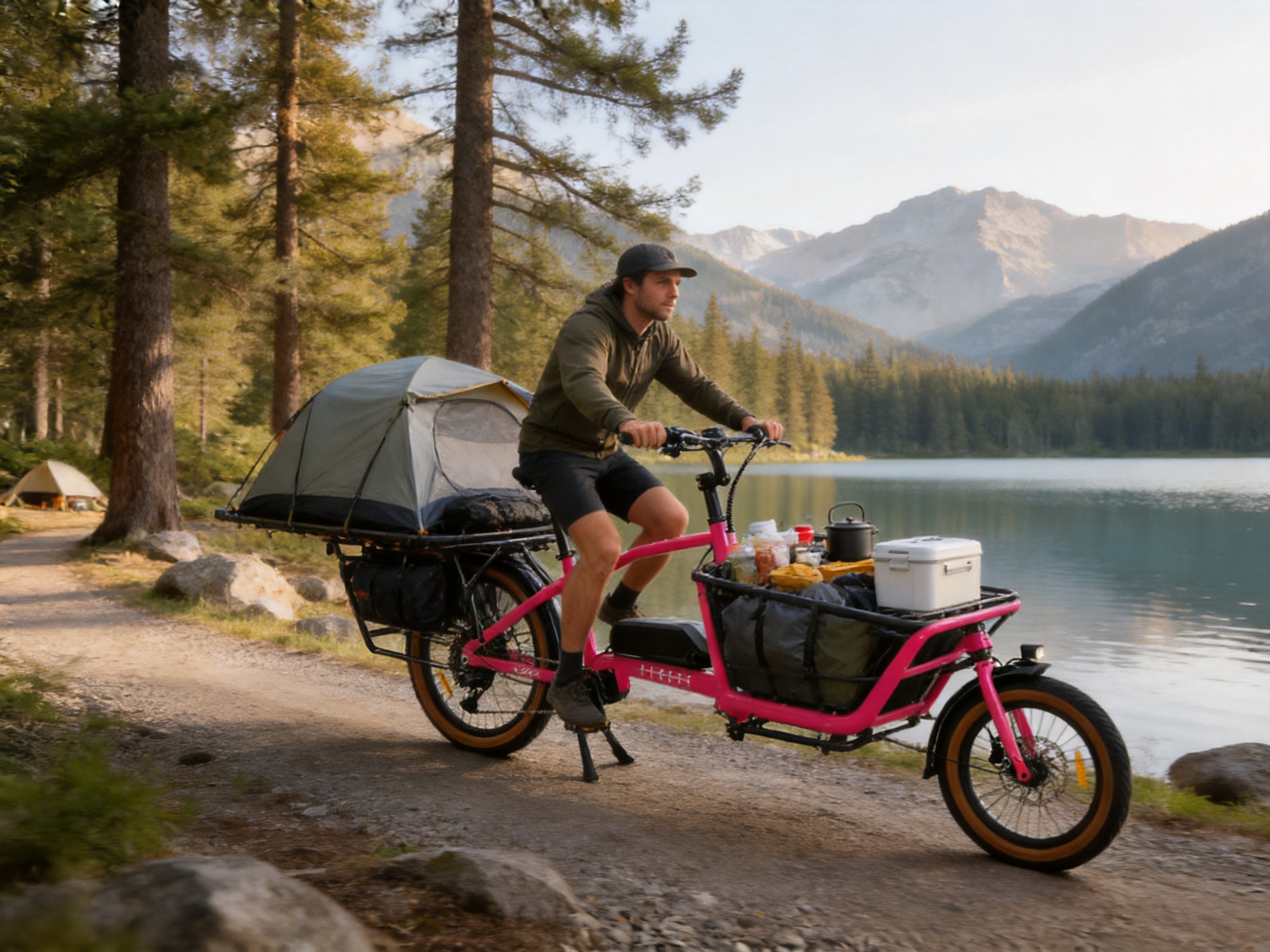
Adventure cargo bikes are changing the way riders travel, camp, commute, and carry equipment. Instead of treating a bicycle as a vehicle for short trips with minimal luggage, the modern adventure cargo bike is designed to combine everyday practicality with the carrying capacity, stability, and durability required for longer excursions. The Atmose Model V ESV1 represents this approach through a long, stable frame, an oversized front camping rack, a mid-drive motor, wide puncture-resistant tires, hydraulic disc brakes, and a generous maximum load rating.
This model is intended for riders who want more than a conventional city bicycle can provide. It can carry camping equipment, food, tools, outdoor recreation supplies, and other bulky items while remaining compact enough for practical use in urban environments. Its design also addresses a common problem in cargo cycling: how to carry large loads without making the bicycle difficult to control. By placing substantial storage space at the front and keeping the load close to the ground, the bike is designed to provide a more predictable riding experience on changing surfaces.
The ESV1 is part of a broader product philosophy built around fun, practicality, reliability, and adaptable mobility. It is suitable for individual adventurers, touring riders, outdoor workers, recreational families, and customers who need a flexible cargo platform for both paved and unpaved routes. While no cargo bike can eliminate the challenges of heavy loading or rough terrain, the ESV1 brings together several carefully selected systems to make those challenges more manageable.
Traditional touring bicycles are efficient and comfortable, but their luggage capacity is normally divided among rear panniers, frame bags, and small front bags. This arrangement works well for lightweight equipment, yet it can become restrictive when a rider needs to carry bulky items such as a tent, cooler, cooking equipment, fishing supplies, photography gear, or work tools.
A standard cargo bike offers a solution by extending the available loading area. However, many cargo bikes are optimized for family transportation, city delivery, or short-distance utility work. Their geometry may prioritize passenger seating, low-speed maneuverability, or large rear boxes rather than wilderness-oriented equipment. The adventure cargo bike occupies a different position. It is designed to preserve the utility of a cargo platform while adding features that support longer rides and more varied terrain.
The ESV1 fits this category through its front folding basket, broad tires, 11-speed drivetrain, torque-oriented motor, and hydraulic braking system. Together, these features create a bicycle that can serve as a touring machine, a utility carrier, and an outdoor transport platform. The result is not simply a bicycle with a larger basket. It is a complete mobility system intended to carry both the rider and the equipment required for a meaningful journey.
The central design idea is straightforward: allow the rider to travel farther with more equipment while retaining stable handling. This principle affects frame construction, storage position, wheel sizing, motor selection, gearing, braking, and tire specification. It also explains why the Model V differs from a lightweight commuter e-bike or a compact family bicycle.
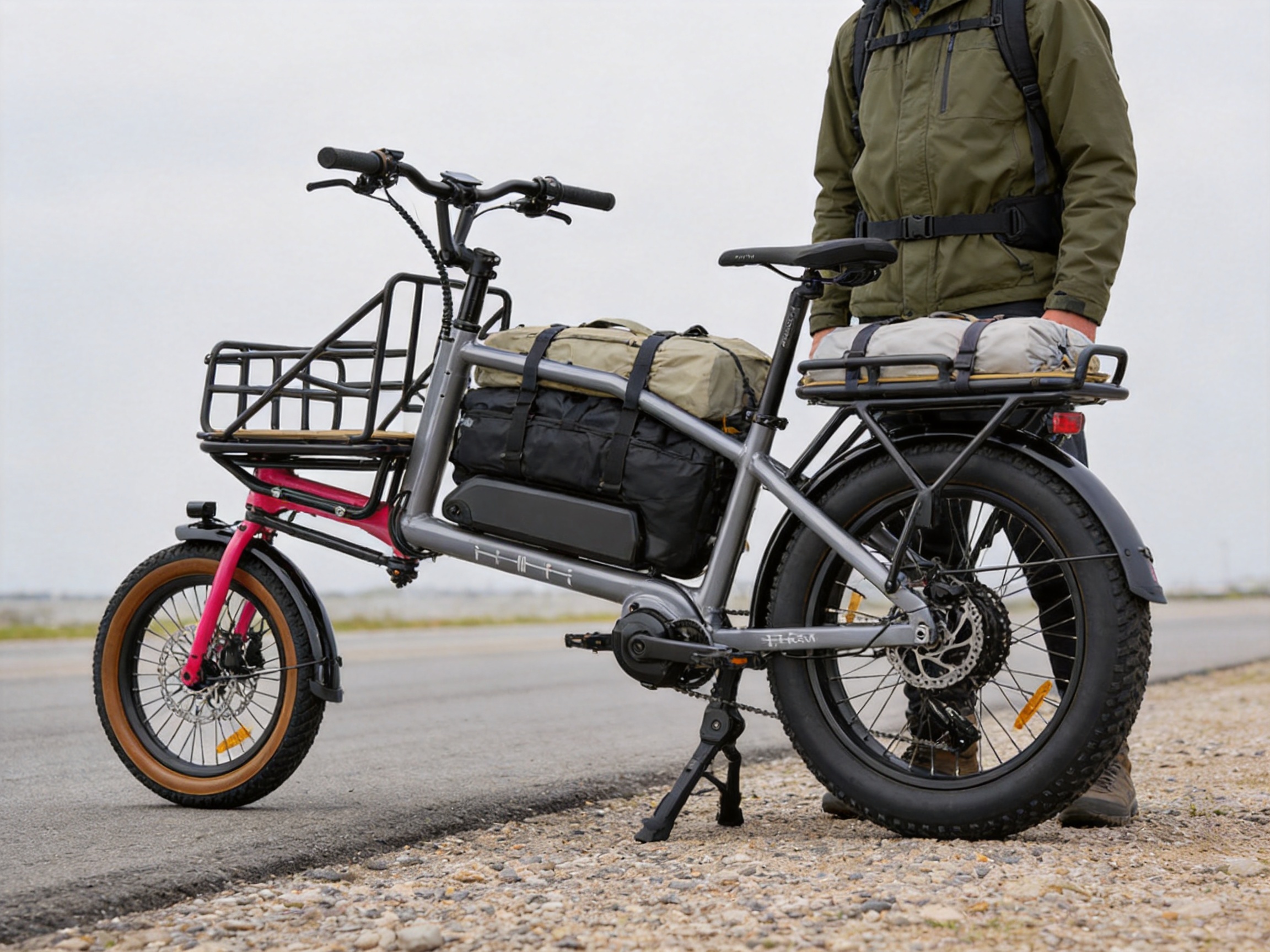
The most distinctive feature of the ESV1 is its oversized front folding basket. The listed basket dimensions are approximately 370 millimeters in length, 370 millimeters in width, and 375 millimeters in height. This gives riders a practical three-dimensional storage area rather than a shallow platform intended only for small packages.
For adventure use, volume is often just as important as weight capacity. A tent may be relatively light but awkwardly shaped. A cooler, dry bag, stove, or fishing box may not fit conveniently into conventional panniers. The front basket provides a defined area for these items and can reduce the need to attach multiple separate bags across the bicycle.
Front storage can also improve access to important equipment. Items such as rainwear, water bottles, maps, snacks, repair tools, or camera equipment can be positioned where they are easier to reach than luggage mounted behind the rider. The rider can organize the basket according to frequency of use, keeping essential items immediately available while placing heavier equipment lower and farther from the handlebars.
The basket is described as folding, which adds practical value when the bike is stored, transported, or used without a full load. A folding structure can reduce the bike’s visual and physical footprint and may make it easier to maneuver the bicycle through a garage, workshop, entrance, or storage area. The precise operating procedure and maximum basket-specific load should be confirmed in the final owner documentation, but the folding concept itself supports a more adaptable cargo platform.
Compared with a conventional front basket, the oversized rack provides more space and a more substantial base for bulky outdoor equipment. Compared with a rear-only cargo setup, it can distribute weight more evenly along the bicycle. This is especially useful when the rear area is already occupied by a pannier, child seat, tool case, or additional luggage.
Load placement remains important. Heavy objects should be secured firmly and positioned as low as practical. Loose items should be placed in closed bags or restrained with suitable straps. The basket should not be overloaded simply because it has a large physical volume. Proper packing helps preserve steering response, braking stability, and the predictable handling that the design is intended to deliver.

Atmose Model V ESV1 Adventure Cargo Bike with Oversized Front Camping Rack
The ESV1 uses a 6061 T4T6 aluminum alloy frame. Aluminum is widely used in modern electric bicycles because it offers a useful balance between low weight, corrosion resistance, stiffness, and manufacturability. The 6061 alloy family is particularly common in bicycle construction because it can be formed and welded into complex structures while providing dependable mechanical performance when correctly processed.
The T4 and T6 designations refer to heat-treatment conditions. In general terms, heat treatment can improve the strength and consistency of aluminum components after forming and welding. The effectiveness of a finished frame depends not only on the alloy designation but also on tube shaping, joint design, welding quality, heat-treatment control, alignment, surface finishing, and inspection procedures.
For a cargo bicycle, the frame has to handle more than the rider’s body weight. It must also manage the combined forces created by a loaded rack, acceleration, braking, turns, bumps, and repeated use. The ESV1’s listed maximum load rating is 170 kilograms. This figure should be understood as a total system limit unless the manufacturer’s final technical documentation specifies otherwise. It may include the rider, cargo, and any accessories. Riders should always follow the official load distribution guidance and avoid exceeding individual component limits.
A strong cargo frame must balance rigidity with controlled comfort. Excessive flexibility can make a loaded bicycle feel vague or unstable, while excessive harshness can transmit uncomfortable impacts through the rider and cargo. The longer dimensions of the ESV1, approximately 1,910 millimeters in length, 750 millimeters in width, and 1,060 millimeters in height, create a stable platform without making the bike exceptionally wide for an urban cargo model.
The frame’s length contributes to directional stability, especially when the front basket is loaded. A longer wheelbase generally gives the bicycle a calmer response during straight-line riding. The 750-millimeter width also provides a reasonable balance between carrying capacity and access through common paths, gates, and storage areas. Riders should still measure their own storage spaces and travel routes before purchase.
The structural advantage of a purpose-built cargo frame is that it is designed around loading from the beginning. Adding a large rack to a standard bicycle may create compromises in steering, frame stress, mounting strength, and weight distribution. In contrast, the Model V is presented as an integrated cargo platform in which the frame, basket, braking system, motor, tires, and drivetrain are selected to work together.
The ESV1 uses a Starunion CM2503 mid-drive system rated at 250 watts. A mid-drive motor places the power unit near the bicycle’s central crank area rather than in the front or rear wheel hub. This location helps centralize mass and allows the motor to work through the bicycle’s gearing.
For a cargo bike, the ability to use the gear system is a significant advantage. When climbing a steep hill, the rider can shift into a lower gear so that the motor and rider operate at a more suitable cadence. When traveling on level pavement, higher gears can support more efficient cruising. The gearing system therefore gives the motor a wider range of operating conditions than a single-speed arrangement.
The 250-watt rating places the motor within a common European e-bike power category, although legal requirements vary by market. Motor assistance limits, speed regulations, throttle rules, helmet requirements, and equipment standards should always be checked according to the country or region where the bicycle will be used.
The model is described as having high-torque performance for steep gradients and loaded outdoor riding. Torque is particularly important for a cargo bicycle because the motor must help move the combined mass of the rider, bike, equipment, and any accessories. A system that feels adequate on a lightweight commuter can feel underpowered when carrying a full camping load.
The mid-drive layout also offers a handling benefit. Since the motor is positioned near the center of the frame, it does not add substantial weight directly to either wheel. This can help preserve balanced steering and wheel response over uneven surfaces. It also allows the front wheel to remain focused on steering and the rear wheel to maintain traction, subject to tire pressure, terrain, and load placement.
Motor performance is influenced by more than the nominal wattage. Battery condition, controller calibration, rider input, gear selection, tire pressure, total weight, gradient, and temperature all affect the result. The ESV1’s strength is the combination of a central motor with an 11-speed drivetrain and a battery sized for practical day rides. Riders can extend range and reduce strain by shifting early, maintaining a steady cadence, and avoiding unnecessary acceleration on steep climbs.
The ESV1 is equipped with a Shimano 11-speed Cues drivetrain. A wide-range multi-speed system gives the rider more control over cadence and effort than a basic city drivetrain. This is valuable when the bicycle must transition between flat streets, long climbs, descents, gravel paths, and changing loads.
On a loaded adventure ride, gear selection directly affects battery efficiency and motor behavior. Climbing in too high a gear can place unnecessary strain on the rider and drivetrain. It can also reduce the motor’s ability to operate smoothly. Shifting to a lower gear before the slope becomes severe allows the rider to maintain more consistent pedaling and reduces the need for sudden power increases.
The drivetrain also supports unpowered riding. If the battery is depleted or the rider chooses to conserve energy, the 11-speed system provides useful flexibility. A cargo bicycle will naturally require more effort than a lightweight road bike, but appropriate gearing can make short unassisted journeys, transport through restricted areas, or emergency riding more manageable.
For outdoor use, drivetrain maintenance is essential. Mud, dust, sand, and water can accelerate wear. Riders should clean the chain and shifting components after particularly dirty rides, inspect the derailleur and cassette, and use a lubricant suitable for the local conditions. A wet-weather lubricant may be appropriate for rainy regions, while a dry formulation can help reduce dust accumulation in arid environments.
The Shimano Cues platform is also relevant to long-term serviceability. A recognized component family can make routine maintenance easier for qualified bicycle technicians and may improve the availability of compatible replacement parts. Actual component compatibility should be verified before ordering replacements, particularly if the bicycle is used in a different market from the original purchase location.
The bike uses a Samsung 36-volt, 15-amp-hour lithium battery, listed with a capacity of 540 watt-hours. Battery capacity is one of the most important specifications for a cargo e-bike because carrying more weight and climbing more hills increases energy consumption.
A 540-watt-hour battery offers a useful balance between capacity and portability. It is large enough to support practical daily use and extended recreational trips, while remaining more manageable than the very high-capacity batteries often found on heavier commercial cargo bikes. Actual range will vary substantially according to rider weight, cargo mass, terrain, wind, temperature, tire pressure, assistance level, and riding speed.
It is not responsible to promise one universal distance figure for every rider. A lightly loaded rider traveling on smooth, level roads at moderate speed may achieve a very different range from a fully loaded rider climbing steep trails. The best range strategy is to use the lowest assistance level that provides the desired comfort, shift efficiently, maintain the tires properly, and plan a reserve for unexpected detours or headwinds.
The use of Samsung battery cells indicates an emphasis on recognized cell quality, but cell branding alone does not define the complete safety or performance of a battery pack. Battery management electronics, enclosure design, wiring, charging controls, thermal management, assembly quality, and testing are all important. The battery should be charged with the approved charger, kept away from extreme heat and moisture, and inspected for damage after a fall or collision.
For multi-day adventures, riders may need to plan charging access. A campground, accommodation, workplace, or public charging location may provide an opportunity to recharge. Charging should take place in a dry, ventilated area using the manufacturer-approved equipment. Riders should not modify the battery, charger, connectors, or wiring without qualified technical support.
The ESV1 uses wide tires measuring 18 inches by 2.4 inches at the front and 24 inches by 2.4 inches at the rear. The tires are described as puncture-resistant. This combination is a notable part of the bike’s adventure-oriented identity.
Wide tires create a larger contact patch and can improve comfort over broken pavement, compact gravel, hard-packed trails, and other imperfect surfaces. They can also provide a greater sense of stability when the bicycle is carrying a substantial load. The smaller front wheel supports a lower front storage area and can contribute to responsive steering, while the larger rear wheel helps carry the rider and cargo over uneven ground.
Puncture resistance is valuable for touring and outdoor use because a flat tire can interrupt a journey far from a repair shop. However, puncture-resistant does not mean puncture-proof. Sharp thorns, glass, metal fragments, severe impacts, or incorrect tire pressure can still cause damage. Riders should carry tire levers, a suitable replacement tube or repair kit, an inflation device, and any tools required by the wheel and valve system.
Tire pressure should be adjusted to the combined load and terrain, within the manufacturer’s specified range. Too much pressure may reduce comfort and traction, while too little pressure can increase the risk of rim strikes, sidewall damage, and unstable handling. A loaded cargo bike requires particular care because the consequences of incorrect pressure become more noticeable as total weight increases.
Compared with narrow commuter tires, the ESV1’s wide tires are better suited to varied surfaces and cargo loads. Compared with highly aggressive mountain-bike tires, they may provide a more balanced compromise between rolling efficiency, road comfort, and trail capability. The bicycle should still be used within its intended limits; it is an adventure cargo bike, not a downhill mountain bike.
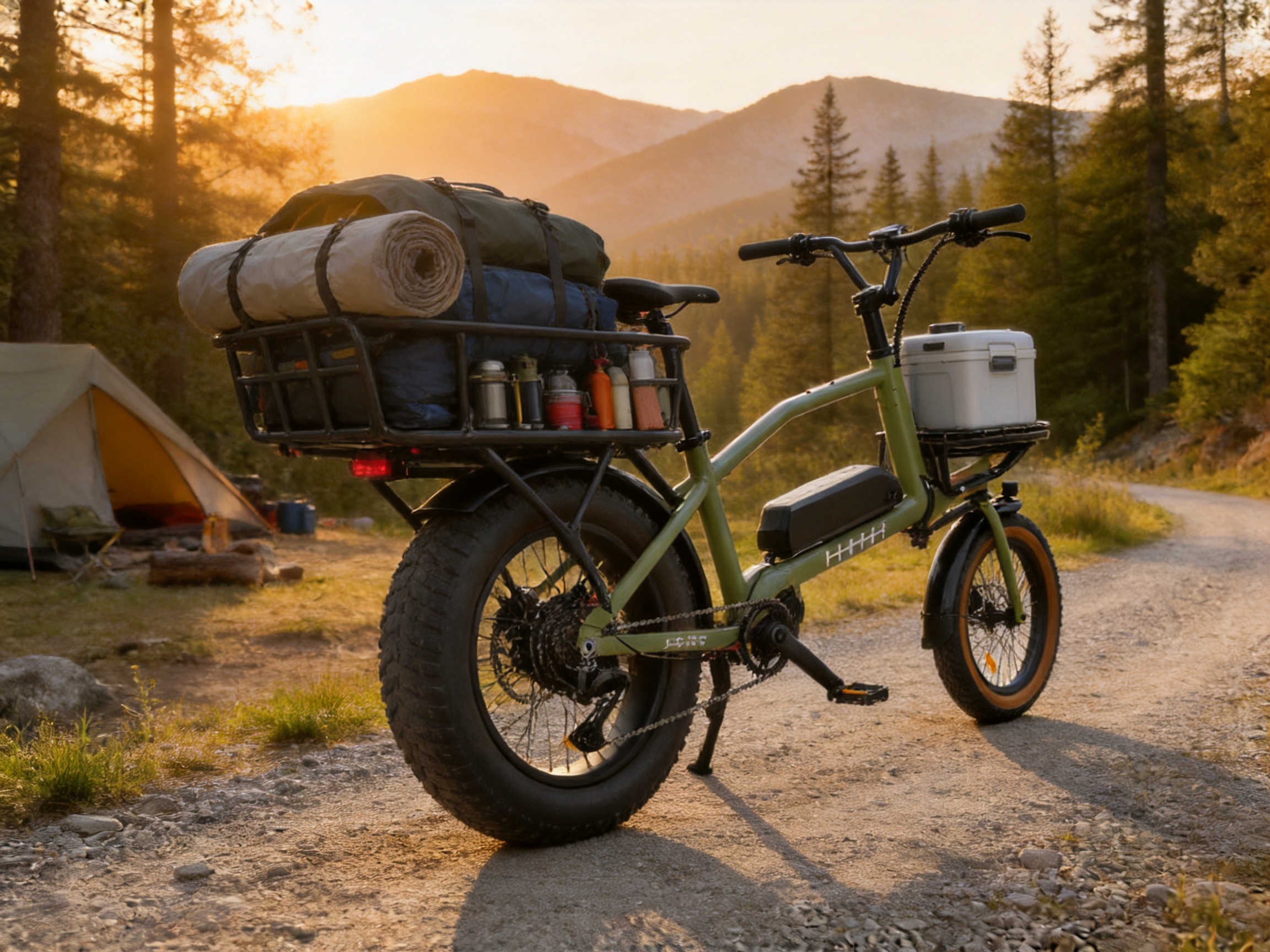
The bicycle is fitted with Tektro hydraulic disc brakes. Hydraulic braking is well suited to cargo bikes because it can deliver strong, progressive braking with relatively low hand effort. This becomes increasingly important when the bike is loaded or traveling downhill.
Wet roads, muddy trails, loose gravel, and unexpected obstacles all make braking performance important. Disc brakes generally maintain more consistent performance than rim brakes when the wheel rims are wet or dirty. The brake rotor is also positioned away from much of the contamination that affects a rim braking surface.
Hydraulic systems use fluid pressure to transfer force from the brake lever to the caliper. This can provide a smooth and controlled feel. Riders can apply braking force progressively rather than relying on abrupt lever movement. With a loaded front basket, progressive braking is especially useful because sudden inputs can influence steering and load stability.
Brake performance depends on setup and maintenance. Pads and rotors wear over time, and contamination can reduce friction. Riders should inspect the braking surfaces, listen for unusual noises, check lever feel, and arrange professional service if the lever becomes unusually soft or the system shows signs of leakage. Hydraulic brake work should be performed by a qualified technician when specialized bleeding or component replacement is required.
Riding technique also matters. On a descent, both brakes should normally be used in a controlled manner rather than relying on only one brake. Riders should reduce speed before sharp turns, keep heavy objects secured, and avoid abrupt steering while braking on loose terrain. Good hardware improves safety, but it does not replace sound judgment.
The listed maximum load rating is 170 kilograms. This provides a substantial working envelope for a cargo bicycle, but the rating must be interpreted correctly. It should not automatically be treated as the cargo-only capacity. The combined weight of the bicycle, rider, luggage, accessories, and any other carried items may be included.
Intelligent packing is one of the most important skills for using an adventure cargo bike effectively. Heavy items should be placed low, close to the central frame area, and secured against movement. Light but bulky items can be placed higher in the front basket if they do not obstruct the rider’s view or interfere with steering. Fragile objects should be padded and protected from vibration.
Load distribution should be checked before departure. The rider should turn the handlebars fully in both directions to ensure that straps, bags, and containers do not catch on cables, the wheel, or the frame. The front wheel should remain free to rotate, and lights, reflectors, and braking components must not be blocked.
After loading, the bike should be tested at low speed in a safe area. The rider can check steering effort, braking response, acceleration, and the behavior of the basket over small bumps. If the bicycle feels unstable, the load should be rearranged before beginning the trip.
Feature |
Specification |
Practical significance |
Frame |
6061 T4T6 aluminum alloy |
Designed for a balance of strength, stiffness, corrosion resistance, and manageable weight |
Battery |
Samsung 36V 15Ah lithium battery, 540Wh listed capacity |
Supports practical cargo riding, commuting, and recreational trips |
Maximum load |
170kg listed maximum |
Provides capacity for rider, cargo, and accessories within official limits |
Motor |
Starunion CM2503 mid-drive, 250W |
Uses the bicycle’s gearing to support climbing and loaded riding |
Drivetrain |
Shimano 11-speed Cues |
Offers a broad range of gears for flat roads, hills, and varied terrain |
Front basket |
370mm by 370mm by 375mm folding basket |
Accommodates bulky camping and utility equipment |
Tires |
Front 18 by 2.4 inches; rear 24 by 2.4 inches |
Combines wide contact areas with a compact front cargo layout |
Brakes |
Tektro hydraulic disc brakes |
Provides controlled stopping power for wet roads, trails, and heavier loads |
Overall dimensions |
Approximately 1910mm long, 750mm wide, 1060mm high |
Creates a stable cargo platform while remaining practical for many urban spaces |
The ESV1’s primary advantage over a conventional bicycle is its integrated carrying capacity. A standard bicycle can be fitted with panniers, racks, and frame bags, but those accessories may distribute weight unevenly or leave bulky objects difficult to secure. The ESV1 begins with a purpose-built cargo structure, allowing storage to be part of the vehicle rather than an afterthought.
Compared with a lightweight commuter e-bike, the ESV1 offers a stronger utility focus. Its wide tires, large front basket, high load rating, mid-drive motor, and hydraulic brakes are selected for situations in which the bicycle must carry more equipment and cope with more demanding surfaces. This makes it a better fit for riders who regularly transport outdoor gear rather than only a laptop and small personal items.
Compared with a rear-heavy cargo bike, the front rack can provide more accessible and balanced storage. A rear cargo platform may be excellent for boxes or passenger seating, but it can make the rear of the bicycle dominant when heavily loaded. The ESV1’s front-focused storage gives the rider another way to distribute equipment and keeps essential items within reach.
Compared with a long-tail cargo bike designed primarily for children or passenger transport, the Model V is more directly oriented toward equipment carrying and exploration. Its storage architecture is useful for camping, fishing, touring, photography, maintenance work, and outdoor recreation. Riders who do not need passenger seating may find this approach more efficient than transporting an unused rear structure.
Compared with a small-wheeled compact cargo bike, the ESV1 offers a more substantial adventure platform. The combination of a long frame, wide tires, 11-speed drivetrain, and high load rating is intended to maintain confidence when the route extends beyond smooth city streets.
Its advantage is therefore not based on one isolated component. It comes from the relationship between the components. The oversized basket would be less useful without stable geometry. The powerful climbing concept would be less useful without a broad gear range. Wide tires would not be enough without effective brakes. A high load rating would be less meaningful without a frame and wheel system designed around cargo use.
The company presents itself as a U.S.-origin cargo e-bike brand with design and research capabilities connected to both California and Paris. This international structure combines American product thinking with European design influence. It also reflects an effort to develop products for different mobility cultures, including family transportation, urban commuting, commercial delivery, and outdoor exploration.
The manufacturing strength of a cargo e-bike is not defined by a single factory operation. It depends on the coordination of product engineering, material selection, frame fabrication, component integration, electrical assembly, quality control, packaging, logistics, and after-sales support. The ESV1 demonstrates a product development approach in which these areas are considered together.
The choice of a 6061 T4T6 aluminum frame suggests attention to material performance and heat-treatment requirements. A cargo frame must be designed with appropriate tube profiles, reinforced mounting locations, accurate alignment, and reliable welded joints. Manufacturing consistency is particularly important because small alignment errors can affect steering, braking, shifting, tire clearance, and long-term component wear.
Another strength is system integration. The front basket, frame dimensions, motor, drivetrain, tires, and brakes are not presented as unrelated accessories. They form an intended use case around adventure cargo transport. This kind of integration helps ensure that the final product serves a clear purpose rather than simply combining popular bicycle components.
Battery integration is also an important manufacturing consideration. A safe electric bicycle requires secure battery mounting, protected wiring, appropriate connectors, reliable charging control, and resistance to ordinary vibration. Cargo bikes experience repeated load changes and can be used on rougher surfaces than ordinary commuters, so electrical components must be installed with practical protection and service access in mind.
Component sourcing is another area of strength. The use of recognized suppliers such as Samsung for battery cells, Shimano for the drivetrain, and Tektro for hydraulic brakes can support consistency and serviceability. These components do not eliminate the need for quality control, but they provide a foundation of established technology around which the complete bicycle can be assembled.
The company’s stated experience includes a mature supply chain and ongoing product innovation. A mature supply chain can help coordinate frame production, battery procurement, drivetrain assembly, brake installation, tires, accessories, packaging, and replacement parts. For international customers, this coordination is especially relevant because dependable availability and technical support are important parts of the ownership experience.
Manufacturing quality should be verified through appropriate inspection at several stages. Typical areas include incoming component checks, frame dimensional inspection, weld and finish review, torque verification, electrical function testing, brake adjustment, gear indexing, wheel trueness, and final road or roller testing. The exact procedures used for this model should be confirmed through the manufacturer’s technical and quality documentation.
The company’s development history also contributes to its product strength. The brand originated from MOTIV, an established American beach cruiser brand, and was later developed through ATMOSE BIKES INC. in California. The establishment of ATMOSE SASU in France in 2026 added a design and research team in Europe. This combination of industrial experience, product development, and international design can support faster adaptation to customer needs and regional market expectations.
An adventure cargo bike is valuable only when it remains dependable after repeated use. Longevity begins with selecting suitable materials and components, but it also depends on maintenance, correct loading, and protection from environmental exposure.
The aluminum frame offers practical corrosion resistance, although dirt, salt, and moisture should still be removed regularly. Riders in coastal regions or areas that use road salt should clean the bicycle more frequently. Water should not be directed at high pressure toward bearings, electrical connectors, the motor, or battery interfaces.
The drivetrain should be inspected after dusty or muddy rides. The chain, cassette, derailleur, and chainring are exposed to contamination, and a loaded mid-drive bicycle can place significant force through these components. Early replacement of a worn chain can help protect more expensive drivetrain parts.
Brake pads and rotors are wear items. Their service life depends on rider weight, cargo weight, terrain, weather, and riding style. Long descents with a heavy load can generate substantial heat, so riders should control speed early and avoid dragging the brakes continuously when safe alternatives are available.
Tire condition should be checked before every longer trip. Look for cuts, embedded objects, uneven wear, low pressure, and sidewall damage. Adventure riders should carry a repair kit even when using puncture-resistant tires. A spare tube and a compact pump are often more useful in the field than relying on the assumption that a flat will not occur.
The battery should be stored according to the manufacturer’s instructions. Extreme temperatures can affect charging and performance. The battery should not be opened, modified, crushed, or exposed to fire. If the casing is damaged or the battery becomes unusually hot, swollen, or odorous, use should stop and qualified support should be contacted.
The Model V is suited to riders who need an electric cargo bike for more demanding carrying tasks than ordinary commuting. A weekend explorer may use the front basket for a tent, sleeping bag, cooking kit, and food. A fishing enthusiast may carry rods, tackle boxes, a cooler, and waterproof clothing. A photographer may use the basket for protective cases and a tripod. A maintenance worker may transport tools and replacement materials.
It can also serve as an urban utility bike. The large front basket may carry groceries, packages, work equipment, or a daily shopping load. The electric assistance can make longer urban journeys more practical, particularly when the route includes hills or when the rider needs to arrive without excessive fatigue.
Recreational families may use the bicycle for park trips and outdoor days, although the listed product information does not identify a child passenger system. Any passenger use would require approved accessories, suitable restraints, and confirmation that the configuration is legally and structurally permitted.
Small businesses may find value in the ESV1 as a low-emission transport platform for local service work, event support, park maintenance, mobile vending support, or equipment delivery. The bicycle is not a replacement for every commercial vehicle, but it can reduce the need for short-distance van trips where roads, parking, or operating costs create difficulties.
The ideal rider is someone who values versatility over minimum weight. The ESV1 is not intended to be the lightest bicycle in a showroom. Its purpose is to carry useful equipment, handle changing conditions, and provide electric assistance when the combined load becomes demanding.
A loaded cargo bike behaves differently from an unloaded commuter bike. Before starting a long trip, the rider should practice turning, stopping, starting on an incline, and maneuvering at low speed. This practice is particularly important when the front basket contains heavy or tall objects.
Acceleration should be smooth. Sudden motor assistance can shift loose cargo or affect the rider’s balance. The rider should select an appropriate assistance level and gear before entering a climb. On a descent, speed should be managed early rather than waiting until a sharp corner or rough section appears.
When crossing uneven ground, the rider should maintain a relaxed grip and keep the load secured. Standing on the pedals may be less suitable when the bicycle is heavily loaded, especially if the front rack contains tall objects. A lower speed and careful line selection can reduce impacts on both the bicycle and its cargo.
Turns should be taken with awareness of the bike’s length and front loading area. The rider should allow additional space around obstacles and avoid leaning aggressively on loose surfaces. The longer frame may feel stable at speed but requires planning in tight spaces.
On steep climbs, the rider should shift before cadence becomes too slow. A mid-drive system can perform effectively when used with the correct gear, but forcing a high gear at very low cadence may increase stress and reduce smoothness. If traction becomes limited, the rider should reduce power input and choose a more stable line.
The ESV1’s folding front basket provides useful flexibility when the bicycle is stored. Even so, the overall dimensions should be considered before purchase. At approximately 1,910 millimeters long and 750 millimeters wide, it requires more space than a standard bicycle. Owners should measure doorways, elevators, bicycle rooms, garages, and vehicle transport systems.
When transporting the bike on a carrier, the rack must be rated for the bicycle’s weight and dimensions. The battery may need to be removed according to the carrier or vehicle manufacturer’s instructions. The front basket should be folded or secured, and all loose accessories should be removed.
Long-term storage should take place in a dry, secure location. The bicycle should not be left exposed to continuous rain, direct sunlight, or freezing conditions when avoidable. The battery should be stored with an appropriate charge level based on the manufacturer’s guidance and checked periodically during extended inactivity.
Cargo e-bikes support sustainability by replacing some short car trips with electrically assisted bicycle journeys. This can reduce local emissions, lower congestion, and make low-carbon transport more practical for people who need to carry goods. The environmental benefit is greatest when the bicycle replaces motor-vehicle use rather than adding another vehicle to the household.
The ESV1’s utility-oriented design may encourage more frequent use because it can handle shopping, commuting, recreation, and equipment transport in one platform. A bicycle that serves several purposes may reduce the need for specialized vehicles and make cycling a more practical part of daily life.
Sustainability also depends on product life. Durable frames, serviceable drivetrains, replaceable tires, maintainable brakes, and responsible battery handling can extend the useful life of the bicycle. Long-term ownership is generally more resource-efficient than frequent replacement, which is why maintenance support and spare-part availability are important considerations.
The company states that sustainability, reliability, practicality, and fun are central to its product philosophy. These values are reflected in the attempt to create a cargo bike that is not restricted to one narrow use. A versatile vehicle can provide more transportation value over its service life.
Prospective buyers should evaluate their typical load before ordering. Consider the rider’s weight, the equipment carried, accessories, clothing, tools, and any additional storage systems. The listed 170-kilogram maximum load should not be exceeded, and each accessory may have its own limit.
Terrain should also influence the decision. The ESV1 is designed for paved roads, urban routes, gravel, and outdoor exploration, but riders should distinguish between manageable mixed surfaces and highly technical trails. Deep sand, large rocks, steep descents, jumps, and aggressive mountain-bike use may exceed the intended design conditions.
Local regulations are essential. The buyer should verify whether a 250-watt mid-drive e-bike with the model’s assistance characteristics is classified as a bicycle, pedelec, or another vehicle category. Requirements may involve speed limits, equipment, lighting, insurance, registration, or approved riding areas.
Service availability should be considered as well. A local bicycle shop familiar with hydraulic brakes, mid-drive systems, electronic diagnostics, and multi-speed drivetrains can be a valuable support resource. Buyers should ask about warranty coverage, replacement batteries, chargers, brake parts, drivetrain parts, and technical documentation.
Finally, riders should assess fit and comfort. The published dimensions describe the bicycle but do not replace a test ride. Handlebar position, saddle height, reach, step-over access, turning behavior, and loading height all affect daily usability.
Check tire pressure, tire condition, wheel security, brake lever feel, battery engagement, visible wiring, cargo straps, lights, and the operation of the folding basket. Confirm that no item can contact the front wheel, brake rotor, chain, or moving steering components.
Remove mud and road contamination with low-pressure water or a damp cloth. Dry the chain and exposed metal parts, inspect the brake rotors, and lubricate the chain when appropriate. Avoid storing the bicycle while it is wet.
Have a qualified technician inspect drivetrain wear, brake pad thickness, hydraulic system condition, wheel alignment, spoke tension, headset bearings, bottom bracket areas, motor mounting, battery contacts, and frame fasteners. Heavy cargo use may require more frequent service than casual commuting.
Complete a short test ride with the actual equipment load. Confirm the expected battery range conservatively, carry repair tools, identify charging opportunities, and prepare a backup plan for mechanical or electrical problems. A well-packed repair kit is part of the bike’s adventure equipment.
The ESV1 is an electric adventure cargo bike designed to carry bulky outdoor equipment and utility loads. It combines a front cargo basket with a mid-drive motor, wide tires, multi-speed gearing, and hydraulic disc brakes.
The listed front folding basket measures approximately 370 millimeters long, 370 millimeters wide, and 375 millimeters high. Riders should confirm the final usable capacity and recommended basket load with the official product documentation.
The published maximum load is 170 kilograms. This should be treated as a total system limit unless the manufacturer states otherwise. The rider, bicycle, cargo, and accessories may all count toward the limit.
A mid-drive motor works through the bicycle’s gear system. This allows the rider to select lower gears for climbing and higher gears for efficient travel on flatter roads. It also keeps the motor’s weight near the center of the bicycle.
The wide tires, puncture-resistant construction, high-torque assistance concept, and hydraulic brakes support mixed-surface riding and outdoor exploration. It should nevertheless be used within its intended limits and is not designed for extreme downhill or technical mountain-bike riding.
Range depends on load, terrain, weather, tire pressure, assistance level, riding speed, and rider input. The 540-watt-hour listed battery provides a practical capacity, but no single range figure applies to every rider or route.
No tire is completely puncture-proof. The tires are described as puncture-resistant, which can reduce the likelihood of common flats. Riders should still inspect them regularly and carry repair equipment on longer journeys.
Hydraulic disc brakes are well suited to cargo bicycles because they can provide strong, progressive braking with low hand effort. Correct adjustment, clean braking surfaces, suitable riding technique, and regular pad inspection remain necessary.
Yes. The product information identifies it as a front folding basket. Folding can help with storage and transport, although the basket should be secured properly whenever the bike is moving.
It may be suitable for local service work, equipment transport, event support, and light commercial delivery where the load and route remain within the bicycle’s limits. Businesses should evaluate regulations, insurance, service support, and daily operating requirements before adopting it.
Its main differences are the purpose-built cargo frame, oversized front storage, 170-kilogram listed maximum load, wide tires, mid-drive system, broad gear range, and hydraulic disc brakes. These features target riders who need to transport substantial or bulky equipment.
Buyers should verify local e-bike regulations, total load limits, accessory compatibility, battery and charger support, warranty terms, service availability, replacement parts, storage dimensions, and the recommended riding surfaces.
The Atmose Model V ESV1 is designed around a clear and useful idea: make adventure equipment easier to transport by bicycle without sacrificing the practical qualities needed for everyday mobility. Its oversized front camping rack is the defining feature, but the complete package is what gives the bike its value.
The 6061 T4T6 aluminum frame provides a foundation for a substantial cargo platform. The 170-kilogram listed load rating supports meaningful carrying capacity when used responsibly. The Starunion 250-watt mid-drive motor is paired with an 11-speed Shimano Cues drivetrain, giving the rider a flexible system for hills, flat roads, and changing loads. The 540-watt-hour Samsung battery supports practical electric assistance, while wide puncture-resistant tires and Tektro hydraulic disc brakes address the demands of mixed surfaces and heavier riding.
Its competitive advantage lies in integration. Rather than being a basic commuter e-bike with an added basket, the ESV1 is conceived as a dedicated adventure cargo machine. It offers more useful volume than a conventional bicycle, more outdoor orientation than many family-focused cargo bikes, and more carrying flexibility than a lightweight city e-bike.
The company’s international product development structure, manufacturing experience, component partnerships, and emphasis on practical mobility provide a foundation for this design. As with any cargo e-bike, real-world performance depends on correct loading, regular maintenance, responsible riding, and compliance with local regulations. Used within those conditions, the ESV1 can serve as a capable platform for camping, touring, utility transport, urban errands, and outdoor exploration.
1. Atmose product information for the Model V ESV1 Adventure Cargo Bike.
2. Atmose technical specifications for frame, battery, motor, drivetrain, basket, tires, dimensions, and brakes.
3. General principles of electric bicycle battery care and lithium-ion battery safety.
4. Bicycle cargo loading, weight distribution, and safe handling practices.
5. Aluminum alloy frame design, heat treatment, welding, and bicycle manufacturing principles.
6. Hydraulic disc brake inspection and maintenance practices for utility and cargo bicycles.
7. Shimano multi-speed drivetrain operation and maintenance guidance.
8. General bicycle touring preparation and mixed-surface riding techniques.
Nov 27, 2026
Nov 25, 2026
Nov 21, 2026


info@atmosecargobike.com

200 rue de la Croix Nivert 75015 Paris

Custom Electric Bakfiets
 English
 Français
 Deutsch






























