Nov 27, 2026
Adventure cargo bikes are usually associated with electric assistance. A motor can make steep climbs easier, extend the practical range of a loaded bicycle, and help riders carry equipment over difficult terrain. Yet electric systems also introduce dependence on batteries, charging access, electronic controls, and additional components that may be difficult to repair far from roads, workshops, and reliable power.
The Atmose Model V V1 takes a different approach. It is a manual adventure cargo bike designed for riders who value mechanical simplicity, carrying capacity, and independence above electrical assistance. Instead of using a motor and battery, the V1 relies on human power, a wide-range Shimano 11-speed Cues drivetrain, hydraulic disc brakes, puncture-resistant tires, and an aluminum frame engineered for practical use in demanding environments.
Its defining feature is an oversized front folding basket measuring 470 millimeters in length, 470 millimeters in width, and 375 millimeters in height. This front deck provides room for camping equipment, tools, coolers, outdoor supplies, or other bulky loads while preserving the compact steering character expected from a cargo bicycle. The result is a machine intended not merely for transportation, but for self-supported travel, bikepacking, remote exploration, and everyday hauling.
The V1 is particularly distinctive because it removes the electrical systems that dominate much of the modern cargo-bike market. That decision makes it lighter than comparable electric cargo bikes, easier to lift and transport, and less dependent on infrastructure. It also gives the rider direct control over the bicycle’s performance. Every climb, acceleration, and descent is managed through gearing, body position, braking technique, and route planning.
For wilderness explorers, bicycle travelers, outdoor professionals, and riders who prefer a straightforward machine, the Model V V1 offers a compelling alternative to conventional electric cargo platforms.
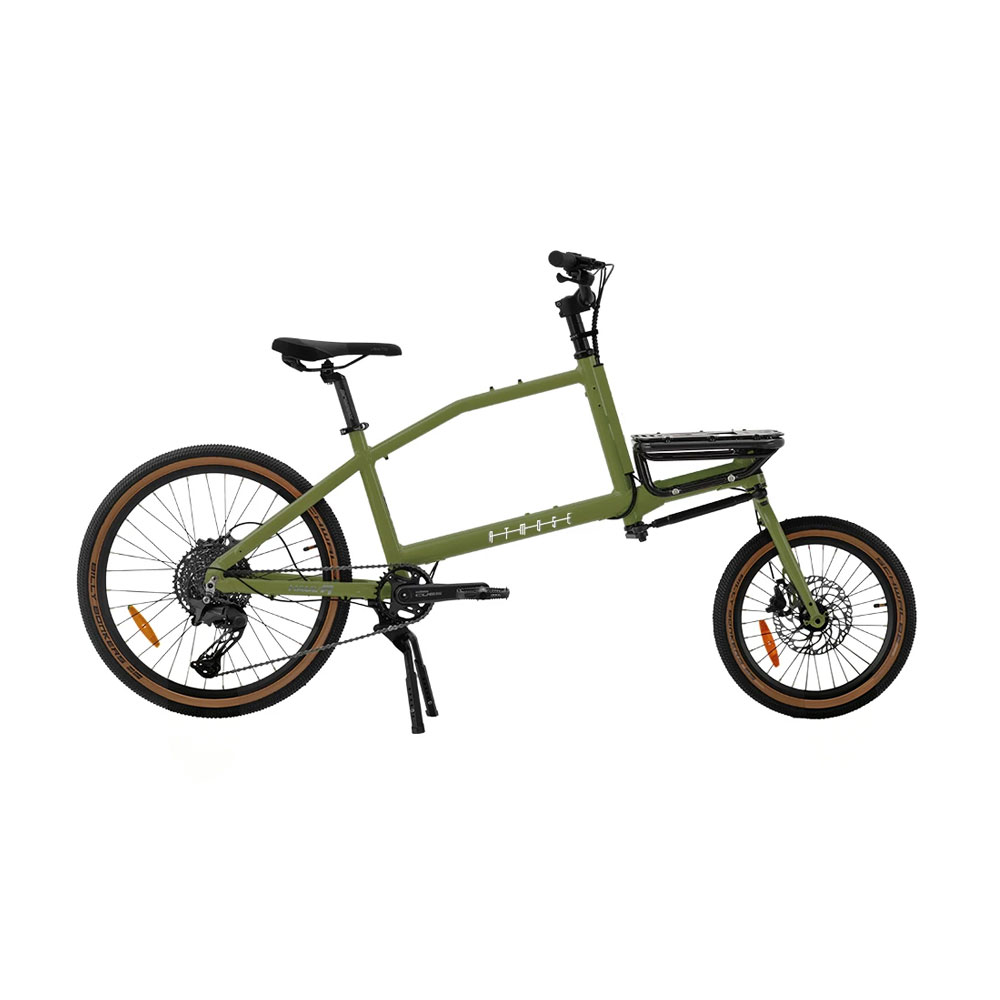
Atmose Model V V1 Manual Adventure Cargo Bike with Oversized Front Rack
The central advantage of the V1 is its mechanical independence. The bicycle does not use a battery, motor, controller, charging port, or electronic display. There is no need to search for a power outlet at a campsite, calculate remaining battery range, or carry a charging cable on a multi-day trip.
This simplicity is valuable in locations where electrical infrastructure is limited or nonexistent. A rider crossing remote trails may be able to find food, water, and shelter without finding a compatible charging point. A manual cargo bike avoids that limitation entirely. Its range is determined primarily by the rider’s energy, available supplies, route conditions, and maintenance planning.
Removing electrical components also reduces the number of systems that require inspection. Mechanical parts can still wear and require maintenance, but many common service tasks can be addressed with familiar bicycle tools and replacement components. The absence of a motor and battery may be especially useful for expeditions where weight, repairability, and field serviceability are more important than assisted speed.
A manual cargo bicycle is not simply an electric cargo bike with its motor removed. The design must be balanced around human power. Gear range, wheel dimensions, frame stiffness, brake performance, load placement, and overall weight all become important factors. The V1 reflects this requirement through a drivetrain intended for climbing under load and a structure capable of supporting substantial rider and basket weight.
The product information specifies a maximum rider load of 145 kilograms and a basket capacity of 25 kilograms. These figures make the bicycle suitable for carrying both a substantial rider and a meaningful quantity of equipment. As with any bicycle, actual performance depends on terrain, speed, load distribution, tire pressure, and riding technique, but the stated limits demonstrate that the V1 is designed as a genuine cargo platform rather than an ordinary bicycle with a small front carrier.
The front folding basket is one of the most important features of the Atmose Model V V1. Measuring 470 by 470 by 375 millimeters, it creates a large, accessible area for items that are awkward to carry in a backpack or standard bicycle pannier.
Camping equipment often includes irregularly shaped objects such as tents, sleeping pads, cooking systems, folding chairs, dry bags, and coolers. These items are difficult to arrange inside narrow bags. The V1’s front basket allows riders to place larger objects on a stable platform and secure them with suitable straps or cargo restraints.
The deck can also serve practical needs beyond recreation. It may be used for transporting maintenance tools, field equipment, groceries, photography supplies, gardening materials, or small business loads. Because the basket is located at the front, the rider can monitor the cargo while traveling and make quick adjustments when necessary.
A large cargo deck is useful only when it works with the bicycle’s steering and frame geometry. The V1 is designed to keep the front load close to the rider’s field of view while preserving a manageable riding character. The basket’s dimensions provide capacity without turning the bicycle into an oversized platform that is difficult to guide along narrow trails.
Proper loading remains essential. Heavy items should be positioned low and centered whenever possible. Lighter bulky objects can be placed higher, while fragile equipment should be protected from vibration and secured against movement. Riders should also remember that adding weight to the front affects steering feel, braking distance, and balance. The V1’s cargo capacity gives the rider more options, but responsible load management is still part of safe cargo-bike operation.
The front basket is described as a folding basket, which provides a practical benefit when the cargo area is not in use. A folding deck can reduce the bicycle’s profile during storage, transportation, or loading. This can be important for riders who need to place the bicycle in a vehicle, move it through a narrow passage, or store it in a limited space.
For expedition use, the folding feature may also make the bicycle easier to handle around campsites, transport points, or aircraft-loading areas. The V1’s lower weight compared with electric alternatives complements this function, helping riders move the bike without relying on a ramp or lifting equipment in every situation.
The Model V V1 uses a 6061 T4T6 aluminum alloy frame. Aluminum alloy is widely valued in bicycle construction because it offers a useful balance of strength, weight, corrosion resistance, and manufacturing practicality. For an adventure cargo bike, the frame must accommodate a long front cargo structure while remaining responsive enough for uneven paths and narrow tracks.
The choice of aluminum supports the V1’s emphasis on portability. A heavy-duty cargo bicycle must be strong, but excessive mass can reduce its usefulness in remote environments. Riders may need to lift the bicycle over fallen branches, carry it across rocky sections, place it onto a transport platform, or load it into a vehicle. A lighter frame and the absence of an electric power system make those tasks more manageable.
Frame strength should not be understood only as resistance to a single large impact. It also involves the ability to support repeated loads, absorb ordinary trail vibration, maintain alignment, and remain predictable during steering and braking. The V1’s structure is intended to support a high rider limit and a dedicated front basket, giving it a fundamentally different role from a lightweight recreational bicycle.
The long cargo-bike format also creates a stable foundation for carrying equipment. A longer bicycle can distribute cargo more effectively than a compact bicycle with a small rear rack. At the same time, the stated overall dimensions of 1,910 millimeters in length, 750 millimeters in width, and 1,060 millimeters in height keep the V1 within a practical format for paths, storage spaces, and transport arrangements.
The V1 uses 18-inch by 2.4-inch front tires and a 20-inch by 2.4-inch rear tire. This mixed-wheel configuration is well suited to a cargo bicycle that needs to balance front-load stability, maneuverability, and rolling performance.
The wide 2.4-inch tires provide a substantial contact patch compared with narrow road-oriented tires. That additional width can help the bicycle remain composed over gravel, compact dirt, uneven pavement, and other surfaces encountered during adventure travel. Wider tires may also allow riders to adjust pressure for comfort and traction, although pressure should always remain within the tire and rim manufacturer’s recommended range.
The front wheel size supports the cargo section while the rear wheel helps maintain a practical riding position and responsive propulsion. The configuration also contributes to the bicycle’s distinctive appearance, but its purpose is functional: the wheels and tires must work under load, across changing surfaces, and during slow technical riding.
The tires are described as puncture-proof or punch-proof in the product specifications. No bicycle tire is entirely immune to every type of damage, but puncture-resistant construction can be valuable when traveling through areas containing sharp stones, thorns, broken branches, or other trail debris. Adventure riders should still carry a repair kit, pump, tire levers, and appropriate replacement equipment.
The bicycle uses a Shimano 11-speed Cues speed system. A broad gear range is particularly important on a manual cargo bicycle because the rider must generate all propulsion without motor assistance. Low gears reduce the force required at the pedals during climbs, while higher gears allow efficient progress on level ground and descents.
When the front basket is loaded, the difference between an adequate gear range and a limited one becomes noticeable. A rider may encounter steep roads, loose surfaces, uneven trails, or long gradual climbs. The ability to select a suitable gear helps maintain a sustainable cadence instead of forcing the rider to push an excessively hard gear.
The drivetrain also gives riders control over energy management. An experienced cyclist can shift early before a steep section, maintain a comfortable cadence, and avoid unnecessary fatigue. On a long trip, this type of pacing may be more valuable than short bursts of speed. The V1 encourages a deliberate style of travel based on preparation, rhythm, and route awareness.
Some simple cargo bicycles use a single-speed or limited-range drivetrain. Such systems can be easy to understand, but they may become demanding when the terrain changes or cargo weight increases. The V1’s 11-speed configuration gives it a broader operating envelope. It can be prepared for steep climbs, moderate urban roads, gravel paths, and faster sections without requiring a complete change of bicycle.
Compared with a typical utility bicycle using a narrow-range gear system, the V1 offers greater flexibility for mixed-terrain riding. Compared with an electric cargo bike, it does not provide powered acceleration, but it also avoids motor-related weight, battery depletion, and electronic dependency. The advantage is therefore not universal; it is strongest for riders who value range independence and mechanical control.
The V1 is equipped with Tektro hydraulic disc brakes. Cargo bicycles require dependable braking because their total mass changes according to the rider and the transported load. A loaded front basket can also affect how quickly the bicycle responds during deceleration.
Hydraulic disc brakes transmit force through fluid rather than a traditional mechanical cable. This design can provide smooth lever action and strong braking control when properly adjusted. Disc brakes also perform consistently across a wider range of weather and surface conditions than many basic rim-brake systems, since the braking surface is separated from the outer rim.
For adventure riding, braking performance is important not only on steep descents but also on loose ground, narrow tracks, and unexpected obstacles. Riders should learn to apply both brakes progressively, maintain appropriate speed before entering difficult terrain, and inspect the system regularly. Hydraulic brakes do not eliminate maintenance requirements; pads, rotors, fluid systems, and mounting hardware still need attention.
The inclusion of hydraulic disc brakes strengthens the V1’s position against basic utility cargo bikes that may use simpler braking equipment. It gives the manual platform a more serious adventure orientation and supports the larger combined weight expected from the rider and cargo.
The absence of a motor changes the riding experience in several positive ways. The bicycle is lighter than an equivalent electric cargo bike, which makes it easier to carry, load, maneuver, and store. It also produces no motor noise, creating a quieter connection with the surrounding environment.
Manual propulsion offers a direct and predictable relationship between effort and movement. Riders can travel at their own pace, stop wherever necessary, and continue without considering battery temperature, charging intervals, or electronic system status. For some cyclists, that directness is a major part of the appeal.
The V1 also provides a practical exercise dimension. It can function as transportation, an expedition tool, and a fitness platform. Carrying cargo over distance naturally encourages riders to develop pacing and endurance. Unlike an electric bicycle, the level of assistance cannot be increased when the route becomes difficult, so the rider becomes more involved in planning and execution.
A manual cargo bicycle requires realistic route planning. Steep climbs, soft ground, strong headwinds, and heavy cargo can increase physical demands. Riders should consider distance, elevation, weather, surface conditions, available water, and their own experience before beginning a trip.
The V1 is designed to make loaded riding practical, not effortless. Its wide-range gearing helps reduce the challenge, but it cannot replace human power. This characteristic is an advantage for riders seeking self-reliance and a limitation for those who need frequent assistance or must cover long distances with minimal physical exertion.
Compared with electric competitors, the V1 is best understood as a specialized alternative rather than a direct replacement for every use case. It is particularly attractive to riders who travel beyond charging access, value a lower overall weight, prefer mechanical systems, or want an adventure bicycle that remains usable when batteries are unavailable.
Electric cargo bikes are highly useful in cities and connected regions, but their operating model depends on energy availability. A rider must eventually recharge the battery, and access to power may be inconvenient during camping trips, long-distance touring, or remote work assignments. The V1 does not share that limitation.
Its operational independence can be valuable for wilderness routes, emergency preparedness, rural mobility, and long journeys where charging stations are unreliable. A rider can carry food, tools, and replacement mechanical parts instead of planning around battery charging locations.
An electric cargo bike combines a mechanical bicycle system with a motor, battery, controller, sensors, wiring, and user interface. These components provide valuable assistance but add weight and service considerations. The V1 eliminates the electrical layer, leaving a more conventional bicycle architecture.
For riders who maintain their own bicycles, a simpler architecture can make diagnosis easier. Mechanical problems may still occur, but there are fewer electronic interfaces to evaluate. This is especially relevant during trips where professional e-bike service is not available.
The V1’s lower weight relative to motorized cargo bikes is a practical asset. An expedition may involve trains, boats, vans, aircraft, rough portage sections, or storage in a small building. Every kilogram matters when the rider must move the bicycle by hand.
The product description specifically emphasizes easier lifting over obstacles, loading onto a bush plane, and maneuvering through narrow unpaved tracks. These uses demonstrate the product’s focus on access rather than only road speed. The V1 is intended to follow the rider into environments where a heavy, battery-equipped cargo bike may be less convenient.
The V1 also differs from ordinary manual cargo bicycles. Its oversized front rack, high rider-load rating, wide tires, 11-speed drivetrain, and hydraulic disc brakes create a more capable specification than a simple city utility bike.
A basic cargo bicycle may be suitable for groceries and short urban journeys but less prepared for rough surfaces or extended travel. The V1 is designed with a broader range of conditions in mind. Its frame and cargo platform support larger loads, while the wide tires and hydraulic brakes add confidence on mixed terrain.
The product’s adventure orientation is also visible in its transport-focused dimensions and lighter construction. It is not merely a shopping bicycle with a front box. It is intended to carry equipment into places where riders may need to lift, push, turn, or temporarily dismount the bicycle.
Atmose is described as a U.S.-origin cargo e-bike brand with an international design and research-and-development team based in Paris. The company combines American product thinking with European design aesthetics. For the Model V V1, this combination is reflected in the attempt to unite functional cargo capacity with a visually organized, practical bicycle format.
American product development traditions often emphasize usefulness, durability, and direct problem solving. European design influence can contribute attention to proportion, urban compatibility, riding comfort, and everyday visual integration. The V1 applies these principles to an adventure platform by providing substantial cargo capacity without abandoning maneuverability and transport practicality.
Atmose originated from MOTIV, an established American beach cruiser brand with extensive industry experience. According to the company information, Atmose benefits from manufacturing expertise, a mature supply chain, and ongoing product innovation. These capabilities are important when developing cargo bicycles because the product must integrate frame design, wheel selection, braking systems, drivetrain compatibility, load-bearing structures, and user-oriented details.
A mature supply chain can also support more consistent sourcing and coordination among component manufacturers. While individual component quality still depends on specification and quality control, an organized production network helps a company manage materials, assembly requirements, inspection procedures, and product updates.
The V1’s value is not based on one component alone. The usefulness of the bicycle depends on how the frame, front basket, wheels, tires, drivetrain, and brakes operate together. A large basket must be supported by an appropriate frame structure. A high load rating must be matched by wheels and braking hardware. Wide tires must fit the frame and fork while preserving clearance. A long cargo design must remain controllable.
This type of system integration is an important manufacturing strength. Precision engineering is visible in the need to align frame interfaces, mount components securely, maintain wheel tracking, and ensure that folding and cargo structures function repeatedly. Even when the product looks simple, a practical cargo bicycle requires careful coordination between design and production.
Atmose states that it is committed to technological upgrades and product innovation. The Model V V1 demonstrates a form of innovation that is not dependent on adding more electronic features. Its innovation lies in adapting a cargo platform to riders who want to explore beyond electrical infrastructure.
By offering a manual version within an adventure cargo-bike range, the company can serve a wider group of users. Some riders may prefer an electric model for urban commuting, while others may choose the V1 for remote touring and equipment-heavy travel. This broader product approach allows the brand to address different mobility philosophies without treating one solution as suitable for everyone.
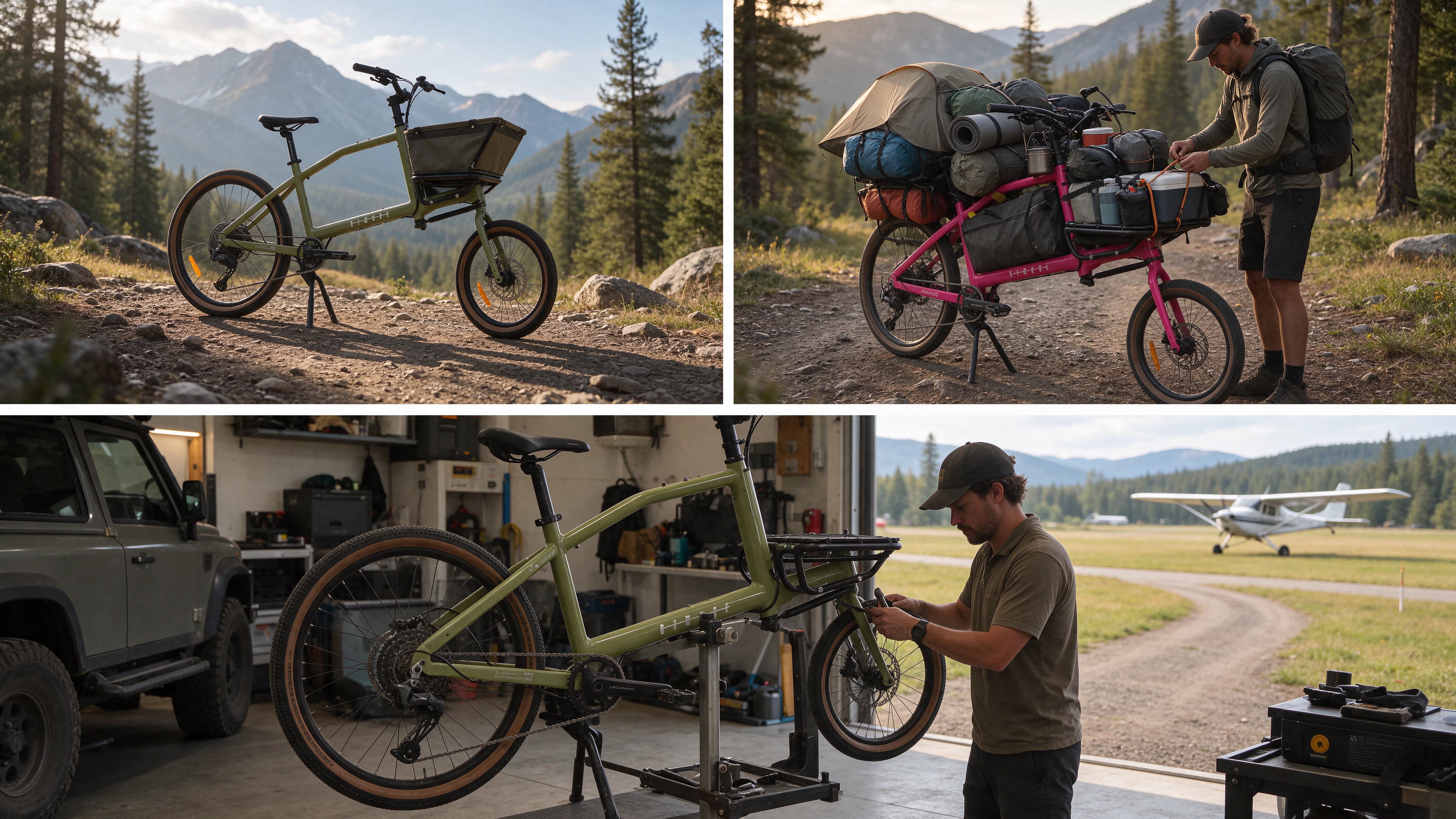
The V1 is naturally suited to bikepacking. The front basket can hold equipment that is too large for conventional frame bags, while the wide tires and broad gear range support changing terrain. A rider can use the available capacity for a tent, cooking equipment, food, water, repair tools, and clothing.
Because the bicycle has no battery, expedition planning is simplified. The rider can focus on route selection, resupply points, weather, and personal endurance rather than charging locations. The trade-off is that the rider must budget energy carefully and avoid carrying more cargo than can be managed safely.
For campground access, fishing trips, photography outings, and outdoor recreation, the V1 can act as a mobile equipment carrier. The front deck is suitable for bulky items, and the manual design avoids motor noise that could disturb quiet environments.
The bicycle may also be helpful when vehicles cannot reach a campsite or when a rider wants to travel beyond a parking area. Its ability to carry a substantial load while remaining narrower than many utility vehicles opens up access to paths and trail systems where appropriate bicycles are permitted.
The cargo platform can support practical tasks around farms, gardens, rural properties, and large outdoor sites. Tools, supplies, small containers, and maintenance equipment can be carried without requiring a motor vehicle for every short trip.
In these environments, mechanical independence may be especially useful. The bicycle can remain ready for use without a charged battery, and regular maintenance can be based on familiar bicycle practices. Riders should always confirm that the intended load and terrain remain within the stated capacity and safe operating conditions.
Although designed for adventure, the V1 can also function as a durable urban cargo bicycle. It may be used for shopping, commuting with equipment, local deliveries, or transporting supplies. Its front basket provides visible and accessible cargo space, while the manual drivetrain avoids the charging requirements associated with e-bikes.
For shorter journeys, a manual cargo bike can be an efficient replacement for car trips. It produces no direct operating emissions, requires less parking space, and encourages active transportation. The bicycle’s practical value is strongest when the route is compatible with the rider’s physical ability and when cargo is loaded responsibly.
Place dense items low and near the center of the basket. Avoid stacking heavy objects high, where they can raise the center of gravity and affect steering. Secure all cargo so it cannot slide, bounce, or fall through the basket during braking.
A loaded bicycle requires more time and distance to stop. Riders should reduce speed before corners, descents, loose surfaces, and crowded areas. Both hydraulic brake levers should be applied smoothly, with attention to traction and weight transfer.
Shift to an easier gear before reaching a steep climb rather than waiting until the bicycle slows dramatically. Maintaining a steady cadence can preserve energy and reduce strain. On descents, select a gear that gives adequate control without allowing excessive speed.
Before an expedition, inspect tire pressure, tread condition, wheel attachment, brake pad wear, rotor condition, drivetrain operation, cargo-basket fasteners, and frame interfaces. Carry basic repair supplies, including a pump, spare tube or compatible repair solution, tire tools, a multitool, chain lubricant, and a method for securing cargo.
| Specification | Atmose Model V V1 | Practical Significance |
|---|---|---|
| Product type | Manual adventure cargo bike | Operates without motor or battery assistance |
| Frame | 6061 T4T6 aluminum alloy | Balances structural utility with relatively low weight |
| Battery | None | No charging requirement or battery-range limitation |
| Maximum rider load | 145 kilograms | Supports a substantial rider load when used correctly |
| Maximum basket load | 25 kilograms | Provides capacity for camping and utility equipment |
| Drivetrain | Shimano 11-speed Cues | Offers a broad range for loaded climbs and varied terrain |
| Front basket dimensions | 470 × 470 × 375 millimeters | Accommodates bulky, irregularly shaped cargo |
| Tires | 18 × 2.4-inch front and 20 × 2.4-inch rear | Wide contact areas for mixed surfaces and cargo stability |
| Brakes | Tektro hydraulic disc brakes | Supports controlled stopping under changing loads |
| Overall dimensions | 1,910 × 750 × 1,060 millimeters | Provides a substantial cargo format while remaining maneuverable |
The V1 is a strong choice for riders who want a cargo bicycle that can travel beyond charging infrastructure. It is well suited to mechanically minded cyclists, bikepackers, campers, rural users, outdoor professionals, and anyone who prefers to keep a bicycle’s operating systems simple.
It may also suit riders who frequently transport the bicycle by hand. The reduced weight compared with electric cargo bikes can make a meaningful difference when the route includes stairs, obstacles, boats, aircraft, or vehicle loading.
On the other hand, riders who need powered assistance for steep daily commutes, long urban distances, or very heavy commercial loads may prefer an electric cargo model. The V1 requires active participation, and its performance depends on the rider’s fitness, route planning, and load discipline.
The product’s greatest strength is that it does not try to be everything for everyone. It is designed around a clear principle: a capable, high-capacity cargo bicycle should remain useful even when a battery cannot be charged or an electronic system cannot be serviced.
The Atmose Model V V1 is a manual adventure cargo bike with an oversized front folding basket. It is designed for camping, bikepacking, outdoor exploration, utility transport, and riders who want cargo capacity without a motor or battery.
No. The V1 is a fully manual bicycle. Its power system and battery are listed as absent, so propulsion comes entirely from the rider through the Shimano 11-speed Cues drivetrain.
The stated maximum load is 145 kilograms for the rider and 25 kilograms for the front basket. Riders should distribute cargo carefully and follow all applicable operating and safety guidance.
The 470 × 470 × 375 millimeter basket is intended for bulky equipment such as tents, coolers, tools, food, dry bags, outdoor supplies, and other properly secured cargo. The exact contents depend on their size, shape, weight, and compatibility with safe loading practices.
A manual cargo bike does not require charging, has fewer systems to maintain, and is generally lighter than an equivalent electric cargo bike. It can be especially useful in remote environments, during transport-heavy expeditions, or for riders who prefer direct mechanical control.
Yes, the 11-speed drivetrain is designed to provide a broad gear range for climbing under load. However, the bicycle has no motor, so steep climbs still require rider effort, appropriate pacing, and realistic cargo planning.
The wide 2.4-inch tires and mixed 18-inch front and 20-inch rear wheel configuration are intended to support mixed surfaces, including unpaved paths. Riders should confirm that specific trails permit cargo bikes and should adjust speed and tire pressure to the terrain.
The bicycle uses Tektro hydraulic disc brakes. These provide controlled braking performance when properly maintained, but riders must still account for load, surface conditions, weather, and stopping distance.
The product information identifies it as a front folding basket. The folding design is intended to improve storage and transport convenience when the cargo area is not being used.
The bicycle is produced by Atmose, a U.S.-origin cargo-bike brand operating through ATMOSE SASU in France and supported by an international design and research-and-development team. The company’s background includes MOTIV, an established American beach cruiser brand.
The company describes its strengths as manufacturing experience, a mature supply chain, precision engineering, international design and research-and-development capability, and continuous product innovation. These strengths support the integration of the aluminum frame, cargo structure, drivetrain, wheels, tires, and braking system.
The front basket and high rider-load capacity give it practical utility potential, but the V1 is primarily presented as an adventure cargo bike. Commercial users should assess local regulations, route demands, cargo requirements, and operating limits before selecting it for business use.
The Atmose Model V V1 presents a clear alternative to the battery-centered cargo-bike market. It does not promise effortless climbing or motor-assisted speed. Instead, it focuses on independence, mechanical reliability, transportability, and useful cargo capacity.
Its 6061 T4T6 aluminum alloy frame, oversized folding front basket, 11-speed drivetrain, wide tires, hydraulic disc brakes, and substantial load ratings create a capable foundation for adventure travel. The absence of a battery reduces infrastructure dependence and helps keep the bicycle lighter than comparable electric platforms.
Atmose strengthens this concept through a product-development approach that combines American mobility thinking, European design influence, manufacturing experience, mature supply-chain coordination, and precision engineering. The result is a cargo bicycle intended for riders who want to carry more, travel farther from conventional services, and remain responsible for the machine’s movement.
For remote explorers, campers, bikepackers, rural users, and practical cyclists, the V1 offers a distinctive balance of capacity and simplicity. It is a reminder that advanced mobility does not always mean adding more electronics. Sometimes, innovation means designing a more purposeful mechanical system—one that continues to work wherever the road ends and charging stations disappear.
Atmose. Model V V1 product specifications and product description.
Atmose. Company information concerning product development, design, research, manufacturing experience, and supply-chain capabilities.
Shimano. Cues drivetrain technical information and bicycle gear-system principles.
Tektro. Hydraulic disc-brake product information and maintenance principles.
International Organization for Standardization. General principles concerning bicycle design, safety, and load considerations.
General bicycle maintenance and cargo-loading practices for touring, utility cycling, and off-road use.
Nov 27, 2026
Nov 25, 2026
Nov 21, 2026


info@atmosecargobike.com

200 rue de la Croix Nivert 75015 Paris

Custom Electric Bakfiets
 English
 Français
 Deutsch