Nov 19, 2026
Choosing a cargo bike for family transportation involves much more than comparing motor wattage or battery capacity. A dependable family cargo bike must carry children, pets, groceries, and personal equipment while remaining stable, comfortable, easy to control, and practical in changing weather. It must also fit into ordinary urban life: school runs, grocery trips, veterinary appointments, commuting, weekend rides, and unexpected errands.
The ESP3 electric family cargo bike is designed around these everyday requirements. Its long front-loading format combines a spacious folding basket with a mid-drive electric assistance system, hydraulic disc brakes, wide puncture-resistant tires, and an aluminum alloy frame. The result is a utility-focused bicycle intended to help families replace short car trips without giving up carrying capacity or riding confidence.
This article examines the bike’s design, performance, safety features, manufacturing strengths, family applications, maintenance requirements, and advantages compared with more basic cargo-bike alternatives. It also explains which specifications matter most when selecting a cargo bike for children, pets, shopping, commuting, or mixed household use.
A family cargo bike is a transportation tool built around people and goods rather than only the rider. Traditional bicycles are generally optimized for one rider and a small backpack. A family cargo bike, by contrast, provides a reinforced frame, an extended loading area, stronger wheels, increased braking capability, and a riding position that supports controlled handling under greater weight.
The ESP3 follows a front-loading cargo-bike layout. The cargo area is positioned ahead of the rider, allowing the rider to keep a direct view of children, pets, shopping, or other items. This arrangement can be particularly useful for parents because the load remains visible during travel. It also provides more flexibility than a rear rack when transporting irregularly shaped objects.
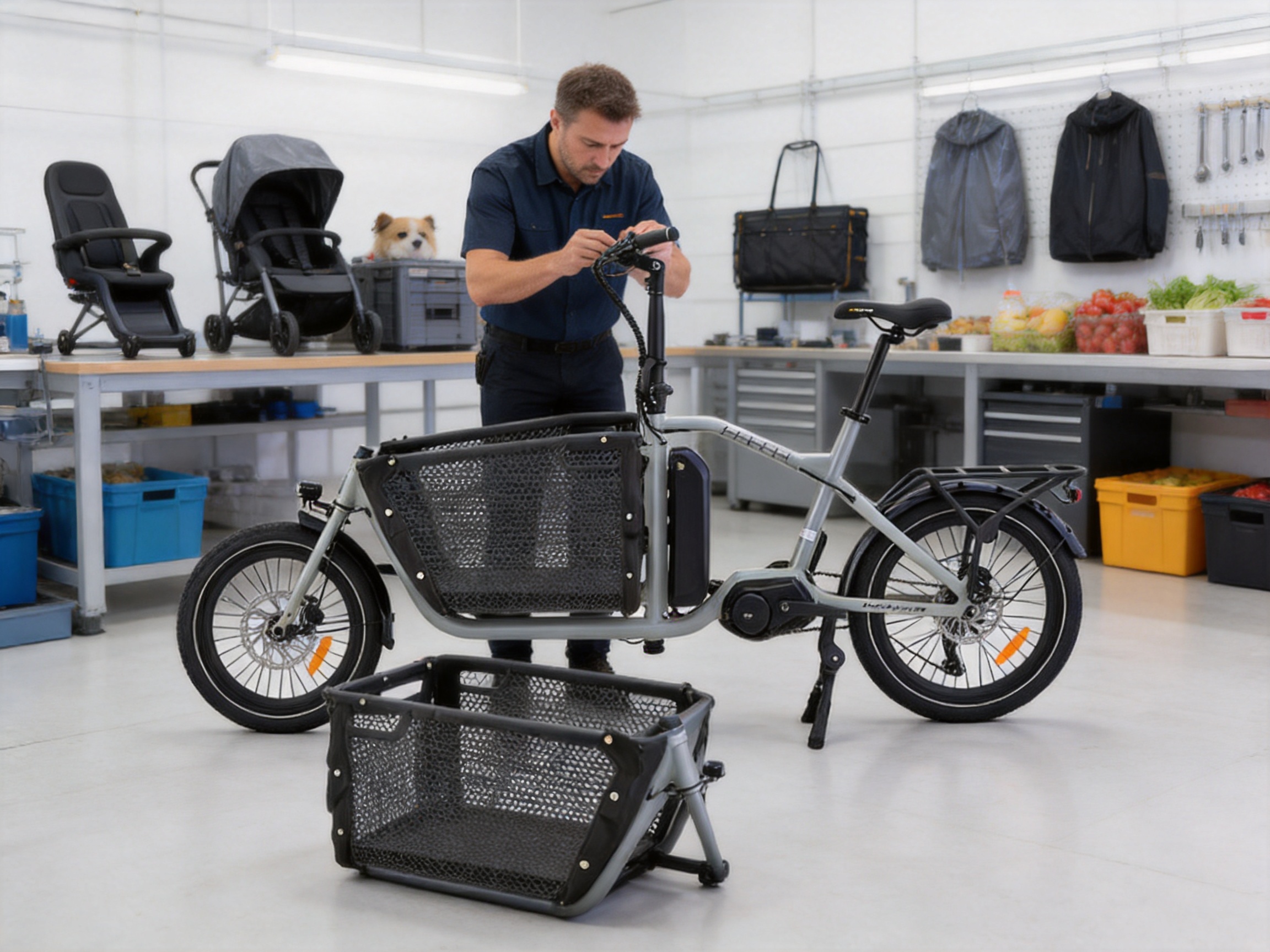
The front basket is foldable, which gives the bike two distinct operating modes. In its expanded configuration, it can be used for groceries, a child seat, a pet carrier, or other equipment. When folded, it reduces the bike’s width and makes storage or passage through narrower areas easier. According to the supplied specifications, the basket can carry up to 35 kilograms and measures approximately 64.5 centimeters by 62 centimeters at the top and 50 centimeters by 39 centimeters at the bottom.
This flexibility is important because family transportation rarely involves the same load every day. One journey may involve a child and a school bag, while another may involve groceries, a pet, or parcels. A fixed-purpose cargo platform can become inconvenient when the user’s needs change. A folding front basket provides a broader range of possible uses without requiring a completely different bicycle.
| Feature | Specification | Practical significance |
|---|---|---|
| Frame | 6061 T4/T6 aluminum alloy | Balances structural strength, corrosion resistance, and manageable weight |
| Battery | 36 V, 15 Ah Samsung lithium battery, approximately 540 Wh | Supports daily commuting, family travel, and utility riding |
| Motor | Bafang M430 mid-drive system, 36 V, 250 W nominal rating | Places assistance at the crank for useful hill-climbing and load control |
| Maximum stated basket load | 35 kg | Suitable for groceries, equipment, small pets, and approved seating systems |
| Stated rider load | 145 kg | Provides substantial capacity for the rider and clothing or personal items |
| Gearing | Shimano nine-speed Sora system | Offers a useful range for flat streets, inclines, and variable loads |
| Brakes | Tektro hydraulic disc brakes | Improves braking control in wet conditions and under heavier loads |
| Tires | 18-inch front and 20-inch rear, 2.4-inch wide puncture-resistant tires | Combines stability, grip, and a lower loading height |
| Overall dimensions | Approximately 2,130 mm long, 680 mm wide, and 1,130 mm high | Provides cargo capacity while remaining suitable for many urban routes |
| Claimed range | Up to approximately 80 km under suitable conditions | Can support multiple short trips between charges |
Published specifications should always be checked against the final configuration, regional regulations, accessory package, and dealer documentation. In particular, the supplied product information refers to a total load of approximately 175 kilograms in one description while listing 145 kilograms for the rider and 35 kilograms for the basket in the specification table. These figures should not be added or interpreted beyond the manufacturer’s approved operating limits. Users should confirm the permitted combined rider, cargo, and accessory weight before carrying passengers.
The electric assistance system is one of the ESP3’s most important distinctions. Instead of using a hub motor placed inside the front or rear wheel, the bike uses a Bafang M430 mid-drive motor. A mid-drive motor delivers power through the bicycle’s crank and chain system. This allows the motor to take advantage of the selected mechanical gear, which can improve climbing performance and control when the bike is carrying a substantial load.
For a family cargo bike, this arrangement can be more useful than simply selecting a motor with a high headline power number. A loaded cargo bicycle must start smoothly, climb safely, and respond predictably at low speeds. The relationship between motor assistance, gearing, wheel speed, rider input, and load is therefore extremely important.
The supplied information identifies the system as a 36-volt, 250-watt nominal motor and also describes output of up to 500 watts and torque of up to 110 newton-meters. These figures may reflect different rating methods or operating conditions. The nominal legal rating, peak output, and maximum torque are not interchangeable. Buyers should confirm the applicable regional specification, assistance limits, and certification details before purchase or road use.
The mid-drive layout also helps maintain balanced weight distribution. A heavy motor in a wheel can increase unsprung mass and influence steering or suspension behavior. Positioning the motor near the bicycle’s center can contribute to a more centralized feel, which is valuable when the front cargo area is already carrying children, pets, or shopping.
The M430 system is described as providing smooth and linear assistance. That characteristic matters for family use. Sudden motor engagement may unsettle a child or cause cargo to shift. A controlled power delivery can make starts at traffic lights, crossings, driveways, and inclines more comfortable for both rider and passenger.
Motor assistance does not remove the need for good riding technique. Riders should select a low gear before a steep incline, start with the front wheel straight, brake before corners, and avoid abrupt steering inputs. A test ride with a realistic load is strongly recommended because a cargo bike’s handling changes as its weight increases.
The bike uses a 36-volt, 15-amp-hour Samsung lithium battery with an approximate capacity of 540 watt-hours. Battery capacity is calculated by multiplying voltage by amp-hour rating, although the energy available during use is influenced by temperature, battery age, rider weight, terrain, tire pressure, assist level, wind, stop-and-go traffic, and cargo weight.
The stated range is up to approximately 80 kilometers. This should be understood as a best-case or favorable-condition estimate rather than a guaranteed distance for every journey. A heavily loaded bike climbing hills in cold weather will consume energy more quickly than a lightly loaded bike traveling on level pavement at moderate speed.
For family transportation, the battery’s practical value is not only its maximum range. It is also the ability to complete several ordinary trips without charging after every short ride. A household might use the bike for a morning school run, a work commute, a grocery trip, and an afternoon pickup. A 540 Wh battery gives the rider useful flexibility, especially when the battery is recharged regularly.
Battery care affects long-term performance. Users should charge the battery with the approved charger, keep contacts clean and dry, avoid exposing the battery to extreme heat, and follow the manufacturer’s storage instructions. If the bicycle will not be used for an extended period, storing the battery at an appropriate partial charge is generally preferable to leaving it completely empty, although the exact recommendation should come from the battery documentation.
Range planning should also leave a reserve. Riders who frequently travel through hilly neighborhoods, carry a maximum load, or use high assistance levels should not plan routes that consume the entire estimated capacity. Maintaining a reserve helps prevent an unexpectedly heavy manual ride home.
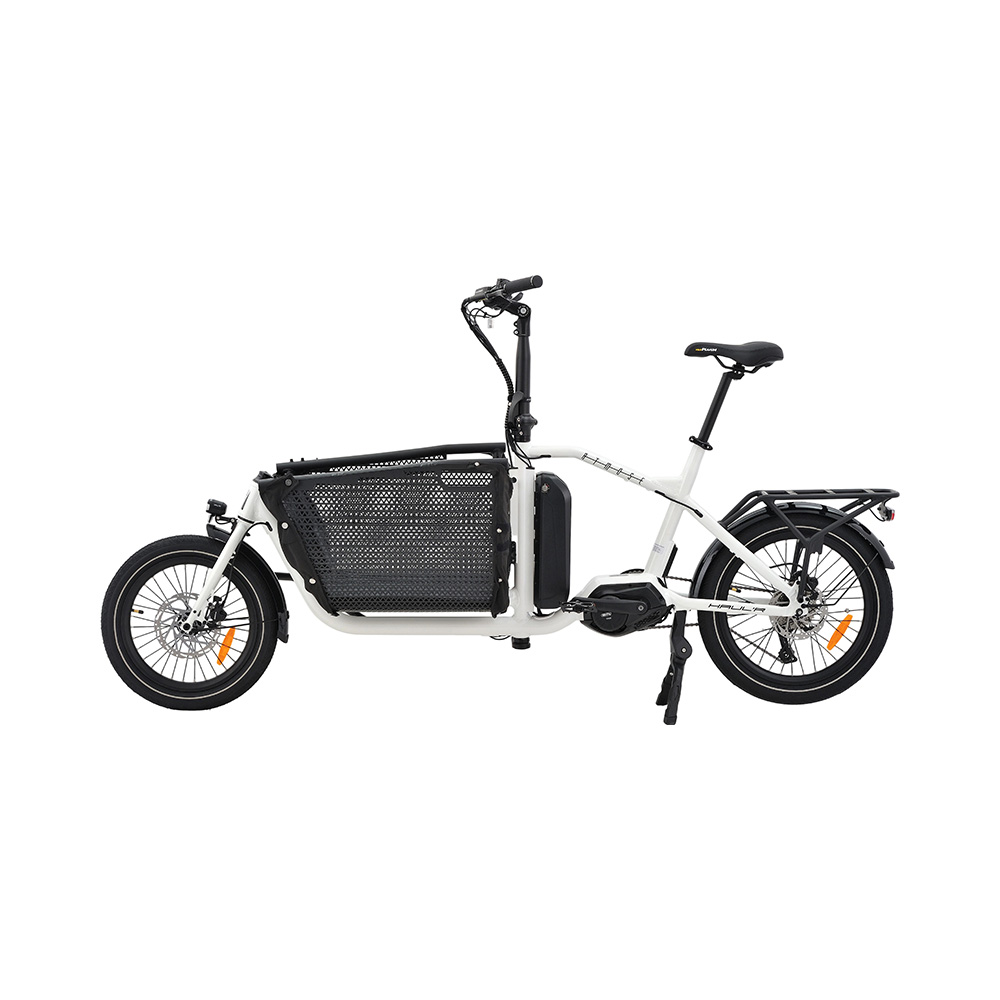
Atmose Model P ESP3 Electric Family Cargo Bike for Kids and Pet Transport
The frame is made from 6061 T4/T6 aluminum alloy. This material is widely used in transportation products because it can provide a useful balance of strength, corrosion resistance, manufacturability, and relatively low weight. For a cargo bicycle, the frame must withstand more than the forces experienced by an ordinary commuter bike. It must cope with repeated acceleration, braking, cornering, uneven roads, curb transitions, and changes in load placement.
The T4/T6 designation relates to heat-treatment conditions used to achieve desired material properties. The exact processing sequence, tube dimensions, welding method, inspection procedures, and finishing process are important to the final result. Material grade alone does not guarantee frame quality. A well-designed cargo frame also depends on geometry, joint design, weld quality, alignment, load paths, and quality control.
The supplied product information states that the frame passes 300,000-cycle fatigue testing and refers to TUV and EN 17860 safety certifications. These are significant points for buyers because fatigue testing addresses repeated loading rather than only a single static force. A cargo bicycle is expected to survive thousands of starts, stops, potholes, and loading cycles. Repeated-load validation is therefore more relevant to daily use than a one-time showroom demonstration.
Certification claims should be supported by current documentation for the exact model and configuration. Buyers, distributors, and fleet operators should request certificates, test reports, or conformity information where appropriate. Regional standards and passenger-carrying rules can vary, and an accessory such as a child seat or rain cover may have its own requirements.
The frame geometry is described as being optimized for stable and confident handling. Stability comes from several interacting design factors, including wheelbase, steering angle, center of gravity, handlebar position, cargo placement, tire size, and frame stiffness. The goal is not simply to make the bike long or heavy. It is to create predictable behavior at low speed while retaining enough maneuverability for urban paths and intersections.
A 680-millimeter overall width is relatively important in city use. Excessive width can make cycle lanes, bollards, doorways, storage rooms, and narrow streets difficult to navigate. The ESP3’s dimensions are intended to provide meaningful cargo volume without becoming impractical for ordinary urban movement. Nevertheless, every buyer should measure their garage, elevator, doorway, storage area, and preferred cycling routes before ordering.
The front folding basket is a central feature of the design. Its stated maximum capacity of 35 kilograms gives it enough strength for substantial grocery loads and approved passenger or pet equipment. The basket can also be folded to reduce its width, reportedly to approximately 365 millimeters in the folded configuration.
For grocery transportation, the front position can make loading and unloading easier. Bags can be placed directly into the basket without lifting them over a rear passenger compartment. The rider can also see the cargo while riding, which makes it easier to notice movement, a loose strap, or a shifting object.
For pet transport, the basket can be configured with a suitable pet carrier or restraint system. Pets should never be allowed to move freely in a cargo area without appropriate containment. A dog may react to traffic noise, pedestrians, other animals, or sudden braking. The correct carrier should be stable, ventilated, weather-appropriate, and compatible with the basket’s dimensions and load rating.
For children, the basket must be paired with approved child seats, benches, harnesses, handholds, foot protection, and weather protection as required by the final configuration. A child should be seated securely, with feet protected from the wheels and moving parts. The rider should also make sure that the child’s helmet, clothing, and accessories cannot contact the spokes, chain, brake rotor, or tires.
The supplied materials state that the front area is compatible with child seats and rain covers. Compatibility should still be checked at the time of purchase because different accessories may have different mounting systems. A professional dealer or trained installer can help verify that the seating system is correctly fitted and that the resulting center of gravity remains within the recommended limits.
Safety is not one individual component. It is the combined result of frame strength, braking, visibility, rider behavior, accessory installation, load distribution, maintenance, and route selection. The ESP3’s safety-oriented features create a useful foundation, but families must also establish safe operating habits.
Hydraulic disc brakes are well suited to a cargo bike because they can provide consistent control with relatively low hand effort. This is particularly helpful when the bicycle is heavy or when a rider is braking repeatedly in traffic. Hydraulic systems can also maintain more consistent performance across changing weather conditions than basic mechanical systems, although they still require inspection and adjustment.
Riders should test the brakes after loading the bike and before entering traffic. The stopping distance of a fully loaded cargo bicycle will be longer than that of an unloaded bicycle. The rider should apply both brakes progressively, keep the handlebars straight during emergency braking, and avoid turning sharply while braking hard.
The wide 2.4-inch tires provide a larger contact patch than narrow road tires. This can improve comfort and grip on imperfect pavement, painted surfaces, compact gravel, and wet streets. The smaller front wheel also helps keep the cargo platform at a practical height and can contribute to a lower center of gravity. Tire pressure should be adjusted within the manufacturer’s recommended range according to rider and cargo weight.
Puncture-resistant construction can reduce interruptions, but no tire is immune to punctures. Riders should regularly check for embedded glass, sharp stones, sidewall damage, and low pressure. Underinflated tires increase rolling resistance and can make steering feel less precise. Overinflated tires may reduce comfort and grip.
Lighting and visibility are also essential. The motor system is described as supporting an integrated six-volt light supply. The final bicycle should be equipped with legally compliant front and rear lighting, reflectors, and any visibility accessories required by local law. Bright clothing, reflective elements, and predictable signaling can further improve safety.
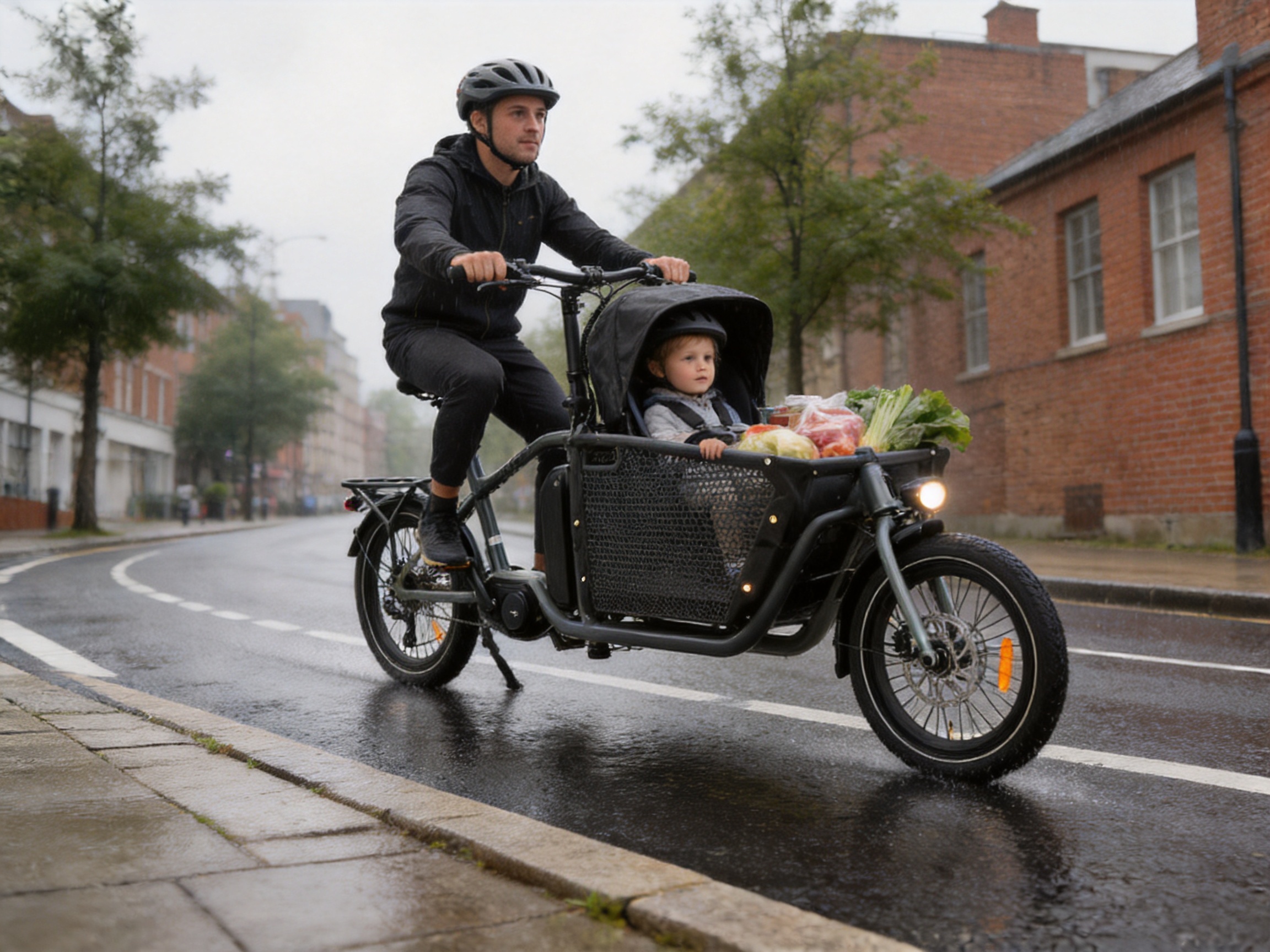
A rain cover can protect passengers and cargo from rain, wind, and light spray. However, weather protection should not obstruct the rider’s view or restrict ventilation. During warm conditions, caregivers should pay attention to heat buildup inside enclosed covers. Children and pets require regular checks throughout the ride.
The ESP3 has several advantages compared with simpler cargo bikes that use a basic rear hub motor, a narrow rack, rim brakes, or a non-folding cargo platform. The first advantage is system integration. The frame, front basket, mid-drive motor, battery, gearing, braking system, and wide tires are designed to operate as one transport platform rather than as an ordinary bicycle with an oversized rack.
A basic hub-motor utility bike may be adequate for light loads on flat routes, but it can feel less natural on steep hills or when starting with a heavy cargo. The ESP3’s mid-drive arrangement uses the bicycle’s gears, which can provide a more practical balance between climbing ability and low-speed control.
A basic rear rack may carry groceries, but it generally cannot provide the same direct visibility or protected space as a front cargo basket. A rear child seat also places the passenger behind the rider, making direct communication and visual checking less convenient. A front-loading format allows the rider to monitor the cargo area more easily.
Mechanical disc or rim brakes can work effectively when properly maintained, but hydraulic disc brakes typically offer lower hand effort and more consistent modulation. That difference becomes more noticeable when the bike is frequently loaded and unloaded or used in wet urban conditions.
Narrow tires may roll efficiently on smooth pavement, yet wide puncture-resistant tires can provide greater confidence over potholes, rough asphalt, and mixed urban surfaces. The ESP3’s tire format reflects the fact that family cargo bikes are utility vehicles first and performance road bicycles second.
The foldable basket also gives the bike an advantage over fixed cargo boxes when storage space is limited. A family may need a high-capacity platform during the morning and a narrower bicycle during storage or transport. Folding capability adds practical versatility without requiring a second vehicle.
Compared with very large cargo bikes, the ESP3 may be easier to position in ordinary city environments because its width remains relatively controlled. It is still a long bicycle, but the approximately 680-millimeter width supports use on routes where an oversized cargo vehicle may be inconvenient.
A cargo bike’s performance depends on the quality of the product-development process as much as on its visible components. The company behind this model combines an American product origin with European design and research-and-development activity. The brand originated in California through MOTIV, an established American beach cruiser company, and later expanded its European presence through ATMOSE SASU in France.
This background provides a combination of perspectives. American product development has traditionally emphasized approachable mobility, recreational use, and practical lifestyle products, while European urban design often places stronger emphasis on compact dimensions, everyday utility, safety expectations, and integration with dense city environments. A family cargo bike benefits from considering both use cases.
The supplied company information also refers to a mature supply chain, manufacturing expertise, continuous innovation, and international design collaboration. These strengths can support more consistent component sourcing and more adaptable product development than a one-off bicycle project. They are especially relevant for distributors and retailers who require repeatable specifications, replacement parts, technical support, and custom-order coordination.
Advanced manufacturing should not be understood only as the use of expensive machinery. It includes engineering validation, controlled material selection, repeatable welding, frame alignment, paint and corrosion protection, component integration, battery quality management, assembly inspection, and final road testing.
For an aluminum cargo frame, manufacturing quality begins with accurate tube preparation and controlled joints. Welding must produce structurally sound connections while limiting distortion. After welding, frame alignment is important because small deviations can influence wheel tracking, steering, braking, and long-term tire wear. Quality checks may include visual inspection, dimensional measurement, alignment fixtures, and sampling or testing according to the manufacturer’s quality program.
Fatigue testing adds another layer of validation. The stated 300,000-cycle test indicates that repeated stress is considered during product development. A robust testing program can expose weaknesses in weld areas, mounting points, steering components, or cargo-platform connections before a product reaches consumers.
Component integration is another manufacturing strength. The bike uses a Bafang drive system, Samsung battery cells or battery branding, Shimano gearing, and Tektro hydraulic brakes. The value of this combination depends on correct compatibility, wiring, mounting, calibration, and assembly. A high-quality component can perform poorly if it is incorrectly installed or paired with unsuitable hardware.
For wholesale customers, the company’s ability to support custom design and custom electric cargo-bike solutions is also relevant. Different markets may require different baskets, passenger accessories, colors, branding, battery configurations, speed settings, or delivery equipment. A manufacturer with an established design and R&D structure is better positioned to evaluate such requests than a reseller that simply imports a fixed specification.
Customization should still be managed through engineering review. Changes to the basket, passenger seating, frame attachments, battery, motor settings, or load distribution can affect braking, stability, certification, and warranty conditions. Responsible customization maintains the safety principles of the original design rather than adding accessories without validation.
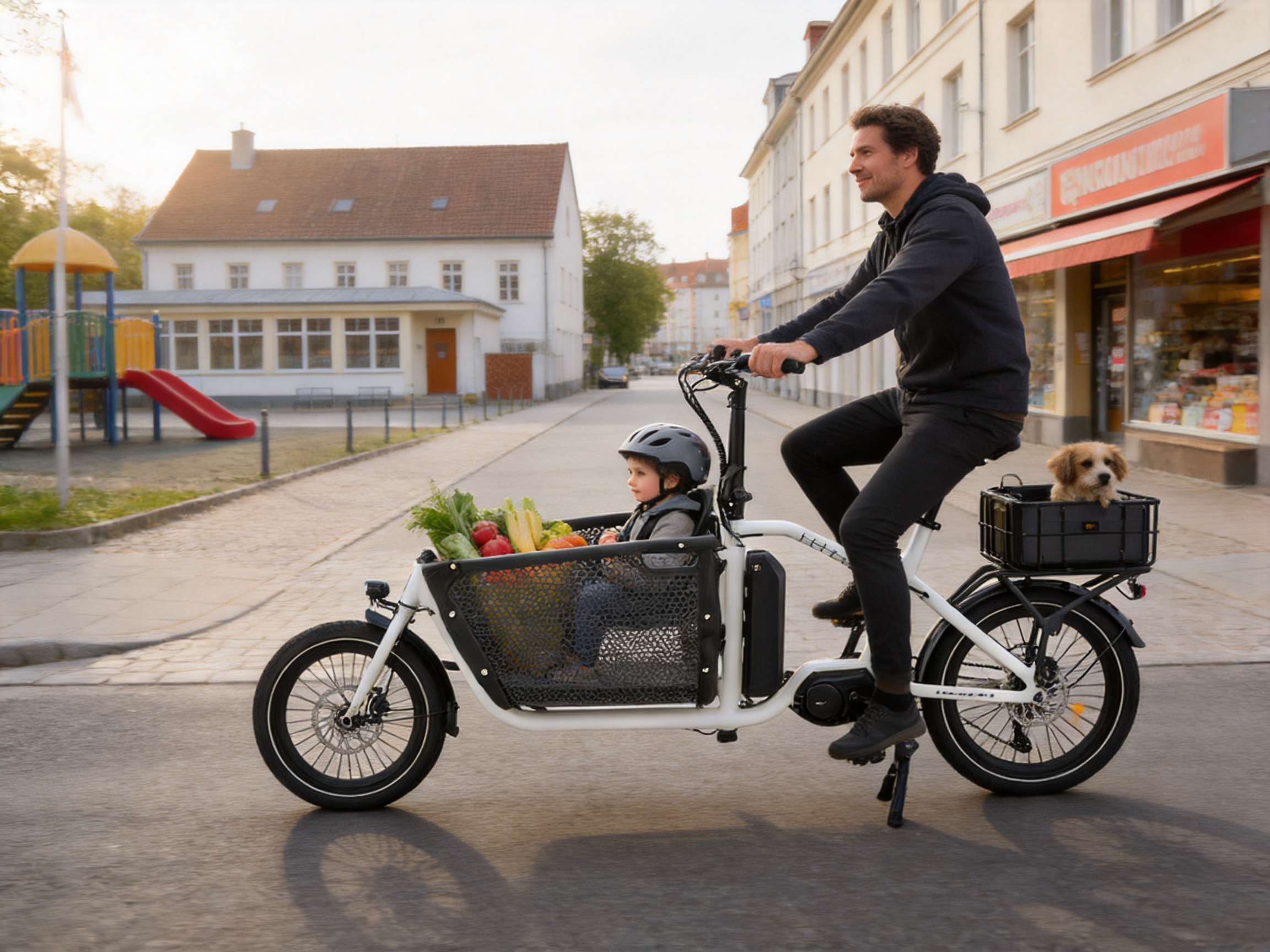
The school run is one of the clearest use cases for the ESP3. Many school journeys are short in distance but difficult by car because of congestion, parking shortages, and restricted stopping areas. A cargo bike can make these trips more direct while providing a routine form of physical activity for the rider.
The front cargo position allows the rider to communicate with children during the journey and check that they remain seated. A rain cover can make the bike more practical in changing weather. Before every trip, the caregiver should check seat attachments, harnesses, foot protection, and cover fasteners.
The 35-kilogram basket capacity is useful for weekly groceries, market shopping, household supplies, or a combination of smaller purchases. The rider should distribute weight evenly and keep heavy items low and centered. Bottles, cans, and other dense objects should not be placed high where they could raise the center of gravity.
Reusable bags can be secured inside the basket to prevent movement. Loose straps, shopping bags, and cords must be kept away from the wheels, chain, crank, and brake components. After loading, the rider should gently test steering and braking before joining the road.
A secure front carrier can make veterinary visits and recreational rides more convenient. The pet should be introduced to the bicycle gradually, first while stationary and then during short rides in a quiet area. Animals can react unpredictably to movement, sounds, and traffic. A properly secured carrier and a calm route are essential.
The basket’s stated capacity makes it suitable for small pets or pet equipment, but the animal’s size, carrier dimensions, ventilation, and combined weight must remain within the approved limit. The rider should also consider whether the pet’s movement could affect steering or balance.
For adults commuting through urban streets, the bike provides a practical alternative to a car for journeys involving work bags, parcels, lunch, shopping, or equipment. The nine-speed drivetrain gives the rider more flexibility than a single-speed utility bicycle, especially when the route includes bridges, ramps, or moderate hills.
The battery supports repeated assisted travel, while the front basket provides a convenient place for work items. Riders should use panniers or internal bags where appropriate and avoid carrying unsecured loads that can shift during cornering.
First-time cargo-bike riders should practice in an open area before carrying children or pets. The bike’s length, steering response, braking distance, and turning radius differ from those of a standard bicycle. Practice should include starting, stopping, slow-speed turns, tight corners, shoulder checks, and passing through narrow spaces.
Loading should begin with the heaviest items placed low and near the center of the basket. Large but light objects can be placed above them, provided they do not obstruct the rider’s view. The rider should check that the load cannot slide forward during braking or shift sideways during a turn.
Starting on level ground is easier than starting on a slope. When stopped at an intersection, the rider should select an appropriate low gear before moving. It is often safer to make a wider, slower turn than to attempt a sharp turn at speed, particularly when the basket is fully loaded.
Curbs and potholes should be approached slowly and as squarely as possible. Sudden impacts can affect both the cargo and the frame. If a route contains frequent rough surfaces, the rider should reduce speed and inspect the bicycle more often for loose fasteners, wheel damage, and alignment problems.
Passengers should be taught to remain seated, keep hands inside the protected area, avoid sudden movement, and wait until the bicycle is fully stopped before entering or leaving. Pets require equivalent discipline through suitable restraints and carriers.
Regular maintenance protects performance and safety. Before each ride, the rider should check tire pressure, brake operation, battery installation, steering movement, wheel security, and the attachment of any cargo or passenger equipment.
The hydraulic brake system should be inspected for leaks, unusual softness, worn pads, rotor contamination, or noise. Brake pads and rotors are wear items. Their service life depends on load, terrain, weather, riding style, and cleaning practices.
The chain and drivetrain should be kept clean and lubricated according to the manufacturer’s recommendation. A stretched or contaminated chain can reduce shifting quality and increase wear on the cassette and chainrings. Because the mid-drive motor transfers power through the bicycle’s drivetrain, proper gear selection and regular drivetrain care are especially important.
The folding basket should be checked for secure hinges, fasteners, cracks, and movement. Folding mechanisms must lock correctly in both operating and folded positions. Any unusual play should be investigated before the bike is used with passengers or heavy cargo.
Aluminum frames do not rust in the same way as untreated steel, but corrosion can still affect fasteners, electrical contacts, brake components, and damaged surface finishes. The bicycle should be cleaned after exposure to road salt, mud, or heavy rain. High-pressure water should be avoided around bearings, electrical connectors, the motor, and battery interfaces.
Software, diagnostic procedures, and motor-system servicing should be performed according to the drive-system documentation. Unauthorized modifications to speed settings, wiring, or battery connections can create safety risks and may affect compliance or warranty coverage.
Replacing short car journeys with an electric cargo bike can reduce fuel consumption, congestion, parking demand, and local emissions. The environmental benefit is greatest when the bicycle replaces trips that would otherwise be made by car rather than trips that would have been walked or cycled.
The utility of a cargo bike also improves household efficiency. A family may avoid driving to school, a supermarket, a veterinary clinic, or a local service provider. Over time, these small substitutions can reduce vehicle mileage and make transportation costs more predictable.
Electric assistance broadens the range of people who can use a cargo bike. Riders do not need to be highly athletic to manage moderate hills or heavier loads. This can make active transportation more accessible to parents, older adults, and commuters who arrive at work without wanting to be exhausted.
Durability is part of sustainability. A product that is used frequently for many years generally provides greater environmental value than a bicycle that is inexpensive but unsuitable for its intended load. Frame testing, replaceable components, established parts suppliers, and proper maintenance all support a longer service life.
Retailers should present the ESP3 as a complete mobility platform rather than merely an electric bicycle. Customers need guidance on accessories, child-seat compatibility, pet carriers, rain protection, battery care, service intervals, and local regulations.
A demonstration should include both unloaded and loaded handling where possible. Customers often judge a cargo bike only by its appearance or motor response, yet the most important experience is how it starts, stops, turns, and parks with realistic cargo.
Retailers should also explain the distinction between nominal motor power, peak output, and torque. Clear communication prevents unrealistic expectations and helps customers select a configuration appropriate to their local laws.
For fleet buyers, the product’s front basket, mid-drive system, hydraulic brakes, and aluminum frame may support applications such as local delivery, campus transport, hospitality services, community mobility, or small-business logistics. Fleet operators should define payload limits, charging procedures, preventive maintenance, spare-parts requirements, and rider training before deployment.
Wholesale customers may also benefit from custom design support. Custom branding, accessory combinations, color programs, and market-specific configurations can help a retailer differentiate its offer. However, every custom change should be reviewed for structural, electrical, regulatory, and warranty consequences.
Before purchasing, buyers should identify the most common use case rather than the most impressive specification. A family carrying two small children may prioritize seating, harnesses, foot protection, and weather coverage. A pet owner may need a ventilated carrier. A commuter may prioritize battery access, luggage organization, and compact storage.
Buyers should measure the intended storage location and route. The bike is approximately 2,130 millimeters long, so it requires more space than a conventional bicycle. The width of doorways, bicycle racks, elevators, gates, and cycle-lane barriers should be considered in advance.
Load planning is also essential. The rider’s weight, children or pet, basket, seats, rain cover, locks, bags, and other accessories all contribute to the total operating load. The manufacturer’s limits should never be exceeded, and accessories should be included in the calculation.
A test ride should cover flat roads, a mild incline, low-speed maneuvering, a controlled emergency stop, and parking. The rider should test the bike with representative cargo if possible. Confidence is more important than a short learning curve, especially when children or animals will be transported.
Local rules may regulate maximum assisted speed, motor rating, lighting, passenger transport, helmet use, and where cargo bicycles may be ridden. Buyers should confirm those requirements with local authorities or a qualified dealer.
It is designed as a family cargo bike and its front cargo area is described as compatible with child seats and rain covers. Children should only be transported using approved, correctly installed seating and restraint equipment. The final passenger capacity depends on the accessory configuration, local regulations, and the manufacturer’s load limits.
The front basket can be used with a suitable pet carrier or restraint system, and the product is designed for family and pet-related transport. The dog’s weight, the carrier’s weight, ventilation, and combined load must remain within the approved capacity. The pet should be secured and introduced to riding gradually.
The supplied information gives a range of up to approximately 80 kilometers. Actual range depends on rider weight, cargo, terrain, temperature, tire pressure, wind, riding speed, and assistance level. Riders should maintain a reserve instead of relying on the maximum estimate.
A mid-drive motor applies assistance through the crank and drivetrain. It can use the bicycle’s gears to support climbing and controlled starts, which is useful for a heavier cargo bike. It also keeps the motor near the center of the bicycle, supporting balanced weight distribution.
The supplied specifications identify a 36-volt, 250-watt nominal motor, while the product description refers to output of up to 500 watts. These may describe different rating methods. Buyers should confirm the exact regional specification, legal classification, and peak-output definition before purchase.
The stated basket capacity is up to 35 kilograms. This figure includes the cargo or passenger equipment placed in the basket. It does not automatically mean that every accessory or passenger combination is approved. The final load must remain within the manufacturer’s instructions.
The bike uses wide 2.4-inch tires described as puncture-resistant. Their width can improve comfort and grip on uneven pavement, but riders should still slow down for potholes, inspect the tires regularly, and maintain the recommended pressure.
The frame uses 6061 T4/T6 aluminum alloy and is described as having passed 300,000-cycle fatigue testing. The design also includes a reinforced front cargo structure and geometry intended for stable handling. Buyers should request current test and certification documentation for the exact model configuration.
Yes. The front basket is designed to fold and is described as approximately 365 millimeters wide when folded. Users should ensure that the folding mechanism is fully secured before riding and that no loose object can interfere with the front wheel or steering.
The high-capacity front basket, electric assistance, hydraulic brakes, and durable frame can support certain local delivery and service applications. Commercial users should evaluate payload requirements, route conditions, charging access, maintenance support, rider training, and local regulations before deploying the bike.
Check the battery installation, tire pressure, brake operation, wheel security, steering, cargo attachments, passenger restraints, basket hinges, lighting, and overall load distribution. A short inspection is particularly important after the bike has been folded, transported, serviced, or exposed to rough roads.
The ESP3 electric family cargo bike is built around a clear purpose: helping families and urban users transport people, pets, groceries, and equipment with less dependence on a car. Its combination of a front folding basket, mid-drive assistance, 540 Wh battery, nine-speed drivetrain, hydraulic disc brakes, wide tires, and aluminum frame gives it a broad range of practical applications.
Its strongest advantages are integration and versatility. The bike is not limited to a single role. It can function as a school-run vehicle, grocery carrier, pet transporter, commuter, weekend utility bike, or light commercial transport platform. The folding front basket improves adaptability, while the mid-drive motor and wide tires support useful performance under changing loads.
The stated frame fatigue testing and references to TUV and EN 17860 standards further support its safety-focused positioning. At the same time, responsible buyers should verify current certification documents, regional specifications, accessory compatibility, passenger limits, and the meaning of published load and motor figures.
Behind the product is an international development structure combining American product origins, European design and R&D, manufacturing experience, established component suppliers, and support for custom cargo-bike solutions. These strengths can be valuable not only to individual families but also to retailers, distributors, fleet operators, and businesses seeking a configurable electric transport platform.
For users who value practical capacity, controlled handling, family safety, and everyday flexibility, the ESP3 presents a compelling alternative to a basic commuter e-bike or a second household car. Its long-term value will depend on correct loading, careful riding, regular maintenance, and selecting the right accessories for the intended application.
1. Product specification sheet for the ESP3 electric family cargo bike, including frame, battery, motor, drivetrain, dimensions, braking system, tires, and basket capacity.
2. Manufacturer product information concerning family transport, pet transport, grocery use, folding basket design, battery performance, and cargo-bike applications.
3. Technical information provided for the Bafang M430 mid-drive motor system and associated electric-assistance components.
4. Technical information provided for Samsung lithium battery systems used in electric mobility applications.
5. Shimano drivetrain component information relating to nine-speed Sora systems.
6. Tektro hydraulic disc-brake technical and maintenance documentation.
7. General engineering principles for fatigue testing, aluminum-alloy frame construction, cargo-bike geometry, and load distribution.
8. European bicycle safety and cargo-bike guidance, including relevant EN 17860 provisions and applicable regional conformity requirements.
9. General road-safety guidance for child passengers, pet carriers, bicycle braking, visibility, and urban cargo-bike operation.
Nov 27, 2026
Nov 25, 2026
Nov 21, 2026


info@atmosecargobike.com

200 rue de la Croix Nivert 75015 Paris

Custom Electric Bakfiets
 English
 Français
 Deutsch