Nov 17, 2026
Urban cargo cycling has traditionally involved a difficult compromise. Riders who want substantial carrying capacity often have to accept a long wheelbase, a large storage footprint, difficult transportation, and a permanent outdoor parking arrangement. Meanwhile, compact folding bicycles are convenient to store but usually lack the stability, cargo volume, and carrying strength required for serious daily utility.
The Atmose Model R ESR1 approaches the problem from a different direction. Instead of reducing the cargo function to make a bicycle foldable, it preserves the front-loading cargo layout and engineers the frame around compact storage. The result is a tri-fold electric cargo bike intended for people who need practical carrying capacity but live in apartments, commute by train, travel by car, or lack access to a secure bicycle shed.
In riding form, the Model R is a full-size front-loading cargo bicycle with a 198-centimeter overall length, a low front basket, a 250-watt mid-drive motor, a 720-watt-hour battery, hydraulic disc brakes, and a load rating of up to 45 kilograms in the basket. In folded form, it measures 120 by 44 by 85 centimeters. With the front wheel removed, the folded package is reduced to 102 by 44 by 76 centimeters.
These measurements are more than specifications on a product sheet. They define the bicycle’s central advantage: a rider can use genuine cargo-bike capacity without committing an entire room, balcony, garage, car rack, or building entrance to bicycle storage.
A conventional front-loading cargo bike is extremely useful once it is outside. Its long frame creates a stable platform for groceries, work equipment, parcels, or family belongings. The rider can see the load, keep it in front of the handlebars, and avoid placing heavy items high on the rear rack. However, that same long frame can make daily ownership inconvenient in dense urban environments.
A typical apartment rider may have to navigate a narrow entrance, a staircase, an elevator, a shared corridor, or a locked basement. Even when the bicycle fits physically, carrying or maneuvering it can be awkward. A train journey adds another challenge. A long cargo bike may be difficult to take through a station, place on an elevator, or store inside an office or train carriage.
Car transportation presents a similar problem. Many full-size cargo bikes require a roof carrier, a rear-mounted rack, or a large vehicle. Those solutions add cost and preparation time. They may also affect vehicle access, parking clearance, and fuel or energy consumption.
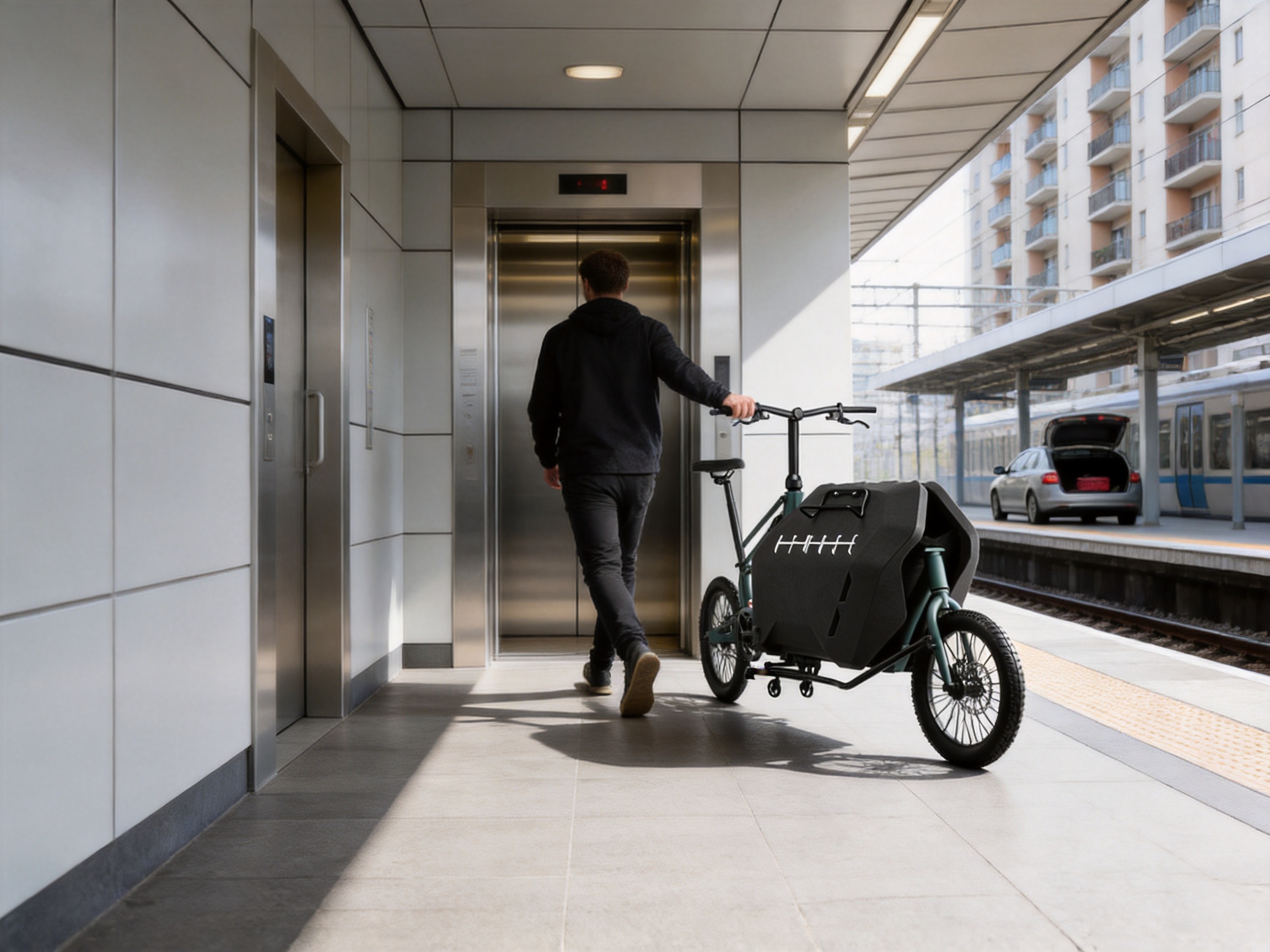
The Model R is designed for these moments. Its folding architecture reduces the length by 78 centimeters compared with its riding configuration. The folded bicycle can be rolled rather than carried, helping the rider move it through a station hall, into an elevator, or across an office floor. Removing the front wheel creates an even shorter package for trunk transportation.
This makes the Model R especially relevant to a category of riders who are often overlooked by traditional cargo-bike design: apartment dwellers, train commuters, mixed-mode travelers, city professionals, small-business operators, and households without a garage.
Many folding bicycles begin with a compact frame and add limited luggage capacity. The Model R begins with a front-loading cargo configuration and creates a folding system around it. That distinction affects how the bicycle functions in everyday use.
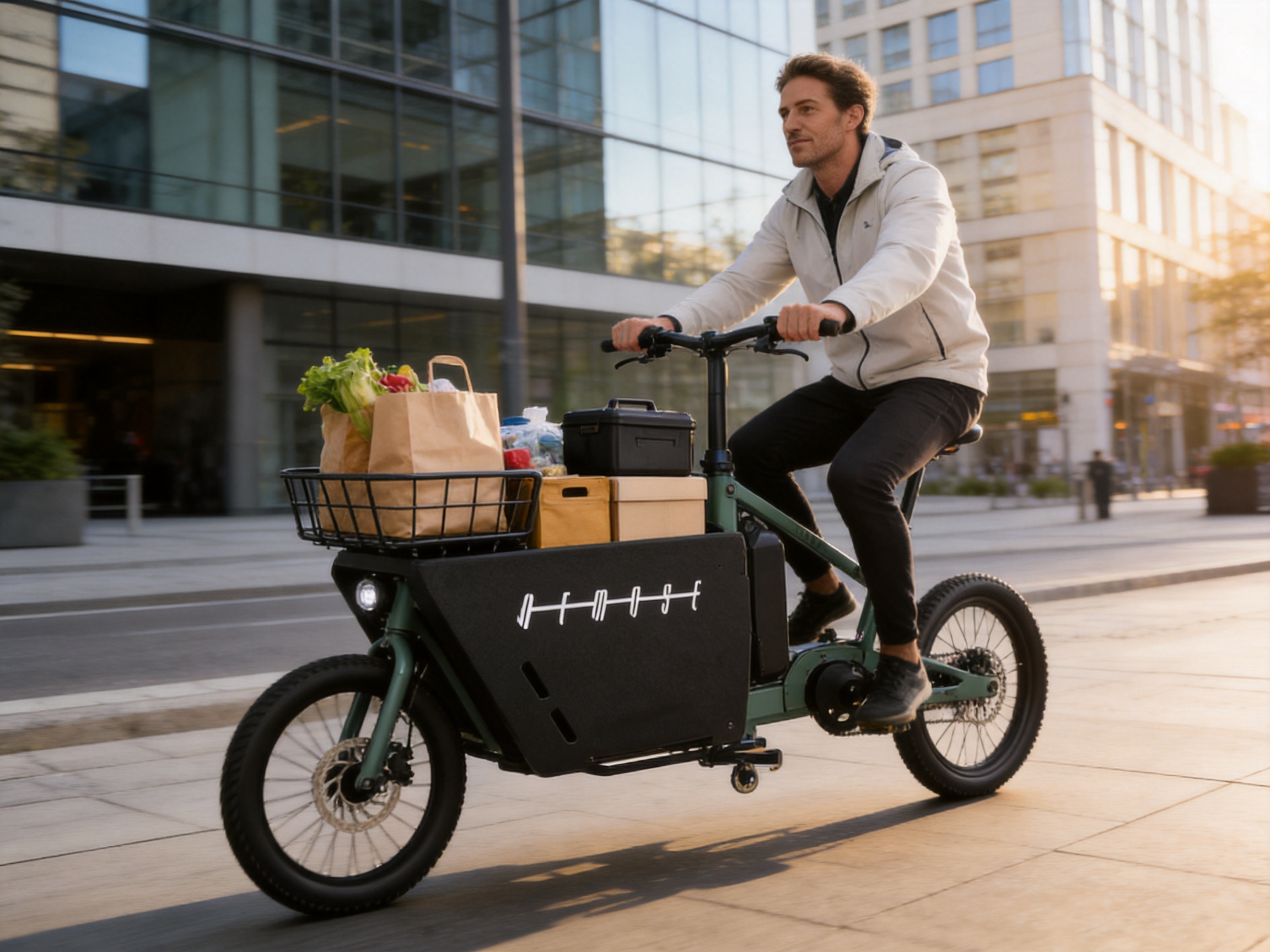
The front basket remains the central carrying area rather than becoming a temporary accessory. Its upper dimensions are approximately 70 by 50 centimeters, while the lower section measures approximately 50 by 36 centimeters. The basket is rated for up to 45 kilograms, allowing it to carry a large grocery shop, a delivery load, tools, sports equipment, or a combination of daily supplies.
Because the load is positioned low and ahead of the rider, the bicycle offers a practical alternative to carrying heavy objects on a rear rack or backpack. A low front load can be easier to monitor, especially when the rider is transporting fragile or irregularly shaped items. It also helps keep the center of mass close to the bicycle’s central structure rather than placing it high behind the rider.
The key design benefit is continuity. The bicycle used on the road is the same cargo platform that folds for storage. The rider does not need to detach a large box, remove a separate cargo module, or convert the bike into a different configuration before folding. That reduces the number of steps involved in daily use and makes the folding function more likely to be used consistently.
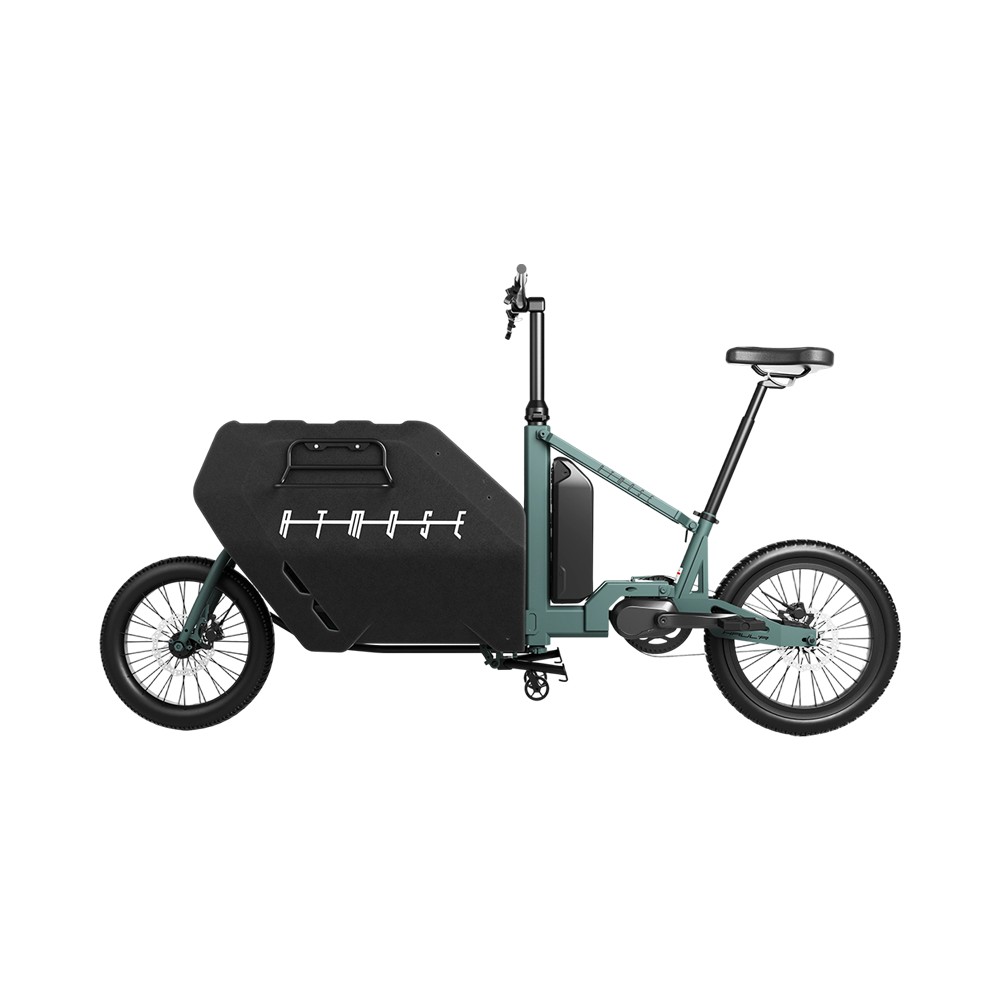
Atmose Model R ESR1 Tri-Fold Cargo E-Bike for Train Commuters and Small Apartments
The Model R uses a three-part folding structure. Its standard folded dimensions are 120 centimeters in length, 44 centimeters in width, and 85 centimeters in height. When the front wheel is removed, the dimensions are reduced to 102 centimeters in length, 44 centimeters in width, and 76 centimeters in height.
This compact package is useful in several environments. In an apartment, it can occupy a hallway corner, a storage cupboard, or a section of a living area. In an office, it can be rolled to a desk or a secure indoor storage point. In a train station, it can be moved through public circulation areas with less difficulty than a long-tail or traditional front-loader. In a vehicle, the shorter configuration can fit into many trunks that would not accept a full-size cargo bicycle.
The folded width of 44 centimeters is particularly important. Length is not the only obstacle in compact buildings; doorways, corridors, lift interiors, and storage compartments can also be restrictive. A controlled width helps the folded bicycle pass through common urban spaces without requiring the rider to tilt it at awkward angles.
The height of 85 centimeters in the standard folded form also allows the bicycle to remain relatively manageable during rolling and storage. Removing the front wheel lowers the overall height to 76 centimeters, which can further improve compatibility with car trunks and low storage compartments.
The folding system should not be judged only by the smallest possible measurement. A folding mechanism is valuable when it is practical enough to use frequently. The Model R’s design emphasizes a complete, repeatable process: fold the frame, roll the bicycle, and remove the front wheel only when the smallest transportation footprint is required.
A full-size cargo bike cannot realistically be expected to become a lightweight object. The more useful objective is to reduce the need for lifting. The Model R is designed to roll while folded, allowing the rider to push it through a station, along a corridor, into a lift, or toward a storage position.
This rolling approach can make a major difference for riders who live above ground level or regularly combine cycling with public transportation. Carrying a heavy folded bike up stairs is tiring and may discourage use. Rolling it across level surfaces is more manageable and makes the fold function part of a normal commute rather than an emergency storage solution.
The design also supports a more orderly relationship with shared spaces. A folded, rolling bicycle can be positioned close to a wall or moved into an elevator without extending across the full length of a corridor. That can reduce inconvenience for other residents, colleagues, or passengers.
The Model R is not merely a folding commuter bike with a small front bag. Its specifications identify it as a cargo platform. The rider capacity is up to 100 kilograms, while the front basket is rated for up to 45 kilograms. These figures create a useful carrying envelope for urban errands and professional tasks.
Typical applications include weekly groceries, parcels, tools, camera equipment, office supplies, market purchases, camping equipment, and personal luggage. A small delivery operator may also use the basket for local orders, documents, or compact commercial loads. The bicycle’s low basket design makes it possible to carry substantial weight without placing everything on the rider’s back.
Weight distribution remains important. The maximum basket capacity should not be treated as a reason to place all items in one unstable pile. Heavy goods should be positioned low and centered, while lighter objects can be placed above them. Riders should also make sure cargo is secured so that it cannot shift during braking, cornering, or folding.
The basket dimensions provide useful volume as well as weight capacity. The wider upper section can accept shopping bags, boxes, containers, and everyday equipment. The narrower lower section helps retain the load and keeps the center of gravity closer to the frame. This tapered geometry is more purposeful than a simple flat platform because it can help prevent items from sliding outward.
Compared with a conventional bicycle basket, the Model R’s front cargo area offers significantly more usable space. Compared with a long-tail cargo bike, it gives the rider direct visual access to the load. Compared with a backpack or pannier-only setup, it reduces the physical burden on the rider and allows larger objects to be carried.
The bicycle is equipped with a 36-volt, 250-watt mid-drive motor delivering up to 70 newton-meters of torque. This configuration is well suited to a cargo bike because the motor’s assistance is applied through the bicycle’s drivetrain rather than directly at one wheel.
A mid-drive system can respond efficiently to changing terrain and load conditions. When the bicycle is carrying groceries or delivery equipment, starting from a traffic light requires more effort than riding an unloaded commuter bike. A high-torque mid-drive helps the rider get moving smoothly, particularly on inclines or when accelerating from a stop.
The location of the motor also keeps the weight closer to the center of the bicycle. Centralized mass can contribute to predictable handling compared with a heavy motor positioned entirely in the front or rear wheel. This is valuable for a front-loading cargo design, where the basket and its contents already influence steering and balance.
The 250-watt rating fits the power expectations of a practical urban electric bicycle, while the torque figure explains the system’s usefulness in real-world conditions. Wattage indicates power output, but torque is especially relevant during starts, climbs, and low-speed maneuvering with a load.
Riders should still use appropriate gearing and maintain smooth control. Electric assistance does not remove the need to plan braking distances, especially when the basket is heavily loaded. The advantage is that the motor reduces the physical effort required to move the combined weight of the rider, bicycle, and cargo through everyday urban traffic.
The Model R uses a Samsung 36-volt, 20-ampere-hour lithium battery with a stated capacity of 720 watt-hours. Battery range always depends on conditions, including rider weight, cargo weight, temperature, terrain, tire pressure, assistance level, stop-and-start frequency, and riding speed. Even so, a 720-watt-hour battery provides a substantial energy reserve for a utility-focused cargo bike.
A larger battery can be valuable for riders who use the bicycle for several purposes in one day. A morning commute may be followed by shopping, a school or work trip, and an evening return journey. A delivery rider may need to complete multiple short routes without recharging between every task.
The battery also offers flexibility for riders who prefer lower assistance on flat roads and higher assistance on hills. Instead of treating every journey as a battery-management exercise, the rider can select assistance according to traffic, cargo, and terrain.
Battery care remains important. Charging should be performed with the appropriate equipment and in accordance with the manufacturer’s instructions. The battery should be protected from extreme heat, moisture, and prolonged neglect. Riders should also remember that the practical range of a loaded cargo bike will differ from the range of a lightly loaded bicycle.
The combination of a high-capacity battery and a mid-drive motor supports the Model R’s central mission: useful electric assistance for a bicycle that is expected to carry real loads, not just provide occasional recreational support.
One of the Model R’s strongest practical features is its low-maintenance drivetrain. It combines a Gates belt drive with a Shimano Nexus 3 internal gear hub. This configuration is especially appropriate for an urban cargo bicycle that may be used in rain, road dirt, stop-and-go traffic, and frequent short journeys.
A belt drive eliminates the need for chain oil and greatly reduces the mess associated with conventional chain maintenance. The belt does not carry liquid lubricant that can transfer to clothing, hands, or cargo. It is also quiet during operation and resistant to many of the routine problems associated with a neglected chain.
The Shimano Nexus 3 internal gear hub encloses the gear mechanism within the rear hub. Instead of exposing multiple sprockets and a derailleur to road debris, the system provides a simpler external arrangement. Three gears are sufficient for many urban journeys, especially when combined with a torque-rich mid-drive motor.
An internal gear hub can also be shifted while the bicycle is stationary. This is useful at traffic lights. A rider approaching a junction can stop in a higher gear, then select a lower gear before starting again. That ability is particularly helpful when the bicycle is loaded and restarting in an overly high gear would require unnecessary effort.
Compared with a derailleur-equipped cargo bike, the belt-and-hub configuration prioritizes cleanliness, simplicity, and durability in daily urban conditions. It may not provide the wide gear range preferred for steep mountain terrain, but the intended use of the Model R is urban mobility, where reliability and ease of use are often more valuable than a large number of exposed gears.
The Model R uses hydraulic disc brakes from Tektro or Magura, depending on configuration. Hydraulic braking provides controlled stopping power with relatively low lever effort. This is important when the bicycle is carrying a rider and up to 45 kilograms of front cargo.
Loaded bicycles have greater total mass than ordinary commuters. They require more energy to slow down and may place greater demands on the braking system during repeated stops. Hydraulic disc brakes are therefore a logical choice for a cargo bike intended for urban traffic, hills, and frequent intersections.
The bicycle uses puncture-proof tires measuring 16 by 2.4 inches at the front and 18 by 2.4 inches at the rear. The relatively wide tire profile can help absorb surface irregularities and provide a stable contact patch. This can be useful on uneven pavement, painted road markings, drainage covers, and other common urban surfaces.
The different front and rear wheel sizes support the compact cargo-bike layout. The front wheel remains small enough to support the low cargo configuration, while the rear wheel provides a stable drive platform. Tire pressure should be checked regularly because both underinflation and overinflation can affect handling, rolling resistance, and puncture protection.
Even with hydraulic brakes and wide tires, riders should adapt their speed to the load. A full basket changes steering response and braking distance. Cargo should be secured, and the rider should practice low-speed turns before carrying the maximum rated load in heavy traffic.
The frame is constructed from 6061 T4/T6 aluminum alloy. This material is widely used in bicycle engineering because it offers a useful balance between low weight, structural strength, corrosion resistance, and manufacturing flexibility.
For a folding cargo bike, frame material must do more than support the rider. It must accommodate hinge areas, load-bearing joints, steering components, the basket structure, the motor system, and the stresses created by repeated folding. The frame must also remain sufficiently rigid for predictable handling when the front basket is heavily loaded.
The T4/T6 designation refers to different heat-treatment conditions used in aluminum processing. In practical product development, controlled alloy selection and heat treatment can help engineers achieve the required balance of formability and strength in different stages of frame production. The final result depends not only on the alloy but also on tube design, weld quality, joint geometry, alignment, and inspection.
The Model R’s frame illustrates the importance of integrated engineering. Folding a standard bicycle frame is relatively straightforward compared with folding a long front-loading cargo structure while preserving steering accuracy and cargo stability. The frame, basket, folding points, cables, drivetrain, and wheel arrangement must work together as one system.
A folding cargo bike requires a higher level of manufacturing discipline than a simple rigid frame. The folding joints must align consistently from one bicycle to the next. If tolerances are poorly controlled, the mechanism may develop play, become difficult to operate, or place additional stress on adjacent components.
Advanced production begins with accurate frame fixtures and jigs. These tools hold tubes, mounting points, and folding interfaces in the correct position during assembly and welding. Consistent fixtures help ensure that steering alignment, wheel tracking, brake mounting, and drivetrain positioning meet the intended design requirements.
Welding quality is also central. Aluminum frames require carefully controlled welding parameters, clean material preparation, and appropriate post-weld treatment. A professional manufacturing process should include inspection of weld appearance, joint integrity, alignment, and the areas surrounding high-stress folding interfaces.
After frame construction, finishing processes protect the aluminum and create a durable surface for regular urban use. Proper coating preparation can improve resistance to moisture, road grime, and cosmetic wear. Final assembly then requires accurate torque settings for fasteners, correct cable routing, brake adjustment, belt tension, wheel alignment, and folding operation.
The Model R’s value therefore comes not simply from the choice of aluminum or the presence of a hinge. It comes from integrating those elements into a repeatable production process capable of making the folding mechanism function reliably over repeated cycles.
Some folding products are designed to be folded only when they are transported or stored for a long period. The Model R is intended for frequent folding as part of a daily lifestyle. A train commuter may fold it every morning and evening. An apartment resident may fold it after each ride. A car traveler may fold it whenever the bicycle is placed in the trunk.
This use pattern places importance on accessible folding points, durable hardware, protected cable routing, and a frame design that does not require extensive disassembly. It also means the rider should receive clear operating instructions and follow the recommended inspection routine.
Regular maintenance should include checking the folding hardware, inspecting the frame and joints for damage, confirming that the front wheel is securely installed, and ensuring that the brakes and tires are in good condition. The belt should be kept clean and correctly tensioned according to manufacturer guidance.
The advantage over a conventional non-folding cargo bike is obvious in storage and transportation. The advantage over a small folding bicycle is its ability to carry a serious load. The challenge is that a folding cargo bike must combine the engineering demands of both categories. The Model R’s design addresses this challenge through a reinforced cargo-oriented frame, centralized motor placement, hydraulic brakes, and a drivetrain selected for low maintenance.
| Design type | Main strength | Common limitation | Model R distinction |
|---|---|---|---|
| Traditional front-loading cargo bike | Excellent load visibility and large front cargo area | Long storage and transportation footprint | Retains front-loading capacity while folding to a compact package |
| Long-tail cargo bike | Stable rear carrying platform and familiar bicycle proportions | Rear load may be less visible and can require accessories for different tasks | Places the primary load in front and supports direct monitoring |
| Small folding commuter bike | Easy storage and convenient multimodal transport | Limited capacity for heavy or bulky cargo | Combines folding convenience with a 45-kilogram front basket rating |
| Electric utility bicycle with rear rack | Simple configuration and relatively low weight | Rack and pannier capacity may be insufficient for large loads | Offers a dedicated low front cargo area for larger everyday items |
| Non-electric cargo bicycle | Simple mechanical system and no battery charging | More demanding when heavily loaded or used on hills | Uses a mid-drive motor and 720-watt-hour battery for assisted transport |
| Carried or roof-mounted cargo solution | Can transport a full-size bicycle without sacrificing frame length | Requires additional equipment, space, and physical lifting | Folds for trunk storage and can be rolled indoors |
Every cargo-bike format has a place. The Model R is not intended to replace every long-tail, front-loader, or compact commuter bicycle. Its strongest competitive position is for riders who need several capabilities at once: substantial front cargo capacity, electric assistance, low-maintenance operation, and compact storage.
That combination is difficult to find. A compact folding bicycle may be easy to store but unable to carry a large load. A conventional cargo bicycle may carry more easily but remain difficult to store. The Model R occupies the middle ground while adding a practical multimodal function.
The bicycle’s folding measurements make it particularly relevant to train commuters. A rider can cycle from home to the station, fold the bike, roll it through the station, and continue the journey by rail. At the destination, the bicycle can be unfolded for the final section of the trip.
This can extend the effective reach of public transportation. Instead of relying on a short walk or a connecting bus, the rider can cover the first and last portions of the journey independently. A folding cargo bike also allows the commuter to carry work equipment, groceries, or personal items without needing a second vehicle.
Indoor storage can provide additional security. Bringing a bicycle into an apartment, workplace, or other controlled environment reduces dependence on outdoor parking and may lower exposure to weather and theft. Riders must of course observe the rules of each railway operator and public facility, since folding-bike policies differ by location and time of day.
The Model R’s rolling capability is important in this context. A commuter may need to move quickly through a station without lifting the bicycle repeatedly. The front wheel removal option is more relevant to car transportation, but the standard folded configuration may be sufficient for station and office use.
For apartment residents, the most important bicycle specification may be the storage dimension rather than the top speed. A bicycle that cannot enter the home safely and conveniently may be used less often, regardless of its riding performance.
The Model R addresses this barrier by reducing its occupied length and allowing indoor rolling. Its folded dimensions create more options for storage: beside a wardrobe, under a workbench, inside a utility area, near an entryway, or in a dedicated closet. The precise fit depends on the building and furniture layout, but the reduction from 198 centimeters to 120 centimeters is meaningful.
Indoor storage also supports routine maintenance. A bicycle kept out of harsh weather is less exposed to standing water, winter salt, and temperature extremes. It may remain cleaner and easier to inspect. The belt drive further reduces the mess associated with bringing the bike indoors.
In small apartments, every object must justify its footprint. A cargo bike that can carry groceries, transport equipment, replace short car journeys, and fold into a compact form has a stronger practical case than a bicycle designed for only one type of trip.
The Model R can serve more than private household needs. Its front basket and electric assistance may suit independent delivery operators, mobile service workers, event staff, office logistics, and local businesses that need to move goods without a van.
A 45-kilogram basket capacity can accommodate parcels, tools, replacement parts, promotional materials, or supplies for short urban routes. The low-maintenance belt drive is valuable for businesses because time spent cleaning chains or correcting drivetrain issues is time away from work. The internal gear hub also simplifies operation for riders who may not have extensive bicycle-mechanical experience.
Folding adds a second commercial benefit. A business may need to store bicycles inside a shop, office, warehouse, or shared facility. A folded vehicle can occupy less floor length and may be easier to move between locations. A company operating several bicycles can also transport them in a suitable car or small van without requiring a large external rack.
Commercial operators should match the load to the basket rating and consider the total weight of the rider, cargo, and equipment. They should also establish a maintenance schedule for brakes, tires, folding joints, belt tension, fasteners, and battery condition.
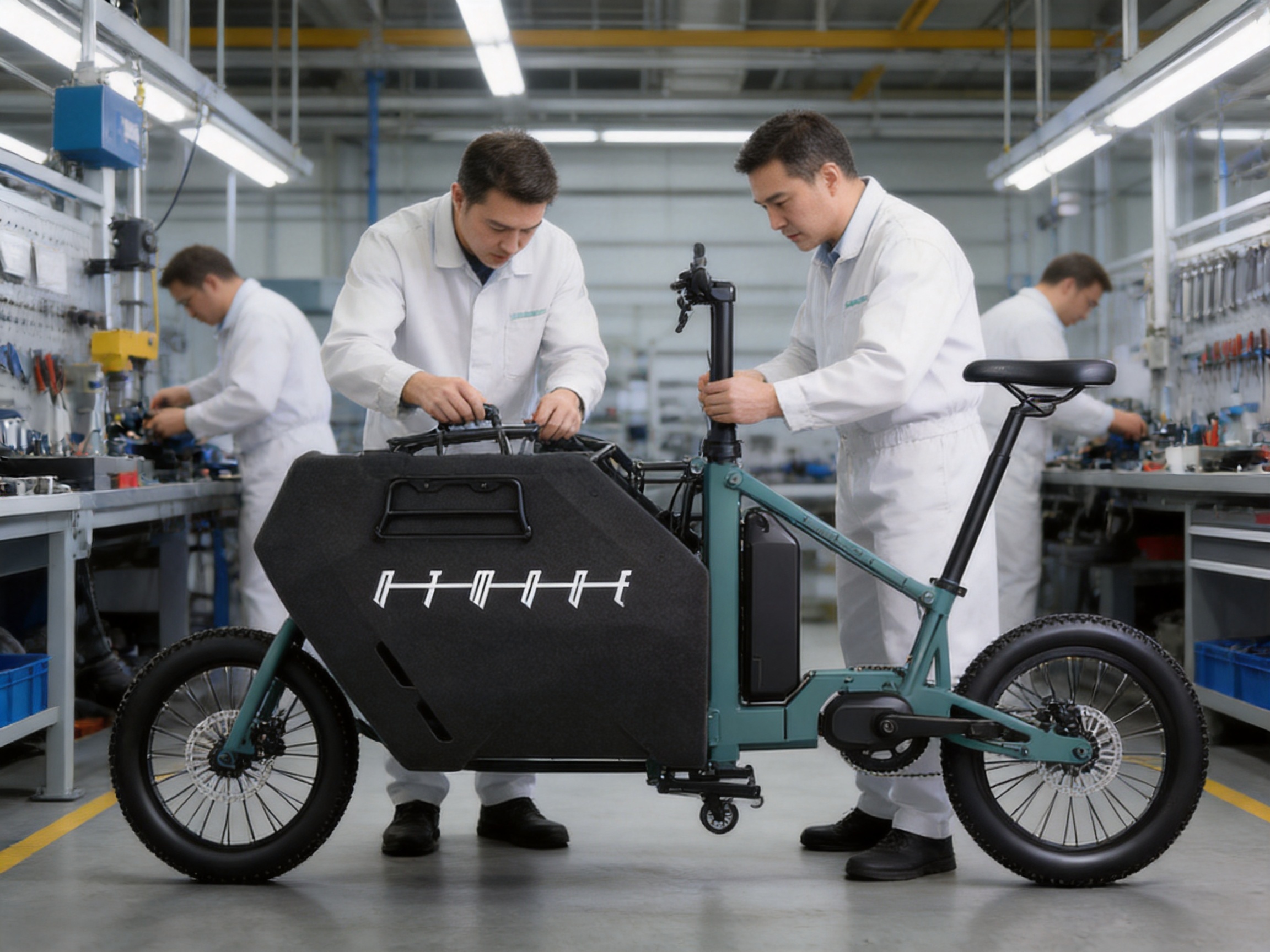
The Model R reflects several manufacturing strengths that are important in modern cargo-bike production. The first is product integration. The frame, folding system, basket, drivetrain, motor, battery, braking system, and wheel sizes are developed around a single use case instead of being assembled as unrelated components.
The second is material selection. A 6061 aluminum alloy frame offers a practical foundation for a bicycle that must remain strong while being manageable to fold and roll. The use of a recognized structural alloy also supports repeatable fabrication when appropriate tube profiles, welding procedures, and heat-treatment practices are applied.
The third is component matching. A 250-watt mid-drive motor with up to 70 newton-meters of torque is paired with hydraulic disc brakes and wide puncture-resistant tires. The Gates belt and Nexus 3 internal hub are selected to reduce maintenance in the same urban environments where the motor and brakes are expected to operate.
The fourth is attention to user workflow. Manufacturing quality is not limited to the frame. It includes whether the bike arrives correctly assembled, whether the brake system is properly adjusted, whether the folding mechanism operates smoothly, whether cable routing avoids interference, and whether the basket remains secure under load.
The company’s international development structure also supports a broad perspective on urban mobility. Atmose originated in the United States and has developed a design and research presence in Paris. That combination brings together American product thinking, European urban design priorities, and an understanding of the practical demands of family mobility, commuting, delivery, and compact living.
Atmose’s parent development history through MOTIV contributes experience in bicycle manufacturing, supply-chain coordination, and product development. The company presents its approach around sustainability, practicality, reliability, and enjoyment. For a product such as the Model R, these principles are most convincing when they appear in details riders experience every day: easy storage, dependable assistance, simple cleaning, stable cargo handling, and repeatable folding.
A sophisticated cargo bicycle should be evaluated at several production stages. Incoming inspection can confirm that aluminum components, drivetrain parts, brake systems, batteries, and tires meet the required specifications. Frame inspection can check alignment and the condition of welds. Assembly inspection can verify torque, cable routing, wheel installation, brake performance, belt tension, and folding operation.
Functional testing is especially important for the Model R because its defining feature is mechanical transformation. The bicycle must be stable when unfolded and secure when folded. The steering system must remain accurately aligned. The front wheel must attach and detach in a controlled manner. The basket must remain firmly supported under an appropriate load.
Battery and electrical-system checks are equally important. The motor, battery, wiring, connectors, and control systems should be tested for correct operation before delivery. Proper packaging and transport protection are also part of manufacturing quality because a precisely built bicycle can still arrive damaged if it is not secured correctly during shipping.
These processes create the foundation for a product that is not only innovative in concept but dependable in routine ownership.
The Model R is best understood as a utility tool rather than a recreational bicycle that happens to have a basket. Its value increases when it replaces multiple short car trips, supports mixed-mode commuting, or makes regular shopping easier.
Before riding, users should check that the folding structure is fully locked, the front wheel is securely mounted, the brake levers feel firm, the tires are properly inflated, and the cargo is balanced. When carrying a heavy load, riders should begin at low speed and become familiar with the steering response before entering dense traffic.
During the ride, the low front basket allows the cargo to remain visible. Riders should avoid blocking the steering area or placing items where they can contact the front wheel. Cargo should be secured with suitable straps or containers, especially if the route includes rough pavement.
After the ride, the bicycle can be folded for indoor storage. The belt drive reduces cleaning requirements, while the hydraulic brakes and puncture-resistant tires reduce the likelihood of frequent roadside interruptions. The bike should still be inspected periodically because low maintenance does not mean maintenance-free.
Owners should pay particular attention to the folding joints and locking interfaces. Dirt should not be allowed to accumulate in a way that prevents complete closure or locking. Any unusual movement, noise, resistance, or looseness should be investigated before continued use.
The Model R is a strong fit for apartment residents who want genuine cargo capacity but do not have a garage. It is also suited to commuters who combine cycling with trains, riders who need to transport a cargo bike in a car, and households that want an alternative to short urban car journeys.
It may appeal to parents and family users who need space for daily goods, although the supplied product information emphasizes the front basket rather than a dedicated child passenger system. Buyers should therefore confirm whether any intended passenger use is permitted and whether the necessary safety accessories are available.
Independent delivery workers and small businesses may benefit from the combination of cargo capacity, electric assistance, low-maintenance drivetrain, and indoor storage. The bicycle can also suit users who value a clean belt drive and do not want the regular lubrication associated with a chain.
The Model R may be less suitable for riders who need very high passenger capacity, extreme off-road capability, or a very large gear range for sustained mountain climbing. It is optimized for compact urban transport, multimodal travel, and practical everyday loads.
The main purpose is to provide a genuine front-loading electric cargo bike that can fold into a compact form for apartment storage, train travel, office storage, and car transportation.
The riding dimensions are approximately 198 centimeters in length, 38 centimeters in width, and 108 centimeters in height.
The standard folded dimensions are approximately 120 by 44 by 85 centimeters. With the front wheel removed, the dimensions are approximately 102 by 44 by 76 centimeters.
The front basket is rated for up to 45 kilograms. The rider capacity is listed as up to 100 kilograms. Users should distribute cargo evenly and follow all applicable safety instructions.
The top of the basket measures approximately 70 by 50 centimeters, while the bottom measures approximately 50 by 36 centimeters.
The bicycle uses a 36-volt, 250-watt mid-drive motor with up to 70 newton-meters of torque.
The product information specifies a Samsung 36-volt, 20-ampere-hour lithium battery with a capacity of 720 watt-hours.
No. It uses a Gates belt drive paired with a Shimano Nexus 3 internal gear hub. This arrangement reduces the need for chain lubrication and helps keep the drivetrain clean.
The Shimano Nexus 3 internal gear hub is designed to allow gear changes while the bicycle is stationary, which can be useful when preparing to restart at a traffic light.
The Model R uses hydraulic disc brakes supplied by Tektro or Magura, depending on the configuration.
The front tire measures 16 by 2.4 inches and the rear tire measures 18 by 2.4 inches. The product information describes them as puncture-proof tires.
Its folding design and rolling capability make it suitable for many train-commuting situations. However, riders must check the rules of the railway operator and station before bringing a folded cargo bike onto public transportation.
With the front wheel removed, the folded package measures approximately 102 by 44 by 76 centimeters, a size intended to fit many car trunks. Trunk dimensions vary, so buyers should measure their vehicle before purchase.
No bicycle is entirely maintenance-free. The belt drive and internal gear hub reduce routine cleaning and lubrication, but riders still need to inspect the brakes, tires, folding hardware, wheel attachments, battery, and frame.
The product combines a load-bearing aluminum frame, folding interfaces, a front cargo structure, a mid-drive system, hydraulic brakes, and removable-wheel functionality. Consistent frame alignment, controlled welding, reliable assembly, and functional testing are therefore essential to product quality.
The Model R is primarily designed for urban transportation. Its wide tires can help with uneven city surfaces, but riders seeking extensive off-road use should select a bicycle specifically engineered for that environment.
The Model R stands out because it treats folding as a central cargo-bike function rather than a compromise added after the main design is complete. It preserves a front-loading basket, supports up to 45 kilograms of cargo, and combines that capacity with a mid-drive motor, a large battery, hydraulic brakes, wide tires, and a low-maintenance belt drivetrain.
Its greatest advantage over many conventional cargo bikes is compact ownership. The bicycle can move from a 198-centimeter riding length to a 120-centimeter folded package, or to a 102-centimeter package with the front wheel removed. It can be rolled through urban spaces, stored indoors, and transported in many vehicles without a roof carrier or external rack.
Its advantage over many small folding bicycles is carrying ability. The Model R is not limited to a small luggage bag or light personal load. It is designed for groceries, equipment, parcels, and practical daily cargo. Its low front basket keeps the load visible and places it in a stable position ahead of the rider.
Behind these features is a product strategy based on integrated manufacturing. The frame material, folding structure, cargo geometry, drivetrain, motor, battery, brakes, and wheels are selected to support one coherent use case: sustainable urban mobility for people who need both space and compactness.
For apartment dwellers, train commuters, small businesses, and city riders who want to replace more car journeys, the Model R offers a persuasive alternative. It is a cargo bicycle for users who need the capabilities of a larger machine but cannot dedicate their homes, offices, or vehicles to its full-size footprint.
Atmose Model R ESR1 product specifications and technical information.
Atmose product descriptions covering folding dimensions, cargo capacity, drivetrain, motor, battery, brakes, and tires.
General bicycle engineering principles relating to aluminum alloy frames, folding structures, hydraulic disc brakes, belt drives, internal gear hubs, and mid-drive electric systems.
Urban mobility and multimodal transportation design considerations for bicycles used with trains, apartments, offices, and passenger vehicles.
Nov 17, 2026
Nov 03, 2026
Oct 26, 2026


info@atmosecargobike.com

200 rue de la Croix Nivert 75015 Paris

Custom Electric Bakfiets
 English
 Français
 Deutsch