Oct 26, 2026
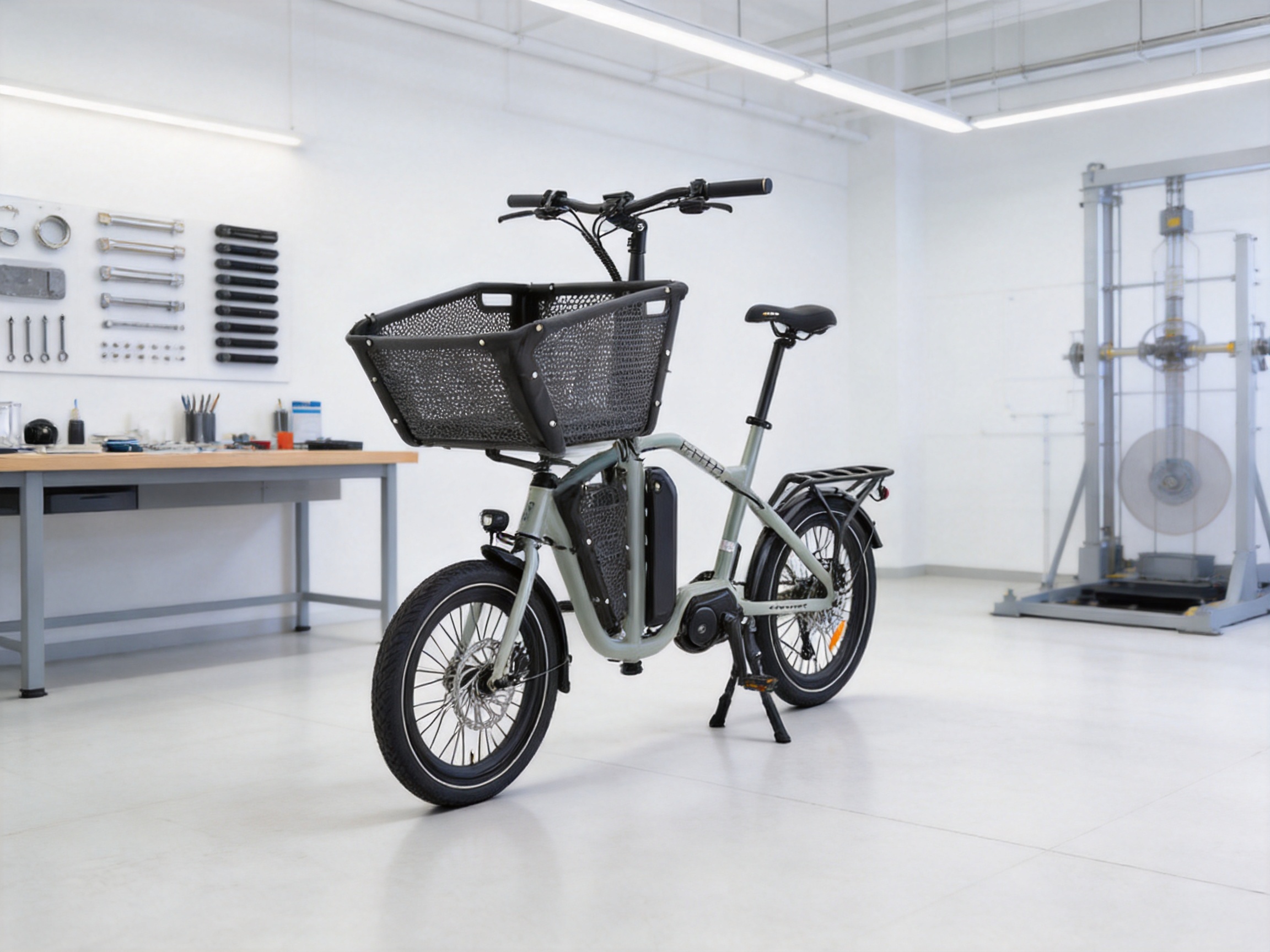
Family transportation is changing. Parents are looking for alternatives to short car journeys, crowded school-zone streets, expensive parking, and inconvenient public transport connections. At the same time, many households want a more sustainable way to carry children, pets, groceries, work equipment, and daily essentials. A well-designed electric cargo bike can answer these needs by combining the maneuverability of a bicycle with the carrying ability of a compact utility vehicle.
The Atmose Model P ESP3 Electric Family Cargo Bike is designed around this exact idea. It is a front-loading electric cargo bike intended for family mobility, pet transport, grocery shopping, neighborhood commuting, and general urban utility. Rather than treating cargo capacity as an afterthought, the Model P integrates a large front basket, a stable long-wheelbase layout, hydraulic disc brakes, a mid-drive motor, and a high-capacity Samsung battery into one practical platform.
Its design focuses on safety, control, versatility, and ease of use. The bike can be configured for children, pets, shopping, or other cargo, while its folding front basket helps make the vehicle more adaptable to different situations. The basket can carry up to 35 kilograms, and the overall design is intended to support a combined operating load of up to approximately 175 kilograms when the rider and front cargo are considered together. The technical specification lists a maximum rider load of 145 kilograms and a basket load of 35 kilograms, so buyers should always confirm the final permitted load according to local regulations and the supplied configuration.
For distributors, retailers, mobility providers, and families comparing cargo bikes, the Model P presents a strong combination of European-oriented design, American product thinking, established manufacturing experience, and carefully selected components. Its appeal does not depend on a single headline feature. Instead, its advantage comes from how the frame, motor, battery, basket, tires, braking system, and safety development work together as one transportation solution.
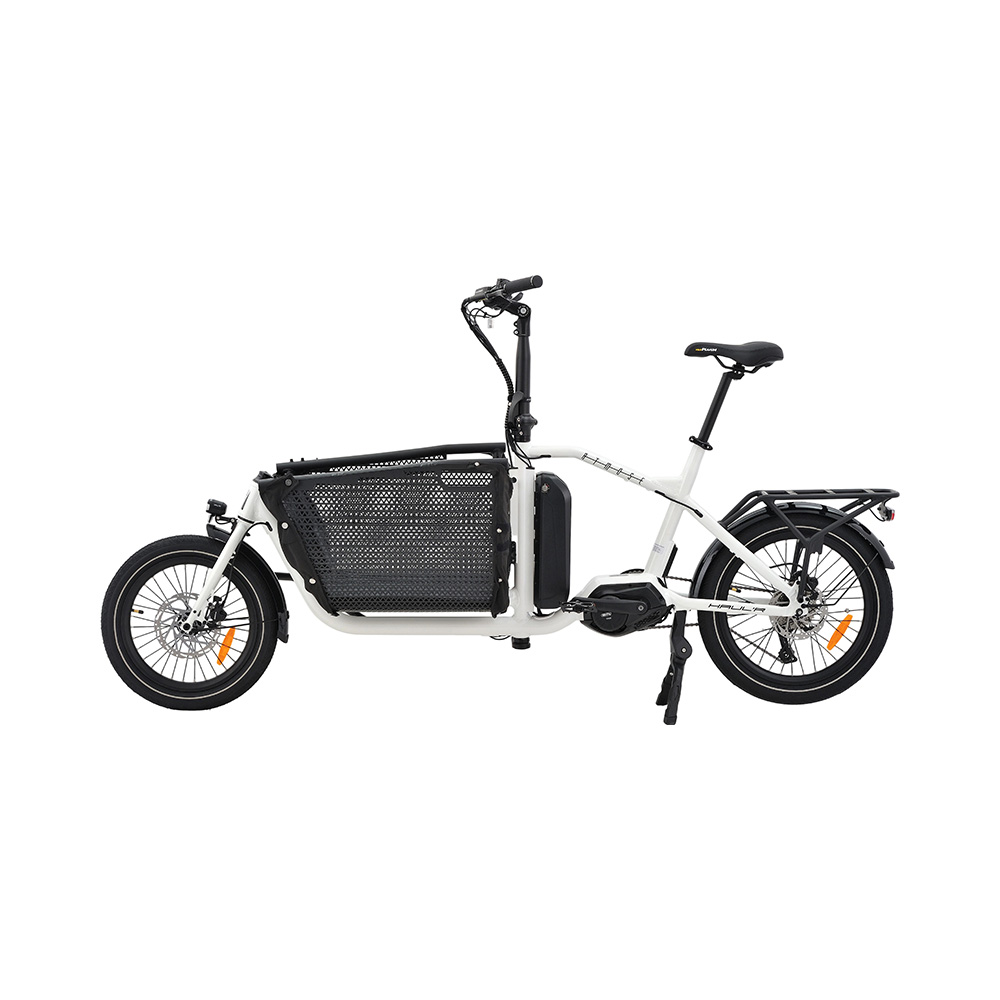
Atmose Model P ESP3 Electric Family Cargo Bike for Kids and Pet Transport
A conventional electric bicycle is generally optimized for one rider and a small amount of personal luggage. A family cargo bike must solve a much more demanding problem. It needs to transport significantly more weight, remain stable when loaded, offer predictable braking, provide a comfortable riding position, and give the rider enough control to handle changing road conditions.
The Model P is built as a cargo platform rather than as a standard bicycle with an accessory rack. Its front basket sits ahead of the rider and provides a dedicated loading area for children, pets, groceries, packages, or equipment. This arrangement keeps the cargo visible and accessible. Parents can maintain awareness of children or animals in the front compartment, while the rider can load groceries without placing heavy bags on a rear rack or balancing them on the handlebars.
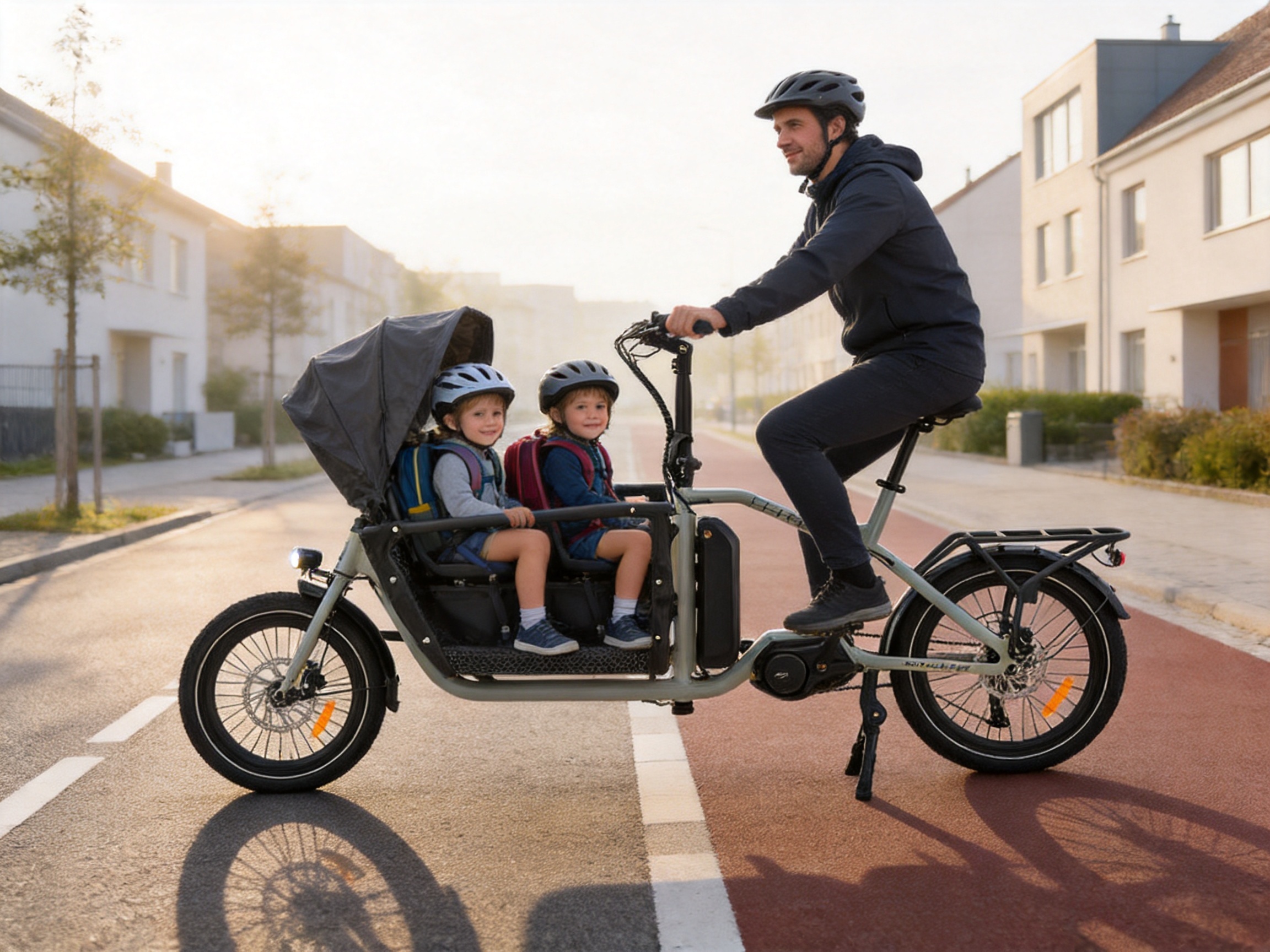
The front-loading layout also contributes to the bike’s everyday practicality. Children can be seated in a dedicated front area with compatible accessories such as child seats and rain covers. A pet can be transported in a more stable, enclosed position than would usually be possible with a traditional bicycle basket. For shopping, the low and broad front container makes it easier to distribute weight rather than concentrating it in a single backpack or rear pannier.
Compared with a two-wheeled bicycle fitted with a small child seat, the Model P offers a larger protected loading area and a more useful center of gravity. Compared with a standard long-tail cargo bicycle, its front basket gives the rider a clearer view of passengers or cargo. Compared with a small electric tricycle, its bicycle-style format can provide a more natural riding experience and a narrower footprint for urban streets.
These differences matter in real use. A school run may involve two children, bags, rainwear, and a changing surface between residential streets and cycle paths. A trip to the veterinary clinic may involve an anxious pet and additional supplies. A grocery trip may require bulky items that cannot fit comfortably into a backpack. The Model P is designed to address these everyday situations without requiring a separate vehicle for each task.
Safety is one of the most important considerations in a family cargo bike because the vehicle may carry children or animals who cannot independently respond to traffic, braking, or changes in balance. The frame therefore needs to tolerate repeated loading, vibration, braking forces, and the stresses associated with starting and stopping in daily traffic.
The Model P uses a 6061 T4T6 aluminum alloy frame. This type of aluminum is widely used in transportation products because it offers a useful balance between structural strength, corrosion resistance, weight, and manufacturability. For a cargo bicycle, the frame must be sufficiently rigid to support a loaded front platform while still remaining manageable for normal riding and parking.
According to the provided product information, the frame has passed a 300,000-cycle fatigue test and is associated with TUV and EN17860 safety certifications. Fatigue testing is particularly relevant to cargo bikes because their frames experience repeated loading rather than one-time static force. Every acceleration, curb transition, braking event, and change in road surface contributes to the long-term stress history of the frame.
A high cycle count indicates that the product development process considers durability over extended repeated use. It does not mean that a bike is maintenance-free or immune to misuse. Riders must still observe the recommended load limits, inspect fasteners, maintain the braking system, check tire pressure, and replace worn components. Nevertheless, a frame developed and evaluated through systematic fatigue testing provides a stronger foundation for dependable family transportation than an untested generic frame.
The geometry is also important. A cargo bicycle with a long or heavily loaded front section must be predictable at low speed, during cornering, and when starting from rest. The Model P is described as having optimized frame geometry intended to support stable and confident handling, including for riders who are new to cargo bicycles. This is a significant advantage over products that simply extend a conventional bicycle without fully recalculating steering, weight distribution, and structural behavior.
Family users often place repeated demands on a cargo bike. The vehicle may be used several times per day, loaded and unloaded at school, exposed to rain, parked outdoors, and ridden over imperfect pavement. A family product must therefore be developed for routine service rather than occasional recreational use.
The combination of aluminum frame construction, cycle testing, safety certification, and dedicated cargo geometry helps address these demands. For retailers, documented testing can also make product training easier. Sales teams can explain not only how much the bike carries but also how the frame was considered for long-term use. For distributors, a clearly defined safety and testing profile can support product positioning in markets where buyers expect traceable quality standards.
Parents should still use appropriate child restraints, seating systems, foot protection, and weather accessories. The frame provides the platform, but safe operation depends on correct assembly, responsible loading, rider behavior, and compliance with local regulations.
The Model P uses a Bafang M430 mid-drive motor with a listed nominal power rating of 250 watts at 36 volts. The product information also describes a motor output of up to 500 watts and maximum torque of up to 110 newton-metres. The exact assistance behavior may vary according to market configuration, controller settings, software, riding mode, and local legal requirements, so the delivered specification should be confirmed before purchase.
A mid-drive motor places the motor near the bicycle’s crankset rather than inside the front or rear wheel. This arrangement offers several advantages for a cargo bike. The motor’s assistance can work through the bicycle’s gearing, allowing the rider to select a suitable gear for hills, starts, and heavier loads. This is particularly useful when the bike is carrying children, pets, or a full basket.
High torque is valuable in situations where the bike must move from a standstill or climb an incline. Cargo bikes are heavier than ordinary bicycles even before they are loaded. When a rider adds groceries or passengers, a motor with responsive torque can reduce the effort required to get moving. It can also make hill starts more controlled, helping the rider avoid abrupt pedal strokes or excessive strain.
The M430 system is described as providing smooth and linear power delivery. This characteristic is important for family use. A sudden surge of assistance can be uncomfortable for passengers and may make a loaded bicycle feel harder to control. Progressive assistance, by contrast, allows the rider to accelerate in a more measured way, especially in crowded areas, near pedestrians, or when leaving a school entrance.
The motor is also described as having an IP6X protection rating for dust and splash resistance. Users should understand that an ingress protection rating does not make the entire bicycle waterproof or permit careless use in deep water. The bike should be stored appropriately, cleaned without directing high-pressure water at electrical components, and maintained according to the manufacturer’s instructions.
The bicycle is equipped with a Shimano nine-speed Sora system. Multiple gears allow the rider to balance cadence, motor assistance, and terrain. Lower gears are useful for steep roads and heavily loaded starts, while higher gears can support efficient travel on flatter streets.
The combination of a mid-drive motor and nine-speed drivetrain gives the bike a more adaptable power system than a single-speed cargo bicycle. Instead of relying only on motor strength, the rider can use the mechanical gearing to keep the motor and legs operating more effectively. This can support smoother climbing and may help manage battery consumption over longer journeys.
For distributors and fleet users, a familiar branded drivetrain can also simplify service planning. Shimano components are widely recognized by bicycle technicians, and their availability can be helpful when routine adjustments or replacements are required. Proper maintenance remains essential because cargo-bike chains, cassettes, and derailleurs can experience higher loads than those on a lightly used city bicycle.
The Model P uses a Samsung 36-volt, 15-amp-hour lithium battery with a stated energy capacity of 540 watt-hours. The supplied product information indicates a range of up to 80 kilometers under suitable conditions. Actual range will depend on rider weight, cargo weight, terrain, temperature, wind, tire pressure, assistance level, stop-and-go riding, and battery age.
A 540-watt-hour battery is well suited to a cargo bike intended for practical daily transportation. It provides enough energy for school runs, local shopping, commuting, and multi-stop errands without requiring constant charging after every short journey. The battery’s capacity is especially useful for riders who encounter hills or routinely carry heavier loads.
Using Samsung cells can offer a recognizable quality reference for buyers and commercial partners. Battery quality depends not only on the cells but also on the battery management system, enclosure, wiring, charging equipment, thermal design, and assembly quality. A reliable battery system should protect against inappropriate charging conditions, excessive discharge, and other operating risks. Users should always use the supplied or approved charger and follow the charging instructions.
For a family, predictable battery behavior is more important than a theoretical maximum range. A parent may need to complete a morning school journey, continue to work, pick up groceries, and return home in the afternoon. The Model P’s battery capacity gives the rider a practical reserve for these kinds of trips, although planning is still recommended for long routes or cold weather.
Range claims should be understood as test-condition estimates rather than guarantees. A lightweight rider on flat pavement using low assistance may achieve a significantly longer distance than a heavily loaded bike climbing hills in high assistance mode. Frequent braking and acceleration also consume more energy than steady riding.
Tire pressure has a noticeable effect on efficiency. Underinflated tires increase rolling resistance, while excessive pressure can reduce comfort and grip. The rider should use the pressure range recommended for the installed tires and cargo load. Regular inspection is especially important because the front and rear tires have different sizes and may experience different loads.
The battery should be stored in a moderate, dry environment and recharged with suitable equipment. Long-term battery care can help preserve useful capacity. Retailers and distributors should provide customers with clear guidance about charging, storage, winter use, and end-of-life recycling.
The front basket is one of the defining features of the Model P. Its listed upper dimensions are approximately 64.5 centimeters by 62 centimeters, while the lower area is approximately 50 centimeters by 39 centimeters. The basket can carry up to 35 kilograms and folds to save space, with the product information indicating a folded width of approximately 365 millimeters.
This folding function gives the bicycle greater flexibility than a permanently fixed cargo box. When the bike is being stored, transported, or used without a large load, the basket can occupy less space. This may make it easier to park in a garage, bicycle room, apartment entrance, retail showroom, or service area.
When expanded, the basket provides a broad platform for family and utility tasks. A parent can carry school bags, groceries, sports equipment, or picnic supplies. A pet owner can configure the area with suitable containment and cushioning. Families can also add compatible child seats and rain covers according to the intended use and local safety requirements.
The basket’s shape helps make loading more straightforward. Unlike a narrow rear rack, it can accept wider objects and provide a lower, more stable position for cargo. The rider can also see the front area while riding, which is useful when carrying a pet or checking that loose items remain secure.
Children and pets have different transportation needs, but both benefit from a stable and visible front position. Children require appropriate seating, foot support, restraints, and weather protection. Pets require a secure carrier or enclosure, a non-slip surface, ventilation, and protection from jumping out. The Model P is designed to be compatible with child seats and rain covers, allowing the base vehicle to adapt as family requirements change.
This adaptability can extend the useful life of the bicycle. A family may initially use the front area for one child, later carry groceries and school bags, and eventually use the bike for pets or recreational equipment. A vehicle that supports multiple configurations can provide greater value than a narrowly specialized product.
It is important to distinguish compatibility from automatic inclusion. Accessories such as child seats, rain covers, pet restraints, and protective liners may be optional or configuration-dependent. Buyers should confirm exactly which equipment is included, how it is mounted, and which weight limits apply to each accessory.
The Model P uses Tektro hydraulic disc brakes. Hydraulic disc brakes are well suited to cargo bicycles because they offer strong stopping performance with relatively low hand effort. This is useful when the rider is carrying substantial additional weight or needs to brake repeatedly in urban traffic.
Hydraulic systems can provide consistent modulation, allowing the rider to apply braking progressively rather than relying only on an abrupt stop. This is particularly important when transporting children or pets, since smooth deceleration is more comfortable and can help prevent cargo from shifting.
The bike uses wide 18-inch by 2.4-inch front tires and 20-inch by 2.4-inch rear tires. Wider tires can contribute to comfort and stability by providing a larger contact patch and additional volume to absorb minor road imperfections. The different wheel sizes support the cargo-bike geometry while maintaining a relatively manageable overall profile.
The tires are described as puncture-resistant. Puncture protection can reduce the risk of interruption during school trips or errands, although it cannot eliminate all punctures. Riders should still inspect the tires for embedded glass, maintain suitable pressure, and replace tires when the tread or sidewalls show excessive wear.
The combination of hydraulic disc brakes, wide tires, and a cargo-specific frame gives the Model P an advantage over basic electric bicycles that use narrow tires, mechanical rim brakes, and lightly reinforced frames. These features do not replace safe riding, but they provide a more appropriate foundation for carrying people and heavier loads.
The listed dimensions are approximately 2,130 millimeters in length, 680 millimeters in width, and 1,130 millimeters in height. The width is relevant for urban use because it affects cycle-lane access, doorways, storage areas, and parking spaces. At approximately 680 millimeters wide, the bike is substantial enough to provide front cargo capacity while remaining narrower than many larger cargo tricycles.
Its long length creates room for the front basket and contributes to weight distribution, but riders must allow additional space when turning, parking, or maneuvering around obstacles. New cargo-bike users should practice in an open area before carrying passengers. They should become familiar with the turning radius, braking distance, stand operation, and behavior on slopes.
The bike is especially suitable for neighborhoods, cycle paths, residential roads, urban streets, school routes, and short-to-medium distance commuting. Its practicality will depend on local infrastructure and regulations. Users should verify whether front-loaded cargo bicycles are permitted on particular cycle paths and whether electric-assistance limits apply in their region.
The folding basket is valuable when storage space is limited, but the full bicycle still requires a suitable parking area. The bike should be stored on a stable surface, protected from theft, and kept away from conditions that could damage the battery or electronic components.
For retailers, the folding basket can also improve showroom presentation. A display bike may be shown in both compact and expanded configurations, helping customers understand its flexibility. For commercial buyers, the folding mechanism may help when several bikes must be transported or stored in a limited warehouse area.
A cargo bike’s quality is determined by more than its component list. The manufacturing process must bring together frame engineering, welding, finishing, electrical integration, component compatibility, assembly control, inspection, packaging, and after-sales support. A strong product development organization considers these areas as one connected system.
Atmose combines an American-origin cargo-bike brand concept with a design and research-and-development team based in Paris. The company’s stated approach brings American product thinking together with European design aesthetics. This combination is relevant to the Model P because the bike is intended to be both functional and visually refined. It must work as a daily transportation tool while fitting into modern urban and family environments.
The company’s background includes MOTIV, an established American beach cruiser brand with manufacturing experience, supply-chain relationships, and product-development knowledge. That foundation can contribute to a more mature approach to sourcing, component selection, production coordination, and product refinement than a newly created bicycle project with no prior industry experience.
The establishment of ATMOSE BIKES INC. in Long Beach, California, in 2023, followed by the creation of ATMOSE SASU in France in 2026, reflects an international operating structure. Such a structure can support product development across markets, especially when customers require different regulations, accessory packages, delivery arrangements, or customization options.
One important manufacturing strength is the integration of components around the cargo frame. The motor, battery, drivetrain, braking system, basket, lighting supply, and accessories must function together without creating interference or compromising serviceability.
The Model P’s design places the Bafang M430 motor at the center of the bicycle’s power system, connects it to a Shimano nine-speed drivetrain, and supports the rider with hydraulic disc brakes. The Samsung battery is sized for the motor and intended use, while the basket is structurally integrated into the front cargo area. This coordinated design approach is preferable to attaching unrelated parts to a conventional frame.
The frame’s safety evaluation also suggests that structural development was treated as a central engineering task. A cargo bike must be checked not only for static weight but also for repetitive fatigue, vibration, steering behavior, braking loads, and real-world use scenarios. Quality manufacturing requires consistency from one production unit to the next, so testing and inspection should be supported by controlled assembly procedures and supplier management.
Atmose presents itself as a supplier for distributors, retailers, and global buyers seeking electric cargo bikes and custom solutions. Its stated strengths include an established supply chain, manufacturing expertise, and ongoing product innovation. This is important for commercial buyers who may need more than a standard retail product.
Potential customization areas can include accessory selection, color and finish, branding, packaging, technical configuration, fleet requirements, and market-specific compliance. The exact scope of customization depends on order volume, production schedules, component availability, and regulatory approval. Buyers should request a formal specification sheet before placing a commercial order.
A supplier capable of supporting customization must coordinate design, engineering, purchasing, production, quality control, and logistics. The advantage for a retailer is the ability to develop a product range that fits its customer base rather than relying entirely on an inflexible standard model. The advantage for a fleet operator is the possibility of configuring the bike around real operating conditions such as delivery work, campus transport, family mobility programs, or tourism.
The Model P competes with several types of transportation products, including standard electric bicycles, rear-loading long-tail cargo bikes, front-loading box bikes, electric tricycles, and low-cost imported utility bicycles. Its strongest advantages are found in the balance between capacity, handling, component quality, and adaptability.
A standard electric bicycle may be less expensive and easier to store, but it generally cannot safely or comfortably carry multiple types of bulky cargo. Adding a child seat or rear rack may provide limited family functionality, but it does not create the same protected front loading area or cargo-specific frame structure.
The Model P is more suitable when the bike must regularly carry children, pets, groceries, or heavier equipment. Its hydraulic brakes, wider tires, mid-drive system, and cargo frame are selected for a higher operating demand.
Rear-loading cargo bikes can be excellent for carrying children, but some riders prefer to keep passengers or pets in front where they remain visible. The Model P gives the rider a direct view of the front cargo area. This can be reassuring for parents and useful when monitoring a pet.
The front basket also provides a broad platform for shopping and mixed cargo. However, users should consider their preferred riding style, storage space, and local infrastructure before choosing between front-loading and rear-loading formats.
Electric tricycles offer strong low-speed stability and can be appropriate for riders who prefer not to balance a two-wheeled bicycle. However, they are often wider, have different cornering behavior, and may require more space in cycle lanes or storage areas. The Model P retains a bicycle-style riding format, which may feel more natural to riders familiar with two wheels.
Low-cost cargo bikes may advertise similar motor power or basket capacity, but the differences often appear in frame testing, braking quality, battery sourcing, component integration, documentation, and after-sales support. A product with documented fatigue testing, recognized drivetrain and brake components, and a structured design and R&D organization can offer greater confidence to buyers who prioritize long-term reliability.
The Model P is primarily designed for family and urban utility use, but its platform can support several customer groups.
For families, the bike can replace selected car trips. School drop-offs, daycare journeys, library visits, playground trips, and neighborhood errands can become active transportation rather than short vehicle journeys. The front area can carry children and bags together, while the electric assistance reduces the physical effort associated with hills and heavier loads.
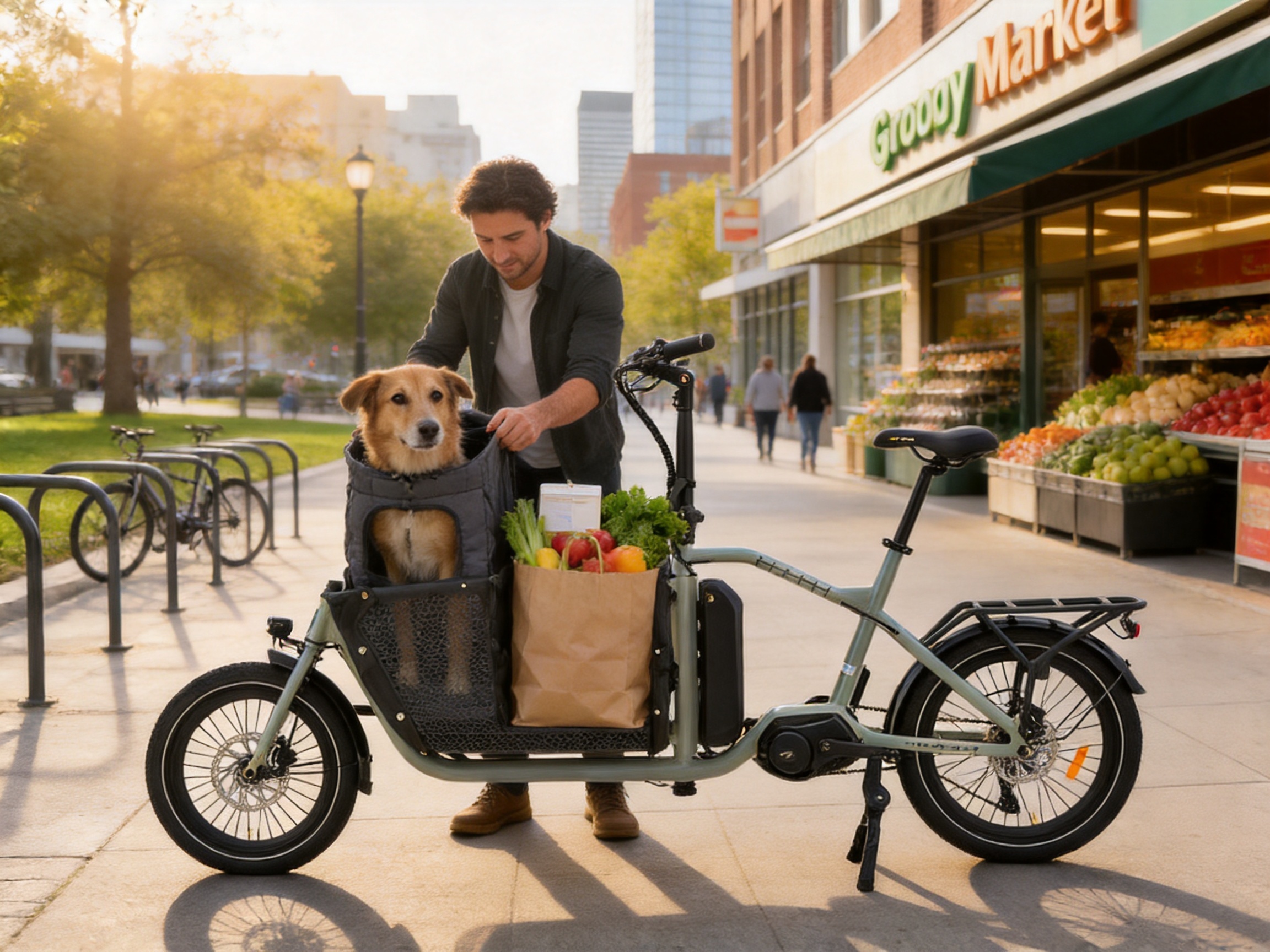
For pet owners, the bike can provide a practical way to transport a dog or other suitable animal to a park, veterinary appointment, grooming appointment, or outdoor location. A safe pet configuration must include appropriate restraints and a surface that prevents slipping. The animal’s size, temperament, and comfort should always be considered.
For grocery shopping, the basket offers capacity for reusable bags, produce, packaged goods, and household supplies. Its low position can be easier to load than a high rear rack. Riders should distribute weight evenly and secure items that could move during braking.
For retailers, the Model P can serve as a premium family cargo bike positioned between recreational e-bikes and larger commercial delivery vehicles. It can be demonstrated with different accessories to show how one platform meets multiple needs.
For mobility programs, housing developments, resorts, campuses, and community transport projects, the bike can support shared family mobility or short-distance utility trips. Commercial users should assess charging arrangements, storage, maintenance, rider training, and local legal requirements before deployment.
A cargo bike succeeds when it feels approachable in ordinary situations. Riders should not need advanced cycling skills to complete a short grocery trip or school run. The Model P’s intended combination of stable geometry, linear motor assistance, wide tires, and hydraulic brakes supports a controlled riding experience.
Before carrying passengers, the rider should practice mounting, starting, stopping, turning, reversing, and parking without cargo. The rider should then test the bike with a light load before moving to the maximum permitted load. This gradual process helps develop an understanding of how cargo affects acceleration, braking distance, steering, and balance.
Loading should be done carefully. Heavy items should be placed low and centrally, while loose items should be secured. Children should remain seated with suitable restraints, and pets should be contained in a way that prevents sudden movement. The rider should check that the basket is properly unfolded and locked before every trip.
Electric assistance should be selected according to conditions. Lower assistance may be adequate on flat roads and can help conserve battery energy. Higher assistance may be useful for hills or heavier loads, but riders should apply it progressively, especially near pedestrians and intersections.
Routine maintenance protects both performance and safety. The rider should inspect brake function, tire pressure, tire condition, chain lubrication, gear shifting, battery mounting, electrical connections, basket hardware, and visible frame areas.
Hydraulic brakes require periodic inspection and may eventually need pad replacement, fluid service, or bleeding by a qualified technician. The drivetrain should be cleaned and lubricated according to riding conditions. Cargo bikes used in rain, dust, or winter road salt may need more frequent cleaning and corrosion checks.
Fasteners around the basket, accessories, handlebars, stem, and wheel assemblies should remain properly tightened. A loose accessory can create a safety hazard even when the main frame and motor are functioning correctly.
Replacing short car journeys with electric cargo-bike trips can reduce local emissions, traffic congestion, noise, and parking demand. The Model P supports this transition by combining practical carrying capacity with pedal assistance. Its ability to transport several categories of cargo makes it more likely to be used frequently rather than stored as an occasional recreational item.
Sustainability also depends on product lifespan. A durable frame, serviceable drivetrain, replaceable tires and brake pads, and a supported electrical system can help extend the useful life of the bike. Longer service life reduces the environmental impact associated with frequent replacement.
Battery management is another important consideration. Lithium batteries should be charged, stored, transported, and recycled responsibly. At the end of their service life, batteries should be handled through approved collection or recycling channels rather than disposed of with ordinary household waste.
Manufacturing sustainability involves more than the final product. It includes material selection, packaging, logistics, supplier practices, repairability, and the company’s approach to product improvement. Atmose’s stated focus on reliability, practicality, and ongoing technological development supports a product philosophy based on useful long-term mobility rather than disposable transportation.
Retail customers should confirm the exact delivered configuration before purchase. Important questions include whether the battery, charger, child seat, rain cover, pet accessories, front basket, lighting equipment, and display components are included. Buyers should also confirm the applicable motor rating, assistance limits, load limits, warranty terms, assembly requirements, and service arrangements in their market.
Wholesale buyers should evaluate packaging dimensions, minimum order quantities, lead times, spare parts availability, technical documentation, training, and after-sales communication. If customization is requested, the buyer should establish whether it affects certification, production timing, replacement parts, or warranty coverage.
For distributors, the Model P’s strongest commercial feature is its broad use case. It can be marketed as a school-run bike, grocery cargo bike, pet carrier bike, family commuter, or urban utility e-bike. This allows one product platform to serve several customer segments while retaining a consistent core inventory.
Retailers should demonstrate the bike with realistic examples. Customers may understand the product more quickly when they see the basket folded and expanded, the position of a child seat, the available space for groceries, and the effect of a loaded basket on handling. A test ride should include starts, stops, gentle turns, and low-speed maneuvering.
| Specification | Model P ESP3 Information | Practical Relevance |
|---|---|---|
| Frame | 6061 T4T6 aluminum alloy | Balances structural performance, corrosion resistance, and manageable weight |
| Battery | Samsung 36V 15Ah lithium battery | Provides a stated 540Wh capacity for daily family and utility riding |
| Stated range | Up to 80 km under suitable conditions | Useful for school runs, errands, commuting, and multi-stop trips |
| Motor | Bafang M430 mid-drive, 36V, 250W nominal rating | Uses the bicycle drivetrain for adaptable assistance on varied terrain |
| Motor output information | Up to 500W output and up to 110Nm torque as described | Supports loaded starts and hill climbing; market configuration should be confirmed |
| Drivetrain | Shimano nine-speed Sora | Provides gear choices for hills, flat roads, and different cargo weights |
| Front basket | Folding design, up to 35kg load | Supports groceries, children, pets, bags, and daily equipment |
| Tires | 18-inch by 2.4-inch front and 20-inch by 2.4-inch rear | Wide, stable tire format suited to urban cargo riding |
| Brakes | Tektro hydraulic disc brakes | Strong, progressive braking with reduced hand effort |
| Dimensions | Approximately 2130mm long, 680mm wide, 1130mm high | Designed for urban utility while requiring appropriate storage space |
| Frame testing | 300,000-cycle fatigue test described | Indicates attention to repeated-load durability |
The Model P is designed for families, parents, pet owners, urban commuters, grocery shoppers, and users who need a practical electric cargo platform. It is especially suitable for short and medium-distance trips where a car may be unnecessary but a conventional bicycle lacks carrying capacity.
The front basket is described as compatible with child seats and rain covers. The exact child seating configuration, number of passengers, age limits, restraint requirements, and accessory load ratings must be confirmed before use. Children should always be securely seated and protected according to local safety requirements.
Yes, the front cargo area is intended to support pet transport when configured with a suitable pet carrier, restraint, non-slip surface, and weather protection. The pet’s size, weight, temperament, and ability to remain calm during movement should be considered.
The technical information lists a maximum rider load of 145 kilograms and a basket load of 35 kilograms. The product description refers to a total load of approximately 175 kilograms. Because these figures may depend on how the load is calculated and on market configuration, buyers should follow the official delivered specification and never exceed the lowest applicable rating.
The stated range is up to 80 kilometers. Actual range will vary with cargo weight, rider weight, assistance level, terrain, temperature, wind, tire pressure, and riding style. Heavy loads and frequent hill climbing will normally reduce range.
A mid-drive motor works through the bicycle’s gears. This allows the rider to select a lower gear for climbing or starting with a heavy load and a higher gear for efficient travel on flatter roads. It can provide a more adaptable riding experience than a fixed-hub motor system.
The product is designed with stable geometry and predictable assistance for confident handling. Nevertheless, first-time riders should practice without passengers, learn the turning radius and braking behavior, and gradually increase the load.
The supplied information states that the frame has passed a 300,000-cycle fatigue test and is associated with TUV and EN17860 safety certifications. Customers should request current certification documents and verify that they apply to the exact model and configuration being purchased.
The front basket is described as foldable. Its folded width is listed as approximately 365 millimeters. Buyers should confirm the precise folding procedure, locking mechanism, and accessory compatibility during product demonstration or delivery inspection.
Its differentiating features include a cargo-specific aluminum frame, documented fatigue testing, a Bafang mid-drive motor, a Samsung battery, a Shimano nine-speed drivetrain, Tektro hydraulic brakes, wide tires, and a flexible front basket. The company also presents manufacturing experience, supply-chain capability, and international design and development support.
Atmose presents its cargo-bike business as supporting custom design and wholesale solutions. Potential customization may involve accessories, appearance, configurations, packaging, or market requirements. The exact possibilities depend on order volume, engineering feasibility, certification, and production planning.
Owners should check tire pressure, brake performance, chain condition, gear shifting, battery mounting, basket hardware, fasteners, frame condition, and accessory restraints. Professional service should be used for hydraulic brake maintenance, electrical faults, structural concerns, or complex drivetrain repairs.
The Atmose Model P ESP3 is designed to make electric cargo cycling more practical for families and urban users. Its value comes from the interaction of several carefully selected features: a 6061 aluminum cargo frame, a front folding basket, a Bafang mid-drive motor, a Samsung 540Wh battery, a Shimano nine-speed drivetrain, Tektro hydraulic disc brakes, wide puncture-resistant tires, and a geometry intended for stable handling.
Compared with a conventional electric bicycle, it offers substantially greater utility for children, pets, groceries, and bulky personal cargo. Compared with a basic cargo-bike conversion, it provides a more integrated product architecture and a stronger emphasis on frame testing and component coordination. Compared with larger tricycles, it retains a narrower bicycle-style format that may be more suitable for many urban streets and storage areas.
The company’s international structure, American product heritage, Paris-based design and R&D activity, manufacturing experience, and supply-chain capability provide additional strengths for both retail and wholesale customers. These capabilities are particularly relevant when buyers require reliable documentation, accessory options, product customization, and long-term support.
For families, the Model P can replace selected car journeys while creating a more active and enjoyable daily routine. For pet owners, it offers a stable front platform for local transport. For retailers and distributors, it provides a versatile product that can be positioned across several growing mobility categories. With correct loading, responsible riding, regular maintenance, and suitable accessories, it is a capable solution for modern family transportation and practical urban mobility.
1. Product specification and technical information supplied for the Model P ESP3 Electric Family Cargo Bike.
2. General principles of bicycle frame fatigue testing and structural durability evaluation.
3. EN17860 cargo bicycle safety and performance considerations.
4. TUV product testing and conformity assessment principles for bicycles and light electric vehicles.
5. Shimano drivetrain maintenance and adjustment guidance.
6. Tektro hydraulic disc brake service and inspection principles.
7. Bafang mid-drive motor system operating and maintenance guidance.
8. Lithium-ion battery charging, storage, transportation, and recycling recommendations.
9. Urban cycling safety practices for transporting children, pets, and heavy cargo.
Nov 17, 2026
Nov 03, 2026
Oct 26, 2026


info@atmosecargobike.com

200 rue de la Croix Nivert 75015 Paris

Custom Electric Bakfiets
 English
 Français
 Deutsch