Oct 08, 2026
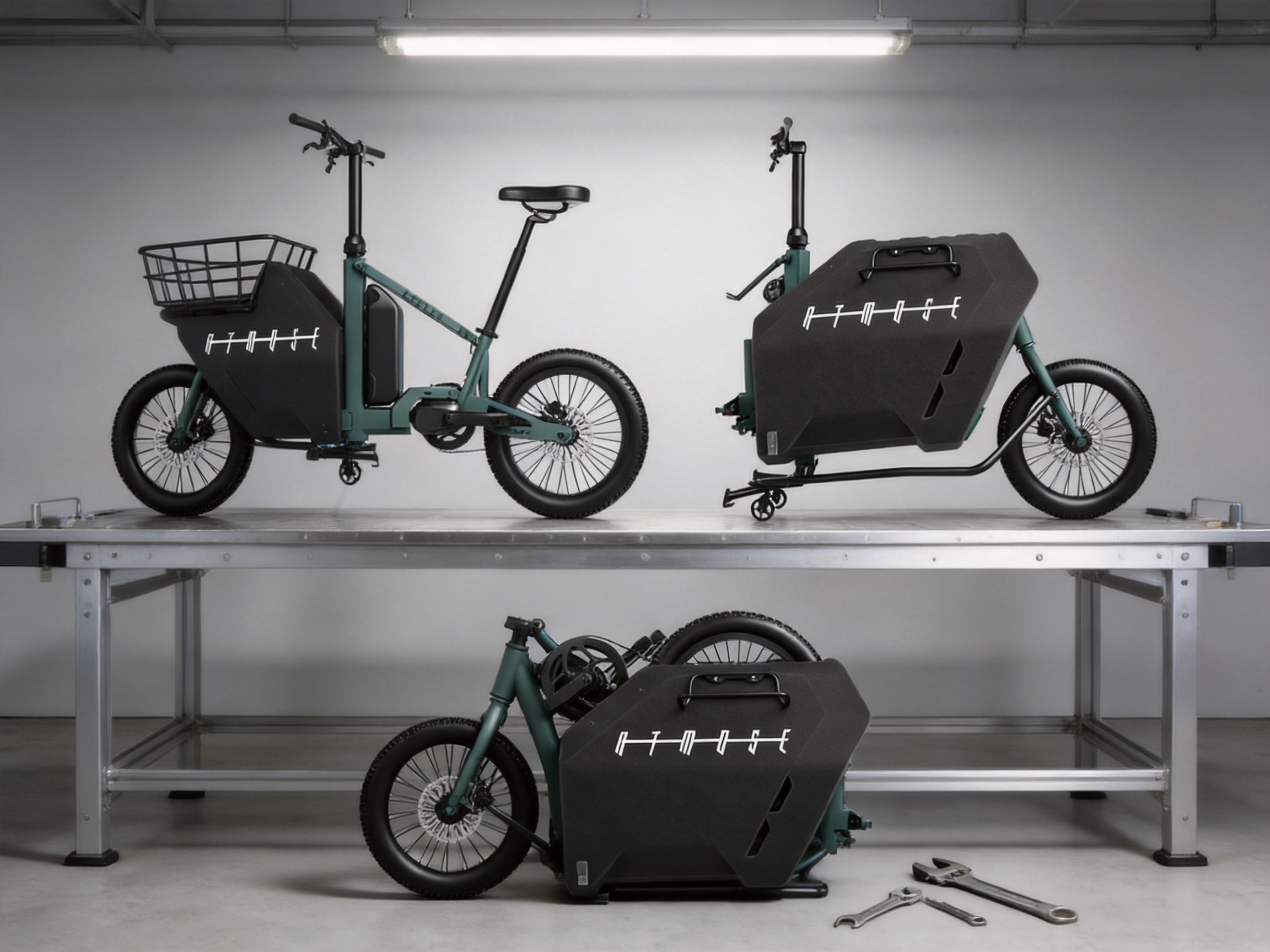
Urban transportation is changing. More people are combining cycling with trains, buses, elevators, shared mobility services and private cars. At the same time, city homes are becoming smaller, storage is becoming more expensive, and traditional cargo bikes are often difficult to move when they are not being ridden. A full-size front-loading cargo bike can be extremely useful on the road, yet its length and weight may create problems in an apartment hallway, a narrow elevator, a station concourse or a compact vehicle.
The Atmose Model R ESR1 addresses this problem with a different approach to cargo-bike design. Instead of asking riders to choose between cargo capacity and portability, it combines a front-loading cargo layout with a tri-fold frame. The bike provides a 198-centimetre riding length when assembled, then folds to 120 × 44 × 85 centimetres for storage and transport. With the front wheel removed, the folded package becomes 102 × 44 × 76 centimetres, a size intended to fit into many car trunks.
This design makes the Model R particularly relevant to train commuters, apartment residents, delivery riders, urban families and anyone who needs a cargo bike to work across several forms of transportation. It is not simply a smaller cargo bike. It is a cargo bike designed around the complete ownership experience: riding, folding, rolling, storing, maintaining and transporting.
Traditional cargo bikes generally prioritise stability, carrying capacity and a long wheelbase. Those qualities are valuable when transporting groceries, work equipment, parcels or daily necessities. However, the same long wheelbase that improves cargo stability can make a bike difficult to store. A rider may be able to use the bike on the street but have nowhere practical to keep it at home or work.
The Model R takes a front-loading format and introduces a folding system that remains part of the bike’s everyday identity. The basket, steering arrangement and drivetrain remain integrated with the riding configuration rather than requiring the rider to convert the bike into a fundamentally different object before storage. This distinction matters because a folding mechanism is only useful if people are willing to use it regularly.
When unfolded, the Model R has a riding length of 198 centimetres, a width of 38 centimetres and a height of 108 centimetres. This gives the rider a full cargo-bike layout with a low, forward load position. When folded, the dimensions reduce to 120 × 44 × 85 centimetres. Removing the front wheel reduces the length again to 102 centimetres.
Those measurements do not make the Model R weightless or completely effortless to move. A cargo e-bike remains a substantial machine. The important advantage is that the bike can be rolled in its folded state rather than carried continuously. This changes the practical calculation for people who need to move through a station, enter an elevator or take a bike into an office.
For many owners, the difference between carrying and rolling is the difference between occasional folding and daily folding. A bike that must be lifted at every stage may remain outside, even when indoor storage would be safer. A bike that can be folded and pushed through a building is more likely to become part of a consistent commute.
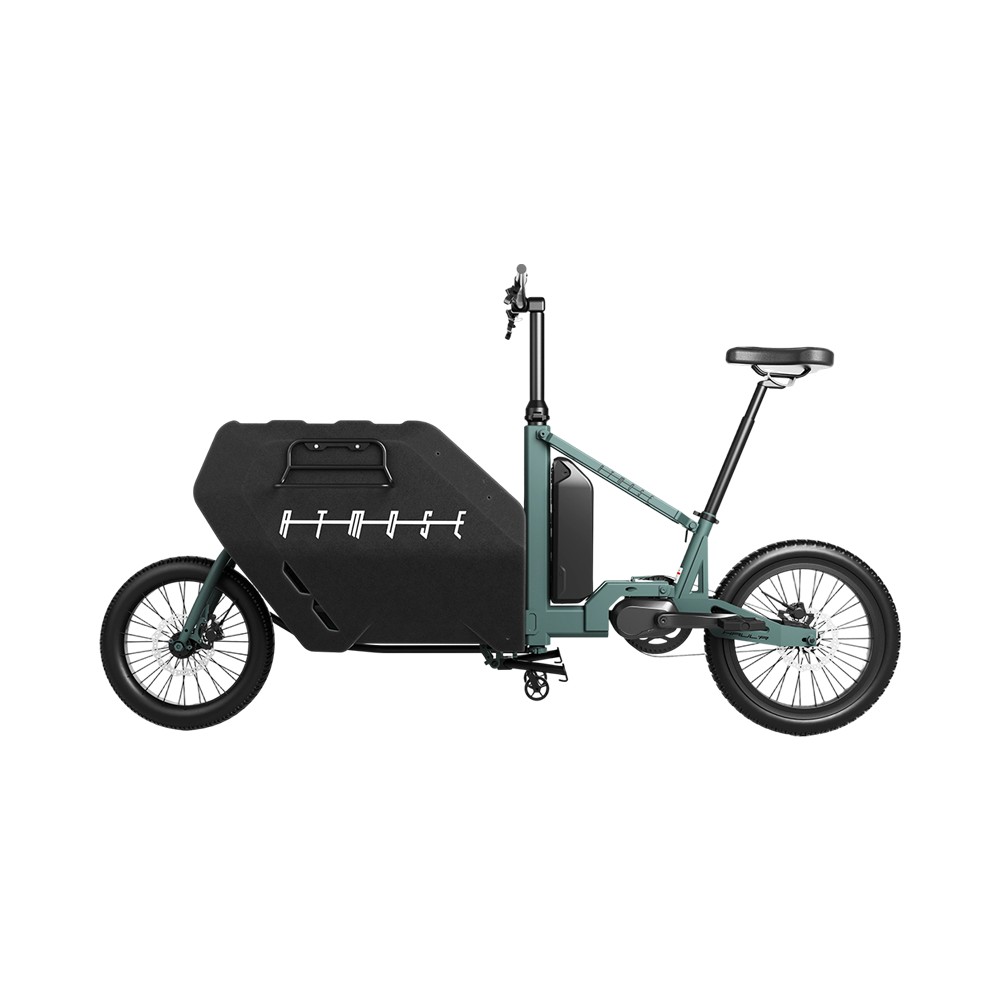
Atmose Model R ESR1 Tri-Fold Cargo E-Bike for Train Commuters and Small Apartments
The central engineering challenge of a folding cargo bike is balancing compact storage with structural strength. Cargo bikes experience higher loads than ordinary city bikes, particularly when a front basket carries groceries, tools or delivery items. Folding joints must therefore be positioned and designed without compromising the rigidity needed for predictable steering and braking.
The Model R uses a 6061 T4/T6 aluminum alloy frame. This material is widely valued in bicycle construction because it offers a useful combination of low weight, corrosion resistance, formability and structural performance. The T4/T6 designation indicates a controlled heat-treatment approach associated with the material’s mechanical properties. In practical terms, the frame is intended to provide a strong foundation for a folding cargo platform while remaining manageable for urban use.
The tri-fold arrangement reduces the bike’s overall length instead of requiring the rider to remove the cargo basket or dismantle the front section. That is an important point of difference from conventional cargo bikes and from some compact folding bicycles. A conventional cargo bike may have excellent carrying ability but take up substantial room. A small folding bicycle may fit in an apartment but lack the basket volume, front-loading position and load rating needed for serious errands.
The Model R brings these two categories closer together. It is compact when stored, but it does not treat cargo capacity as an afterthought. The front basket measures 70 × 50 centimetres at the top and 50 × 36 centimetres at the bottom. It is rated for up to 45 kilograms of cargo, while the rider capacity is specified at up to 100 kilograms.
The tapered basket geometry helps create a low and contained loading area. Loads can be placed in front of the rider, where they remain visible during the journey. Visibility is useful in daily transport because it makes it easier to check a bag, monitor a parcel or confirm that groceries are secure without stopping and dismounting.
A 45-kilogram basket rating also gives the Model R a broader role than a bicycle intended only for light shopping. It can support a substantial grocery run, small business equipment, office supplies, delivery parcels or recreational gear. Riders should still distribute weight carefully, secure loose objects and follow local loading and safety requirements, but the underlying platform is designed for meaningful utility.
The Model R’s first major advantage over many conventional cargo bikes is storage flexibility. A full-length cargo bike typically needs a dedicated garage, courtyard, secure bicycle room or outdoor parking position. The Model R can be folded into a substantially shorter package and rolled through indoor spaces. This makes it more suitable for apartments, offices, workshops and homes without ground-level storage.
The second advantage is multimodal transport. Many cargo bikes are practical only from the point where the rider starts cycling. The Model R is intended to participate in the journey before and after the cycling segment. A commuter can ride to a station, fold the bike where permitted, roll it through the station and continue from another stop. A worker can drive to a city edge, place the folded bike in a trunk and complete the final urban section by bicycle.
The third advantage is reduced dependence on external carrying equipment. A conventional cargo bike may require a roof carrier, rear carrier or trailer when transported by car. The Model R can be folded, and with the front wheel removed it measures 102 × 44 × 76 centimetres. This can simplify occasional car transport and reduce the need to install a permanent bike rack.
The fourth advantage is its maintenance-oriented drivetrain. The Gates belt drive replaces a conventional chain. A belt drive does not require chain oil and generally avoids the oily residue associated with chain lubrication. It can therefore be attractive to riders who store the bike indoors, carry it into an office or use it around clean clothing and furniture.
The Shimano Nexus 3 internal gear hub complements the belt system. Because the gears are enclosed inside the hub, the system is protected from much of the dirt and exposure experienced by an external derailleur. The ability to shift while stopped is especially useful for a loaded cargo bike. A rider approaching a traffic light can select a lower gear before starting again rather than trying to change gears while balancing a heavy load.
These benefits do not mean the Model R is automatically superior for every rider. A long-tail cargo bike may offer more rear passenger flexibility. A large bakfiets may provide greater enclosed volume. A lightweight folding bicycle may be easier to carry upstairs. The Model R’s advantage is its specific balance: meaningful front cargo capacity, electric assistance, a full riding configuration and a folding system for storage and multimodal use.
Small folding e-bikes are often convenient for commuters, but many are designed around the rider alone. Their frames, wheels and luggage systems may not be intended for heavy front cargo. Adding a large aftermarket basket can alter steering, exceed the intended load rating or interfere with folding.
The Model R starts with cargo capability as a primary design requirement. The front basket is integrated into the bicycle’s architecture and rated for up to 45 kilograms. The rider does not need to improvise a cargo solution by combining a small folding bicycle with oversized bags or racks.
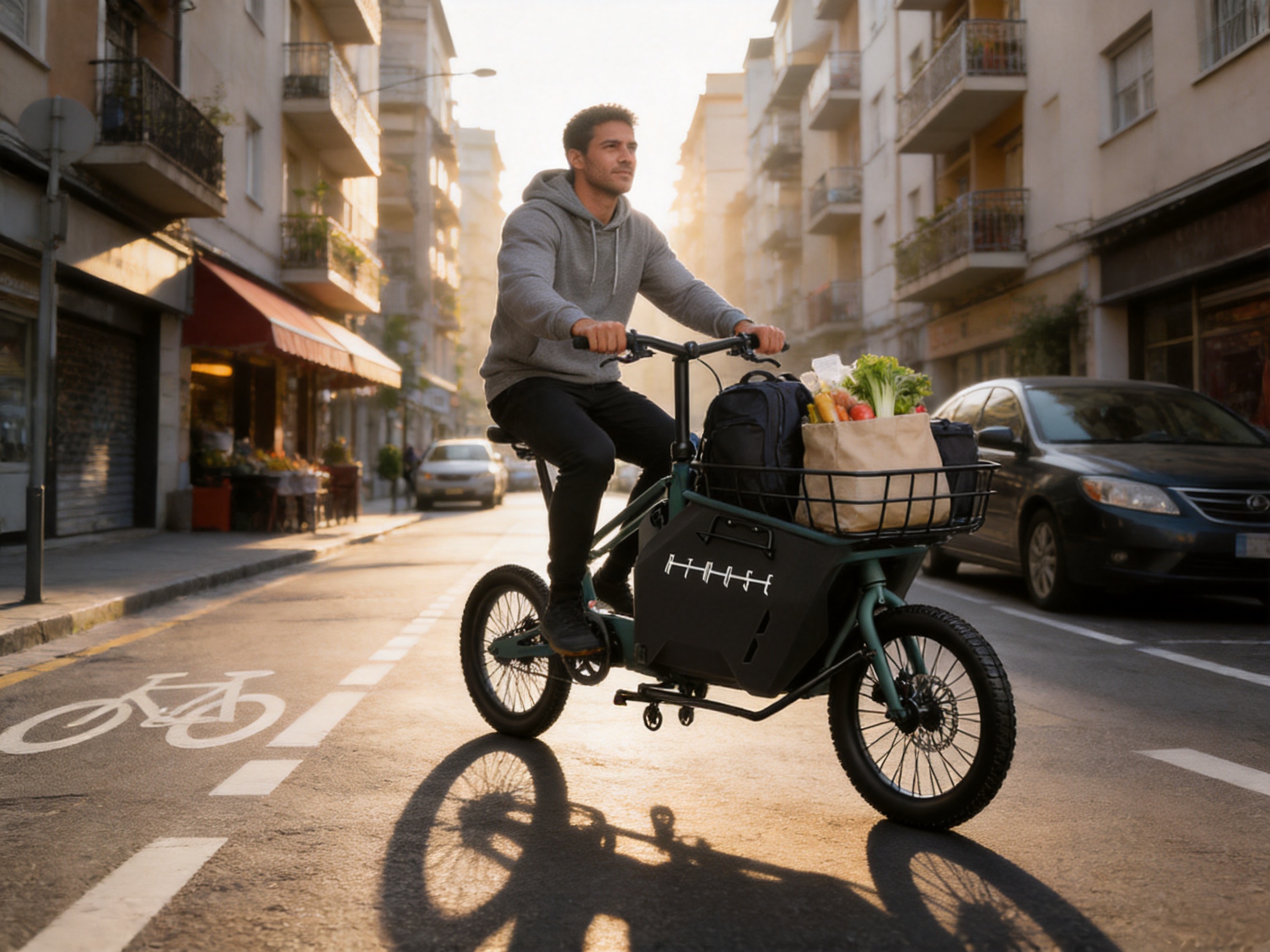
The front-loading layout also creates a different riding experience. Cargo is positioned ahead of the rider rather than behind the saddle, which can make it easier to see and access. For business users, that may help with quick deliveries. For households, it can simplify loading groceries or daily equipment. For commuters, it creates room for a work bag, lunch, rainwear and other items without placing everything on the rider’s back.
At the same time, the Model R retains the storage advantages associated with folding bicycles. It can occupy a smaller footprint in an apartment or vehicle than an equivalent non-folding cargo bike. The result is a product aimed at people who have cargo-bike needs but cannot accommodate a permanent full-size machine.
A folding cargo bike must be easy to move when stored, but it also needs sufficient assistance when fully loaded. The Model R uses a 36-volt, 250-watt mid-drive motor with up to 70 Newton-metres of torque. The mid-drive position places the motor near the bicycle’s central mass and allows assistance to work through the bicycle’s gearing.
This is particularly useful in stop-and-go urban traffic. A loaded cargo bicycle needs to start smoothly from intersections, climb ramps and handle short inclines without making the rider feel that the cargo is overwhelming the frame. Up to 70 Nm of torque gives the motor a substantial assistance reserve for these situations, subject to the applicable assistance settings, rider input, terrain and local regulations.
Because the motor is a mid-drive system, the rider’s selected gear can influence how effectively the motor delivers assistance. The Shimano Nexus 3 hub provides three internal ratios, allowing the rider to choose a lower ratio for starting and climbing or a higher ratio for more efficient cruising. This combination is more functionally integrated than simply adding a motor to one wheel while leaving the rider to manage all load-related gearing challenges independently.
The motor is paired with a Samsung 36-volt, 20-amp-hour lithium battery with a stated capacity of 720 watt-hours. Battery range will vary according to cargo weight, rider weight, terrain, temperature, tyre pressure, assistance level, wind, stopping frequency and riding style. A large battery capacity is therefore not a guarantee of a specific distance, but it provides a useful energy reserve for demanding urban journeys.
For commuters, the battery can help make the bicycle a realistic replacement for short car trips. For delivery users, it can support multiple stops during a working period. For families and household users, it can reduce the effort associated with carrying heavy loads. The key benefit is not merely speed; it is the ability to make a loaded journey feel manageable and repeatable.
Riders should charge and store the battery according to the manufacturer’s instructions, protect it from extreme temperatures and use an appropriate charger. Battery performance and service life depend on responsible charging practices as well as on the quality of the battery cells and management system.
Carrying 45 kilograms in the front basket changes the demands placed on braking and handling. The Model R uses hydraulic disc brakes supplied in a Tektro or Magura configuration. Hydraulic systems can provide strong braking control with relatively low lever effort, which is useful in urban conditions where riders may need to stop quickly and repeatedly.
Brake performance is only one part of safe control. Load distribution, tyre condition, riding speed and road surface all affect stopping distance. Riders should place heavier objects low in the basket, secure items so they cannot shift, keep both hands ready for steering and allow additional stopping room when the bike is loaded.
The front tyre measures 16 × 2.4 inches and the rear tyre measures 18 × 2.4 inches. These relatively wide tyres are intended to provide a stable contact patch and help absorb minor imperfections in urban pavement. The different wheel sizes support the compact cargo-bike geometry while contributing to a balanced riding position.
The tyres are described as puncture-proof. No bicycle tyre is completely immune to every puncture under every condition, so riders should still check pressure, inspect the tread and remove sharp debris when necessary. Proper inflation is especially important on a cargo bike because pressure affects steering effort, rolling resistance, comfort and braking behaviour.
The combination of hydraulic disc brakes and wide puncture-resistant tyres supports the Model R’s intended role as a practical city transport tool. The equipment is not merely decorative or designed for occasional recreational use. It is selected around the demands of heavier loads, frequent starts and varied urban surfaces.
One of the Model R’s most appealing ownership features is the Gates belt drive. Conventional bicycle chains are effective and widely serviceable, but they require lubrication, attract dirt and can transfer grease to hands, clothing or interior surfaces. This can be inconvenient when a bicycle is stored in a hallway or taken into an office.
A belt drive uses a toothed belt rather than a metal chain. It operates without routine oiling and generally produces a clean, quiet transmission. For commuters who wear work clothes, this can make the bicycle easier to live with. For apartment residents, it can reduce the amount of cleaning needed before bringing the bike indoors.
The belt system works with the Shimano Nexus 3 internal gear hub. The hub encloses the gear mechanism, protecting it from much of the spray and dirt that can reach an exposed derailleur. The three-speed arrangement is intentionally straightforward. It does not attempt to provide the wide range of a high-performance touring system, but it suits a utility bicycle focused on urban starts, moderate climbs and everyday reliability.
Internal hub gears also allow the rider to change ratio while stationary. This is valuable when the bicycle is carrying cargo. If a rider stops in a high gear, the next start can otherwise require significant pedal force. Selecting a lower gear before moving again reduces that difficulty.
The belt and hub do not eliminate all maintenance. Riders should still inspect belt tension, brake pads, wheels, fasteners, tyres, folding joints and electrical connections. Periodic professional servicing may be appropriate, particularly for a bicycle used with heavy loads or high frequency. The advantage is that routine care is designed to be cleaner and less demanding than frequent chain lubrication and derailleur adjustment.
The Model R reflects a manufacturing approach that combines material selection, integrated design and practical use-case development. The 6061 T4/T6 aluminum alloy frame provides the structural foundation, while the folding architecture requires precise alignment between the frame sections, steering components, drivetrain and cargo basket.
A folding cargo bike cannot be developed as a simple collection of independent parts. The folding sequence must be compatible with cable routing, brake operation, electrical wiring, wheel clearance and basket geometry. The bike must be rigid and predictable when unfolded, yet compact and manageable when folded. This type of product places greater demands on design coordination than a conventional rigid-frame city bicycle.
Atmose describes itself as combining American product thinking with European design aesthetics. The company originated in California and developed from MOTIV, an established American beach cruiser brand. Its international design and research-and-development team is based in Paris, and ATMOSE SASU was established in France in 2026. This structure gives the brand a cross-market perspective that is relevant to a product intended for dense urban environments and multimodal transport.
The company also identifies manufacturing expertise, a mature supply chain and continuous innovation as part of its foundation. For the Model R, these strengths are visible in the integration of several systems: an aluminum folding frame, a front-loading cargo structure, a mid-drive motor, a high-capacity battery, a belt transmission, an internal gear hub and hydraulic braking.
Advanced manufacturing should not be understood only as the use of automated machinery or complex factory equipment. It also includes the ability to control interfaces between components, maintain repeatable alignment, verify load-bearing areas and produce a product that performs consistently across repeated folding cycles. In a folding cargo bike, hinge alignment, locking surfaces and frame tolerances are particularly important because small inconsistencies can affect steering, noise, wear or folding ease.
The material provided for the Model R does not specify individual factory machines, assembly-line cycle times, welding procedures or certification test results. It would therefore be inappropriate to claim particular manufacturing technologies that have not been disclosed. However, the product’s specification shows a clear emphasis on integrated engineering, durable materials, established drivetrain suppliers and practical serviceability.
This approach is valuable for international buyers, fleet operators and distributors. A cargo bicycle used for business or family transport must be more than visually attractive. It must be supported by repeatable production, a dependable component supply chain and a product philosophy that considers long-term use. Atmose’s stated background in manufacturing expertise and supply-chain development supports that commercial objective.
The Model R is particularly well matched to homes where storage is limited. A rider living on a fourth floor may not have access to a private garage. An apartment resident may need to pass through a narrow entrance and an elevator. An office worker may want to keep the bicycle inside rather than leave it at a public rack. In all of these cases, folded dimensions matter as much as riding performance.
The 120 × 44 × 85 centimetre folded size can fit into spaces that would reject a 198-centimetre bicycle. The reduced 102 × 44 × 76 centimetre format, achieved by removing the front wheel, expands transport possibilities further. The bike can be positioned in a vehicle’s luggage area without requiring an external rack, assuming the specific vehicle has sufficient interior dimensions and payload capacity.
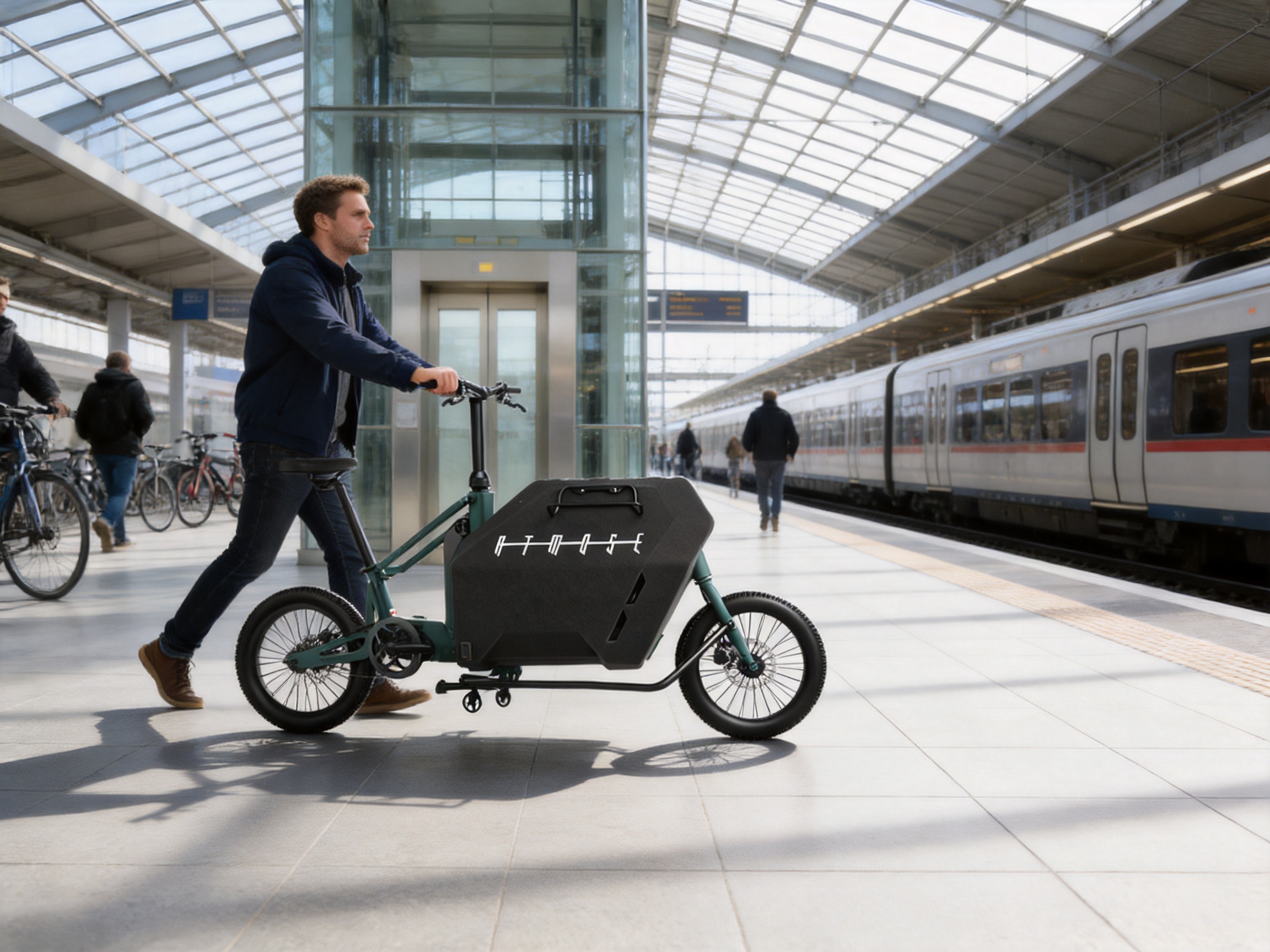
Train travel introduces additional considerations. Rail operators may impose rules relating to folding bicycles, peak periods, reservations, dimensions and storage locations. Riders should check the relevant operator’s policies before travelling. The Model R’s folding capability can make rail integration more practical, but it does not override transport regulations.
The rolling function is equally important. Once folded, the bicycle is intended to be pushed across a station hall, into an elevator or toward a workplace. A rider may still need to lift it over steps or into a vehicle, but rolling reduces the number of situations where full lifting is necessary.
This encourages a different relationship with the product. Rather than treating folding as an emergency measure, the owner can use it as part of a normal daily routine. Ride to the station, fold, roll, travel, unfold and continue. That sequence is central to the Model R’s identity.
The first target group is the city commuter who combines cycling and rail travel. Such a rider may need an e-bike for the first and last portions of a journey but cannot leave it outdoors all day. The Model R provides cargo capacity for work equipment and a folded format for indoor or train-related storage where permitted.
The second group is the apartment-based household. The rider may use the bike for groceries, errands, school-related equipment or local shopping. The 45-kilogram front basket can accommodate substantial loads, while the folding frame reduces the space needed at home.
The third group is the small business or independent delivery user. A courier, florist, repair technician or local retailer may need to transport equipment without investing in a large commercial cargo vehicle. The front basket remains accessible, the belt drive reduces routine cleaning and the electric motor assists repeated urban starts.
The fourth group is the car owner who wants to extend the range of a vehicle. The folded bicycle can travel in the trunk, allowing the rider to park outside a congested centre and complete the final journey by e-bike. This can be useful for events, business visits, tourism or weekend travel.
The fifth group is the rider who values a clean and low-maintenance drivetrain. The Gates belt drive, Nexus 3 hub and internal storage potential make the bike appealing to people who do not want the oily upkeep associated with a conventional chain-driven cargo cycle.
The Model R may be less suitable for riders who require a very large passenger cabin, long-distance touring range, high-speed performance or a bicycle that can be carried easily up several flights of stairs. Its strongest proposition is practical urban flexibility, not maximum capacity in every category.
Correct loading is essential to obtain the best handling from any front-loading cargo bike. Heavy objects should be positioned low and near the centre of the basket rather than stacked high or placed at the extreme front. The load should be secured so it cannot slide, bounce or fall during braking.
Riders should become familiar with the bicycle before carrying the maximum rated load. An unloaded cargo bike and a fully loaded cargo bike can feel different during acceleration, cornering and braking. Practising at low speed in an open area helps the rider understand steering response and turning clearance.
The front basket should not be overloaded beyond its stated 45-kilogram rating, and the rider should remain within the 100-kilogram rider limit. The combined weight of the rider, cargo and any accessories affects battery range, braking distance and tyre pressure requirements.
Folding should be performed on stable ground with the bicycle under control. Loose cargo should be removed or secured before folding. The rider should follow the manufacturer’s folding sequence and confirm that the frame is fully locked before riding. Folding joints, locking mechanisms and fasteners should be checked periodically, especially when the bicycle is used frequently.
When carrying the bike in a vehicle, it should be protected from movement and contact with other objects. The battery should be handled according to the manufacturer’s transport instructions. The front wheel should be reinstalled correctly before riding, with the axle and brake system checked after installation.
| Category | Model R ESR1 specification |
|---|---|
| Frame | 6061 T4/T6 aluminum alloy folding frame |
| Motor | 36-volt, 250-watt mid-drive motor |
| Maximum motor torque | Up to 70 Nm |
| Battery | Samsung 36-volt, 20 Ah lithium battery, 720 Wh |
| Rider capacity | Up to 100 kg |
| Front basket capacity | Up to 45 kg |
| Transmission | Gates belt drive with Shimano Nexus 3 internal gear hub |
| Front tyre | 16 × 2.4 inches, puncture-proof design |
| Rear tyre | 18 × 2.4 inches, puncture-proof design |
| Brakes | Tektro or Magura hydraulic disc brakes |
| Basket dimensions | 70 × 50 cm at the top; 50 × 36 cm at the bottom |
| Unfolded dimensions | 198 × 38 × 108 cm |
| Folded dimensions | 120 × 44 × 85 cm |
| Folded dimensions without front wheel | 102 × 44 × 76 cm |
It is tempting to describe the Model R simply as a folding cargo e-bike, but that description understates its design priorities. The folding mechanism is valuable because it is connected to the rest of the product. The battery supports loaded riding. The mid-drive motor works with the internal gear hub. The belt drive makes indoor storage cleaner. The basket remains part of the bike rather than becoming an accessory that must be removed.
This integration distinguishes the Model R from products that add folding capability without reconsidering the cargo experience. The goal is not only to reduce dimensions. It is to make a cargo bike more compatible with the places where modern riders live and work.
Its advantages are therefore cumulative. The rider receives a practical front basket, electric assistance, a high-capacity battery, hydraulic braking, wide tyres, low-maintenance transmission and compact storage. Each feature addresses a different barrier to daily use. Together, they create a more flexible mobility system.
For manufacturers, this type of integration requires careful coordination between design, engineering, component sourcing, assembly and quality control. For users, the result is a bike that can adapt to multiple stages of a journey instead of being limited to the cycling stage alone.
Atmose positions itself as a cargo e-bike company focused on modern family mobility, urban commuting, commercial delivery and outdoor exploration. Its stated philosophy, “Fun & Practical,” reflects a product strategy that combines utility with approachability. Cargo bikes can be highly functional, but if they are difficult to operate, store or maintain, their utility is reduced.
The company’s origins in California and its Paris-based design and research-and-development presence provide a combination of perspectives. American product development traditions often emphasise usability and broad consumer appeal, while European urban design environments place strong importance on compact streets, multimodal transport, storage constraints and sustainable mobility.
ATMOSE BIKES INC. was founded in Long Beach, California, in 2023 by Cameron Perstein and Guojie Shen. ATMOSE SASU was established in France in 2026 alongside a new design and research-and-development team. The company also draws on MOTIV’s experience as an established American beach cruiser brand.
This history supports the company’s ability to develop products for different market requirements. Cargo bicycles sold internationally must account for varied urban patterns, customer expectations, service networks, component availability and local regulations. A product such as the Model R benefits from being designed with more than one type of city or rider in mind.
The company’s emphasis on sustainability, reliability, practicality and innovation is consistent with the Model R’s purpose. A bicycle that replaces short car journeys can contribute to more efficient urban transport, while a foldable design can extend the range of places where the bicycle can be stored and used.
The Model R ESR1 is designed to provide front-loading cargo capacity in a bicycle that can also fold for storage and transport. It is especially suited to train commuters, apartment residents, urban households, delivery users and people who need to combine cycling with car travel.
The folded bicycle measures approximately 120 × 44 × 85 centimetres. When the front wheel is removed, the dimensions reduce to approximately 102 × 44 × 76 centimetres.
Its folded dimensions are intended to make indoor storage easier in hallways, elevators, closets and small apartments. The bike remains a substantial object, so users should measure their available space and access routes before purchase.
The front basket is rated for up to 45 kilograms. It measures 70 × 50 centimetres at the top and 50 × 36 centimetres at the bottom. Loads should be distributed evenly and secured during riding.
The specified rider capacity is up to 100 kilograms. Riders should also consider the combined effect of body weight, cargo, accessories and any additional equipment.
No. The Model R uses a Gates belt drive paired with a Shimano Nexus 3 internal gear hub. The belt does not require routine chain lubrication, and the internal hub helps protect the gearing from dirt and weather.
The bicycle uses a 36-volt, 250-watt mid-drive motor with up to 70 Newton-metres of torque. Actual assistance depends on riding conditions, settings, rider input, load, terrain and applicable regulations.
The battery is a Samsung 36-volt, 20-amp-hour lithium battery with a stated capacity of 720 watt-hours. Real-world range varies according to factors such as load, terrain, temperature, tyre pressure, assistance level and riding style.
The folding design and rolling capability are intended to support multimodal journeys, including train travel where permitted. Riders must check the rules of each rail operator because size, reservation and peak-time requirements vary.
Its front basket, 45-kilogram cargo rating, electric assistance and low-maintenance drivetrain make it relevant to small delivery operations and mobile businesses. Operators should assess their specific route, legal requirements, service needs and daily cargo patterns.
The key advantages are its reduced folded dimensions, ability to roll when folded, compatibility with car transport, indoor-storage potential and integrated front cargo layout. A conventional cargo bike may provide more total volume or passenger flexibility, so the best choice depends on the intended use.
The Model R is designed around a substantial front cargo load rather than only personal transport. It combines a 45-kilogram basket rating with a mid-drive motor, high-capacity battery and cargo-bike geometry.
The belt drive and internal gear hub reduce routine drivetrain cleaning, but the bike still requires inspection of brakes, tyres, wheels, folding joints, fasteners, electrical connections and belt tension. Regular professional servicing may be appropriate for heavily used bicycles.
The Atmose Model R ESR1 represents a practical response to one of the most persistent problems in urban cycling: a cargo bike can be highly useful on the road but difficult to accommodate everywhere else. By combining a full front-loading cargo configuration with a tri-fold frame, the Model R is designed to remain useful before, during and after the ride.
Its 6061 T4/T6 aluminum alloy frame, 250-watt mid-drive motor, up-to-70-Nm torque, 720-Wh battery, hydraulic disc brakes and wide puncture-resistant tyres support loaded city riding. Its Gates belt drive and Shimano Nexus 3 hub reduce drivetrain maintenance. Its 45-kilogram front basket gives the bike meaningful utility for shopping, equipment and delivery work. Most importantly, its folded dimensions and rolling function make it more compatible with apartments, offices, stations and car trunks.
The product’s strongest competitive advantage is not a single specification. It is the way those specifications work together. The Model R is a cargo bike that folds without abandoning its cargo purpose, an e-bike that supports practical loads, and a transport tool designed for the realities of dense urban life.
Supported by Atmose’s American origins, Paris-based design and research-and-development activities, manufacturing experience, supply-chain foundation and stated commitment to practical innovation, the Model R demonstrates how cargo cycling can evolve beyond the traditional full-size format. For riders who need capacity but cannot dedicate an entire room, garage or vehicle rack to a bicycle, this compact tri-fold approach offers a compelling alternative.
Atmose Product Specification Sheet. Model R ESR1 technical information, frame, motor, battery, drivetrain, braking, tyre and dimensional data.
Atmose Product Overview. Flex & Fold Mobility Cargo Bike product description and use-case information.
Atmose Company Information. Corporate history, design and research-and-development structure, manufacturing background and product philosophy.
Gates Carbon Drive Technical Materials. General principles of belt-drive bicycle transmission and maintenance.
Shimano Nexus Internal Gear Hub Technical Information. General operating principles of internal bicycle gearing.
General bicycle engineering references concerning aluminum alloy frames, hydraulic disc brakes, cargo loading, tyre pressure and urban cycling safety.
Nov 17, 2026
Nov 03, 2026
Oct 26, 2026


info@atmosecargobike.com

200 rue de la Croix Nivert 75015 Paris

Custom Electric Bakfiets
 English
 Français
 Deutsch