Oct 06, 2026
Adventure cargo bikes are becoming increasingly capable. What began as a category focused mainly on school runs, grocery shopping, and short urban trips has expanded into a broader form of transportation for camping, fishing, touring, trail access, and everyday utility. Riders now expect one bike to handle family errands during the week and carry outdoor equipment into remote areas at the weekend. That demand requires more than a large frame or an electric motor. It requires a carefully balanced structure, dependable braking, useful storage, predictable handling, and a power system capable of supporting both the rider and the load.
The ESV1 Adventure Cargo Bike is designed around that complete-use idea. It combines an aluminum alloy frame, a mid-drive motor, a 36-volt battery, an 11-speed Shimano Cues transmission, hydraulic disc brakes, and a large front folding basket. Its most distinctive feature is the oversized front storage deck, which is intended for bulky equipment such as tents, coolers, camping bags, fishing supplies, tools, or recreational gear.
Rather than treating cargo capacity as an accessory added to a conventional bicycle, the ESV1 makes carrying equipment part of its central design purpose. The low and stable front storage area gives riders a practical way to transport large objects while maintaining a manageable overall profile. With a stated maximum load of 170 kilograms, the bike is built for substantial carrying duties, although users should always follow the manufacturer’s loading guidance and distribute weight carefully.
This article examines the ESV1 as an adventure-oriented cargo platform. It considers the bike’s engineering, storage design, power delivery, braking, durability, riding behavior, manufacturing strengths, practical applications, and advantages over more limited cargo-bike alternatives.

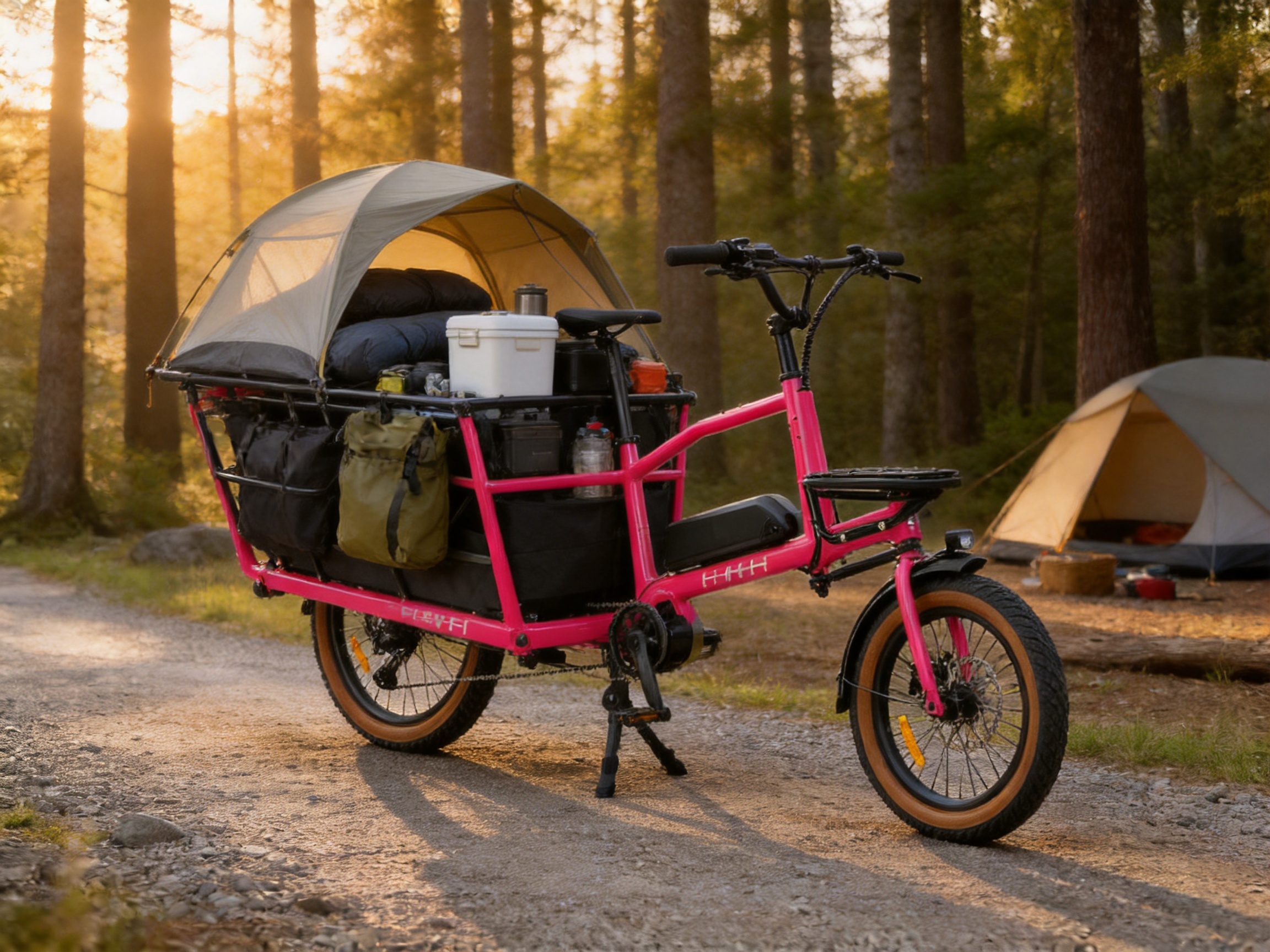
Atmose Model V ESV1 Adventure Cargo Bike with Oversized Front Camping Rack
Many cargo bicycles are optimized for one particular environment. Compact models may be excellent for narrow city streets but have limited space for camping equipment. Long-tail bicycles can carry passengers or panniers but may not provide a broad, stable platform for bulky objects. Front-loading cargo bikes often have generous capacity, yet their frames and storage areas may be designed primarily for paved roads and family transport rather than rougher outdoor use.
The ESV1 takes a different approach by combining the utility of a front-loading cargo bike with the equipment-carrying needs of an adventure bicycle. Its front folding basket measures approximately 470 millimeters in length, 470 millimeters in width, and 375 millimeters in height. This creates a sizable three-dimensional storage area rather than a narrow rack intended only for small bags.
The distinction matters in real-world use. A backpack can be placed on almost any bicycle, but camping equipment often has awkward dimensions. A tent may be long when packed. A cooler may be wide and rigid. A fishing box may be difficult to secure on a standard rear rack. A compact generator, outdoor cooking kit, or work case can also exceed the useful capacity of ordinary bicycle luggage systems.
By positioning a large storage area at the front, the ESV1 allows riders to keep heavy objects lower and closer to the bicycle’s central structure. This can help reduce the pendulum effect associated with high or rear-mounted loads. It also allows the rear of the bike to remain available for additional bags, accessories, or personal seating arrangements, depending on the configuration chosen by the user.
The front platform is not simply about maximum volume. Its usefulness also depends on accessibility. Gear placed in front of the rider can be inspected quickly, removed without unloading the entire bicycle, and organized according to the journey. For touring, this may mean separating cooking equipment from sleeping equipment. For commercial users, it may mean keeping frequently accessed tools in the forward section while securing heavier stock elsewhere.
The ESV1 uses a 6061 T4T6 aluminum alloy frame. Aluminum alloy is widely used in performance and utility bicycles because it offers a useful balance between low weight, corrosion resistance, rigidity, and manufacturing flexibility. For a cargo bike, frame design is especially important because the structure must manage the combined forces generated by the rider, motor assistance, cargo, braking, turning, and uneven ground.
A high-capacity cargo frame cannot be judged only by its static load figure. It must also remain controlled when the load shifts, when the rider brakes suddenly, and when the bike travels over a surface containing potholes, gravel, roots, or mud. The ESV1’s frame is therefore part of a broader system that includes its wheel sizes, tire width, front storage position, braking equipment, and mid-drive power unit.
The stated maximum load is 170 kilograms. This figure indicates that the bike is intended for serious utility rather than light recreational carrying. The total load should be understood as the combined weight of the rider, cargo, and any equipment attached to the bicycle, unless product documentation specifies otherwise. Responsible loading remains essential. A high load rating does not eliminate the need to secure cargo, keep the center of gravity controlled, and reduce speed when carrying unfamiliar or unevenly distributed objects.
Aluminum alloy also supports consistent production through established forming, welding, machining, and finishing processes. A mature manufacturing system can use controlled tube preparation, repeatable welding fixtures, dimensional inspection, surface treatment, and final assembly checks to produce frames with consistent alignment. These processes are particularly valuable for cargo bicycles because small alignment errors can become more noticeable under high loads or during braking.
The company behind the product describes its development approach as combining American product thinking with European design and research-and-development input. That combination is relevant to a product such as the ESV1. American utility-bike traditions often emphasize practical use, durability, and straightforward ownership, while European urban-bike development frequently focuses on efficient packaging, clean integration, maneuverability, and daily usability. The ESV1 brings those priorities together in a platform intended for both transportation and exploration.
The oversized front basket is the defining feature of the ESV1. It gives the bike a visual identity, but its more important role is functional. A front storage deck can improve the way cargo is organized because the rider has a direct view of the load. This is useful when traveling on uneven roads, where straps may need occasional checking or where equipment must remain within easy reach.
A large front compartment can also reduce the need to place everything on the rear of the bike. Rear-heavy loading may affect climbing behavior and can make the bicycle feel less balanced when starting, stopping, or maneuvering at low speed. Dividing cargo between the front and rear areas can produce a more neutral load distribution, provided that the rider respects the bike’s recommendations and does not overload the steering assembly.
Camping equipment is an excellent example of the basket’s intended use. A rider might carry a tent, sleeping bag, compact stove, cooking utensils, food, water, clothing, and a small repair kit. These items vary significantly in shape and density. The front basket can accommodate soft bags and rigid containers together, while its depth helps prevent smaller objects from sliding off the platform during normal riding.
Outdoor users should still use straps, cargo nets, or suitable tie-down systems. The basket is a carrying structure, not a substitute for secure attachment. Loose equipment can interfere with steering, contact the front wheel, or fall into the road. The safest arrangement keeps straps away from rotating components and places dense items low within the basket.
The folding function adds another practical advantage. When the basket is not required, a folding design may help reduce the bike’s footprint during storage, transport, or maintenance. It also gives owners greater flexibility: the same bicycle can be configured for a large camping load one day and a smaller daily errand the next. This adaptability helps distinguish a purpose-built cargo bike from a standard bicycle fitted with a small removable rack.
The ESV1 uses a front wheel and tire specification of 18 inches by 2.4 inches and a rear specification of 24 inches by 2.4 inches. This mixed-wheel arrangement reflects a deliberate compromise between cargo-bike stability, front-end control, and rear rolling efficiency.
A smaller front wheel can help lower the front cargo area and keep the load closer to the ground. Lower cargo placement can contribute to a more accessible loading height and may help reduce the effect of a tall load on steering. It can also make the front structure more compact, which is useful when the bike carries a wide basket.
The larger 24-inch rear wheel provides a longer contact path over uneven surfaces and can help maintain momentum when the bike is loaded. Larger wheels generally roll more easily over small obstacles than very small wheels, although tire pressure, tread pattern, wheel strength, and total load are equally important. The ESV1’s configuration is therefore suited to riders who want cargo stability without giving up the ability to travel beyond smooth pavement.
The 2.4-inch-wide tires provide additional air volume compared with narrow road-oriented bicycle tires. Wider tires can improve comfort, grip, and surface adaptability when properly inflated. They are useful on compacted gravel, forest access roads, park paths, and rough urban streets. The supplied tires are described as puncture-resistant, an important characteristic for adventure use where sharp stones, thorns, glass, or metal debris may be more common.
Puncture resistance does not mean puncture immunity. Riders traveling away from repair facilities should carry a pump, tire levers, a spare tube or compatible repair system, and basic tools. Tire condition should also be inspected before every longer trip. A cargo bike places greater stress on tires than a lightly loaded commuter bicycle, particularly during cornering and braking.
The combination of wide tires and a substantial frame can help the ESV1 remain composed when carrying outdoor supplies. Nevertheless, off-road riding should be approached realistically. The product is designed for rugged exploration and uneven trails, but it is not automatically a replacement for a dedicated mountain bike. Riders should avoid terrain that exceeds the bike’s handling limits, and they should reduce speed on loose descents, wet surfaces, steep side slopes, and areas with deep ruts.
Electric assistance becomes especially valuable when a cargo bicycle is fully loaded. The ESV1 uses a Starunion CM2503 mid-drive motor rated at 250 watts. Unlike a hub motor, a mid-drive motor applies assistance through the bicycle’s drivetrain. This allows the motor to work with the selected gear, which can be advantageous when climbing hills or managing changing terrain.
For a loaded adventure bike, the ability to select an appropriate gear is more important than simply having a high peak output figure. On a steep incline, a lower gear can help the motor operate more effectively while allowing the rider to maintain a manageable cadence. On flatter roads, a higher gear can support efficient cruising. The relationship between rider input, gear choice, cadence, and motor assistance is one of the main reasons mid-drive systems are widely used in performance-oriented cargo bicycles.
The ESV1’s Shimano 11-speed Cues system provides a broad range of mechanical ratios. This gives the rider more control over climbing, acceleration, and cruising than a narrow-range transmission. The drivetrain can be used to reduce strain on the motor and rider, particularly when the bike is carrying camping equipment or traveling over rolling terrain.
A mid-drive system also places the motor near the bicycle’s central mass rather than inside one of the wheel hubs. Central motor placement can help preserve balanced weight distribution. With an oversized basket at the front, keeping the drive system around the bottom-bracket area is useful for maintaining an integrated layout rather than adding substantial weight directly to the front or rear wheel.
Riders should develop good shifting habits when using a mid-drive cargo bike. Shifting before a steep climb, easing pedal pressure during gear changes, and avoiding unnecessary force through the drivetrain can help reduce wear. The motor, chain, cassette, and derailleur are working under greater loads than they would on a lightly loaded conventional bicycle, so regular cleaning and adjustment are important.
The 36-volt, 15-amp-hour Samsung lithium battery is listed with a capacity of 540 watt-hours. Battery range depends on many factors, including rider weight, cargo weight, temperature, terrain, tire pressure, assistance level, wind, stop-and-start frequency, and riding speed. A flat route with moderate assistance may produce a substantially different result from a steep trail carrying a full camping load.
For practical trip planning, riders should treat the published battery capacity as an energy resource rather than a guaranteed distance figure. A useful approach is to begin a long trip with a fully charged battery, plan a reserve for the return journey, and identify charging opportunities where possible. Heavy loads and steep gradients consume energy quickly, so adventure riders should avoid planning a route that depends on using every last percentage of battery capacity.
The ESV1 is equipped with Tektro hydraulic disc brakes. Hydraulic disc brakes are well suited to cargo bicycles because they offer strong stopping performance with relatively low hand effort. This matters when a rider is managing a heavy total load, descending a slope, or braking repeatedly on a winding route.
Disc brakes also perform consistently in conditions where rim brakes may be less effective, including wet roads, muddy paths, and surfaces contaminated by water or fine debris. The brake rotor is positioned away from the tire contact surface, and the hydraulic system can provide controlled modulation when the rider needs to adjust speed gradually rather than make an abrupt stop.
Good braking hardware does not remove the need for safe technique. A loaded cargo bike has greater momentum than an unloaded bicycle, so stopping distances increase. Riders should begin braking earlier, especially before corners or descents. The front and rear brakes should be applied progressively, with attention to surface conditions and weight distribution.
Before an extended adventure, users should inspect the brake pads, check for unusual rotor noise or rubbing, and confirm that the brake levers feel firm. Hydraulic systems require appropriate maintenance if a leak, spongy lever, or significant performance change develops. Brake components should be replaced with compatible parts and serviced by a qualified technician when necessary.
The strongest advantages of the ESV1 become clearer when it is compared with several common alternatives. A conventional bicycle with a rear rack may be inexpensive and efficient for light loads, but its carrying capacity is limited by rack strength, available space, and the effect of high or rearward weight. It is not generally designed for 170 kilograms of combined load or for large rigid camping equipment.
A standard electric commuter bike may provide motor assistance, but its frame, tires, brakes, and storage points are usually optimized for personal transportation. Adding bags to such a bike can work for short trips, yet it does not transform the bicycle into a stable cargo platform. The ESV1 begins with cargo use as a primary design requirement.
A compact cargo bicycle may be easier to store and maneuver in a dense apartment environment. However, compactness often limits front basket size, wheelbase, tire volume, or total load capacity. The ESV1 is intended for riders who are willing to accept a more substantial bicycle in exchange for greater carrying capability and improved adventure versatility.
Some long-tail cargo bikes provide excellent rear carrying capacity, especially for children or panniers. Their rear-focused layout can be very practical, but bulky objects may be more difficult to place securely. The ESV1’s oversized front basket offers a different loading strategy and gives riders direct visibility of the main cargo area.
Traditional front-loading cargo bikes may also provide large storage compartments, but some are designed mainly for city streets, school transportation, or commercial deliveries. The ESV1 differentiates itself by emphasizing puncture-resistant tires, high-torque climbing support, hydraulic brakes, and outdoor equipment storage. Its purpose is not limited to moving goods from one address to another; it is intended to extend the rider’s ability to reach and enjoy less developed environments.
Compared with a small motor scooter or utility vehicle, the ESV1 has the advantages of bicycle-scale access, lower operational complexity, and human-powered assistance. It can use paths and areas that are inaccessible to larger vehicles, and it produces no direct exhaust emissions during use. It also retains the physical engagement of cycling, even when the motor supports the rider on climbs.
No single vehicle is ideal for every purpose. The ESV1 may be larger than a basic commuter bike, and it requires more storage space and more attention to loading. Its advantages are most significant for users who value capacity, versatility, outdoor access, and the ability to replace multiple short vehicle trips with one adaptable electric cargo bicycle.
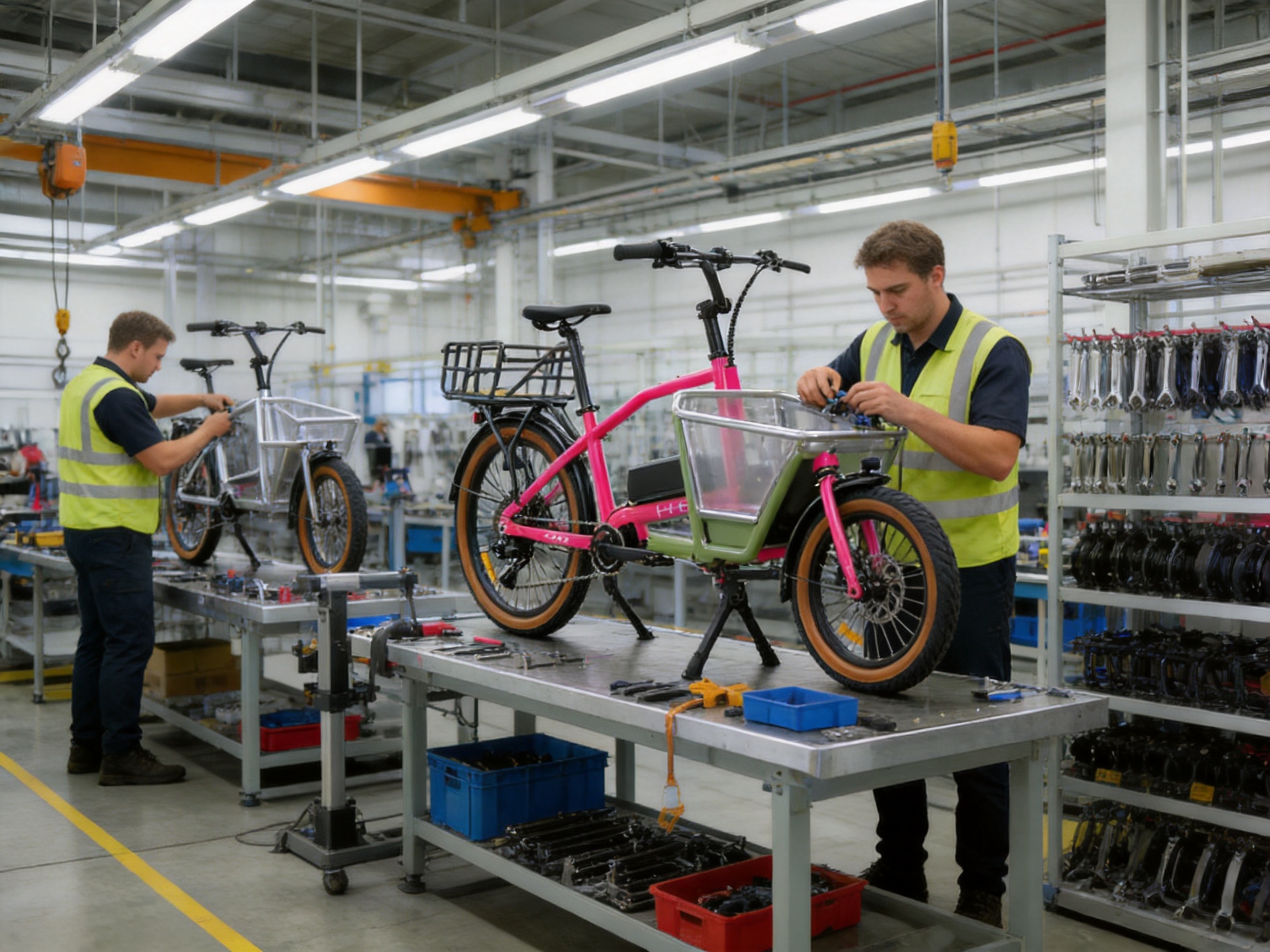
A capable cargo bicycle depends not only on the visible specification list but also on the quality of the development and manufacturing system behind it. Cargo frames experience repeated stress, electric systems require reliable integration, and accessories such as large front baskets must align correctly with the steering and braking architecture. Consistency is therefore as important as innovation.
The company’s background includes an established American beach-cruiser brand, manufacturing experience, a mature supply chain, and continuous product development. These strengths provide a foundation for creating products that are intended for regular use rather than occasional display. Experience with bicycle manufacturing can support better component selection, production planning, supplier coordination, and quality-control procedures.
The ESV1’s design suggests a systems-based development process. The front basket, frame, wheels, motor, battery, transmission, tires, and brakes must work together. A large front storage structure affects steering load. A powerful climbing system affects drivetrain strength. A high total load affects tire selection and braking. An adventure-oriented product cannot be developed successfully by optimizing each component in isolation.
Frame manufacturing typically begins with material preparation and precise tube cutting or forming. Components must then be positioned in fixtures that help maintain alignment during welding. For a cargo bike, the accuracy of the head tube, bottom bracket area, rear triangle, and cargo-support structure is especially important. After welding, frames can undergo visual inspection, dimensional checks, finishing, and coating. Consistent procedures help ensure that production units perform similarly and that components fit correctly during final assembly.
Aluminum alloy frames require appropriate welding knowledge and process control. Heat input, joint preparation, fixture stability, and post-welding inspection all influence the finished structure. A manufacturer with an established supply chain can coordinate materials and production tools more effectively, reducing variation between batches. This is important for large cargo frames, where dimensional consistency affects steering, wheel alignment, cable routing, and brake performance.
Component integration is another manufacturing strength. The battery, motor, display or control interface, wiring, sensors, and drivetrain must be assembled in a way that protects them from vibration, moisture, and accidental damage. Cable routing should avoid sharp bends and moving parts. Battery mounting should be secure but serviceable. Motor and drivetrain alignment must be checked during final assembly.
The company also emphasizes international design and research-and-development capability, with a design and R&D team based in Paris and company origins in California. This international structure can help bring together different perspectives on utility, styling, ergonomics, regulatory expectations, and riding environments. A bike intended for global buyers must be adaptable to diverse uses, from urban logistics to recreational touring and commercial work.
Manufacturing strength should also be measured by the ability to support customization and wholesale requirements. The company presents itself as a supplier of electric cargo-bike and electric-bakfiets solutions for global buyers, including custom design and larger orders. This suggests a business model capable of adapting configurations, specifications, or branding for different market needs, subject to technical feasibility and applicable regulations.
Customization is most valuable when it is controlled through a structured engineering process. Changing a basket, rack, battery, motor, or frame component can affect load distribution and safety. A responsible manufacturer must evaluate such changes rather than simply adding parts. The ESV1’s platform-oriented design may provide a useful basis for different adventure, delivery, family, or utility configurations, but every variation should preserve appropriate structural and braking margins.
The most obvious application is carrying camping equipment to a campsite, cabin, lakeside area, or trailhead. The front basket can hold a tent, sleeping system, cooking gear, food, and other supplies. The motor supports climbs that might otherwise be difficult with a heavy load, while the wide tires help the bike remain comfortable on mixed surfaces.
Riders should pack according to density. Heavy items such as water, cooking fuel, tools, or food should be positioned low and centered. Lightweight but bulky items can occupy the upper part of the basket. Clothing and sleeping equipment can be placed in waterproof bags to protect them from rain and road spray.
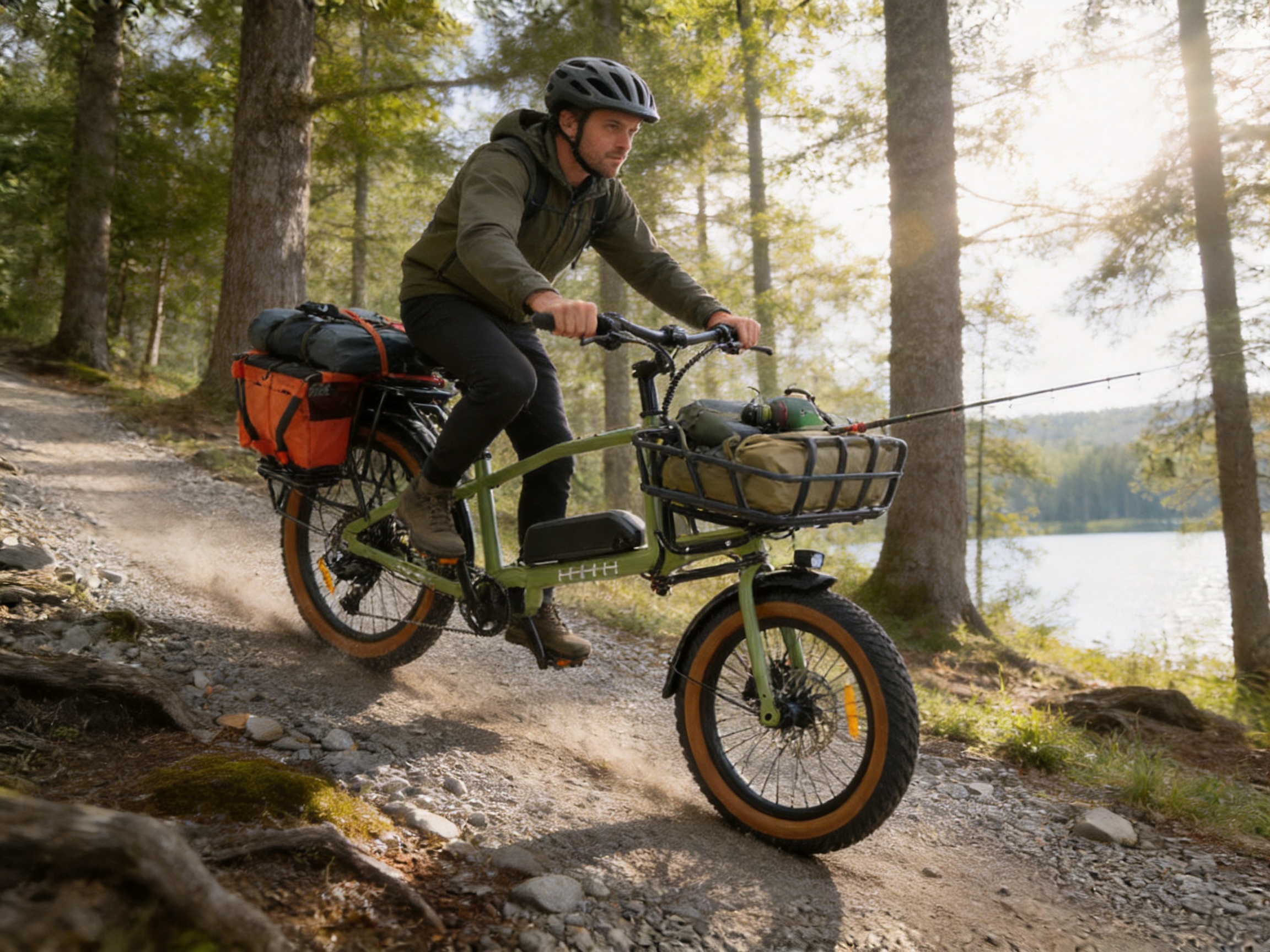
Fishing equipment often consists of long, rigid, or irregularly shaped objects that are difficult to carry on a normal bicycle. A large front deck can accommodate tackle boxes, coolers, waders, folding chairs, and compact rods when they are secured properly. The bike can serve as a practical transport option for reaching locations where motor vehicles are inconvenient or prohibited.
Because fishing areas may include mud, gravel, and wet grass, the hydraulic disc brakes and puncture-resistant tires are useful features. Riders should clean the bicycle after exposure to grit, mud, saltwater, or standing water, paying particular attention to the chain, brake components, and wheel areas.
The ESV1 can also serve users who live outside dense urban areas. It can transport groceries, gardening supplies, tools, parcels, or maintenance equipment between a home, workshop, market, or nearby property. The large basket may reduce the number of trips required, while the electric assist makes heavy loads more practical over rolling terrain.
Small businesses and mobile service providers may use an adventure-style cargo bike for equipment transport. Landscapers, photographers, repair technicians, event workers, and outdoor instructors may benefit from a bicycle that can carry tools while accessing narrow paths or pedestrian areas. The front cargo space provides a clear equipment zone, and the high load capacity can support a more comprehensive work kit.
Commercial users should consider local regulations, insurance, lighting requirements, load-securing standards, and battery-charging procedures. A cargo bike used daily for business should also follow a preventive maintenance schedule rather than waiting for components to fail.
Although the ESV1 is positioned as an adventure cargo bike, its carrying ability can also support practical household transportation. It may carry groceries, sports equipment, picnic supplies, or luggage for a day trip. Users should only carry passengers if the bicycle has an approved passenger configuration and the relevant safety equipment. The presence of a large basket alone does not authorize passenger transport.
Correct setup has a major influence on how a cargo bicycle feels. Before riding, users should adjust saddle height, handlebar position, tire pressure, brake lever reach, and assistance settings. A comfortable and controlled posture becomes even more important when the bike is carrying heavy equipment.
Load distribution should be planned before departure. A useful arrangement places dense items near the bottom of the front basket and keeps the total mass centered from side to side. Long objects should not extend into the steering path or obstruct lights. Soft bags can fill empty spaces, but they should not be allowed to hang near the tires or drivetrain.
New owners should practice with an unloaded bicycle first, then add weight gradually. Starting, stopping, turning, and parking feel different as cargo is added. Practicing in a quiet area helps the rider learn the bike’s dimensions and braking response before entering traffic or traveling on a trail.
Assistance should be selected according to terrain and battery needs. High assistance is useful for steep climbs or difficult starts, but moderate settings can extend range on flatter roads. Gear selection remains important even when the motor is active. A lower gear can make a climb more manageable and may reduce stress on the drivetrain.
When descending with a full load, speed should be controlled early. Riders should avoid waiting until the final moment to brake. On loose surfaces, smooth inputs are preferable to abrupt steering or braking. If the route becomes too steep, narrow, or unstable, dismounting and walking may be the safest choice.
A cargo bike carries more weight and often covers more demanding surfaces than a standard commuter bike, so maintenance should be treated as part of ownership. Before each ride, the rider should check tire condition and pressure, brake function, wheel security, cargo attachments, battery seating, and the general condition of the drivetrain.
The chain and gear system should be cleaned and lubricated at appropriate intervals. Mud and dust can accelerate wear, especially when the bicycle is used on trails. The 11-speed Shimano Cues drivetrain should be kept correctly adjusted so that shifting remains precise under load.
Brake pads and rotors should be inspected regularly. Heavy cargo and repeated descents increase braking wear. Any unusual vibration, grinding, reduced stopping power, or lever softness should be investigated promptly.
The battery should be stored and charged according to the manufacturer’s instructions. Extreme temperatures, moisture, physical damage, and unauthorized modifications can reduce battery life or create safety risks. The charging area should be dry, ventilated, and away from flammable materials. Riders should use the specified charger and avoid using damaged batteries or cables.
After wet or muddy rides, the bike should be cleaned without directing high-pressure water at bearings, electrical connections, the motor, or the battery compartment. A gentle rinse or damp cloth followed by drying is generally safer. The frame, basket, wheels, and drivetrain should be checked for trapped debris.
Periodic professional inspections are advisable for high-use bikes. A qualified technician can check wheel tension, headset adjustment, bottom-bracket condition, motor mounting, frame joints, brake hydraulics, and drivetrain wear. This is particularly important for commercial users or riders who frequently operate near the maximum load.
Electric cargo bikes can contribute to more sustainable transportation by replacing some short car trips. Their usefulness increases when one bicycle can perform several roles: commuting, shopping, recreation, outdoor travel, and small-scale delivery. A versatile platform may reduce the need to own separate vehicles for every task.
The sustainability of a bicycle also depends on its useful life. Durable materials, serviceable components, repairability, and responsible maintenance can extend ownership and reduce replacement frequency. The ESV1’s aluminum frame, established bicycle components, and hydraulic braking system are part of a design intended for continued use rather than disposable convenience.
Sustainability also includes manufacturing responsibility. A mature supply chain and structured quality control can reduce rejected parts, assembly errors, and premature product failure. Continuous product development can improve efficiency, reliability, and usability over time. The company’s stated focus on reliability, practicality, and green transportation reflects this broader view of electric mobility.
Riders can support the environmental benefits of the bike by charging responsibly, maintaining tire pressure, repairing punctures and worn components when practical, and planning efficient routes. Battery replacement should be handled through appropriate recycling or collection channels rather than ordinary household waste.
The ESV1 is best suited to riders who need more capacity than a conventional bicycle can provide and who want to travel beyond strictly paved urban routes. It is particularly relevant to campers, anglers, rural residents, outdoor enthusiasts, small businesses, and families seeking a multipurpose utility bicycle.
It may also appeal to buyers who value a front-loading design but do not want to give up climbing support or off-road capability. The combination of a large front basket, central motor, wide puncture-resistant tires, 11-speed gearing, and hydraulic brakes creates a balanced specification for mixed-use riding.
Potential buyers should consider their available storage space, transportation method, typical route width, charging access, and expected cargo weight. The ESV1 is a substantial cargo bike, not a minimal folding commuter. Its benefits are greatest when the rider regularly uses its capacity and adventure-oriented equipment.
The ESV1 Adventure Cargo Bike is built around a clear proposition: carry meaningful amounts of equipment, travel confidently over mixed surfaces, and use electric assistance to make demanding journeys more accessible. Its oversized front folding basket separates it from ordinary commuter bicycles and gives it a practical advantage over cargo models that rely on smaller racks or rear-only storage.
The 6061 T4T6 aluminum alloy frame and 170-kilogram stated maximum load support serious utility. The 250-watt Starunion mid-drive motor works with the Shimano 11-speed Cues drivetrain to provide controlled assistance on hills. The 540-watt-hour Samsung battery offers a useful energy platform, while the 18-inch and 24-inch puncture-resistant tires provide a balance of low cargo placement, stability, and mixed-surface capability. Tektro hydraulic disc brakes add the control needed for a heavier bicycle operating in wet, muddy, or hilly environments.
Its advantages are reinforced by the company’s broader strengths: American product origins, European design and research-and-development input, established bicycle manufacturing experience, a mature supply chain, and an emphasis on custom solutions for global users. These capabilities support a product-development process in which frame structure, cargo storage, electric assistance, braking, and practical ownership are considered together.
For riders who want one vehicle for camping, errands, outdoor recreation, rural transport, and light commercial work, the ESV1 offers a compelling alternative to smaller utility bicycles and less adaptable cargo systems. Its success ultimately depends on responsible loading, correct maintenance, sensible route selection, and safe riding technique. Used within those limits, it is a capable platform for carrying more, going farther, and turning everyday cycling into a more versatile form of transportation.
The ESV1 is an adventure-oriented electric cargo bike. It is designed to carry substantial loads while supporting travel on paved roads, gravel routes, access roads, and suitable uneven trails.
Its main distinguishing feature is the oversized front folding basket. The basket measures approximately 470 millimeters by 470 millimeters by 375 millimeters and is intended for bulky items such as camping equipment, coolers, tools, fishing gear, and luggage.
The listed maximum load is 170 kilograms. Riders should confirm whether the figure includes the rider, cargo, and accessories, and should always follow the latest official loading guidance.
The bike uses a Starunion CM2503 mid-drive motor rated at 250 watts. A mid-drive system works through the bicycle’s gearing, which can be useful for loaded climbs and changing terrain.
The ESV1 uses a Samsung 36-volt, 15-amp-hour lithium battery listed at 540 watt-hours. Actual range varies according to load, terrain, assistance level, weather, tire pressure, speed, and riding behavior.
A mid-drive motor applies assistance through the bicycle’s drivetrain. This allows the rider to use the 11-speed transmission to select an appropriate gear for climbs, acceleration, or cruising, while also keeping the motor’s weight near the center of the bicycle.
It is equipped with a Shimano 11-speed Cues speed system. The wide gear range gives riders more flexibility when carrying heavy cargo or riding on hills.
The bike uses Tektro hydraulic disc brakes. They are designed to provide strong, controllable braking with relatively low hand effort and are well suited to wet, muddy, or heavily loaded riding conditions.
The bike uses 2.4-inch-wide puncture-resistant tires, with an 18-inch front wheel and a 24-inch rear wheel. They are suitable for many mixed-surface routes, including compacted gravel and uneven access roads, but riders should avoid terrain beyond the bicycle’s handling limits.
Yes. The oversized front basket is specifically intended to carry camping essentials and other bulky outdoor equipment. Heavy items should be kept low and centered, and all cargo should be secured with suitable straps or nets.
The front basket is described as a folding basket. Its folding function may make storage, transport, and changing between cargo configurations more convenient.
It may be suitable for small-scale delivery, mobile service work, outdoor instruction, event support, or tool transport. Commercial users should verify local regulations, insurance requirements, equipment limits, lighting rules, and maintenance needs.
Not necessarily. The supplied information lists a maximum load of 170 kilograms, but the exact interpretation should be confirmed in the official product documentation. Many bicycle load ratings include the rider, cargo, and accessories together.
Regular maintenance should include checking tire pressure, brakes, wheels, cargo attachments, battery seating, chain lubrication, drivetrain adjustment, and frame condition. Mud and water should be removed after difficult rides, and electrical components should not be exposed to high-pressure washing.
No. It is designed for adventure cargo use and suitable mixed-surface travel, but it is not automatically a replacement for a dedicated mountain bike. Riders should avoid jumps, extreme downhill terrain, deep obstacles, and surfaces that exceed the bike’s design limits.
The company combines American product origins, European design and research-and-development input, established bicycle manufacturing experience, a mature supply chain, and a stated capacity to support custom and wholesale cargo-bike solutions. These strengths can help integrate frame design, electric systems, accessories, quality control, and market-specific requirements.
1. Product specification sheet for the ESV1 Adventure Cargo Bike, including frame, battery, drivetrain, motor, basket, tire, dimension, load, and brake information.
2. Technical information concerning 6061 aluminum alloy bicycle-frame construction and structural design considerations.
3. Shimano Cues drivetrain service and operating principles for multi-speed bicycle systems.
4. General technical guidance on mid-drive electric bicycle motor integration and gear-assisted climbing performance.
5. General bicycle safety practices for cargo loading, braking, tire inspection, and mixed-surface riding.
6. Manufacturer background information concerning product development, international design and research, manufacturing expertise, supply-chain management, and custom cargo-bike solutions.
Nov 17, 2026
Nov 03, 2026
Oct 26, 2026


info@atmosecargobike.com

200 rue de la Croix Nivert 75015 Paris

Custom Electric Bakfiets
 English
 Français
 Deutsch