Aug 17, 2026
Adventure cycling demands more than speed, style, or a generous battery range. It demands confidence when the route becomes rough, the weather changes, the nearest service point is far away, and every kilogram carried has to earn its place. For riders who explore beyond dependable infrastructure, mechanical simplicity can be just as valuable as electrical assistance. The Atmose Model V V1 Manual Adventure Cargo Bike is designed around that principle.
The V1 is a purpose-built, non-electric cargo bike for wilderness travel, bikepacking, expedition touring, outdoor work, and long-distance exploration. It removes the motor and battery found on electric cargo bicycles and replaces them with a direct, mechanical riding experience. Its concept is straightforward: offer a highly capable cargo platform with an oversized front rack, a wide-range drivetrain, hydraulic disc brakes, puncture-resistant tires, and a durable aluminum frame, while avoiding dependence on charging stations or electrical components.
This approach gives the V1 a distinctive position in the cargo-bike market. Most modern cargo bikes emphasize motor assistance, connected features, high-capacity batteries, and urban convenience. Those qualities are valuable for commuting, family transport, and delivery work, but they are not always ideal for remote adventure. A manual bike can be easier to maintain in the field, easier to transport over obstacles, and more predictable when a journey extends beyond the reach of workshops and electrical infrastructure.
The V1 is not simply an ordinary bicycle fitted with a large basket. Its frame, wheel arrangement, cargo capacity, braking system, gearing, and dimensions are configured around carrying equipment while retaining practical maneuverability. With a front folding basket measuring 370 millimeters in length, 370 millimeters in width, and 375 millimeters in height, it creates a substantial loading area without requiring a trailer for every expedition.
For riders who value independence, durability, and a direct connection with the trail, this manual adventure cargo bike offers a compelling alternative to conventional electric cargo models.
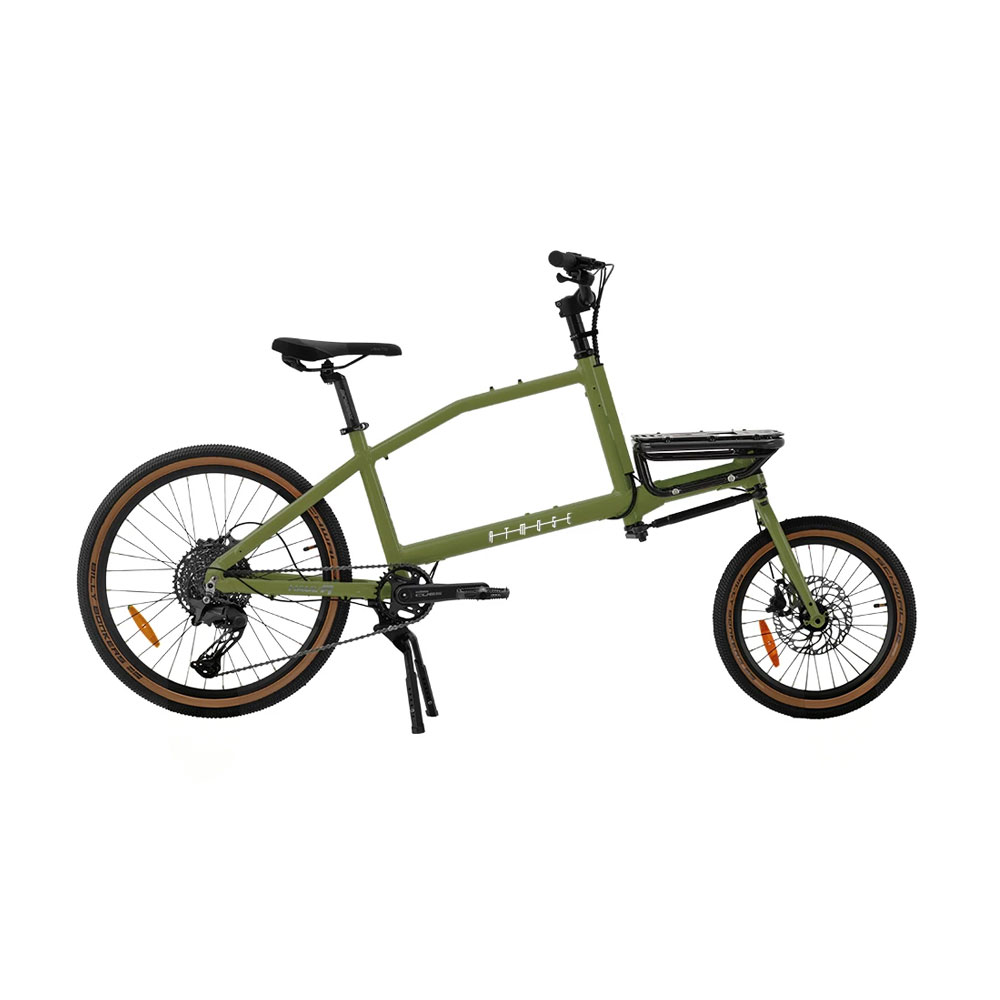
Atmose Model V V1 Manual Adventure Cargo Bike with Oversized Front Rack
Electric cargo bikes have transformed everyday transportation. They help riders carry children, groceries, tools, and commercial loads over hills and longer distances. However, electrical systems introduce additional considerations. Batteries must be charged, motors require specialized components, and electronic faults may be difficult to diagnose far from a dealer or service center. Battery weight can also make a bike harder to lift, transport, or maneuver when the riding surface ends.
The Model V V1 addresses these concerns by using a purely mechanical configuration. It has no battery and no motor. Instead, the rider’s effort is transferred through a Shimano 11-speed Cues drivetrain. This makes the bike particularly suitable for environments where charging stations are unavailable or where the rider wants complete control over maintenance and energy management.
The absence of electrical assistance does not mean the bike is limited to gentle paths. The V1 is designed for loaded travel, climbing, and uneven terrain. Its wide-range gearing allows riders to select a lower gear when carrying camping equipment uphill and a higher gear when traveling efficiently on flatter ground. The system supports a broad range of terrain and riding conditions without relying on software, battery capacity, or motor output.
This simplicity is an important competitive advantage. A conventional electric cargo bike may be faster on a climb when its battery is full, but its assistance level depends on remaining charge, system condition, and electronic control. The V1 provides a more consistent experience. Its performance depends on the rider, gearing, tire pressure, terrain, and load rather than on an energy storage system.
For a wilderness traveler, that predictability can be more valuable than maximum powered acceleration. A rider can plan an expedition around food, water, navigation, clothing, and tools instead of adding charging equipment or calculating battery reserves. The bike becomes a self-contained mechanical platform rather than a vehicle dependent on external power.
The defining feature of the V1 is its oversized front rack and folding basket. The front cargo area is engineered to accommodate equipment that would be inconvenient to carry in conventional panniers. Tents, sleeping bags, cooking equipment, coolers, repair tools, dry bags, and outdoor supplies can be organized on the front deck in a way that keeps them accessible during a trip.
The stated basket capacity is 25 kilograms, while the maximum rider load is 145 kilograms. These figures make the V1 suitable for a substantial combination of rider and equipment, although users should distribute cargo carefully and remain within the specified limits. A balanced load improves steering control, braking behavior, and stability on rough surfaces.
The front folding design contributes to practical storage and transport. When the basket is folded, the bike can be more convenient to store in a workshop, vehicle, aircraft cargo area, or compact shelter. This is especially useful for expedition riders who need to combine cycling with other forms of transportation. A bike that can be loaded onto a support vehicle or moved through a narrow access point offers more route flexibility than a permanently extended cargo platform.
Compared with a standard touring bicycle, the V1 provides a more substantial cargo interface. A conventional bicycle may require multiple panniers, a rear rack, a handlebar bag, and a trailer to carry the same expedition equipment. The V1 consolidates much of that capacity in a single front loading area. This can simplify packing and make frequently used items easier to reach.
Compared with many compact cargo bikes, the V1 emphasizes open loading volume rather than a small enclosed compartment. That makes it adaptable to irregularly shaped gear. A cooler, rolled shelter, waterproof container, toolbox, or field case can occupy the basket without needing a custom bag. The platform is therefore suitable not only for recreation but also for outdoor professionals, mobile researchers, remote maintenance crews, photographers, and adventure guides.
Cargo capacity is useful only when it remains manageable on the trail. The V1’s loading area is positioned to support practical organization while preserving the bike’s overall riding character. Riders should place dense items low and near the center of the basket, secure loose objects with appropriate straps, and avoid allowing cargo to interfere with steering or braking components.
The front rack also encourages a different packing strategy from a rear-loaded touring bicycle. Frequently accessed items can be positioned at the top or toward the rear of the basket, while heavier equipment can be placed lower. This makes it possible to separate emergency supplies, navigation equipment, food, and sleeping gear according to how often they are needed.
For an expedition, organization can be as important as capacity. A well-arranged basket reduces the time spent unpacking and repacking. It also helps riders inspect their load before a technical section of trail. The V1’s open cargo format allows the rider to see whether straps are secure and whether weight is distributed evenly.
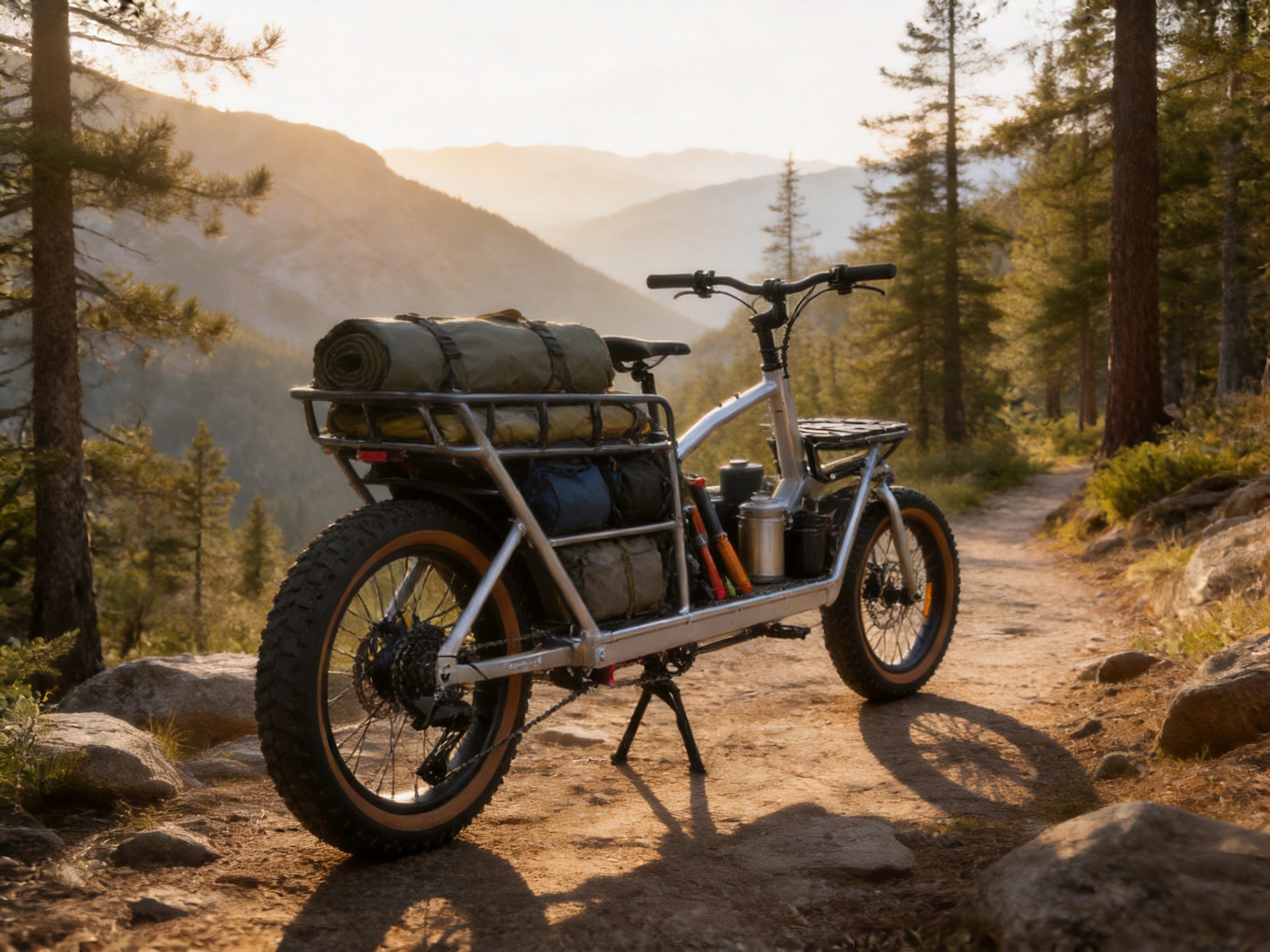
The V1 uses a 6061 T4T6 aluminum alloy frame. Aluminum is widely valued in cargo-bike design because it combines relatively low weight with useful strength, corrosion resistance, and manufacturing flexibility. The use of a recognized 6061 alloy platform reflects the bike’s emphasis on a practical balance between durability and transportability.
The frame is not presented as an oversized industrial structure that relies on mass alone. Instead, the design aims to support a meaningful cargo load while remaining light enough for expedition use. The product information specifically emphasizes that the manual V1 is significantly lighter than comparable electric versions. This difference matters when the route includes stairs, fallen trees, soft ground, river crossings, steep carrying sections, or vehicle loading.
At 1,910 millimeters in length, 750 millimeters in width, and 1,060 millimeters in height, the bike retains a substantial cargo-bike footprint while remaining within a manageable size for paths, storage areas, and transport. The dimensions support a stable riding position and a generous loading platform without turning the bike into an unwieldy utility vehicle.
Frame design for an adventure cargo bike requires attention to several competing goals. A longer cargo structure can improve load placement and stability, but excessive length can make tight turns difficult. A wider cargo platform can increase capacity, but excessive width may create problems on narrow trails. A stronger frame may tolerate higher loads, but additional material can make the bike harder to lift. The V1 is positioned as a compromise between carrying ability, maneuverability, and field portability.
Its aluminum construction also supports the company’s wider manufacturing strengths. Atmose combines American product development heritage with European design and research-and-development activity. The company describes its work as being supported by manufacturing experience, an established supply chain, and continuing product innovation. In the V1, those strengths are expressed through a product that integrates frame material, cargo structure, drivetrain selection, braking, tires, and folding functionality into one coherent use case.
Remote riding changes the meaning of reliability. In an urban environment, a malfunction may be inconvenient but manageable. A rider can often reach a repair shop, use public transportation, or call for assistance. On a wilderness route, a failure can disrupt a schedule, compromise equipment, or create a serious safety concern.
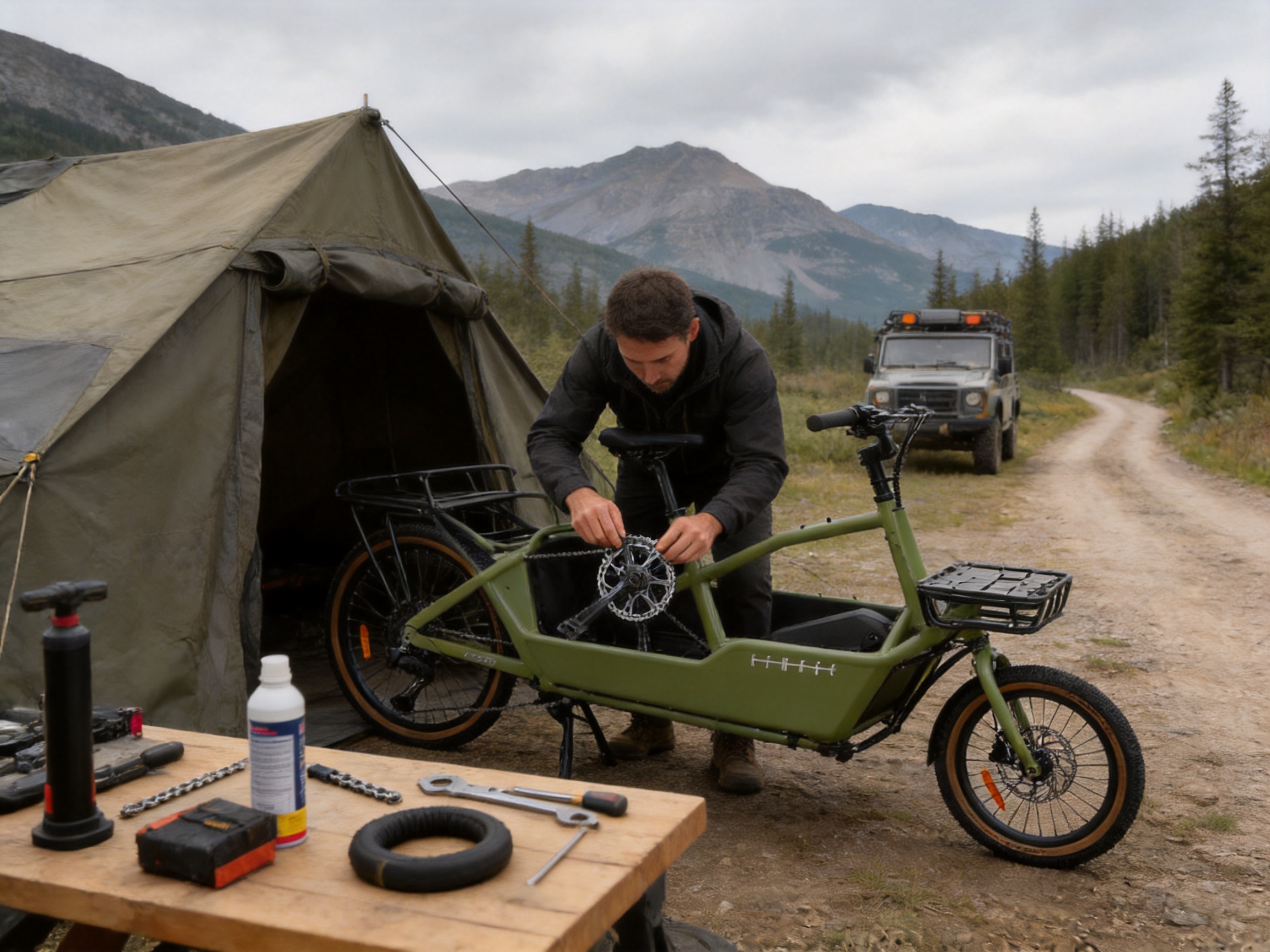
The V1 reduces the number of systems that must be supported in the field. There is no motor controller, battery management system, charging port, display, pedal-assistance sensor, or proprietary electrical diagnostic process. The remaining mechanical components can be inspected and serviced using familiar bicycle tools and replacement parts appropriate for the drivetrain and braking system.
This does not make the bike maintenance-free. Chains need lubrication, tires need inspection, brake systems require attention, and gear adjustment must be kept in good condition. However, the maintenance model is straightforward and familiar. Riders can prepare before departure and carry a practical selection of spare parts, including tubes or repair materials, chain tools, brake-related supplies, and fastening hardware.
The absence of a battery also removes concerns about cold-weather battery performance, storage charge, charging access, and long-term battery replacement. For multi-day travel, this can simplify logistics. A rider still needs to manage personal energy and food, but the bicycle itself does not consume stored electrical energy.
Mechanical simplicity is particularly valuable for international travel. Different regions may have limited access to brand-specific electronic components, while mechanical bicycle parts are generally easier to understand and replace. The V1’s Shimano 11-speed Cues drivetrain and Tektro hydraulic disc brakes are recognizable component systems that can be maintained by qualified bicycle technicians familiar with modern bicycle equipment.
One of the V1’s strongest advantages over many competitors is not a single component but the reduction of system complexity. Every additional subsystem can offer benefits, yet it can also create another point requiring inspection, troubleshooting, or replacement. The manual configuration makes a deliberate trade: it gives up powered assistance in exchange for lower system complexity and a direct mechanical operating model.
This trade will not suit every rider. Someone carrying heavy cargo through steep urban streets may reasonably prefer a motor. Someone commuting long distances every day may prioritize assistance. The V1 is aimed at riders whose priorities are independence, field serviceability, lower transport weight, and freedom from charging infrastructure.
The Shimano 11-speed Cues system provides the V1 with a broad selection of ratios. A wide-range drivetrain is essential for a manual cargo bike because the rider must adapt to changes in slope, surface, wind, and cargo weight. A low gear reduces the force required at the pedals during steep climbs, while higher gears allow efficient progress on smoother or descending sections.
On an adventure journey, terrain can change repeatedly within a few kilometers. A route may begin on pavement, transition to gravel, rise through a forest road, and finish on a rocky climb. The 11-speed arrangement gives the rider more opportunities to maintain a comfortable cadence instead of forcing a choice between gears that are too difficult and too easy.
Gear range also supports better energy management. A rider carrying a full basket should avoid pushing an excessively high gear on a climb, where muscular fatigue can accumulate quickly. By selecting an appropriate lower ratio, the rider can maintain a more sustainable effort. On long journeys, this ability to control exertion is central to comfort and endurance.
The drivetrain’s mechanical nature is consistent with the V1’s wider design philosophy. It offers performance through gearing rather than a motor, allowing skilled riders to use route planning, cadence, and load management to overcome demanding terrain. This can create a more engaging experience for cyclists who prefer direct control over assisted acceleration.
The V1 uses 18-inch by 2.4-inch tires at the front and a 20-inch by 2.4-inch tire at the rear. The relatively wide 2.4-inch profile provides a broad contact patch and supports the bike’s intended use on mixed and unpaved surfaces. Wide tires can help improve comfort, traction, and confidence on gravel, compact dirt, forest tracks, and uneven paths when inflated appropriately for the rider and cargo load.
The tire specification also reflects the bike’s cargo role. A loaded bicycle places more demand on its contact points than a lightly equipped road bike. Wider tires can help distribute that load and reduce the harshness of small surface irregularities. They can also offer additional stability when the rider is carrying camping equipment or other bulky items.
The product information identifies the tires as punch proof. This feature is valuable for adventure use, where sharp stones, thorns, rough debris, and remote trail conditions can increase the likelihood of punctures. No tire is completely immune to damage, and riders should still carry repair equipment, but puncture-resistant construction can reduce interruptions and improve confidence.
The combination of different wheel sizes is also suited to cargo-bike geometry. The front wheel and cargo area can be arranged to support a low and practical loading position, while the rear wheel contributes to efficient propulsion and overall handling. The result is a configuration designed around the interaction between rider, cargo, and frame rather than the conventions of a standard single-purpose bicycle.
Tire pressure should be adjusted according to rider weight, cargo, terrain, temperature, and tire manufacturer recommendations. Hard surfaces generally benefit from a firmer setup, while loose or uneven trails may reward a slightly lower pressure within safe limits. Riders should avoid excessive reduction, because underinflation can increase rim impacts, rolling resistance, and the risk of tire damage.
Before a long expedition, the complete loaded bicycle should be tested on a range of surfaces. This allows the rider to evaluate steering response, braking distance, comfort, and traction before reaching remote terrain. Tire pressure is part of the V1’s performance system and should be treated as an adjustable setup element rather than a fixed number.
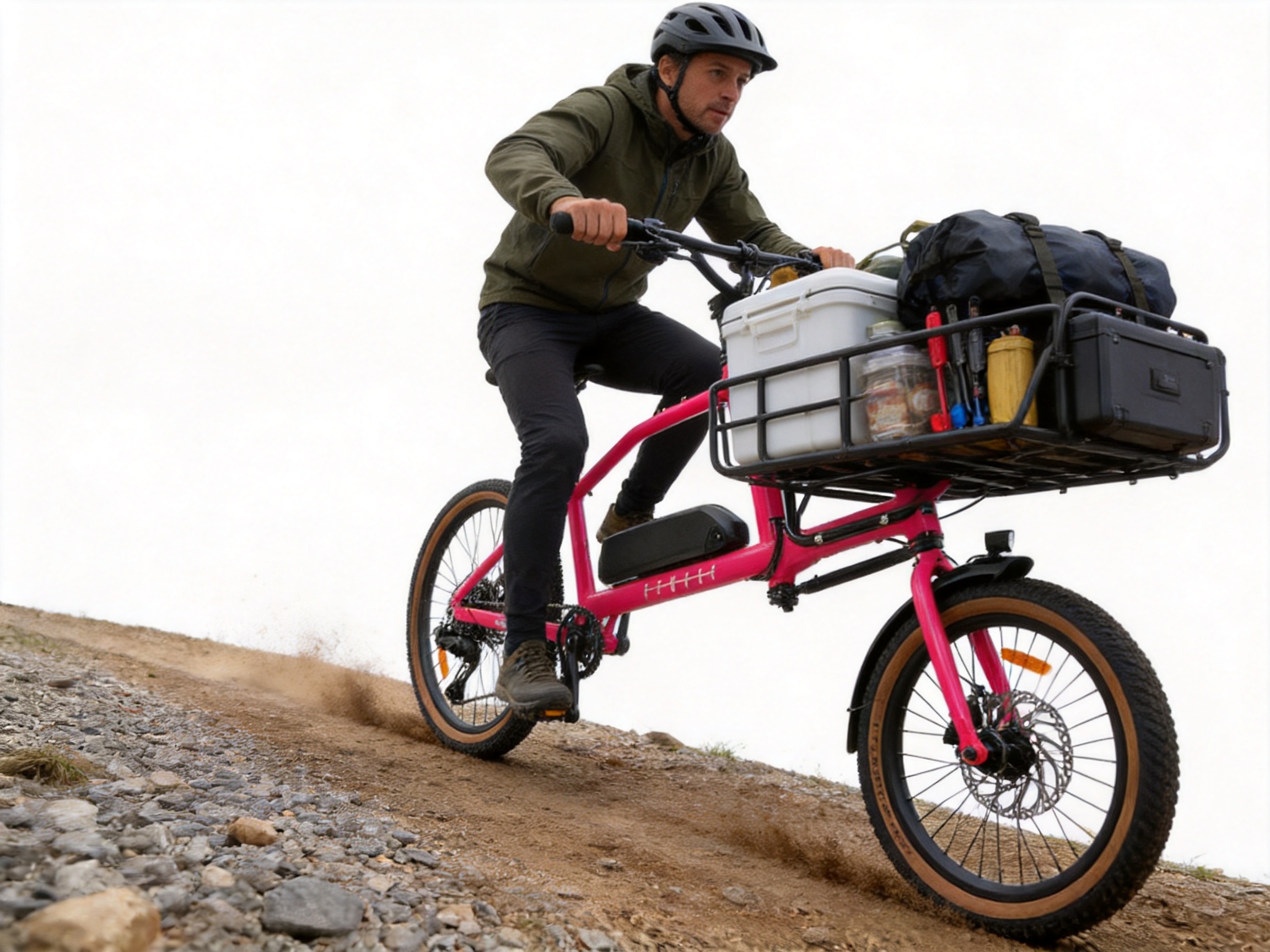
The V1 is equipped with Tektro hydraulic disc brakes. Cargo bikes benefit significantly from powerful and controllable braking because the total moving mass can be much greater than that of a conventional bicycle. When the rider, basket, equipment, and frame are all moving downhill, predictable braking is essential.
Hydraulic disc brakes transmit force efficiently and can provide smooth modulation at the brake levers. This allows the rider to manage speed gradually on descents, loose surfaces, and technical sections rather than relying only on abrupt braking. Consistent braking can also reduce rider fatigue during long downhill routes.
Brake performance should always be matched to the actual load and conditions. Riders should inspect rotor condition, pad wear, lever feel, and hydraulic lines before departure. Wet weather, mud, dust, and steep terrain may require more frequent checks. The V1’s braking equipment is an important part of its adventure capability, but safe riding still depends on appropriate speed and route judgment.
Compared with basic mechanical rim brakes often found on simpler utility bicycles, hydraulic disc brakes can offer advantages in wet conditions, heat management, and control. They are especially appropriate for a cargo bike intended to carry significant equipment on varied terrain. The braking system complements the wide tires and strong frame by giving the rider a more complete control package.
“Outperform” does not always mean traveling faster. In remote adventure cycling, performance may mean completing a route without needing external support, carrying the bike across an obstacle, maintaining control over energy use, or repairing a problem with available tools. From that broader perspective, the V1 can offer advantages over electric cargo bikes in specific conditions.
First, the V1 does not depend on a battery. A rider can begin a journey without checking a charge level or identifying a charging point along the route. The bike’s available range is determined primarily by human endurance and supplies, making planning more direct.
Second, the V1 is lighter than its electric counterparts. Weight becomes particularly important when the bike is not rolling. A powered cargo bike may be easy to ride with assistance but difficult to lift after a trail blockage, transport into a shelter, or load onto a small aircraft. The V1 is designed with these non-riding situations in mind.
Third, the mechanical system can be more accessible to experienced cyclists and bicycle mechanics. Instead of relying on electronic diagnostics, the rider can inspect the drivetrain, brakes, wheels, and frame using familiar procedures. That is a practical benefit for remote travel and international expeditions.
Fourth, the manual format encourages careful pacing. Riders become more aware of terrain, load, cadence, and energy reserves. For some adventurers, this creates a more satisfying and immersive experience than motor assistance. The bicycle becomes an active part of the expedition rather than a powered transport device.
Electric cargo bikes still hold clear advantages for many applications. They are often preferable for steep city routes, frequent heavy hauling, mobility support, and riders who need assistance over long daily distances. The V1’s advantage is more specialized: it is designed for riders who value mechanical independence and field portability above electrical assistance.
The V1 reflects the broader capabilities of Atmose as a cargo-bike company with an international development structure. The company originated in California and was developed by MOTIV, an established American beach cruiser brand. It later established ATMOSE SASU in France, alongside a design and research-and-development team. This combination brings together American product thinking, European design sensibility, and an international manufacturing and supply-chain framework.
The stated company philosophy is “Fun & Practical.” For the V1, practicality appears in the focus on cargo access, folding functionality, serviceable mechanical systems, manageable dimensions, and adventure-oriented components. The design is not based solely on appearance. It responds to specific operational requirements: carrying equipment, navigating unpaved routes, climbing under load, and coping with limited infrastructure.
Advanced manufacturing is not limited to the use of automation or sophisticated machinery. It also includes the ability to translate a clear use case into a reliable integrated product. The V1 requires coordination between frame geometry, aluminum alloy selection, basket construction, wheel sizing, drivetrain compatibility, brake performance, tire clearance, and load ratings. Each of these decisions influences the others.
A cargo-bike frame must be produced with consistency because small variations in alignment can influence steering, braking, drivetrain operation, and load stability. The use of a defined 6061 T4T6 aluminum alloy specification indicates a controlled material choice rather than an unspecified frame construction. Component selection from established suppliers further supports consistency and serviceability.
Atmose also identifies manufacturing expertise, a mature supply chain, and continuous innovation as important company strengths. These capabilities are significant for custom and wholesale buyers. Commercial customers often need reliable product specifications, repeatable production, adaptable configurations, and long-term support rather than a one-off prototype. A company capable of combining product engineering with supply-chain coordination is better positioned to serve these requirements.
The V1’s product architecture demonstrates a form of design validation through integration. The oversized front rack is not an accessory added after the frame was completed. It is central to the product identity. The folding basket must work with the steering geometry, cargo clearance, overall width, rider position, and transport requirements.
Likewise, the drivetrain is not selected in isolation. An 11-speed system must work with the wheel sizes, intended cargo weight, rider effort, and climbing requirements. Hydraulic disc brakes must be appropriate for the combined system weight and expected terrain. The punch-resistant tires must fit the wheels and frame while supporting the intended balance between comfort and durability.
This integrated approach is an important distinction from generic bicycle platforms that are adapted to carry cargo without a complete rethinking of the riding experience. The V1 is developed as an adventure cargo bike from the beginning, which allows its main systems to support a common purpose.
The V1 is suitable for a broad range of outdoor uses. Bikepacking is the most obvious application. Riders can carry shelter, cooking equipment, clothing, food, water, and repair tools without attaching a separate trailer for every trip. The front basket can accommodate larger items that are difficult to fit into traditional soft bags.
Camping trips are another natural use. A cooler, compact stove, sleeping system, and personal equipment can be arranged in the basket and secured for travel. The bike’s mechanical configuration is also attractive for campsites or remote bases where electrical charging is limited or unavailable.
Expedition touring can benefit from the V1’s ability to combine cargo volume with a manually powered drivetrain. Long-distance riders can travel through regions where infrastructure varies widely. They can use the same bicycle on paved roads, gravel routes, and rough access tracks, provided that the terrain is appropriate and the load is managed responsibly.
Outdoor work is another possibility. Field photographers, environmental researchers, trail crews, guides, and remote maintenance workers may need to carry specialized equipment over distances that are too long to walk comfortably but not suitable for a motor vehicle. The front cargo area offers a flexible platform for cases, tools, and supplies.
The V1 may also serve as a practical transport option for riders who deliberately avoid motorized assistance. Some cyclists prefer the physical challenge of carrying their own energy. Others may choose a manual bike because of simplicity, exercise, lower maintenance complexity, or the desire to reduce dependence on charging systems. The bike can support these priorities without sacrificing cargo practicality.
Compared with a standard commuter bicycle, the V1 offers much greater cargo capacity, more substantial braking equipment, and a frame designed around loaded use. It is better suited to carrying large or irregular equipment but may be larger than a typical city bicycle.
Compared with a compact electric cargo bike, it is lighter in its non-electric configuration and does not require charging. It may require more physical effort on steep hills, especially when fully loaded, but it offers a simpler operating system and fewer electrical dependencies.
Compared with a longtail cargo bike, the V1 places its primary cargo volume at the front rather than behind the rider. This can make gear more visible and accessible. The preferred format depends on whether the user prioritizes front-loading convenience, passenger carrying, rear pannier compatibility, or a particular riding style.
Compared with a bicycle-and-trailer combination, the V1 provides an integrated platform with fewer separate connections and less equipment to store. A trailer may still offer greater total volume for certain expeditions, but it adds length and another set of wheels, tires, couplings, and loading considerations.
Compared with a basic utility tricycle, the V1 retains a bicycle-oriented layout that can feel more responsive and easier to maneuver on narrow trails. A tricycle may provide standing stability in some situations, while the V1 is designed for riders who want a more active two-wheel adventure experience.
| Feature | Manual Adventure Cargo Bike | Typical Electric Cargo Bike | Standard Touring Bicycle |
|---|---|---|---|
| Primary energy source | Rider power | Battery and rider power | Rider power |
| Charging requirement | None | Required for electrical assistance | None |
| Front cargo capability | Oversized folding basket, rated for 25 kilograms | Varies by model and accessory package | Usually limited to a small rack or handlebar bag |
| Drivetrain | Shimano 11-speed Cues | Motor-assisted drivetrain with mechanical gearing | Varies by model |
| Brake system | Tektro hydraulic disc brakes | Varies by model | Varies by model, often lighter-duty |
| Remote serviceability | Primarily mechanical inspection and repair | May require electrical diagnostics and specific parts | Primarily mechanical inspection and repair |
| Transport over obstacles | Advantaged by the absence of motor and battery weight | Typically more difficult when powered components add mass | Usually easy, but with less cargo capacity |
| Best suited to | Wilderness travel, bikepacking, camping, and remote work | Urban hauling, assisted commuting, and steep daily routes | Light touring and general cycling |
Before taking the V1 into remote terrain, riders should inspect every major system. The frame and basket should be checked for damage, loose fasteners, and signs of stress. The cargo platform should be tested with the intended load, not merely with an empty basket. This helps the rider understand how the additional weight affects steering and stopping.
The drivetrain should shift cleanly across all available gears. A wide-range system is most useful when it is properly adjusted. The chain should be lubricated for the expected weather and surface conditions, and riders should carry a suitable maintenance product for longer trips.
Hydraulic brakes should have a firm and consistent lever feel. Brake pads and rotors should be inspected before departure, particularly if the route includes prolonged descents. Any uncertainty about hydraulic brake condition should be addressed by a qualified technician before the expedition begins.
Tire condition and pressure should be evaluated with the actual cargo loaded. A bicycle that feels stable when empty may respond differently when the basket is full. Test rides should include turns, braking, moderate climbs, and descents. Riders should also practice folding and unfolding the basket so that transport procedures are familiar before the trip.
Cargo should be secured using straps or containers appropriate for rough terrain. Loose equipment can shift during braking or on uneven surfaces, affecting steering and balance. Waterproof bags may be useful even when the basket itself remains open, especially in changing weather.
A loaded front basket changes the feel of steering. Riders should make smooth inputs, avoid sudden direction changes, and allow extra distance for braking. On loose surfaces, a controlled speed is preferable to aggressive cornering. When descending, the rider should keep the load stable and use both brakes progressively.
Climbing technique is also important. Selecting a lower gear before the slope becomes severe helps maintain cadence and reduces the temptation to shift under excessive pedal pressure. If the trail becomes too steep or technical, the V1’s lower weight relative to an electric cargo bike can make dismounting and pushing more manageable.
Because the V1 is manually powered, pacing is central to successful travel. Riders should plan rest stops, food intake, hydration, and daily distance around the terrain and total load. The bike provides the carrying platform, but the expedition remains a partnership between rider, equipment, and environment.
The manual configuration can reduce the number of energy-storage and electronic components required for operation. It does not make the bicycle impact-free: aluminum production, component manufacturing, transportation, maintenance, and eventual disposal all have environmental consequences. However, a bike that does not rely on a battery may simplify ownership and avoid eventual battery replacement.
The V1’s potential service life is supported by its mechanical architecture and established bicycle components. Long-term durability depends on maintenance, storage, riding conditions, load discipline, and replacement of wear parts. Owners who maintain the drivetrain, brakes, tires, and fasteners can help preserve performance over many seasons.
Atmose presents sustainability, reliability, practicality, and fun as central commitments. The V1 supports those values by encouraging low-impact human-powered travel while remaining useful for carrying equipment. It can replace some short vehicle trips, support outdoor access without fuel, and provide a practical alternative to motorized transport in suitable environments.
The V1 is best suited to riders who want a serious cargo platform without an electric system. It is especially relevant to experienced cyclists, bikepacking enthusiasts, wilderness travelers, campers, adventure guides, outdoor workers, and users who regularly travel beyond dependable infrastructure.
It is also suitable for buyers who prioritize low electrical complexity and transportability. If a bicycle must be lifted over obstacles, loaded into a small vehicle, or stored in a remote location, the absence of a heavy motor and battery can be a meaningful benefit.
The V1 may be less suitable for riders who need effortless assistance on steep urban hills, who carry extremely heavy loads every day, or who want to arrive at work with minimal physical exertion. Those users may be better served by an electric cargo model. The strength of the V1 is its clear focus rather than universal compromise.
For the right rider, the V1 provides a rare combination: cargo capacity large enough for real equipment, mechanical performance suitable for climbing, braking and tire systems appropriate for mixed terrain, and a design philosophy centered on independence.
The V1 is a manual adventure cargo bike designed for wilderness exploration, bikepacking, camping, outdoor work, and remote travel. It uses no motor and no battery, relying on rider power and a mechanical drivetrain.
The motorless design removes the need for charging and reduces the number of electrical components that must be serviced. This makes the bike attractive for remote environments where charging stations and specialized repair services may not be available.
The stated maximum basket load is 25 kilograms. The rider and cargo should be distributed carefully, and users should not exceed the manufacturer’s specified limits.
The listed maximum rider load is 145 kilograms. The total setup should also account for equipment, clothing, water, and accessories.
The front folding basket measures 370 millimeters in length, 370 millimeters in width, and 375 millimeters in height.
The bike is equipped with a Shimano 11-speed Cues drivetrain. Its broad gearing is intended to help riders manage climbs and changing terrain while carrying cargo.
The V1 uses Tektro hydraulic disc brakes. These provide controlled braking performance suitable for a loaded bicycle, although regular inspection and maintenance remain essential.
The front uses an 18-inch by 2.4-inch tire, while the rear uses a 20-inch by 2.4-inch tire. The tires are described as punch proof and are intended for mixed and unpaved riding conditions.
Yes. The V1 can be used on paved roads, but its design is especially focused on mixed surfaces, gravel, trails, camping routes, and adventure travel. Tire pressure and cargo setup should be adjusted for the riding surface.
The 11-speed wide-range drivetrain is designed to support climbing under load. However, because the V1 has no motor, steep climbs require physical effort and appropriate pacing from the rider.
The V1 does not provide motor assistance, but it avoids charging requirements and is lighter than its electric counterparts. It can also be easier to inspect and repair in remote locations. Electric cargo bikes remain advantageous when powered assistance is the primary requirement.
The folding front basket can make storage and transport more convenient. The bike’s exact transport method will depend on the vehicle, rack, interior dimensions, and local safety requirements.
The oversized front basket can carry camping gear, tents, coolers, tools, food, water containers, dry bags, photography equipment, and other outdoor supplies, provided the load remains within the stated capacity and is securely fastened.
No. Like all bicycles, it requires maintenance. The chain, gears, brakes, tires, wheels, fasteners, and frame should be inspected regularly. Its advantage is that the operating system is primarily mechanical and does not require battery or motor diagnostics.
The product is associated with Atmose, a cargo-bike company with origins in California and design and research-and-development activity in Paris. The company identifies manufacturing experience, an established supply chain, and continuous product innovation as part of its strengths.
Its cargo platform may be useful for selected commercial and field applications, such as outdoor services, mobile maintenance, photography, guiding, and equipment transport. Commercial users should evaluate route conditions, daily loads, service requirements, and regulatory obligations before purchase.
The V1 offers a much larger front cargo area, a frame designed around loaded transport, hydraulic disc brakes, cargo-oriented wheel sizing, and a stated basket capacity of 25 kilograms. It is designed to carry substantial equipment while remaining a bicycle rather than a motor vehicle.
The Atmose Model V V1 Manual Adventure Cargo Bike is built around a clear and valuable idea: the most capable adventure vehicle is not always the one with the most technology. In remote travel, the ability to operate without charging, reduce system complexity, carry substantial equipment, and move the bicycle over obstacles can be more important than motor output.
Its 6061 T4T6 aluminum alloy frame, oversized folding front basket, Shimano 11-speed Cues drivetrain, Tektro hydraulic disc brakes, and punch-resistant 2.4-inch tires create a practical package for loaded exploration. The bike’s dimensions and cargo ratings support serious use while its manual configuration keeps the platform relatively light and field-accessible.
Atmose’s broader strengths in product development, international design, manufacturing coordination, supply-chain management, and cargo-bike innovation are reflected in the V1’s integrated design. Rather than adapting a basic bicycle to carry a few bags, the company has developed a product around the needs of adventure cargo transport.
For families and commuters, an electric cargo bike may often be the most convenient choice. For riders heading toward remote campsites, rugged access roads, long-distance trails, and regions without reliable infrastructure, the V1 offers a different kind of confidence. It is a mechanical workhorse for people who want to carry more, depend on less, and keep moving when the route leaves modern convenience behind.
Atmose Bikes. Model V V1 Product Information and Technical Specification Sheet.
Atmose Bikes. Adventure Cargo Bike Model V Product Description and Product Imagery Documentation.
Atmose Bikes. Corporate Information, Product Development Philosophy, and Company Background.
Shimano. Cues Bicycle Drivetrain Product and Service Information.
Tektro. Hydraulic Disc Brake Technical and Maintenance Information.
Aluminum Association. General Information on 6061 Aluminum Alloy Applications.
International Organization for Standardization. General Bicycle Safety, Testing, and Load-Related Guidance.
Nov 27, 2026
Nov 25, 2026
Nov 21, 2026


info@atmosecargobike.com

200 rue de la Croix Nivert 75015 Paris

Custom Electric Bakfiets
 English
 Français
 Deutsch