Nov 09, 2026
Adventure cycling demands more than a comfortable frame and a large carrying platform. Riders who travel beyond paved roads need equipment that can carry substantial loads, remain controllable on uneven terrain, tolerate difficult weather, and continue working when access to charging infrastructure, repair shops, and replacement components is limited. The Atmose Model V V1 Manual Adventure Cargo Bike is designed around that reality.
Unlike a conventional electric cargo bike, the V1 removes the motor, battery, controller, charger, and related electrical systems. What remains is a mechanically driven cargo bicycle built for riders who value independence, straightforward maintenance, and dependable performance in remote environments. Its purpose is not to imitate an electric bicycle. Instead, it offers a different proposition: a lighter, simpler, highly capable adventure platform that puts the rider in complete control of the power source.
With an oversized front rack, wide puncture-resistant tires, an 11-speed Shimano Cues drivetrain, hydraulic disc brakes, and a 6061 T4T6 aluminum alloy frame, the V1 combines cargo capacity with off-road practicality. It can carry camping equipment, food, tools, photography equipment, or expedition supplies while remaining narrower and more maneuverable than many utility-focused cargo platforms.
The result is a cargo bike intended for wilderness travel, bikepacking, rural transport, outdoor work, and any journey where resilience matters more than maximum motor assistance. It is a machine for riders who want a cargo bicycle that can be understood, maintained, and operated without depending on a battery-powered system.
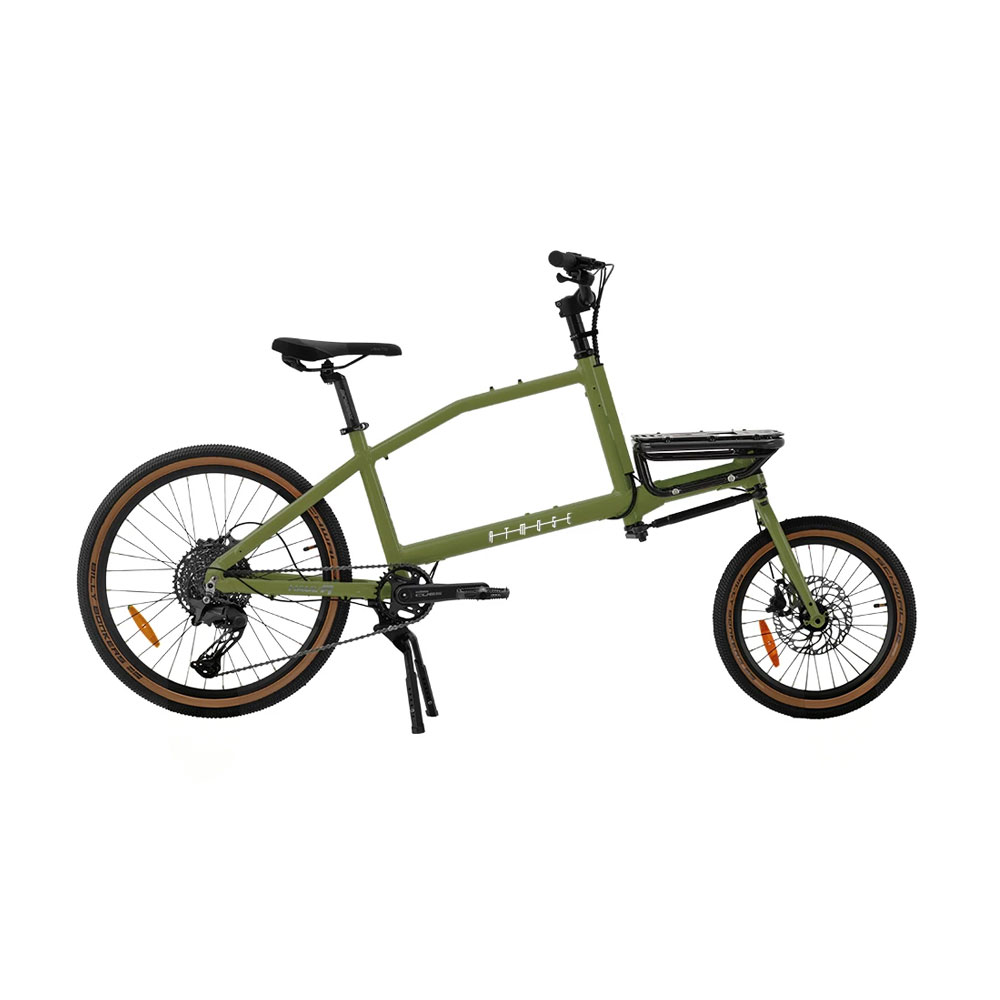
Atmose Model V V1 Manual Adventure Cargo Bike with Oversized Front Rack
Many cargo bicycles are evaluated primarily by motor output, battery capacity, assisted range, and charging speed. These are useful measures for urban transportation, delivery work, and long-distance commuting. However, they are not the only measures of performance. In remote adventure riding, mechanical simplicity can be just as important as electrical power.
The Model V V1 approaches the problem from a different direction. It uses human power and mechanical gearing as its complete propulsion system. This means the bike does not require a charged battery before departure, and its operating range is not limited by battery capacity. As long as the rider can continue pedaling and the mechanical components remain serviceable, the bike can continue moving.
This philosophy creates several practical advantages. A manual cargo bike eliminates concerns about finding a compatible charger in isolated locations. It also avoids dependence on electronic displays, motor sensors, wiring harnesses, battery management systems, and proprietary diagnostic tools. For riders who travel far from roads, workshops, and urban infrastructure, fewer systems can mean fewer possible failure points.
The V1 is especially relevant to expedition riders who plan routes through forests, mountain passes, beaches, rural tracks, and remote campsites. A mechanical drivetrain can be inspected with familiar bicycle tools, and its key operating principles are easy to understand. This straightforward design does not remove the need for maintenance, but it makes maintenance more accessible and predictable.
Compared with an electric cargo bike of similar carrying capacity, the manual V1 is also significantly lighter in concept and equipment. It does not carry the mass of a motor and battery, which can make lifting, portaging, loading, and low-speed handling easier. This matters when a route includes stairs, fallen trees, rocky sections, narrow bridges, muddy ground, or transport by vehicle or aircraft.
The defining visual and functional feature of the V1 is its oversized front folding basket. The platform measures approximately 470 millimeters in length, 470 millimeters in width, and 375 millimeters in height. This creates a substantial loading area for equipment that would be difficult to carry on a standard bicycle.
Adventure riders rarely travel with only a small backpack. A multi-day trip may require a tent, sleeping bag, cooking system, water containers, food, spare clothing, tools, navigation equipment, first-aid supplies, and protective gear. The front rack gives these items a dedicated location and can reduce the need to overload the rider’s back.
A front cargo platform can also improve organization. Frequently used equipment can remain accessible in the basket, while fragile or weather-sensitive items can be secured in smaller bags. A cooler, dry box, camera case, or field-work container can be positioned on the rack without requiring a specialized trailer.
The stated basket capacity is 25 kilograms. That capacity is substantial for a front platform, but it should be used responsibly. Cargo must be secured, distributed evenly, and positioned so that it does not interfere with steering, braking, visibility, or the rider’s ability to mount and dismount. Heavy objects should be placed as low and centrally as practical, while loose equipment should be restrained against movement.
The folding design adds versatility during storage and transport. When the rack is folded or configured for a particular load, the bike can be easier to store in a workshop, vehicle, or expedition shelter. This is valuable for users who combine cycling with trains, vans, boats, aircraft, or other forms of transport.
Compared with a conventional rear pannier setup, a large front deck can make loading bulky objects more convenient. It is suitable for items that are too wide, tall, or irregularly shaped for narrow side bags. At the same time, the position of the cargo allows the rider to keep the rear portion of the bike available for additional bags, a rack, or personal equipment, provided that total weight remains within the recommended limits.
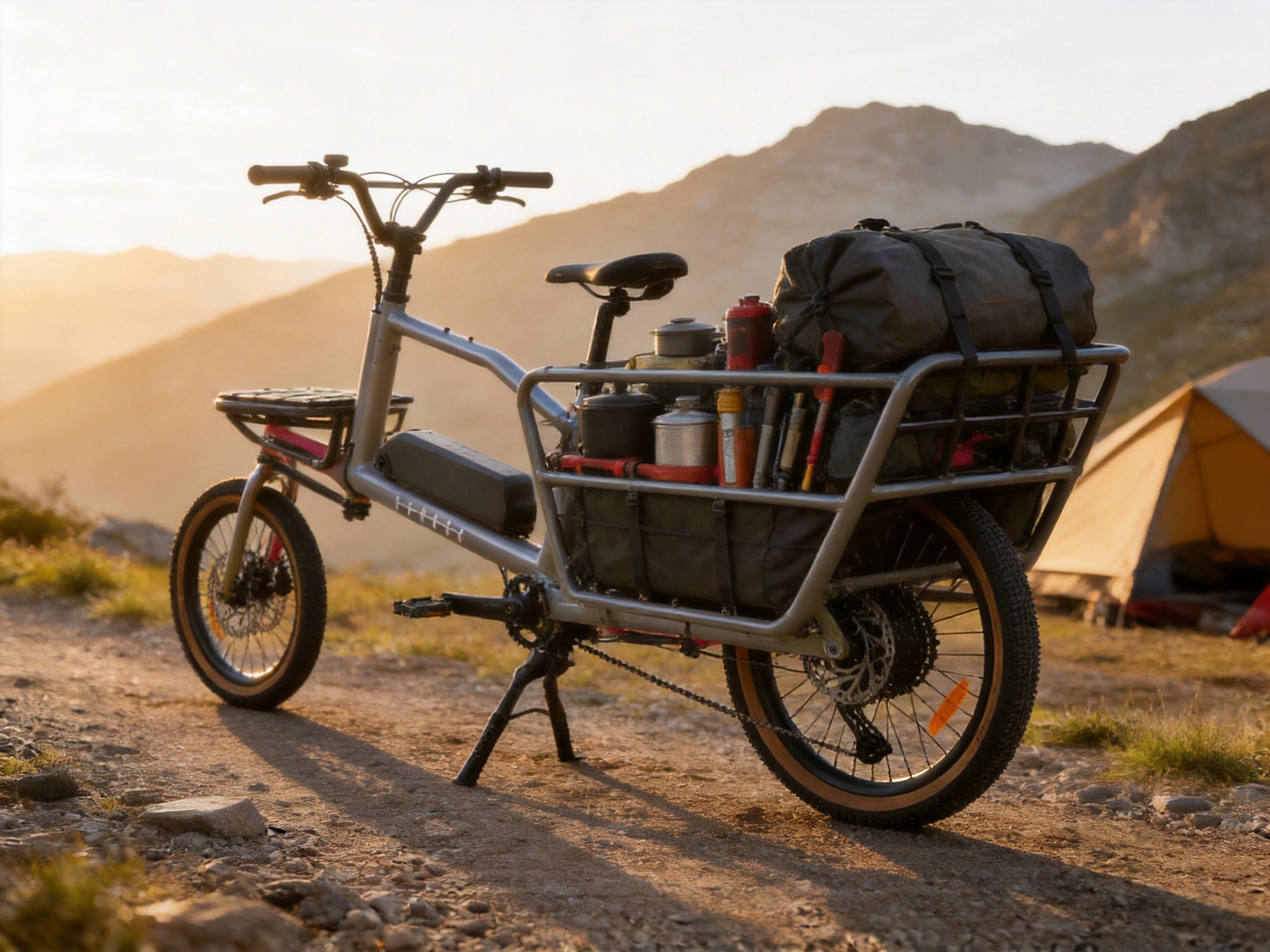
The Model V V1 is specified for a maximum rider load of 145 kilograms and a basket load of 25 kilograms. These figures indicate that the bike has been developed as a serious utility and cargo platform rather than a lightweight recreational bicycle.
Load capacity is valuable only when it is combined with stable handling. A bicycle carrying camping supplies must remain predictable when accelerating, braking, turning, and traveling across changing surfaces. The frame, wheel configuration, tires, drivetrain, and brake system must work together to control the additional mass.
The V1’s front cargo area makes it possible to carry equipment without attaching a trailer. A trailer can offer additional capacity, but it also increases overall length, turning radius, storage requirements, and the number of moving connections between the bicycle and the load. A built-in cargo platform keeps the load integrated with the bicycle itself.
For outdoor professionals, the platform can support field equipment, maintenance tools, survey materials, or supplies for remote work. For recreational riders, it can carry a complete camp setup. For rural users, it may serve as a practical transport solution for groceries, firewood accessories, gardening supplies, or small equipment.
Riders should distinguish between maximum permissible load and ideal everyday load. A cargo bike may be structurally capable of carrying a high load, but terrain, gradient, rider strength, braking distance, tire pressure, weather, and route conditions all affect handling. On steep or technical terrain, a lighter and better-balanced load will generally be easier to control.
The V1 uses a 6061 T4T6 aluminum alloy frame. Aluminum alloys in this family are widely used in bicycle construction because they offer a useful combination of low weight, structural performance, corrosion resistance, and manufacturability.
The frame is the foundation of a cargo bicycle. It must handle the combined forces produced by the rider, cargo, wheels, braking, steering, and uneven ground. Adventure use can create repeated impacts and torsional loads that are not present on a smooth city route. For that reason, the frame must be designed around more than static weight alone.
The use of a recognized aluminum alloy provides a consistent material basis for engineering and production. It supports controlled fabrication, repeatable welding, and predictable finishing. The T4T6 designation also reflects the importance of heat-treatment conditions in achieving the intended balance between forming characteristics and final strength.
Aluminum construction contributes to the V1’s manual adventure character. Since the bike does not include a motor or battery, the frame can be part of a comparatively lighter overall package. Reduced mass is useful when lifting the bicycle over an obstacle, placing it onto a vehicle, carrying it through a campsite, or maneuvering it on narrow trails.
A lightweight frame does not mean that the bike is intended only for delicate use. The V1 is built around cargo applications, wide tires, hydraulic braking, and a large front platform. Its advantage comes from combining structural purpose with the absence of unnecessary electrical mass.
The V1 is equipped with 18-inch by 2.4-inch front tires and 20-inch by 2.4-inch rear tires. The tires are described as puncture-resistant, an important characteristic for a bicycle intended to travel beyond maintained urban roads.
Wide tires create a larger contact area with the ground and can improve comfort and traction on gravel, compact soil, grass, forest paths, and other imperfect surfaces. They also allow riders to adjust tire pressure for changing terrain, within the limits recommended by the tire and wheel manufacturers.
The different front and rear wheel sizes are appropriate for a cargo design that prioritizes stability, maneuverability, and a practical loading height. The smaller rear wheel can support a compact cargo-bike layout, while the front wheel and cargo area are integrated to maintain a balanced riding position.
Puncture-resistant construction is particularly useful in wilderness settings. Sharp stones, thorns, broken branches, and debris can pose a greater risk away from maintained roads. No tire is completely immune to punctures, but additional protection can reduce interruptions and improve confidence when carrying a valuable or difficult-to-replace load.
Wide tires also help absorb vibration before it reaches the frame and cargo. This can protect equipment and reduce rider fatigue. However, tires are not a substitute for careful route selection. Soft mud, deep sand, exposed roots, and steep loose surfaces may still require reduced speed, altered tire pressure, or dismounting.
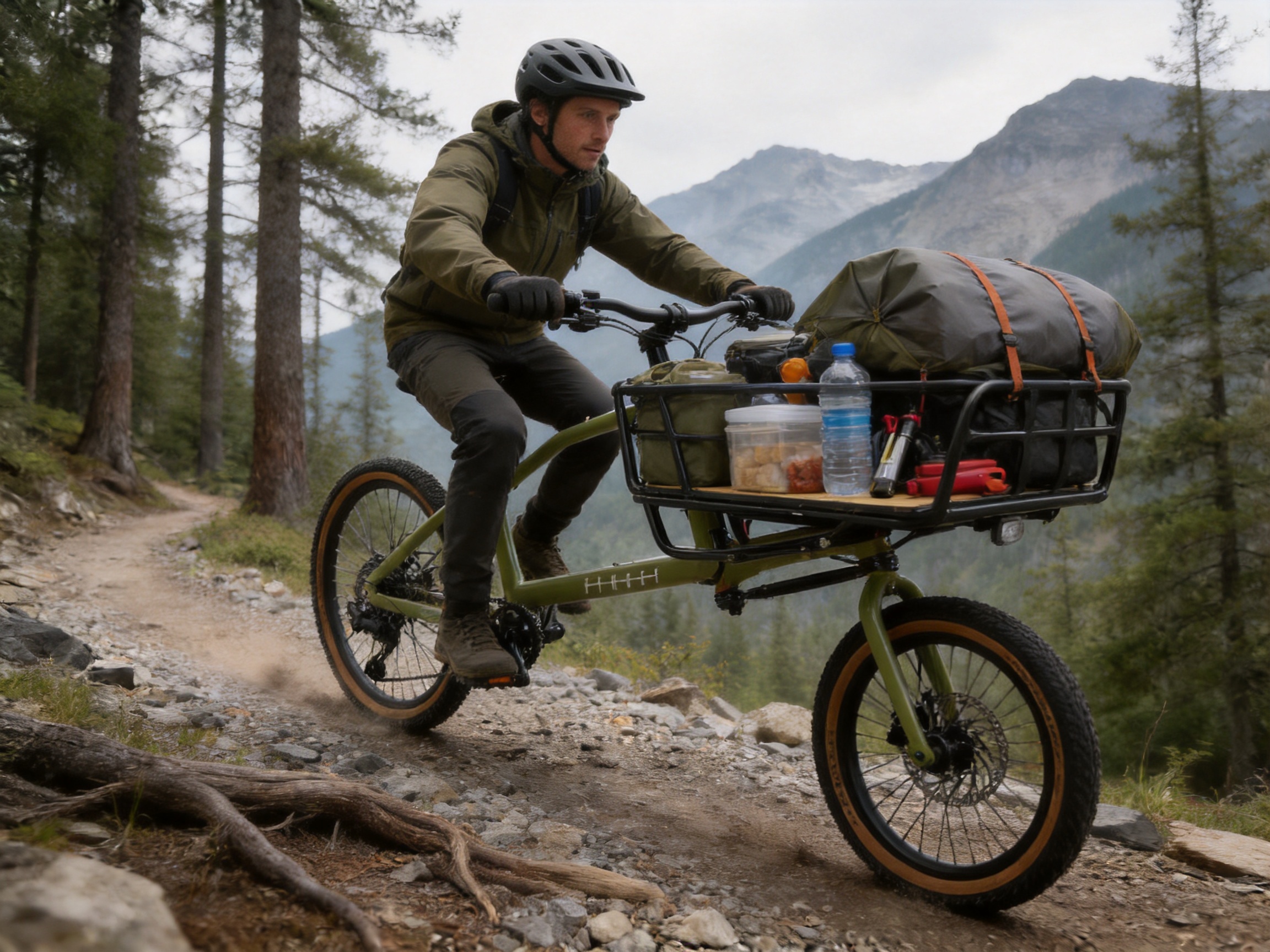
The V1 uses an 11-speed Shimano Cues drivetrain. A wide-range gearing system is essential for a manual cargo bike because the rider must manage both the weight of the bicycle and the additional cargo without motor assistance.
Low gears provide mechanical advantage on climbs and rough terrain. They allow the rider to turn the pedals more easily when approaching a steep gradient or starting from a low-speed position. Higher gears are useful on flat roads, descending sections, and faster connecting routes.
An 11-speed system offers a useful spread of ratios while keeping shifting relatively straightforward. For an adventure rider, the goal is not simply to have many gears. The goal is to have practical gear steps that allow efficient cadence control as the surface, slope, and cargo load change.
When carrying a full front basket, riders should select a lower gear before a climb rather than waiting until the bicycle slows dramatically. Anticipating terrain reduces strain on the chain, cassette, and rider. Smooth shifting also helps maintain traction on loose surfaces because sudden pedal force can cause a tire to slip.
Mechanical gearing is one of the V1’s key advantages over electric cargo bikes for remote travel. An electric system can make hills easier, but it introduces dependence on energy storage and electronic components. The V1 instead relies on a familiar bicycle drivetrain that can be adjusted, cleaned, lubricated, and serviced using established maintenance practices.
Because the bike is designed for demanding use, regular drivetrain care remains important. Chain lubrication, derailleur inspection, cable condition, cassette wear, and chainring condition should be checked before extended trips. A spare chain link, basic adjustment tool, tire repair equipment, and a suitable pump are sensible additions to an expedition kit.
The V1 is fitted with Tektro hydraulic disc brakes. Cargo bicycles require dependable braking because the total moving mass may be significantly greater than that of a standard bicycle.
Hydraulic disc brakes transmit lever pressure through fluid rather than a conventional mechanical cable. This can provide smooth modulation and consistent braking feel when the system is correctly maintained. Disc brakes also perform effectively in a range of weather and road conditions, although water, mud, grit, and heat can still affect performance.
Brake performance becomes especially important on descents. A loaded adventure bike builds momentum, and stopping distances increase when the surface is loose, wet, or uneven. Riders should control speed before a technical descent instead of relying on hard braking at the last moment.
The large cargo platform encourages users to carry equipment that may have considerable value. Reliable brakes help protect the rider, the bicycle, and the load. They also support careful low-speed handling in crowded campsites, narrow paths, and shared roads.
Before a long trip, brake pads, rotors, fluid condition, lever feel, and fasteners should be inspected. Any sign of a spongy lever, unusual noise, uneven pad wear, or reduced stopping power should be addressed before riding. Hydraulic systems are dependable when properly maintained, but they should be serviced by a qualified technician if air enters the system or a leak is suspected.
The bike measures approximately 1,910 millimeters in length, 750 millimeters in width, and 1,060 millimeters in height. These dimensions provide a meaningful cargo platform without creating the extreme overall size associated with some long-tail or commercial delivery bicycles.
The 750-millimeter width is relevant when navigating gates, narrow trails, storage rooms, campsite paths, and transport spaces. The bike remains a substantial machine, but its proportions are intended to balance carrying ability with everyday maneuverability.
At approximately 1,910 millimeters long, the V1 can carry a large front load while remaining suitable for normal bicycle infrastructure in many environments. Riders should still consider turning space and braking distance, especially when the basket is fully loaded.
The physical dimensions also make the V1 practical for mixed journeys. It can be used to travel from a home or vehicle to a trailhead, through a rural settlement, and onward into a remote area without changing equipment. That flexibility distinguishes it from cargo platforms designed exclusively for urban deliveries or exclusively for lightweight trail riding.
An electric cargo bike is often the better choice for riders who need frequent assistance on steep urban routes, want to carry heavy loads with less physical effort, or must maintain a high average speed. The manual V1 is not intended to eliminate those benefits. Its strength lies in situations where other priorities matter more.
The first advantage is energy independence. The V1 does not require charging, spare batteries, solar panels, or access to electrical outlets. This simplifies trip planning and removes range anxiety related to battery depletion.
The second advantage is mechanical simplicity. A manual bike has fewer major systems that can stop operation. There is no motor to diagnose, no battery management system to monitor, and no electronic controller to troubleshoot. A mechanical fault can still occur, but many common issues can be identified and repaired with conventional tools.
The third advantage is reduced weight. Electric cargo bikes must carry the motor and battery even when assistance is not needed. The V1 avoids that additional mass, which can make it easier to lift and portage.
The fourth advantage is long-term independence from battery aging. Batteries gradually lose capacity over time and may require replacement. The V1 does not have this particular ownership concern. Its long-term maintenance is focused on familiar bicycle parts such as tires, chains, brake pads, bearings, cables, and drivetrain components.
The fifth advantage is quieter operation. Without a motor, the V1 produces no motor whine. This can be desirable in natural environments, wildlife observation areas, and quiet rural communities.
There are also trade-offs. The rider must provide all propulsion, and a heavy load or steep route may require greater fitness and more careful pacing. The manual V1 is therefore most attractive to users who deliberately choose active travel, mechanical reliability, and remote independence over effortless assisted climbing.
A traditional adventure or bikepacking bicycle may be lighter and more agile when carrying only compact personal equipment. However, it often lacks the integrated capacity needed for bulky or heavy cargo. The V1 addresses that limitation with its oversized front rack and cargo-oriented structure.
Instead of distributing every item among a handlebar bag, frame bag, seat pack, and small panniers, riders can place larger containers on the front platform. This makes it easier to carry equipment that does not conform to the narrow shape of standard bikepacking bags.
The V1 also offers a more practical loading position for users who need frequent access to their equipment. A work kit, food box, or camera case can be reached without removing a large seat pack or unpacking multiple bags.
The wide tires and hydraulic brakes further distinguish the V1 from lightweight touring bicycles. They support a more stable and controlled experience when the bicycle is carrying substantial cargo across mixed surfaces.
The trade-off is that a cargo bike will not feel identical to a minimalist mountain or gravel bike. It is designed to carry more, not merely to travel fast with less. Its value appears when the journey includes equipment, supplies, or tools that would overwhelm a conventional adventure bicycle.
The V1’s design philosophy can be understood as a form of purposeful simplification. Removing the motor and battery does not mean reducing the bike to a basic or under-equipped product. Instead, it concentrates the design effort on the mechanical systems that remain essential: frame strength, cargo integration, wheel stability, drivetrain range, braking control, and tire durability.
This concentration is valuable because every component has a clear role. The front platform is directly connected to the cargo-carrying purpose. The wide-range drivetrain is matched to human propulsion. The hydraulic brakes are suited to higher total mass. The wide tires are selected for mixed terrain. The aluminum frame supports a balance between strength and manageable weight.
Such integration is more meaningful than simply adding a large basket to an ordinary bicycle. A cargo platform changes the loading forces, steering behavior, and braking requirements of the entire vehicle. A properly designed cargo bike must account for these interactions from the beginning.
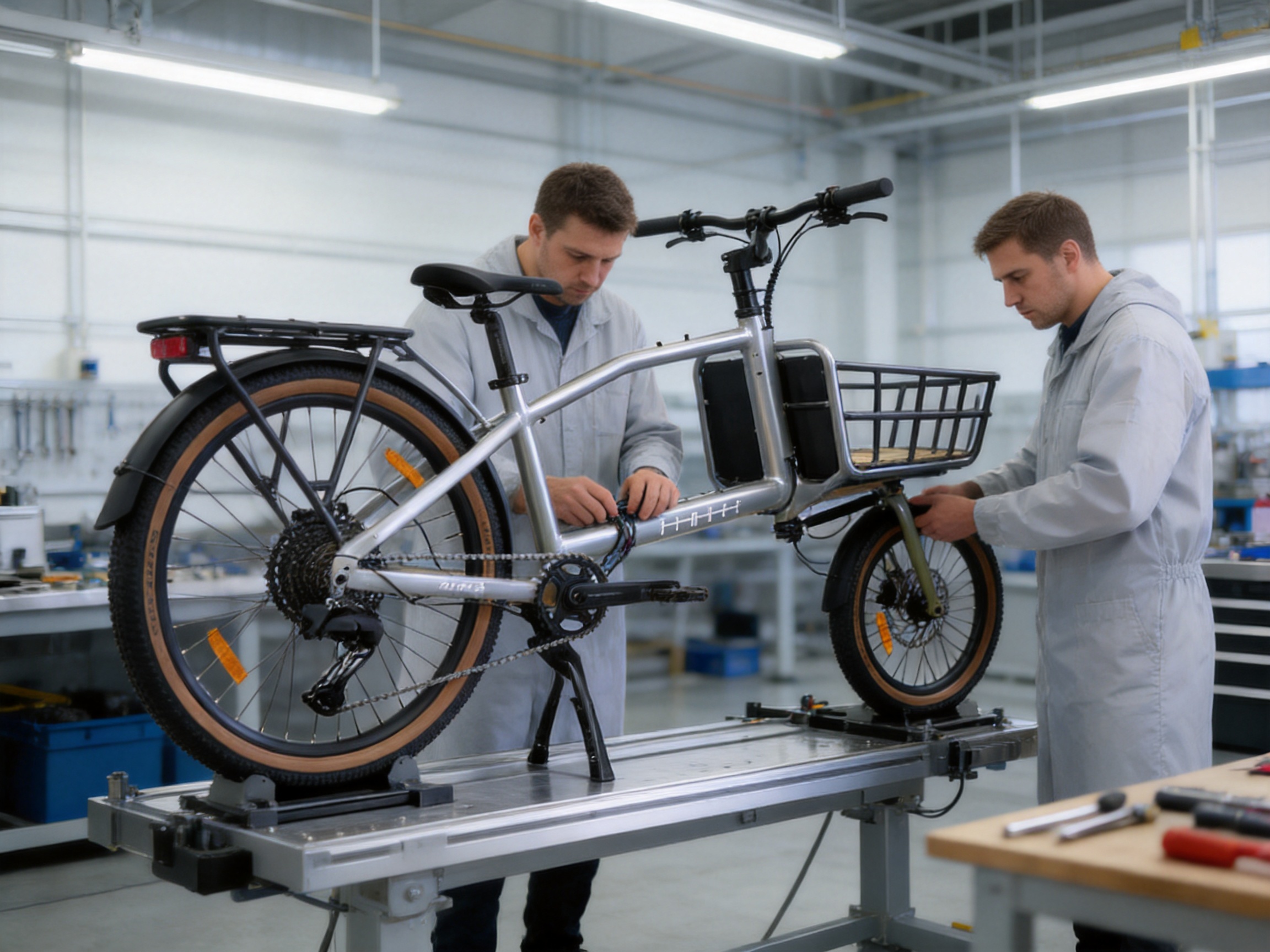
The company describes the V1 as a precision-engineered mechanical workhorse. In practical terms, that means the design must prioritize repeatable component alignment, secure fastening, reliable welds, accurate wheel installation, and consistent adjustment of the drivetrain and brakes.
Atmose combines an American product-development origin with a European design and research-and-development presence in Paris. The company’s background includes the experience of MOTIV, an established American beach cruiser brand, as well as a mature manufacturing network and supply-chain relationships.
This combination can support a product-development process that connects user requirements, industrial design, engineering decisions, and production execution. For a cargo bike, that connection is important. A visually attractive bicycle must also be structurally coherent, serviceable, and practical to manufacture at consistent quality.
The use of a defined 6061 aluminum alloy gives the manufacturing process a controlled material foundation. Frame production typically requires careful tube preparation, accurate fixture alignment, controlled welding, inspection of joints, finishing, and final assembly. Although the supplied product information does not specify individual factory machinery or certification procedures, these production stages are central to achieving a dependable aluminum cargo frame.
Precision fixtures are especially important for a cargo bicycle. Small alignment errors can affect wheel tracking, steering response, brake rotor position, and drivetrain operation. A repeatable fixture system helps keep frame dimensions consistent from one unit to the next.
Weld quality is another key consideration. A cargo frame experiences repeated loading, particularly around the head tube, bottom bracket, rear triangle, rack supports, and other high-stress junctions. Consistent welding practice, appropriate preparation, and post-weld inspection help support structural reliability.
Component integration also reflects manufacturing competence. The front rack must align correctly with the steering and frame structure. The wheels must be tensioned and installed accurately. Hydraulic brake lines must be routed safely. The derailleur and shifter must be adjusted to work across the full gear range. These tasks require more than simply assembling individual parts; they require a coordinated final inspection process.
Atmose’s stated strengths include continuous innovation, manufacturing experience, a mature supply chain, and international design and R&D cooperation. For global buyers, these capabilities are relevant because they can support product customization, wholesale supply, component sourcing, and adaptation to different market requirements.
A mature supply chain can also improve production continuity. Cargo bicycles contain specialized frames, racks, wheels, tires, brake components, drivetrain parts, and finishing materials. Coordinating these inputs helps reduce delays and supports more consistent product availability.
From a buyer’s perspective, manufacturing strength should be evaluated not only by the appearance of a finished bicycle but also by the clarity of its specifications, availability of replacement parts, assembly quality, service documentation, and responsiveness to support requests. The V1’s use of recognizable components such as Shimano Cues and Tektro hydraulic brakes can make future servicing more straightforward than a design dependent entirely on obscure proprietary parts.
Quality control for a manual cargo bike should begin with incoming materials and continue through final assembly. The frame material, tubes, rack parts, wheels, tires, drivetrain, brake components, and fasteners must all meet their intended specifications.
Frame inspection should include checking alignment, weld appearance, mounting points, surface finish, and dimensional consistency. Wheel inspection should include rim condition, spoke tension, axle security, and correct tire installation. Brake inspection should confirm that levers, lines, calipers, rotors, and pads are correctly installed and adjusted.
Because the front rack is central to the product’s identity, it deserves special attention. The basket should fold and unfold smoothly, remain secure in its operating position, and support an evenly distributed load. Any latch, hinge, or fastening element should be checked before a trip.
Final road testing is also important. A cargo bike can appear correctly assembled while still displaying steering, braking, shifting, or noise issues under motion. A controlled test ride allows technicians to verify gear changes, brake response, wheel tracking, cargo-platform stability, and handling at different speeds.
These processes are not visible in a product photograph, but they strongly influence ownership satisfaction. A well-designed bicycle can only deliver its intended performance when manufacturing and assembly preserve the design’s accuracy.
The V1 is naturally suited to multi-day journeys in areas where charging infrastructure is unavailable. Its large front basket can carry camping equipment, food, water, and repair supplies, while the manual drivetrain allows the trip to continue without energy planning around battery capacity.
In rural areas, the bike can support practical transportation between homes, farms, villages, campsites, and outdoor work sites. Its cargo capacity may reduce the need for short vehicle trips while preserving the physical and environmental benefits of cycling.
Photographers, conservation workers, maintenance teams, researchers, and guides may benefit from a bicycle that can carry equipment over tracks that are too narrow for a vehicle. The front platform provides a stable location for cases and tools, while the wide tires support uneven ground.
The manual configuration can be useful in situations where dependable transport is required without assuming access to electricity. The bike may carry first-aid materials, food, communication equipment, or repair supplies. It should not be treated as an emergency vehicle without appropriate preparation, but its simplicity can be an advantage when infrastructure is limited.
Although classified as an adventure cargo bike, the V1 can also support recreational outings. Picnic equipment, sports gear, beach supplies, and day-trip provisions can be carried without requiring a car. The rider should plan the route and load according to fitness, terrain, and braking conditions.
Preparation should begin with a realistic assessment of the route. Riders should consider distance, elevation, surface conditions, weather, water availability, resupply points, and the weight of all equipment. A manual cargo bike rewards careful pacing and efficient packing.
Before departure, inspect the frame for damage, check all visible fasteners, confirm that the front basket locks securely, and verify that the tires are inflated appropriately. Test the brakes under controlled conditions and shift through all 11 gears while the bicycle is lightly loaded.
Pack the heaviest items low and toward the center of the basket. Avoid allowing cargo to extend into the front wheel, brake lines, steering path, or rider’s view. Use straps or containers that prevent movement. A shifting load can affect steering and create unnecessary stress on the rack.
Carry a repair kit that includes tire levers, a pump or inflator, a spare tube suitable for the wheel sizes, a patch kit, a multi-tool, chain repair equipment, spare fasteners where appropriate, and basic brake and drivetrain supplies. Riders traveling far from assistance should also carry navigation equipment, lighting, water, food, and weather protection.
During the ride, inspect the bicycle at regular intervals. Check tire pressure, brake feel, rack fasteners, and cargo straps. Early detection of a loose bolt or damaged tire is easier than dealing with a failure after many kilometers on a remote trail.
A front cargo platform changes the steering feel of a bicycle, particularly when loaded. New owners should practice in a safe, open area before beginning a difficult journey.
Start with a moderate load and become familiar with low-speed turns, braking, mounting, and dismounting. Keep both hands on the handlebars when riding. Avoid abrupt steering inputs, especially on loose ground.
Brake earlier than usual when approaching intersections, descents, obstacles, or sharp turns. A loaded bike carries more momentum, and the front rack may influence steering response. Use both brakes progressively and maintain a speed that matches the surface.
On climbs, shift to a lower gear before the slope becomes steep. Maintaining a smooth cadence is generally more efficient than forcing a high gear. If the terrain becomes too difficult, dismounting and walking the bike is a normal and sensible part of adventure riding.
On descents, remain attentive to heat and braking performance. Use controlled braking rather than dragging the brakes continuously for long periods. Stop if the brakes feel different, produce unusual sounds, or do not provide the expected response.
The V1’s long-term value is closely connected to maintainability. A manual bicycle has routine wear parts, but these parts are generally familiar to bicycle mechanics and widely available through established distribution channels.
The chain and cassette should be kept clean and lubricated. The derailleur should be protected from impact and checked for alignment after rough transport or a fall. Brake pads and rotors should be inspected for wear. Tires should be checked for cuts, embedded debris, and loss of pressure.
Wheel bearings, headset bearings, bottom bracket components, and folding-rack hardware should be inspected periodically. The appropriate service interval depends on mileage, climate, load, and terrain. Wet, sandy, or muddy conditions generally require more frequent cleaning and inspection.
The absence of a battery does not mean the bike is maintenance-free. Instead, maintenance is concentrated in systems that are visible, mechanical, and familiar. This can make ownership more predictable for riders who prefer to perform basic service themselves.
Recognizable components also support ownership value. Shimano drivetrain parts and Tektro hydraulic brake systems have established service knowledge in many bicycle markets. Replacement availability will depend on region, but the use of known component families can be advantageous for dealers and repair technicians.
The V1 supports sustainable transportation by enabling cargo movement without fuel consumption during use and without the energy-storage requirements of an electric bicycle. Human-powered transportation has a low operating impact, particularly when it replaces short vehicle journeys.
Its sustainability also relates to product longevity. A bicycle that can be maintained with replaceable mechanical components may remain useful for many years. Long service life reduces the need for frequent replacement and allows owners to repair rather than discard the entire product when individual parts wear.
Atmose presents sustainability, reliability, practicality, and enjoyment as central values. The V1 reflects these principles in a direct way. It is practical because it carries useful loads, reliable because it avoids dependence on electrical systems, and sustainable because it supports active transport with a durable mechanical platform.
Responsible use still matters. Riders should select suitable routes, avoid damaging sensitive natural areas, respect access restrictions, and maintain the bicycle so that worn components do not create safety or environmental problems.
The V1 is a strong choice for riders who enjoy self-supported travel and do not want their route limited by charging access. It suits people who are comfortable providing their own effort and who value the confidence that comes from a simple, serviceable machine.
It is also appropriate for users who need more cargo volume than a standard touring bicycle can provide but do not require electric assistance. Campers, rural commuters, outdoor workers, and expedition riders may find the integrated front rack particularly useful.
The bike may be less suitable for riders who want effortless hill climbing, who regularly carry extremely heavy loads over steep urban routes, or who need to cover long distances at high speed with minimal physical exertion. Those users may prefer an electric cargo model.
The best application is one in which the V1’s advantages are meaningful: remote access, mechanical independence, bulky cargo, mixed terrain, and a preference for active travel.
The Atmose Model V V1 Manual Adventure Cargo Bike is built around a clear and distinctive idea: adventure cargo transportation does not always need a motor. By combining a 6061 T4T6 aluminum alloy frame, an oversized folding front basket, wide puncture-resistant tires, an 11-speed Shimano Cues drivetrain, and Tektro hydraulic disc brakes, it provides a practical platform for carrying people and equipment beyond the limits of ordinary bicycles.
Its main advantage over electric cargo bikes is not maximum assisted power. It is independence from charging, batteries, and electronic systems. Its advantage over conventional adventure bicycles is cargo capacity and integrated utility. Its advantage over basic utility bikes is the combination of wide tires, off-road capability, hydraulic braking, and a design intended for serious loads.
The company’s American origins, Paris-based design and research capabilities, manufacturing experience, mature supply-chain relationships, and emphasis on continuous innovation provide a foundation for developing specialized cargo bicycles for global users. While detailed factory processes are not publicly specified in the supplied materials, the product’s material selection and component integration point toward a manufacturing approach centered on repeatability, structural integrity, component compatibility, and final assembly quality.
For riders who see a cargo bike as an expedition tool rather than simply a city vehicle, the V1 offers a compelling balance. It is designed to carry meaningful equipment, travel across imperfect ground, and remain usable in places where electrical infrastructure disappears. In that environment, simplicity is not a compromise. It is the central performance feature.
No. The V1 is a fully manual cargo bike. It does not include a motor, battery, or electric power system. The rider supplies all propulsion through the mechanical drivetrain.
A manual cargo bike does not depend on charging stations, battery capacity, or electronic systems. This can be valuable in remote locations where access to electricity is limited or unavailable. It is also lighter and can be serviced using familiar bicycle maintenance practices.
The stated maximum basket load is 25 kilograms. Cargo should be evenly distributed and securely fastened. Riders should also consider terrain, speed, braking distance, and handling when deciding how much to carry.
The product information specifies a maximum rider load of 145 kilograms. The rider, cargo, terrain, and operating conditions should all be considered when planning a trip.
The V1 uses an 11-speed Shimano Cues drivetrain. Its wide range is intended to provide useful gearing for climbs, flat roads, descents, and loaded riding.
The bicycle uses Tektro hydraulic disc brakes. Hydraulic disc brakes provide controlled braking performance when correctly installed and maintained.
The front tires are 18 inches by 2.4 inches, and the rear tires are 20 inches by 2.4 inches. The tires are described as puncture-resistant and are intended for mixed surfaces and adventure use.
The frame is made from 6061 T4T6 aluminum alloy. This material is commonly used in bicycle frames because it offers a balance of structural performance, manageable weight, corrosion resistance, and manufacturability.
Yes. The front cargo basket is described as a folding basket. Its dimensions are approximately 470 millimeters long, 470 millimeters wide, and 375 millimeters high.
Yes. Although it is designed for adventure use, the V1 can be used on paved roads, rural routes, cycle paths, and other suitable surfaces. Riders should remain aware of its cargo-bike dimensions and allow additional braking distance when loaded.
The 11-speed drivetrain provides gearing optimized for climbing under load, but the bike remains human-powered. Steep terrain requires appropriate fitness, pacing, route planning, and potentially walking the bicycle on particularly difficult sections.
Routine maintenance includes checking tire pressure, brake pads, hydraulic brake function, drivetrain cleanliness, chain lubrication, gear adjustment, wheel security, rack fasteners, and frame condition. Maintenance frequency depends on use, terrain, weather, load, and storage conditions.
The V1 provides a substantially larger integrated front cargo platform and is designed to carry heavier, bulkier loads. It combines cargo capacity with wide tires, hydraulic braking, and a utility-focused frame.
The V1 has no motor or battery. It is lighter in system design, does not require charging, and can be maintained using mechanical bicycle service practices. The trade-off is that the rider must provide all propulsion.
The ideal user is an adventurous rider, camper, rural commuter, outdoor worker, or expedition traveler who values mechanical simplicity, substantial cargo capacity, and freedom from charging infrastructure.
| Specification | Model V V1 Details |
|---|---|
| Product type | Manual adventure cargo bike |
| Frame | 6061 T4T6 aluminum alloy |
| Battery | Not applicable |
| Power system | Manual drivetrain |
| Maximum rider load | 145 kilograms |
| Maximum basket load | 25 kilograms |
| Drivetrain | Shimano 11-speed Cues |
| Front basket dimensions | 470 millimeters long by 470 millimeters wide by 375 millimeters high |
| Front tire size | 18 inches by 2.4 inches |
| Rear tire size | 20 inches by 2.4 inches |
| Brake system | Tektro hydraulic disc brakes |
| Overall dimensions | 1,910 millimeters long by 750 millimeters wide by 1,060 millimeters high |
| Primary use | Adventure travel, bikepacking, rural transport, outdoor work, and cargo carrying |
Atmose Bikes. Model V V1 product specifications and product description.
Atmose Bikes. Company information concerning product philosophy, design, research and development, manufacturing experience, and sustainability objectives.
Shimano. Cues drivetrain product-family information and bicycle component service principles.
Tektro. Hydraulic disc-brake system information and maintenance guidance.
General bicycle engineering references concerning aluminum alloy frame construction, cargo-bike load distribution, hydraulic braking, tire pressure, and adventure bicycle maintenance.
Nov 23, 2026
Nov 09, 2026
Nov 01, 2026


info@atmosecargobike.com

200 rue de la Croix Nivert 75015 Paris

Custom Electric Bakfiets
 English
 Français
 Deutsch