Sep 06, 2026
Adventure cycling is often associated with remote roads, mountain passes, forest tracks, and destinations far beyond the reach of ordinary transport. In these environments, simplicity is not merely a design preference. It can determine whether a journey remains enjoyable, practical, and manageable. The Atmose Model V V1 Manual Adventure Cargo Bike is designed around that principle. It removes the motor, battery, charging equipment, and other electrical systems found on an electric cargo bike, replacing them with a fully mechanical platform intended for riders who value independence, serviceability, and direct control.
The result is a cargo bike with a distinct purpose. It is not designed to imitate a commuter e-bike without electrical assistance, nor is it simply a conventional bicycle with a larger front carrier. The V1 combines a 6061 T4T6 aluminum alloy frame, a high-capacity front folding basket, wide puncture-resistant tires, an 11-speed Shimano Cues drivetrain, and hydraulic disc brakes into a package intended for camping, expedition riding, trail access, and heavy-load travel.
Its most important advantage is also its most fundamental difference: there is no battery to charge and no motor to maintain. The rider supplies the power, while the mechanical systems are engineered to provide a broad range of gearing, stable load handling, and reliable braking. For remote travel, this architecture can offer meaningful benefits over electrically assisted cargo bikes, particularly when access to charging, replacement parts, or technical support is limited.
At the same time, the V1 is not limited to wilderness use. Its large front rack can support equipment for work, recreation, shopping, and daily transportation. The bike’s compact overall length for a cargo platform, its folding front basket, and its relatively low electrical-system complexity make it a versatile tool for people who want a practical cargo bicycle without depending on a power source.
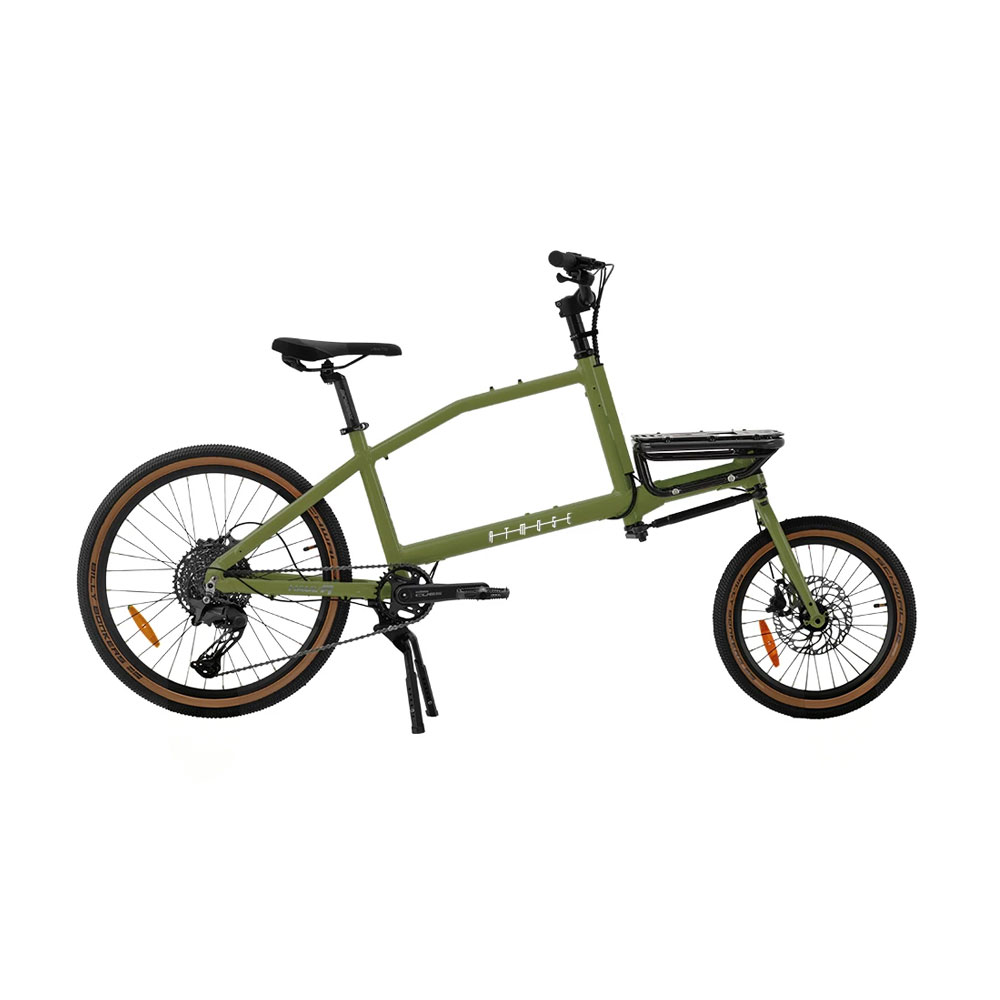
Atmose Model V V1 Manual Adventure Cargo Bike with Oversized Front Rack
Many cargo bikes measure performance through motor wattage, battery capacity, assisted range, and acceleration. Those specifications are useful for urban riders, family transport, and commercial delivery, but they do not describe every kind of adventure. In a remote environment, performance may instead mean the ability to keep moving when a battery is empty, to repair a mechanical issue with familiar tools, or to lift the bicycle around an obstacle without managing the weight of a large battery pack and motor.
The V1 is built around this second definition of performance. It focuses on mechanical efficiency, rider control, carrying capacity, and serviceability. The absence of electrical assistance requires more physical input, especially on steep climbs or when the bike is heavily loaded. However, that trade-off is intentional. The rider gains a machine that can be prepared for a journey without calculating charging stops or carrying a spare battery.
This approach also creates a more direct connection between rider and terrain. Cadence, gear selection, tire pressure, body position, and load distribution become central to the riding experience. For bikepacking purists and experienced cyclists, that direct interaction is part of the appeal. The bicycle becomes an extension of the rider rather than a powered vehicle controlled primarily through an assistance setting.
Compared with a standard touring bicycle, the V1 offers a much larger carrying area and a more stable platform for bulky equipment. Compared with an electric cargo bike, it provides a lighter and mechanically simpler alternative. Compared with a conventional cargo bike with a small front basket, it offers substantially more usable deck space for camping equipment, coolers, tools, dry bags, and other irregularly shaped loads.
The most obvious feature of the Model V V1 is its manual power system. The product information lists no battery and no power system, confirming that the bike is designed to operate entirely through pedal power. This design eliminates several components that can become significant considerations during long-distance travel: the battery charger, motor controller, display, wiring harness, sensors, and electrical connectors.
Removing these components has several practical consequences. The bicycle does not depend on a particular charging standard, electrical outlet, charging schedule, or battery-management system. It can be used immediately after transport, stored for long periods without monitoring battery charge, and taken into regions where power infrastructure is unavailable. A rider preparing for a remote trip can focus on tires, chain lubrication, brake condition, spare tubes, tools, and food rather than planning an electrical support strategy.
Mechanical simplicity also helps reduce the number of specialized diagnostic procedures required in the field. A mechanical problem is never desirable, but a rider who understands bicycle maintenance can often inspect or service the drivetrain, brakes, wheels, or tires using familiar tools. By contrast, an electrical fault may require a diagnostic device, a replacement controller, a compatible battery, or assistance from a trained technician.
This does not mean that a manual bike is maintenance-free. The chain still needs lubrication, the brake system still requires inspection, and the tires must be checked for wear and punctures. The absence of a motor does not remove the importance of proper setup or preventive care. Instead, it makes the maintenance system more transparent and gives the rider greater control over routine service.
For competitors that rely on electric assistance, the V1 offers a clear alternative for specific use cases. It is especially attractive to riders who consider charging dependency a disadvantage, who travel far from roads and buildings, or who prefer a bicycle that can remain operational without an electronic support network. Its competitive advantage is not maximum assisted speed or effortless hill climbing. Its advantage is independence.
The V1 uses a 6061 T4T6 aluminum alloy frame. Aluminum is widely used in modern bicycles because it offers a practical balance between structural strength, corrosion resistance, weight, manufacturability, and cost. For a cargo bike intended to carry substantial equipment, frame material must be considered together with tube dimensions, joint design, load paths, fork construction, wheel support, and component selection.
The stated T4T6 designation indicates a material and heat-treatment approach associated with aluminum frame production. In practical terms, this reflects attention to both forming and final structural performance. The alloy must be shaped into a frame that can resist repeated forces from pedaling, braking, uneven surfaces, steering inputs, and cargo movement. A cargo frame experiences different stresses from a lightweight road bicycle because its loads are often higher, more concentrated, and less uniform.
The V1’s frame is designed to support an overall rider load of up to 145 kilograms, while the front basket is rated for up to 25 kilograms. These figures should be understood as operating limits rather than casual suggestions. A rider should distribute cargo evenly, secure loose equipment, and consider the effect of load height and position on steering and braking. The frame may be strong enough for substantial loads, but handling always depends on how those loads are arranged.
One of the strengths of the design is that the cargo area is positioned at the front while remaining integrated into the bicycle’s overall geometry. This allows the rider to keep visual awareness of the load, which is valuable when transporting camping equipment or work materials. It also allows equipment to be organized without extending a long rear trailer or adding a separate towing system.
The frame’s aluminum construction can also provide a practical advantage during transport. Although the exact complete-bike weight is not supplied, the manual V1 is described as significantly lighter than its electric counterparts. Removing the battery and motor naturally reduces system mass. This can make the bike easier to lift onto a vehicle, maneuver through narrow passages, move across steps, or position near a campsite.
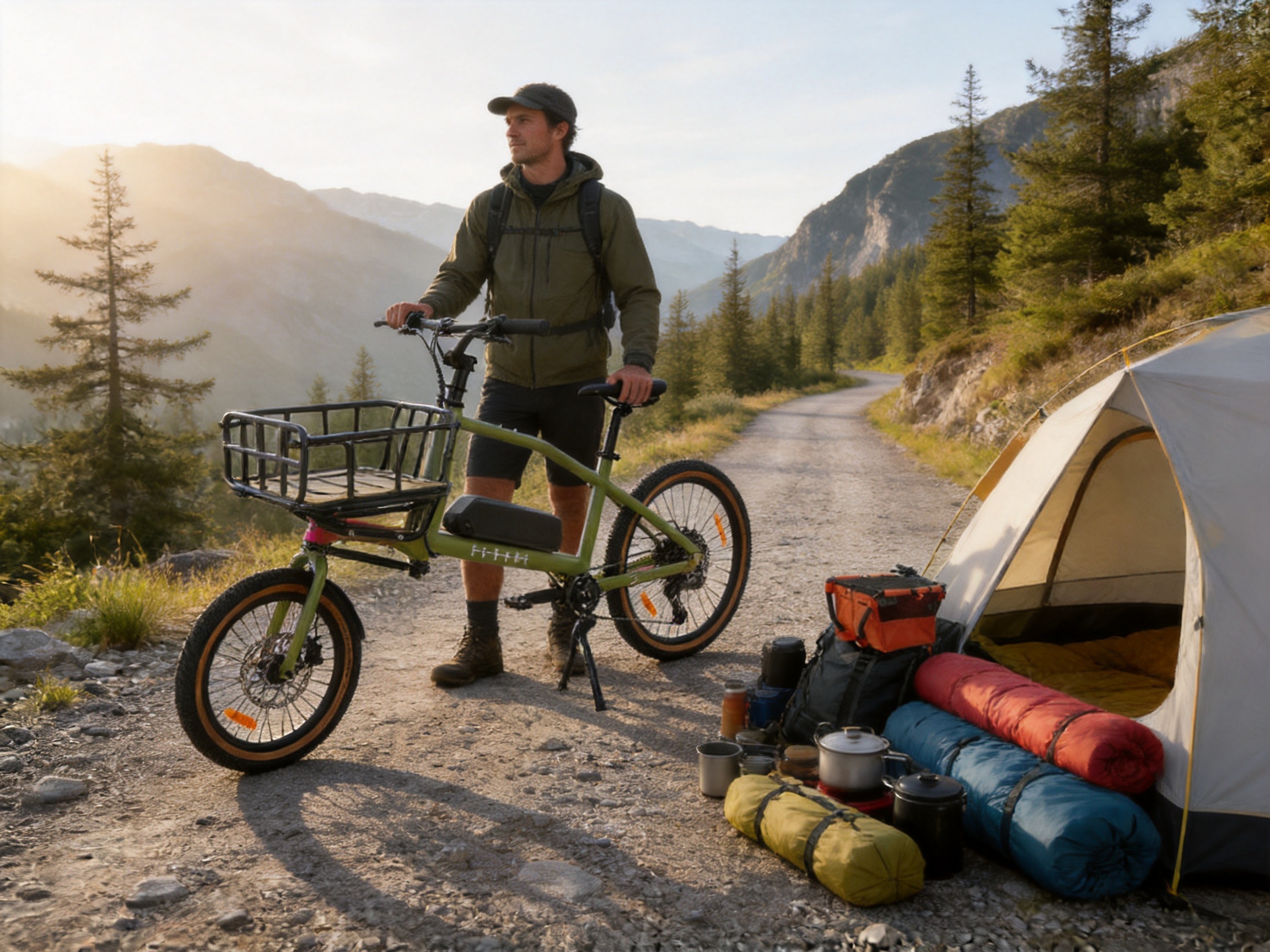
The defining visual and functional feature of the Model V V1 is its oversized front basket. The listed dimensions are approximately 470 millimeters in length, 470 millimeters in width, and 375 millimeters in height. This creates a large, box-like carrying area suited to equipment that does not fit comfortably on a conventional bicycle rack.
A large cargo platform is particularly useful for adventure travel because camping loads are often bulky rather than dense. A tent, sleeping bag, compact stove, cooler, repair kit, cooking equipment, rain gear, and food supplies can consume considerable space even when their total weight is moderate. The V1 provides a dedicated area for this type of equipment without requiring the rider to attach multiple small bags across the frame.
The basket’s front position also supports practical load organization. Frequently used items can be kept within reach, while heavier equipment can be placed low and toward the center of the basket. Riders can separate soft goods from tools, protect sensitive items, and use straps or cargo nets to prevent movement. Good organization improves not only convenience but also stability, because uncontrolled cargo can affect steering and braking.
The basket is described as folding, which creates an additional advantage for storage and transport. A front cargo structure can otherwise make a bicycle difficult to place in a vehicle, store in a narrow room, or move through a doorway. Folding capability helps reduce the bike’s practical footprint when the cargo area is not in use. It may also simplify loading the bicycle into a transport vehicle or preparing it for air or specialty transport, subject to the carrier’s size and weight restrictions.
Compared with a standard bicycle rack, the V1 basket can carry wider and taller items. Compared with a trailer, it keeps the load directly attached to the bicycle and avoids the extra length, separate wheel, and tracking behavior associated with towing. Compared with panniers alone, it offers a more open and accessible space for irregular cargo.
However, the basket should not be treated as an invitation to overload the front of the bike. The stated maximum basket load is 25 kilograms. Riders should remain within that limit and should avoid placing dense, unstable, or tall items where they can interfere with steering. The strongest cargo bike remains safest when the load is balanced, secured, and kept as low as practical.
The Model V V1 uses wide 18-inch by 2.4-inch tires at the front and a 20-inch by 2.4-inch tire at the rear. The product information identifies these as puncture-proof tires, a feature intended to improve reliability when riding over rough ground, gravel, roots, debris, and other surfaces that may present a higher puncture risk than smooth pavement.
Wide tires offer several potential benefits for adventure cargo riding. Their larger air volume can help absorb small impacts and reduce the harshness of uneven terrain. They can also provide a broad contact patch, supporting traction on loose surfaces when tire pressure is set appropriately. On gravel, compact dirt, and forest access roads, this can contribute to a more confident and controlled ride.
The different front and rear wheel sizes are also relevant to handling. The smaller rear wheel can help keep the cargo-bike frame compact while supporting a lower load position. The larger front wheel can roll over surface irregularities in a predictable manner. Together, the wheel sizes contribute to the bike’s balance between stability, maneuverability, and cargo capacity.
Puncture-resistant construction is valuable for remote travel because tire problems can interrupt an expedition and may be difficult to address far from a workshop. Even puncture-resistant tires are not invulnerable, however. Riders should carry appropriate repair equipment, inspect the tread regularly, maintain proper inflation, and understand how to remove and reinstall the wheels.
Tire pressure should be adapted to rider weight, cargo weight, terrain, and weather. Excessively high pressure can reduce comfort and traction on uneven surfaces, while excessively low pressure can increase rolling resistance and the possibility of rim damage. The ideal setting depends on the tire specification and the conditions of the journey, so riders should use the manufacturer’s recommended range as a starting point and make careful adjustments.
A cargo bicycle intended for adventure travel needs a drivetrain that can handle changing terrain and variable loads. The V1 is equipped with a Shimano 11-speed Cues system. An 11-speed drivetrain gives the rider a broad selection of ratios, allowing the bike to be adapted to flat roads, gradual climbs, steep sections, descents, and technical surfaces.
Gear range is especially important on a manual cargo bike. Without motor assistance, the rider must select a gear that keeps pedaling manageable while maintaining enough control over the bicycle. A lower gear can reduce the effort required on a climb, while a higher gear can support efficient travel on level ground or descending roads. Frequent gear changes are normal during loaded riding and should be viewed as a tool rather than a sign of insufficient power.
The Shimano Cues platform is designed for practical cycling applications and is well suited to riders who value reliable shifting across a wide range of conditions. The availability of a recognized component system can also be an advantage when replacement parts or service are needed. Riders traveling internationally should still confirm compatibility and carry essential spares, but using a familiar drivetrain standard is generally more convenient than relying on obscure or highly specialized components.
Riding technique remains as important as the number of gears. Riders should shift before a climb becomes too steep, reduce pressure on the pedals during shifting, and avoid forcing the chain across an extreme combination of gears. When approaching a loaded ascent, it is better to select an easier gear early than to wait until cadence has fallen dramatically.
The drivetrain also contributes to the bike’s competitive positioning. An electric cargo bike may climb with less physical effort, but its operation depends on battery charge and motor support. A basic single-speed cargo bike may be simple, but it can be difficult to use on varied terrain with a heavy load. The V1 occupies a middle ground: mechanically straightforward, yet equipped with enough gearing to make demanding terrain more manageable for a prepared rider.
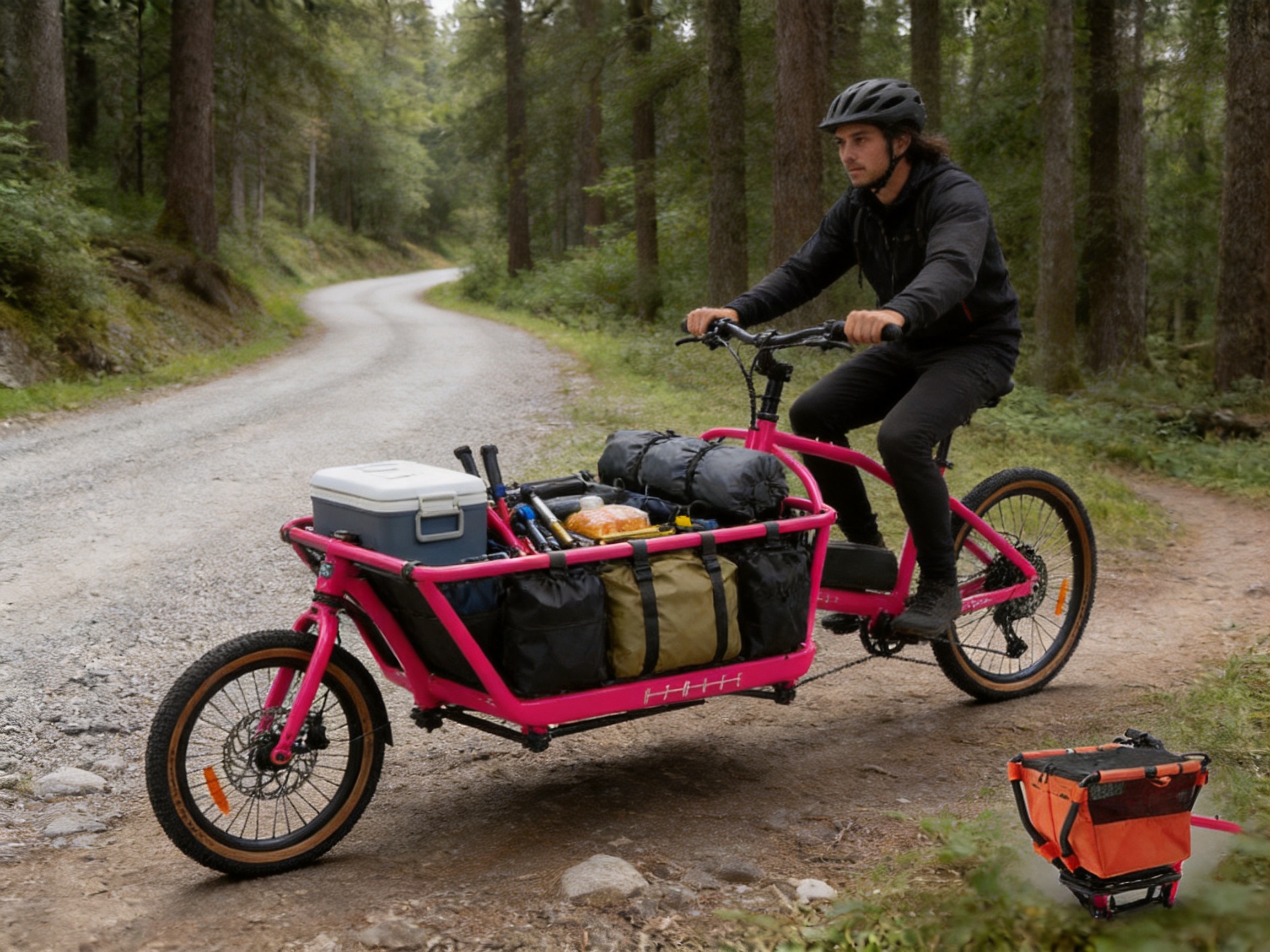
Load capacity and adventure capability are incomplete without effective braking. The V1 uses Tektro hydraulic disc brakes, which are intended to provide controlled stopping and speed management when carrying cargo across mixed terrain.
Hydraulic disc brakes transmit lever force through fluid rather than a conventional mechanical cable. This can produce smooth modulation and consistent operation when the system is correctly maintained. Disc brakes also separate the braking surface from the wheel rim, making them useful in wet, muddy, or abrasive environments where rim braking can be less consistent.
For an adventure cargo bike, braking performance matters in more situations than emergency stops. Riders may need to regulate speed on long descents, make controlled stops on loose surfaces, or slow down before a tight turn while carrying a high-value or fragile load. Smooth braking helps preserve cargo stability and reduces the likelihood of abrupt weight transfer.
Brake performance depends on setup and maintenance. Pads should be inspected for wear, rotors should be checked for contamination or damage, and the hydraulic system should be serviced according to the component manufacturer’s recommendations. Riders should become familiar with the front and rear brake balance and should practice braking with a loaded basket before beginning a remote trip.
Compared with basic rim brakes, hydraulic disc brakes can offer an advantage in demanding weather and terrain. Compared with low-cost mechanical systems, a hydraulic setup may deliver a more refined lever feel. These benefits support the V1’s role as a load-carrying adventure machine rather than a casual bicycle used only on flat, dry streets.
A cargo bike behaves differently from a lightweight road or mountain bicycle, especially when the front basket is filled. The V1’s design aims to keep the large load area usable without making the bike unnecessarily cumbersome. Still, riders should allow time to become familiar with steering, braking, starting, stopping, and low-speed balance.
Before a long journey, it is advisable to perform short test rides with progressively heavier loads. Begin with an empty basket, then add equipment while observing how the bicycle responds. Test braking on level ground, practice tight turns at low speed, and check whether straps or cargo bags move under acceleration and braking. This process helps identify problems before they occur far from support.
Load placement is a major factor in handling. Heavy items should generally be positioned low and centered. Light, bulky items can occupy the upper area, provided they are secured and do not obstruct the rider’s view or interfere with steering. Uneven side-to-side loading can make the bike feel unbalanced, while a very high load can increase the tendency to lean during turns.
Starting from a standstill requires particular care when the basket is heavily loaded. The rider should keep the handlebar straight, select an appropriate low gear, and apply smooth pedal pressure. Sudden steering inputs can be amplified by cargo movement. On narrow trails, riders should also consider the total width of the bicycle and the possibility that the basket may contact vegetation, rocks, or barriers.
The listed overall dimensions are approximately 1,910 millimeters long, 750 millimeters wide, and 1,060 millimeters high. These dimensions provide a useful reference for storage, vehicle transport, trail access, and doorway clearance. The width is significant enough that riders should plan routes carefully where bollards, narrow gates, or crowded paths are present.
The V1 competes across several categories rather than against a single type of bicycle. Its strengths become clearer when compared with the alternatives most likely to be considered by adventure and utility riders.
| Alternative | Potential Limitation | V1 Advantage |
|---|---|---|
| Electric cargo bike | Requires charging, includes additional electrical components, and can be heavier | Operates without a battery or charging infrastructure and is easier to handle in remote locations |
| Standard touring bicycle | Limited space for bulky or unusually shaped cargo | Provides a large front folding basket with a stated capacity of up to 25 kilograms |
| Single-speed utility bike | May be difficult to pedal on varied terrain or steep climbs | Offers an 11-speed drivetrain for a broader range of riding conditions |
| Rear-rack bicycle | Often depends on panniers and smaller compartments | Allows the rider to carry larger, more accessible equipment in a dedicated front cargo area |
| Bicycle with trailer | Longer overall configuration and separate towing wheel | Keeps cargo integrated with the bike and avoids trailer tracking behavior |
| Heavy electric delivery bike | Greater system weight and dependence on electronic service | Uses a lighter manual architecture for riders prioritizing portability and mechanical simplicity |
These comparisons do not mean that the V1 is universally superior. An electric cargo bike may be the better choice for a rider who needs frequent assistance, carries heavy loads up steep urban streets, or wants to reduce physical effort. A conventional touring bicycle may be faster for a rider who carries only a small amount of gear. The V1’s advantage is its focused balance of cargo utility, off-grid independence, and mechanical control.
The V1 reflects a product-development approach that combines American cargo-bike product thinking with European design and research-and-development resources. The company originated in California and has developed an international design and R&D structure based in Paris. This combination can support a broad understanding of user needs, from practical family transportation and commercial delivery to outdoor exploration.
The company’s stated background includes experience from an established American beach cruiser brand, along with manufacturing expertise, a mature supply chain, and continuous product innovation. These foundations are important because a cargo bike is not simply a larger standard bicycle. It requires coordination among frame engineering, load analysis, braking, wheel construction, cargo integration, component sourcing, assembly, and quality assurance.
Material selection is one part of the manufacturing process. The use of 6061 T4T6 aluminum alloy requires appropriate tube preparation, forming, joining, finishing, and inspection. Cargo-bike frames must be manufactured with consistent alignment and reliable joints because even small deviations can affect steering, wheel tracking, braking, and load behavior. A disciplined production process helps ensure that the finished bicycle performs consistently from one unit to the next.
Precision engineering is particularly relevant to the V1’s mechanical philosophy. When a product does not rely on a motor to compensate for inefficient design or inconsistent operation, the frame geometry, drivetrain alignment, wheel installation, brake setup, and cargo structure all become more important. The bicycle must work as a coordinated system, with each part supporting the next.
The company’s mature supply-chain experience can also strengthen product availability and serviceability. Standardized components such as the Shimano 11-speed Cues drivetrain and Tektro hydraulic brakes provide recognizable service platforms. Consistent sourcing and assembly procedures can make it easier to maintain component compatibility and support replacement needs across different markets.
Advanced manufacturing should not be understood only as the use of automated machinery. It also includes engineering validation, material control, process repeatability, assembly discipline, inspection, and feedback from real-world use. For a cargo bike, important quality objectives include frame alignment, secure fasteners, smooth shifting, reliable braking, correct wheel seating, stable basket attachment, and accurate load-rating communication.
The company’s development of several cargo-bike categories also indicates a portfolio approach. Family, urban companion, adventure, heavy-duty, children’s learning, and flexible mobility models address different user requirements. This variety can encourage the transfer of engineering lessons across product categories while allowing each model to retain a clear purpose. The V1 benefits from that broader cargo-bike focus while maintaining its identity as a manual adventure platform.
The V1’s sustainability benefits begin with its operating model. A bicycle that requires no battery charging produces no direct energy demand during use and avoids the eventual replacement of a traction battery. This does not make the product impact-free, since manufacturing, transportation, maintenance, and component replacement still require resources. However, the absence of an electrical powertrain simplifies the ownership cycle and can reduce the number of specialized components that must be managed over time.
Mechanical durability also supports longer product use. A well-maintained frame, drivetrain, wheelset, and braking system can remain serviceable for many years. The rider can replace wear parts individually rather than replacing a complete powered system. Chain, cassette, brake pads, tires, cables, and other consumable components can be serviced as needed.
Sustainability is closely linked to actual use. A cargo bike becomes more environmentally valuable when it replaces car trips, reduces the need for short-distance motor travel, or supports transportation in areas where a vehicle is inconvenient. The V1’s cargo capacity makes it suitable for carrying groceries, tools, recreational equipment, and supplies that would otherwise require a car or a separate trailer.
Its adventure capability can also encourage low-impact access to outdoor areas. Riders can travel to campsites, trailheads, rural roads, and natural destinations using human-powered transport. Responsible use remains essential: riders should follow local access rules, avoid damaging sensitive terrain, pack out waste, and respect pedestrians and other trail users.
The V1 is best suited to riders who actively value self-sufficiency. This includes bikepackers, campers, outdoor workers, expedition cyclists, rural residents, and utility riders who may travel beyond dependable access to charging infrastructure. It can also suit people who enjoy the physical challenge of carrying gear under their own power.
It is a particularly strong option for those who want a cargo bike that can perform several roles. During the week, the front basket can carry tools, groceries, or work supplies. At the weekend, it can transport camping equipment, a cooler, or outdoor recreation gear. The same frame can support practical urban transportation and remote exploration without requiring a second power system.
Riders should be comfortable with physical effort and should select routes appropriate to their fitness, experience, and cargo weight. The V1 does not provide motor assistance, so a fully loaded ascent will demand meaningful energy. This is part of the product’s character, not a defect, but it should be considered honestly before purchase.
The bike may be less appropriate for users who need frequent powered assistance, who have limited ability to pedal heavy loads, or who regularly face steep urban hills where motor support is essential. Those users may prefer an electric cargo model. The most suitable product depends on the rider’s priorities, not simply on the number of features listed in a specification sheet.
Adventure reliability depends on preparation as much as product design. Before departure, the rider should inspect tire condition and inflation, verify that the front basket is securely attached, check all visible fasteners, test both brakes, and confirm that the drivetrain shifts through its available gears.
Cargo should be packed in waterproof or weather-resistant bags where necessary. Loose straps should be secured away from the wheels, chain, and brake components. Heavy items should be placed low and centered, while fragile equipment should be protected from vibration and direct impact.
A basic repair kit should include tire levers, a suitable pump or inflator, spare tubes or compatible repair materials, a multitool, chain lubricant, and any tools required for the bicycle’s specific components. Riders going far from assistance may also carry spare brake pads, a quick-link for the chain, zip ties, tape, and a small selection of fasteners.
Navigation and communication equipment are equally important for remote travel. A manually powered bicycle does not depend on a battery, but the rider may still use electronic navigation or communication devices. Those devices should have their own charging plan, such as a power bank or solar system, if the journey extends beyond normal battery life.
Finally, riders should test the fully loaded bike before committing to a long route. The test should include starts, stops, low-speed turns, moderate climbs, controlled descents, and travel over the type of surface expected on the journey. This is the best way to confirm that the load distribution and riding technique are appropriate.
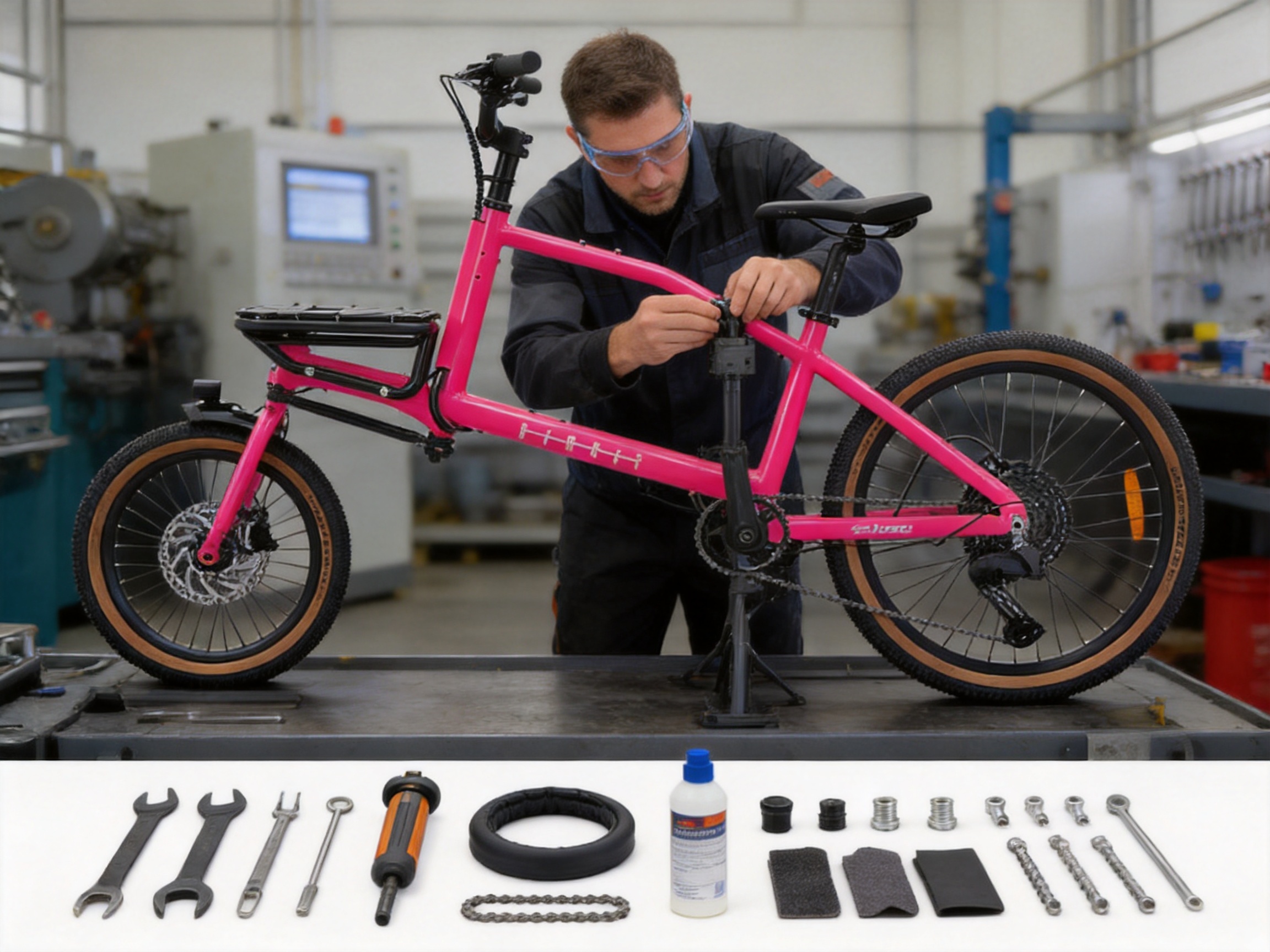
The mechanical architecture of the V1 makes routine care straightforward, but regular attention remains essential. The chain should be cleaned and lubricated according to riding conditions. Dust, mud, water, and sand can accelerate wear, particularly during off-road use. A clean, correctly lubricated chain shifts more smoothly and reduces unnecessary friction.
Hydraulic brake pads and rotors should be checked regularly. A change in lever feel, unusual noise, vibration, or reduced stopping power should be investigated immediately. The brakes should never be contaminated with chain lubricant, grease, or cleaning products not intended for braking surfaces.
The tires should be inspected for cuts, embedded debris, abnormal wear, and sidewall damage. Puncture-resistant construction reduces risk but does not eliminate the need for inspection. Correct inflation supports handling, comfort, and rolling efficiency, especially when the front basket is carrying a significant load.
Wheel security and spoke condition should also be checked. Cargo bikes transmit substantial forces through their wheels, especially when traveling over uneven terrain. Any looseness, unusual noise, or change in wheel alignment should be addressed before continued use.
The folding basket should be kept free of dirt and should be checked for smooth operation and secure locking. Because the basket is central to the V1’s utility, its attachment points deserve the same attention as the drivetrain and brakes. Cargo straps and accessories should not interfere with folding mechanisms, steering, or wheel movement.
No. The V1 is a manual cargo bike with no battery and no power system. It operates entirely through rider input and a mechanical drivetrain.
The main benefit is independence from charging infrastructure and electrical components. The bike can be used in remote areas where charging stations are unavailable, and it may be easier to maintain with conventional bicycle tools and knowledge.
The stated maximum basket load is 25 kilograms. Cargo should be distributed evenly, secured carefully, and kept within the specified limit.
The listed maximum rider load is 145 kilograms. Riders should also account for clothing, personal equipment, and any accessories when considering the total operating load.
Yes. The oversized front folding basket is designed for bulky equipment such as tents, coolers, bags, tools, and outdoor supplies. Heavy items should be placed low and centered, and all equipment should be secured against movement.
The product information identifies it as a front folding basket. Its folding function is intended to make storage and transport more convenient when the full cargo area is not required.
The V1 uses an 11-speed Shimano Cues drivetrain. The wide gearing range is intended to help the rider manage flat roads, climbs, descents, and changing loads.
The bike uses wide 2.4-inch puncture-resistant tires, with an 18-inch front wheel and a 20-inch rear wheel. They are suited to mixed surfaces and adventure-oriented use, although riders should select routes appropriate to their skill and the bike’s cargo load.
The V1 uses Tektro hydraulic disc brakes. These are intended to provide controlled braking and speed management in both everyday and demanding riding conditions.
It can be used on climbs when the rider selects an appropriate low gear and manages the cargo weight carefully. Because it has no motor assistance, steep climbs with a heavy load require greater physical effort than they would on an electric cargo bike.
The V1 does not include a motor, battery, controller, display, or related electrical hardware. Removing these systems reduces overall equipment mass and can make the bicycle easier to lift, transport, and maneuver.
Yes. Its large front basket can carry groceries, tools, work supplies, and other everyday items. However, riders should consider the bike’s 750-millimeter width when navigating narrow paths, gates, or crowded spaces.
It has fewer specialized systems to maintain because it lacks a motor and battery. Nevertheless, the chain, gears, tires, wheels, brakes, basket, and frame still require regular inspection and servicing.
The V1 is especially suitable for bikepackers, campers, outdoor workers, rural users, and riders who prefer a self-sufficient mechanical bicycle. It is also appropriate for people who want substantial cargo capacity without relying on electric assistance.
The Atmose Model V V1 Manual Adventure Cargo Bike is defined by a clear and purposeful idea: dependable cargo transportation does not always require a motor. By combining a 6061 T4T6 aluminum alloy frame, a large folding front basket, wide puncture-resistant tires, an 11-speed drivetrain, and hydraulic disc brakes, it creates a platform for riders who want to carry meaningful equipment into places where charging and technical support may not be available.
Its advantages over competing designs are specific and practical. It is simpler than an electric cargo bike, more capable of carrying bulky loads than a standard touring bicycle, more versatile on varied terrain than a single-speed utility bike, and more integrated than a bicycle-and-trailer combination. The manual architecture also reduces weight and creates a direct, responsive riding experience for people who enjoy being fully involved in the journey.
The company’s broader strengths support this product concept. Its California origins, Paris-based design and R&D presence, manufacturing experience, mature supply chain, and focus on cargo-bike innovation provide a foundation for developing bicycles that combine utility with thoughtful design. The use of recognized mechanical components and an aluminum frame reflects an emphasis on serviceability, practical performance, and long-term use.
The V1 is not intended to make every ride effortless. Instead, it is intended to make demanding journeys possible without depending on a battery. For riders who value self-reliance, carry substantial equipment, and want to explore beyond the limits of urban infrastructure, that distinction can be more important than electric power. It is a cargo bike for those who see the effort of riding as part of the adventure and who want a durable mechanical partner for the road ahead.
1. Product specification sheet for the Model V V1 Manual Adventure Cargo Bike.
2. Technical information concerning 6061 aluminum alloy frame construction and heat treatment.
3. Shimano component documentation for the Cues 11-speed drivetrain family.
4. Tektro hydraulic disc brake maintenance and operating guidance.
5. General bicycle industry practices for cargo loading, tire maintenance, brake inspection, and drivetrain service.
6. Company information concerning product development, design, research and development, manufacturing experience, and cargo-bike applications.
Nov 27, 2026
Nov 25, 2026
Nov 21, 2026


info@atmosecargobike.com

200 rue de la Croix Nivert 75015 Paris

Custom Electric Bakfiets
 English
 Français
 Deutsch