Nov 11, 2026
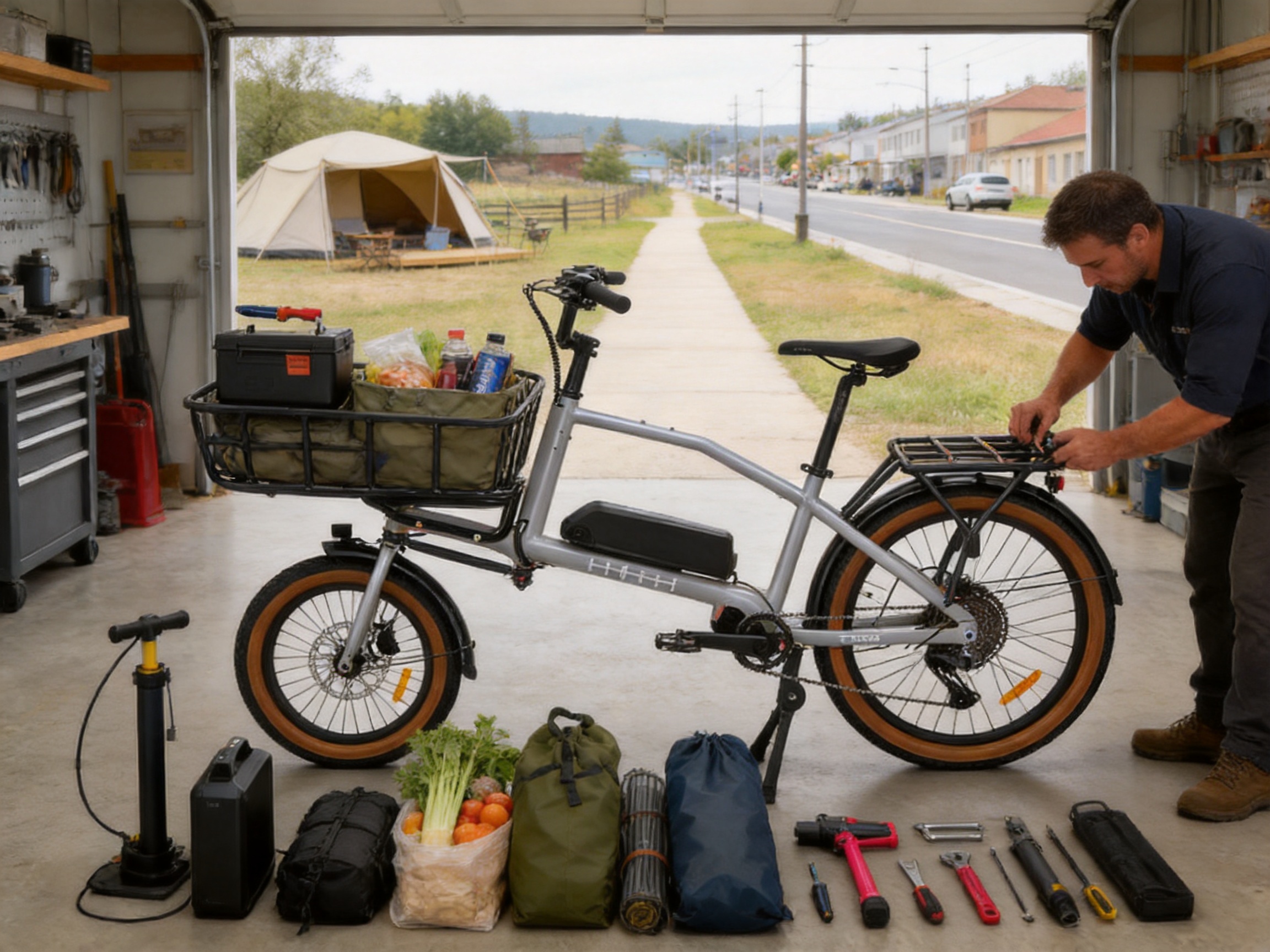
Adventure cargo bikes are designed for riders who want more than ordinary transportation. They must carry substantial equipment, remain stable on changing surfaces, climb demanding gradients, and provide dependable braking when conditions become wet, muddy, or unpredictable. The Atmose Model V ESV1 addresses these requirements with a purpose-built configuration centered on an oversized front camping rack, a high-torque mid-drive system, puncture-resistant tires, hydraulic disc brakes, and a durable aluminum frame.
Rather than treating cargo capacity as an accessory added to a conventional bicycle, the Model V is developed around the idea that storage, handling, propulsion, and braking must work together. Its front folding basket is large enough for camping equipment, outdoor supplies, coolers, fishing gear, and other bulky items. At the same time, its relatively compact overall length helps preserve maneuverability compared with much longer front-loading cargo bicycles.
This article examines the product’s design, practical advantages, technical specifications, outdoor performance, manufacturing philosophy, and suitability for different users. It also explains how the Model V compares with more conventional cargo bicycles and why the company’s combination of American product thinking, European design development, established manufacturing experience, and international research and development supports the bike’s intended role.

Atmose Model V ESV1 Adventure Cargo Bike with Oversized Front Camping Rack
The Model V ESV1 is an adventure cargo bike built for riders who want to travel beyond paved city streets. Its defining feature is the oversized front camping rack, which creates a stable, visible, and accessible platform for outdoor equipment. The rack is positioned ahead of the rider, making it possible to transport large objects without placing every item behind the saddle or on a separate trailer.
This arrangement is particularly useful for camping trips, fishing excursions, rural errands, weekend exploration, and equipment-heavy recreational riding. A tent, sleeping bag, portable stove, cooler, dry bag, folding chair, or fishing box can be carried at the front while the rider retains a clear view of the road and the bike’s balance remains easier to manage than with a high, rear-mounted load.
The product description emphasizes three central objectives: going farther, packing more, and exploring deeper. These goals describe a bike that is not limited to short-distance urban transport. The Model V is intended to serve as a practical platform for riders who need the carrying capability of a cargo bike but also want the handling and visual character of an adventure bicycle.
The ESV1 designation identifies the product configuration, while Model V places it in the adventure cargo bike category. This distinction is important because the bike is not simply a family carrier or a delivery vehicle. Its frame, motor, tire selection, braking system, and rack are combined for a use case involving mixed terrain, substantial equipment, and longer periods away from conventional services.
The front folding basket measures approximately 470 millimeters in length, 470 millimeters in width, and 375 millimeters in height. These dimensions provide a generous three-dimensional cargo space rather than a narrow platform intended only for small shopping bags. The basket can accommodate equipment with irregular shapes, including camping containers, outdoor tools, bundled clothing, and recreational supplies.
A major benefit of a front cargo platform is load visibility. The rider can see the basket and its contents more easily than a large rear load, which helps with checking straps, covers, and balance during a ride. The forward position also makes the bike useful for frequent-access items such as water bottles, jackets, food, maps, repair tools, and small equipment that may need to be reached during a journey.
The basket’s folding function adds versatility. When the front storage area is not required, folding it can help reduce visual bulk and make the bicycle easier to store or move through narrow areas. When it is needed, the rack can be used as the central cargo area for an adventure-focused setup.
Keeping heavy objects low is one of the most important principles in cargo bike design. A low center of gravity generally contributes to more predictable handling than carrying the same load high above the wheels. This is especially valuable on uneven trails, where sudden steering movements and surface changes can affect a heavily loaded bicycle.
Compared with a backpack, the front rack reduces strain on the rider’s shoulders and back. Compared with panniers alone, it provides more usable volume for bulky objects. Compared with a trailer, it keeps the load integrated with the bicycle and avoids the additional length, turning path, and parking challenges created by a separate towed unit.
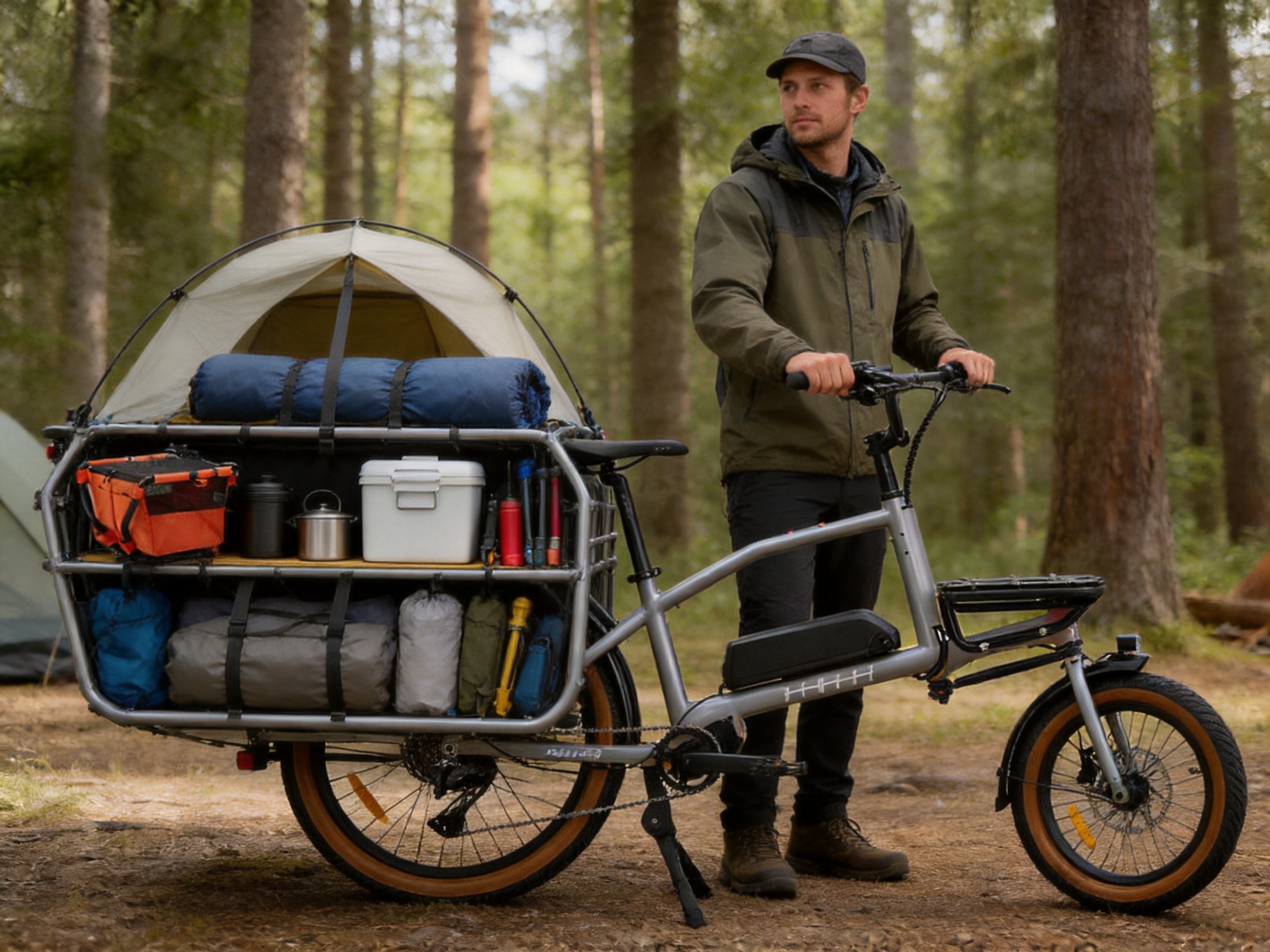
The listed maximum load is 170 kilograms. This figure represents a substantial carrying capability, but users should interpret it as a total system limit unless the manufacturer provides a more specific breakdown. In practical terms, total load planning should account for the rider, cargo, accessories, and any other equipment being transported.
A high maximum load does not mean that every item should be placed at the front. Good cargo-bike handling depends on balanced distribution. Dense objects should be secured low and close to the center of the bike whenever possible. Lightweight or frequently accessed items can be placed toward the upper portion of the basket, while loose objects should be contained in bags, boxes, or straps designed for cycling use.
Load security is equally important. Camping equipment can shift because it is often soft, irregular, or made up of several separate items. A tent bag may slide, a cooler may move during braking, and a sleeping bag may catch wind if it is not covered. Proper straps, a waterproof cover, and a sensible arrangement help preserve steering control and prevent equipment from falling into the wheel or road.
The front basket is especially useful for loads that are wide rather than tall. A broad, low arrangement is generally preferable to a narrow, high stack. Riders should avoid creating a tall profile that may affect visibility or respond strongly to side winds. The bike’s usable advantage comes from its area and stability, not from stacking cargo as high as possible.
For business users, the same design can support mobile services, outdoor maintenance work, event support, market transport, and small-scale delivery. For private users, it can carry the equipment required for a full day away from home. In both cases, the rack allows the bike to substitute for some short car trips without requiring a large vehicle.
The ESV1 uses a 6061 T4T6 aluminum alloy frame. Aluminum is widely used in modern bicycle construction because it offers a useful combination of low weight, corrosion resistance, formability, and structural performance. The frame material is appropriate for a cargo bicycle that must support a meaningful load while remaining manageable for everyday riding and storage.
The T4T6 designation indicates a heat-treatment sequence associated with aluminum alloy processing. Although the exact tubing profiles, weld procedures, and testing methods are not specified in the supplied product information, the material choice reflects an engineering approach focused on producing a rigid and durable load-bearing structure.
Cargo bikes experience forces that are different from those experienced by lightweight recreational bicycles. Acceleration, braking, steering, road impacts, and uneven cargo distribution all place additional demands on the frame and fork area. The structural design therefore has to support not only the rider but also the rack and the changing forces created by cargo.
The Model V’s integrated front storage concept makes frame and rack compatibility particularly important. A rack that is merely attached to a standard front fork can influence steering feel and load distribution. A purpose-oriented adventure cargo bike is better positioned to manage those requirements because the storage area is part of the overall product concept rather than an afterthought.
Aluminum also supports long-term practical ownership. With appropriate care, it does not develop the same type of red rust associated with untreated steel. However, riders should still inspect weld areas, fasteners, rack mounting points, and the underside of the frame after exposure to mud, salt, water, and abrasive trail debris.
The ESV1 uses a Starunion CM2503 mid-drive motor rated at 250 watts. A mid-drive motor is positioned near the bicycle’s central crank area instead of being built into the front or rear hub. This layout can offer several advantages for a cargo bicycle, especially when the bike is loaded or traveling over gradients.
Because the motor works through the bicycle’s drivetrain, the rider can use the Shimano 11-speed Cues system to select an appropriate gear. Lower gears can help the motor and rider manage steep climbs, while higher gears can support more efficient progress on level roads or gentle descents. This interaction between motor and gearing is one reason mid-drive systems are often selected for bicycles intended for hills and variable terrain.
The product description identifies the motor as being tuned for steep gradients. That makes the system relevant to back-country roads, forest approaches, hilly routes, and loaded journeys where a basic low-torque motor may struggle. A rider still needs to select suitable gears, maintain cadence, and manage battery energy, but the motor’s central position and drivetrain integration are designed to support this type of use.
Another advantage of a central motor is weight distribution. A hub motor places additional mass at one wheel, while a mid-drive motor keeps major propulsion weight closer to the center of the bicycle. Centralized weight can contribute to a more balanced feel, especially when a substantial load is carried on the front rack.
The listed power rating is 250 watts. Local laws may define power, speed assistance, equipment requirements, and permitted riding areas differently, so owners should check the rules applicable to their location before using the bicycle on public roads or trails. The motor rating alone does not determine legal classification in every market.
The bike is equipped with a Samsung 36-volt, 15-amp-hour lithium battery, listed as 540 watt-hours. Watt-hours provide a useful way to estimate stored energy. In simple terms, a 540 watt-hour battery can supply a moderate amount of power over an extended period, but actual range depends heavily on conditions and riding behavior.
Rider weight, cargo weight, gradient, wind, tire pressure, terrain, temperature, assist level, stop-and-go riding, and drivetrain condition all affect energy consumption. A heavily loaded bicycle climbing rough trails will use energy more quickly than the same bicycle traveling at a steady pace on flat pavement.
The battery capacity is well matched to the Model V’s intended role because adventure riding often involves variable terrain and limited opportunities for charging. Riders planning long trips should still calculate a conservative route, identify charging options, and avoid assuming that the maximum theoretical range will be available in demanding conditions.
Battery care is an important part of manufacturing value and ownership value. Owners should use the designated charging equipment, avoid exposing the battery to unnecessary heat or moisture, and follow appropriate storage practices. Regular inspection of connectors and mounting hardware can also help prevent electrical or mechanical problems.
For commercial or frequent recreational users, the battery can be viewed as an operational component rather than merely an accessory. A reliable energy system supports predictable daily use, while a well-planned charging routine reduces downtime. The removable or integrated format should be confirmed with the seller if battery access is a deciding factor for a particular use case.
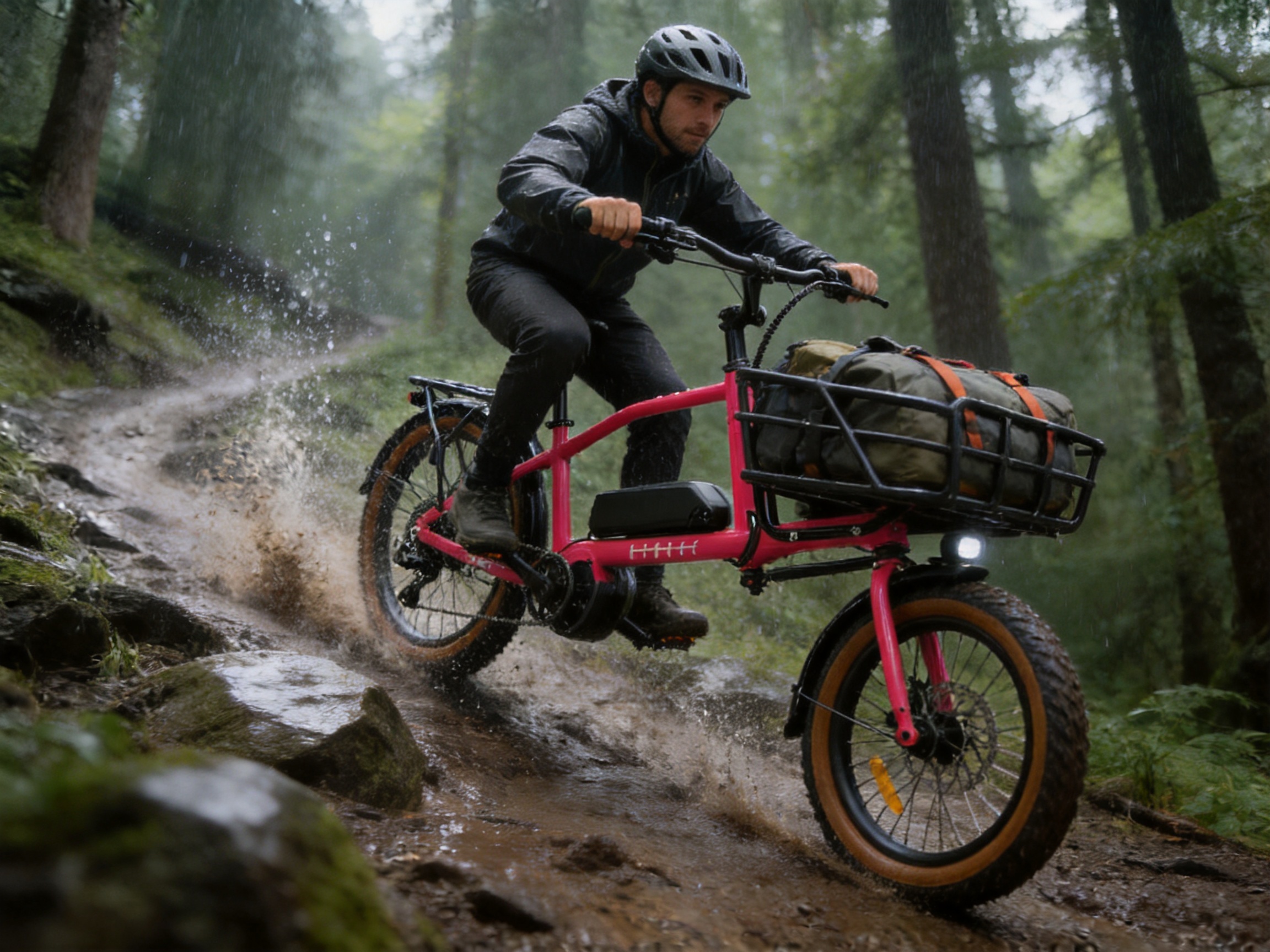
The Shimano 11-speed Cues system gives the rider a broad range of gear options. This is especially useful on a cargo bike because the resistance experienced by the rider varies significantly according to load. A bicycle that feels easy to pedal when empty may require a much lower gear when carrying camping equipment up a slope.
Multiple gears allow the rider to maintain a more comfortable cadence. Rather than forcing the motor and rider to overcome every gradient in one fixed ratio, the drivetrain provides choices for climbing, cruising, and transitioning between surfaces. This can improve control and help the rider manage battery consumption more intelligently.
Gear selection is also a safety factor. A low gear gives the rider greater control when starting on an incline or moving slowly through uneven terrain. A suitable gear can reduce sudden effort at the pedals, while a correctly selected higher gear can make steady road travel more comfortable.
As with any multi-speed bicycle, the drivetrain benefits from regular cleaning, lubrication, adjustment, and inspection. Cargo-bike users should pay particular attention to chain wear because heavy loads and frequent hill climbing can increase drivetrain stress. Replacing worn components before they become severely damaged is generally more economical than repairing a complete drivetrain failure during a trip.
The ESV1 uses wide 18-inch by 2.4-inch front tires and a 24-inch by 2.4-inch rear tire. The tires are described as puncture-resistant. Their width is significant because wider tires can provide a larger contact area, improved cushioning, and more confidence on loose or imperfect surfaces.
The different front and rear wheel sizes reflect a design that balances front-end maneuverability with rear-wheel support. The compact front wheel helps keep the front cargo section accessible and controlled, while the larger rear wheel can contribute to smooth rolling and stable propulsion beneath the rider.
Wide tires do not make a bicycle invulnerable to punctures or eliminate the need for pressure checks. Sharp stones, thorns, glass, and metal debris can still cause damage. However, puncture-resistant construction can reduce the frequency of common failures and increase confidence when traveling away from repair facilities.
Tire pressure should be selected according to rider weight, cargo weight, surface, and manufacturer guidance. Too much pressure can reduce comfort and traction on rough ground, while too little pressure can increase rolling resistance and the possibility of rim damage. A loaded adventure cargo bike deserves a more careful pressure routine than an unloaded commuter bicycle.
The tires are best understood as supporting mixed-surface travel rather than guaranteeing unrestricted off-road performance. Riders should evaluate trail width, loose soil, rocks, mud, water, and gradients before committing to a route. The bike’s capability is enhanced by its tires, motor, brakes, and frame, but responsible route selection remains essential.
The ESV1 is fitted with Tektro hydraulic disc brakes. Hydraulic disc systems transmit braking force through fluid rather than a conventional mechanical cable. They are commonly selected for cargo bicycles because they can provide strong, progressive braking with relatively low hand effort.
Braking performance is particularly important when a bicycle carries a large load. The combined mass of rider, bicycle, and equipment creates more momentum, especially on downhill sections. Wet roads, mud, gravel, and changing traction make controlled deceleration even more important.
Hydraulic disc brakes can offer consistent performance in conditions where rim brakes may be affected by water, mud, or wheel contamination. Their position at the hub also keeps the braking surface away from the tire’s outer edge. The supplied product description specifically highlights hydraulic braking as an advantage for wet and muddy conditions.
Riders should apply the brakes progressively and allow additional stopping distance when the bicycle is heavily loaded. Braking before a corner is generally preferable to making a sudden hard stop while turning on loose ground. Brake pads, rotors, hoses, and lever feel should be inspected periodically, particularly after long descents or rough-weather use.
Strong brakes do not replace safe riding technique. Cargo must be secured, tire grip must be considered, and the rider should keep the bicycle under control rather than relying on emergency braking at the last moment. The value of the hydraulic system is its ability to provide a dependable control resource when the rider needs it.
The listed bike dimensions are approximately 1,910 millimeters in length, 750 millimeters in width, and 1,060 millimeters in height. These dimensions place the Model V in a practical middle ground: it offers substantial cargo capability without reaching the extreme length of some specialized long-tail or long-john cargo designs.
The 750-millimeter width is relevant for storage, gates, cycle paths, doorways, and vehicle transport. Riders should measure their intended storage area before purchasing, especially if the bicycle will be kept in an apartment, garage, shed, elevator, or shared bicycle room.
Its overall length is long enough to support a useful front cargo area but compact enough to remain practical for urban turns and ordinary parking. Compared with a trailer combination, the integrated design is easier to predict because the steering, cargo area, and rear wheel remain part of one vehicle.
Handling will naturally change when the basket is full. Riders should practice first with a light load, then gradually increase weight while learning how the bike accelerates, turns, and stops. This gradual approach is valuable for anyone moving from a normal bicycle to a cargo model.
Many cargo bikes are designed mainly for children, groceries, or last-mile delivery. The Model V differentiates itself by focusing on outdoor exploration and equipment transport. Its specification combines a large front rack, high-torque mid-drive propulsion, wide puncture-resistant tires, and hydraulic brakes in one package.
A large front basket makes the load easy to monitor and reach. Rear cargo systems can be highly useful, but they may require the rider to dismount or walk around the bicycle to access equipment. For camping and outdoor use, front access can simplify frequent stops and reduce the need to unpack the entire bike.
The mid-drive arrangement provides a natural match for the 11-speed drivetrain. This is a meaningful distinction from basic hub-motor cargo bikes that may offer less flexibility on steep hills or when heavily loaded. The Model V’s system is intended to use the bicycle’s gears to help manage different gradients and surfaces.
The stated 170-kilogram maximum load positions the bike as a serious carrying platform. Although users must interpret this figure according to the manufacturer’s complete safety guidance, it indicates that the bike is not intended only for light shopping or occasional small cargo.
Hydraulic disc brakes and puncture-resistant tires give the Model V a stronger argument for mixed-weather and mixed-surface use than a basic city bicycle. These features are not exclusive to adventure cargo bikes, but their combination is especially relevant when the rider may be far from repair services or traveling with expensive equipment.
The company presents itself as a U.S.-origin cargo e-bike brand with American product thinking and European design aesthetics. The brand originated in California and was developed by MOTIV, an established American beach cruiser company with industry experience. In 2026, ATMOSE SASU was established in France alongside a new design and research and development team.
This international structure can support a product development process that combines different areas of expertise. American product thinking is associated by the company with practical, user-focused mobility concepts, while the Paris-based design and research team contributes European design sensibility and attention to urban usability. The result is intended to balance utility, appearance, comfort, and reliability.
The company also describes a mature supply chain and years of manufacturing experience. A mature supply chain can be valuable in cargo-bike production because a complete bicycle depends on coordinated components: frame materials, motors, batteries, drivetrain parts, brake systems, tires, racks, fasteners, electrical connections, and protective finishes must work together.
Manufacturing quality is not determined by one component alone. It depends on how accurately parts are produced, how consistently frames are assembled, how electrical systems are tested, how braking components are installed, and how the finished bicycle is inspected before delivery. For a product designed to carry up to 170 kilograms, these process considerations are especially important.
The Model V’s component selection suggests a system-level approach. The aluminum alloy frame provides a structural foundation. The mid-drive motor is matched with an 11-speed drivetrain. The front rack is sized for substantial cargo. The tires and brakes support outdoor conditions. This type of integration is more valuable than simply adding the largest possible motor or rack to an unrelated bicycle frame.
Atmose’s stated philosophy of “Fun & Practical” also has manufacturing implications. Practicality requires attention to access, serviceability, load placement, riding position, reliability, and daily usability. Fun requires the bike to feel manageable rather than cumbersome. A successful adventure cargo bike must combine these qualities instead of sacrificing one completely for the other.
Because detailed factory procedures are not included in the supplied information, buyers should request specific details about frame testing, battery certification, motor testing, quality-control inspection, warranty coverage, spare parts, and service support. These questions are not signs of distrust; they are normal considerations when evaluating any high-value electric cargo bicycle.
A cargo bicycle must be assessed as a complete transportation system. Important quality areas include weld consistency, alignment, rack attachment, wheel construction, spoke tension, brake installation, drivetrain adjustment, battery mounting, cable routing, and software or display operation where applicable.
Frame alignment affects handling and tire wear. Rack alignment affects load security and steering feel. Wheel quality affects rolling stability under weight. Brake setup affects stopping distance and control. Electrical connections affect reliable assistance. A strong manufacturing process should address each of these areas during assembly and final inspection.
For outdoor use, sealing and protection are also important. Mud and water can reach the lower frame, motor area, connectors, brake components, and drivetrain. Riders should follow the manufacturer’s cleaning instructions and avoid using high-pressure water directly on bearings, electrical connectors, or motor seals.
Long-term reliability depends on maintenance as well as initial quality. Even a well-manufactured bicycle requires torque checks, brake service, tire inspection, chain care, battery care, and periodic professional inspection. The advantage of a mature manufacturing and supply-chain organization is that it can potentially support replacement parts and technical assistance over the product’s service life.
The Model V is particularly suited to riders who want to transport equipment to campsites, lakes, trailheads, cabins, or rural destinations. Its rack can carry the bulky items that are difficult to fit into conventional panniers. The motor helps reduce the physical barrier created by hills and heavy loads, while the wide tires provide additional comfort on uneven approaches.
A practical camping load might include a tent, sleeping system, cooking equipment, food, water, clothing, repair tools, lighting, and personal items. These should be organized into weather-resistant containers so that the load remains stable and protected. The basket’s size is useful, but riders should still make the final arrangement compact, balanced, and securely attached.
For fishing, the front storage platform can carry tackle boxes, rods in appropriate holders, coolers, waders, and other equipment. For photography or nature observation, it can transport tripods, camera bags, field guides, and protective cases. For day exploration, the same area can hold a picnic load, sports equipment, or supplies for a long-distance route.
Adventure riding also requires preparation for situations that are less common in urban use. A rider should consider carrying a pump, tire repair tools, spare tubes or compatible repair equipment, lights, a first-aid kit, water, and a charged mobile phone. A motor-assisted cargo bike can extend the distance a rider can cover, but it should not encourage inadequate planning.
Although the Model V is positioned as an adventure cargo bike, its capabilities also translate to urban use. The large front rack can carry groceries, work equipment, parcels, market supplies, or tools. The upright, practical format may suit people who want to replace some short car journeys while retaining the ability to transport more than a standard bicycle can handle.
Small businesses can use the bike for local delivery, mobile maintenance, landscaping support, event logistics, or market operations. The 250-watt mid-drive system and wide tires can be useful when the route includes inclines, cobblestones, rough lanes, or mixed road surfaces.
For commercial users, total operating cost matters as much as headline specifications. A cargo e-bike can reduce fuel use, parking expenses, and congestion exposure on short routes. However, commercial buyers should evaluate battery charging, daily range, service intervals, insurance, security, weather protection, and replacement-part availability.
The front basket’s visual accessibility can also be useful for businesses that need to present goods or maintain quick access to tools. The bike can function as a transport platform without requiring a large rear enclosure. This flexibility helps explain why the Model V can serve both recreational and professional roles.
Riders moving from a normal bicycle should expect a different steering response. A cargo bike is longer, heavier, and more affected by load placement. The appropriate learning process is gradual: begin in an open area, test braking at low speed, practice slow turns, and learn how the steering feels with an empty basket before adding equipment.
Starting and stopping deserve special attention. A loaded bike may require more effort to accelerate and more distance to stop. The electric motor can make starting easier, but riders should avoid using excessive assistance in tight spaces. Smooth pedal input helps preserve traction and reduces sudden movement of the cargo.
Cornering should be controlled and deliberate. Riders should reduce speed before entering a corner, maintain a stable line, and avoid abrupt steering corrections. On loose surfaces, the wide tires can help, but they cannot overcome excessive speed or poorly distributed cargo.
The bike’s strengths are most apparent when the rider works with its design. Keeping the load low, using the correct gear, maintaining suitable tire pressure, and braking early will produce a more comfortable and predictable experience than treating the bicycle like an unloaded road bike.
A basic maintenance program begins with pre-ride checks. Confirm that the front rack is securely folded or deployed, cargo is strapped down, tires are properly inflated, brakes feel firm, the battery is locked or mounted correctly, and the drivetrain shifts normally.
After wet or muddy rides, rinse away loose dirt using gentle methods and dry the bicycle before storage. Clean and lubricate the chain according to the lubricant manufacturer’s instructions. Check the brake rotors for contamination and inspect the tires for embedded stones, thorns, or cuts.
At regular intervals, inspect rack fasteners, frame joints, wheel axles, spokes, crank components, pedals, and handlebar controls. Heavy cargo use can increase vibration and mechanical stress. Any unusual noise, looseness, brake pulsing, steering change, or electrical interruption should be investigated before the next demanding ride.
Battery maintenance should follow the supplied technical guidance. Avoid storing a battery in extreme temperatures, use the correct charger, and do not continue using a battery that shows signs of damage, swelling, overheating, or unusual odor. Professional service is appropriate for electrical faults and internal battery concerns.
Before purchasing, prospective users should identify their main routes and cargo needs. Consider whether the bicycle will be used on paved roads, gravel paths, forest roads, steep hills, or wet surfaces. Estimate the combined weight of rider and equipment rather than considering cargo weight alone.
Measure storage doors, elevators, vehicle racks, and charging areas. Confirm whether the front basket’s dimensions suit the intended equipment. Ask about approved accessories, cargo restraints, replacement tires, brake pad availability, battery replacement, warranty terms, and local service arrangements.
Buyers should also confirm the legal status of the motor-assisted bicycle in their country or region. Rules may cover maximum assisted speed, motor rating, throttle operation, helmet use, lighting, registration, insurance, and trail access. Compliance is the responsibility of the user and may vary significantly between jurisdictions.
Feature |
Listed specification |
Practical significance |
Product configuration |
ESV1, Model V Adventure Cargo Bike |
Designed for outdoor equipment transport and mixed-surface exploration |
Frame |
6061 T4T6 aluminum alloy |
Lightweight structural material with corrosion resistance and suitable load-bearing properties |
Battery |
Samsung 36 V, 15 Ah, 540 Wh lithium battery |
Provides stored energy for assisted riding; actual range depends on conditions |
Maximum load |
170 kg |
Supports substantial combined rider and cargo weight when used within manufacturer guidance |
Motor |
Starunion CM2503 mid-drive, 250 W |
Central propulsion with drivetrain-based gearing for hills and variable terrain |
Drivetrain |
Shimano 11-speed Cues |
Provides gear range for climbing, cruising, and loaded riding |
Front basket |
470 mm × 470 mm × 375 mm folding basket |
Accommodates bulky camping, fishing, delivery, and recreational equipment |
Tires |
Front 18 × 2.4, rear 24 × 2.4 puncture-resistant tires |
Supports comfort, traction, and reduced puncture risk on imperfect surfaces |
Brakes |
Tektro hydraulic disc brakes |
Strong, progressive control for heavier loads and wet conditions |
Overall dimensions |
1,910 mm × 750 mm × 1,060 mm |
Useful cargo capacity while remaining practical for storage and urban movement |
The Model V ESV1 is designed as an adventure cargo bike for transporting outdoor equipment, camping supplies, fishing gear, work tools, and other bulky loads. It combines a large front folding basket with electric assistance, wide tires, and hydraulic disc brakes.
The listed maximum load is 170 kilograms. Users should confirm whether this figure includes the rider, cargo, accessories, and bicycle, and should follow the manufacturer’s detailed loading instructions. Cargo should be distributed low and securely rather than concentrated high at the front.
The basket offers a wide, accessible cargo area for tents, coolers, sleeping equipment, food, cooking supplies, and outdoor tools. Its front position makes the load easy to monitor and can keep heavy equipment low compared with a high backpack or tall rear stack.
The ESV1 uses a 250-watt mid-drive motor and an 11-speed Shimano Cues drivetrain. This combination is intended to support gradient riding by allowing the motor and rider to work through lower gears. Actual climbing performance depends on total load, slope, surface, battery charge, and riding technique.
The battery is rated at 540 watt-hours, but no single range figure can apply to every rider. Heavy cargo, steep hills, high assistance, low temperatures, soft surfaces, and frequent stops reduce range. Riders should plan conservatively and identify charging options on longer trips.
The wide puncture-resistant tires, hydraulic disc brakes, mid-drive motor, and adventure-oriented rack make the bike suitable for many mixed-surface routes. Trail access depends on local rules and the condition of the route. Extremely technical terrain, deep mud, narrow paths, and obstacles may exceed the bike’s intended use.
Hydraulic disc brakes generally provide strong and progressive stopping with low hand effort. They are useful on a loaded bicycle and can perform consistently in wet or muddy conditions. Riders should still brake early, maintain the system, and allow extra stopping distance when carrying heavy cargo.
It identifies the aluminum alloy and heat-treatment designation used for the frame material. Aluminum offers a useful balance of structural capability, corrosion resistance, and manageable weight. Detailed welding, testing, and safety procedures should be confirmed with the manufacturer or authorized seller.
No. Although the Model V is designed around adventure use, its large front basket and high load capacity can also support urban errands, small-business delivery, mobile maintenance, market transport, and work equipment. Its suitability depends on the route, local regulations, and the user’s cargo requirements.
Prospective buyers should confirm total load limits, battery access, charging requirements, warranty terms, local servicing, spare parts, accessory compatibility, storage dimensions, legal classification, and the availability of replacement tires and brake components. They should also measure their intended storage and charging spaces.
The Atmose Model V ESV1 occupies a distinctive position within the cargo-bike market. It is not merely a family carrier with an electric motor and it is not simply a standard bicycle fitted with a small front rack. Its design centers on the practical demands of outdoor equipment transport: a large folding basket, a 170-kilogram listed maximum load, central motor assistance, an 11-speed drivetrain, wide puncture-resistant tires, and hydraulic disc brakes.
Its strongest advantage over more conventional cargo bikes is the way these features support a specific lifestyle. Riders who camp, fish, explore rural roads, transport tools, or travel beyond paved streets can benefit from a storage system designed around bulky equipment. The bike also retains enough practical dimension to remain relevant for urban errands and local business use.
The company’s stated background adds another important dimension. Atmose combines American origins and product thinking with a Paris-based European design and research and development presence. Its connection with MOTIV, mature supply-chain experience, and focus on integrated component selection support an approach that aims to balance durability, usability, appearance, and riding enjoyment.
As with any heavy-duty electric bicycle, the real ownership experience will depend on correct loading, responsible route selection, regular maintenance, battery care, and access to service. The specification is promising for riders who need a capable, equipment-focused cargo platform, but buyers should confirm technical details, legal requirements, and after-sales support before making a final decision.
For its intended audience, the Model V ESV1 offers a compelling combination of carrying capacity and exploration potential. It transforms the cargo bike from a simple utility vehicle into a practical outdoor companion—one capable of moving people and equipment farther while reducing dependence on cars for many short and medium-distance journeys.
1. Atmose ESV1 Product Specification Sheet. Product name, frame, battery, motor, drivetrain, rack, tire, brake, load, and dimension information.
2. Atmose Model V Adventure Cargo Bike Product Description. Design objectives, front-rack applications, climbing performance, durability, and outdoor-use positioning.
3. Atmose Company Information. Brand history, product philosophy, American origins, Paris design and research presence, manufacturing background, and supply-chain development.
4. Shimano Cues Technical Product Literature. General principles of multi-speed bicycle drivetrain operation and gear selection.
5. Tektro Hydraulic Disc Brake Technical Guidance. General principles of hydraulic braking, inspection, and maintenance.
6. General Bicycle Cargo-Loading and Safe-Riding Practices. Principles of weight distribution, secure fastening, braking distance, tire-pressure management, and mixed-surface riding.
Nov 11, 2026
Nov 07, 2026
Nov 05, 2026


info@atmosecargobike.com

200 rue de la Croix Nivert 75015 Paris

Custom Electric Bakfiets
 English
 Français
 Deutsch