Nov 05, 2026
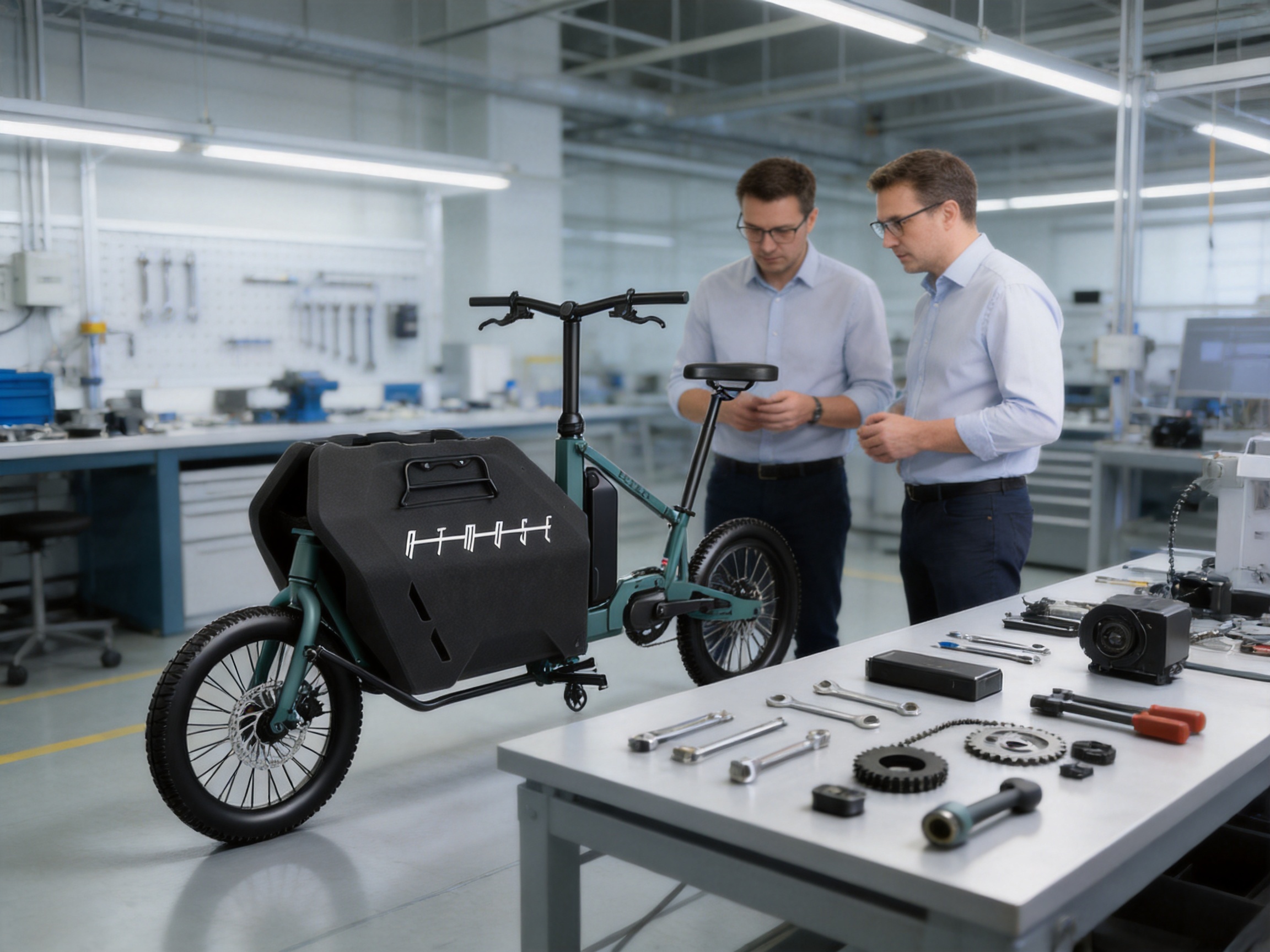
Urban transportation is changing rapidly. More people want the carrying capacity of a cargo bike, yet many city residents do not have the storage space associated with a full-size utility bicycle. A fourth-floor apartment, a narrow corridor, a shared elevator, a compact car, or a crowded railway station can turn a conventional cargo bike into an impractical ownership choice. The solution is not always a smaller basket or a lighter frame. In many cases, riders need a genuinely capable cargo bicycle that can also become compact when the journey is over.
The Atmose Model R ESR1 Tri-Fold Cargo E-Bike is designed around that specific requirement. It combines a front-loading cargo layout with a folding frame, allowing riders to use a practical cargo platform on the road and a significantly shorter package at home, at work, or during multimodal travel. Its design brings together a 250-watt mid-drive motor, up to 70 Nm of torque, a 720 Wh Samsung battery, hydraulic disc brakes, puncture-proof tires, a Gates belt drive, and a Shimano Nexus 3 internal gear hub.
Its central advantage is straightforward: the cargo configuration used while riding is also the configuration that folds. The rider does not need to convert the bike into an entirely different format before storage. The regular riding length is 198 cm, while the folded dimensions are 120 × 44 × 85 cm. With the front wheel removed, the package reduces further to 102 × 44 × 76 cm, a size intended for many car trunks and compact storage areas.
This combination makes the Model R particularly relevant to train commuters, apartment residents, delivery users, families without private storage, and riders who want to carry substantial loads without buying a van or installing a permanent vehicle rack. More importantly, it demonstrates a product philosophy in which folding capability is not treated as a novelty. It is integrated into the cargo-bike structure, drivetrain, load area, and daily operating routine.
Traditional cargo bikes offer substantial practical benefits. Their long frames, front boxes, low load platforms, and stable handling can make them excellent for groceries, work equipment, deliveries, and family transportation. However, their size can create a serious ownership barrier. A bike may be easy to ride but difficult to store, carry upstairs, place inside an elevator, or transport by car.
Many apartment dwellers cannot leave a cargo bike outside because of theft, weather, building restrictions, or limited communal space. A bicycle stored outdoors may require a heavy lock, a covered area, and regular cleaning. In contrast, an indoor-storage bicycle can be protected from rain, salt, dirt, and opportunistic theft. The difficulty is that a full-size cargo bike often cannot pass through the same spaces as an ordinary bicycle.
Train travel creates another challenge. A commuter may want to ride from home to a station, take the train for part of the journey, and continue cycling at the destination. A conventional cargo bike can be difficult to bring through station entrances, escalators, platforms, and train doors. Even when railway policies permit bicycles, space and handling remain concerns.
The Model R addresses these problems through its tri-fold arrangement. It does not merely shorten a standard bicycle by folding the handlebar or collapsing a small frame. The bike is designed as a front-loading cargo vehicle first, with folding points incorporated into its overall structure. This allows the basket, steering arrangement, and main riding concept to remain part of the folded package.
That distinction matters because folding convenience is valuable only when riders are willing to use it regularly. A folding mechanism that requires extensive disassembly, complicated adjustments, or the removal of the cargo structure may be acceptable for occasional transport but frustrating for daily commuting. The Model R is presented as a bike that can be folded in place, rolled when folded, and returned to riding configuration without abandoning its cargo function.
The Model R ESR1 uses a 6061 T4/T6 aluminum alloy frame. This material is widely used in bicycle construction because it offers a useful balance of low weight, stiffness, corrosion resistance, and manufacturability. In a cargo-bike application, frame design is especially important because the structure must manage not only rider weight but also the changing forces created by a front-mounted load.
The electrical system combines a 36-volt, 250-watt mid-drive motor with a Samsung 36-volt, 20 Ah lithium battery rated at 720 Wh. The motor delivers up to 70 Nm of torque. A mid-drive places motor assistance near the bicycle’s central drivetrain rather than directly in a wheel hub. This can support balanced weight distribution and allow the motor to work through the selected gear ratio.
The mechanical system uses a Gates belt drive and Shimano Nexus 3 internal gear hub. The belt avoids the exposed lubrication and cleaning requirements associated with a conventional chain. The internal gear hub encloses its shifting mechanism, helping protect it from road grime and reducing the number of exposed moving parts.
Hydraulic disc brakes provide braking force at the wheels, while puncture-proof tires are specified in a 16-inch by 2.4-inch front size and an 18-inch by 2.4-inch rear size. The different wheel dimensions support the bike’s compact, front-loading geometry. The wide tire profiles are intended to improve contact with urban surfaces and help maintain confidence when the bike is carrying a load.
The rider capacity is listed as 100 kg, and the front basket is rated for up to 45 kg. The basket measures 70 × 50 cm at the top and 50 × 36 cm at the bottom. These dimensions provide a broad opening while retaining a narrower lower section, creating a practical space for bags, packages, groceries, work equipment, and other everyday cargo.
| Specification | Model R ESR1 Detail |
|---|---|
| Frame | 6061 T4/T6 aluminum alloy |
| Motor | 36 V, 250 W mid-drive motor |
| Maximum motor torque | Up to 70 Nm |
| Battery | Samsung 36 V, 20 Ah, 720 Wh lithium battery |
| Rider capacity | Up to 100 kg |
| Front basket capacity | Up to 45 kg |
| Drive system | Gates belt drive |
| Internal gearing | Shimano Nexus 3 internal gear hub |
| Front tire | 16 × 2.4 inches, puncture-proof |
| Rear tire | 18 × 2.4 inches, puncture-proof |
| Brakes | Hydraulic disc brakes, Tektro or Magura specification |
| Riding dimensions | 198 cm long × 38 cm wide × 108 cm high |
| Folded dimensions | 120 × 44 × 85 cm |
| Folded dimensions without front wheel | 102 × 44 × 76 cm |
Many compact bicycles sacrifice carrying capacity to achieve a smaller footprint. They may include a small rear rack, a front basket, or a limited luggage platform, but they do not provide the low, open cargo area associated with a dedicated cargo bike. The Model R takes a different approach by keeping the front-loading cargo structure central to the product.
The front basket is not an accessory added after the frame has been designed. It is part of the bike’s intended operating concept. A top opening of 70 × 50 cm creates room for larger bags and irregularly shaped items, while the lower measurement of 50 × 36 cm gives the basket a stable base. The load is positioned ahead of the rider and relatively low, allowing the rider to see the cargo and monitor its position during the journey.
A 45 kg basket rating gives the bike more utility than a typical commuter bicycle. It can handle a substantial grocery run, a box of tools, supplies for a small business, or equipment for a day outdoors. The total usable load will always depend on how weight is distributed, how it is secured, and the riding environment, but the stated rating indicates that the bike is intended for more than light personal luggage.
Front-loading cargo bikes can also provide a different riding experience from rear-loading bicycles. The rider remains close to the load and can often observe it more directly. For deliveries or errands, this can make organization easier. For families, a front platform can offer a clear view of bags or supplies. For commercial riders, a broad basket can reduce the need to divide one load among several small panniers.
The compact storage advantage does not require the user to remove the basket every time the bike is parked. Because the cargo arrangement folds with the frame, the rider can preserve the core utility of the bicycle during the transition from riding to storage. This is one of the most important differences between a folding cargo bike and a standard cargo bike fitted with a detachable carrying system.
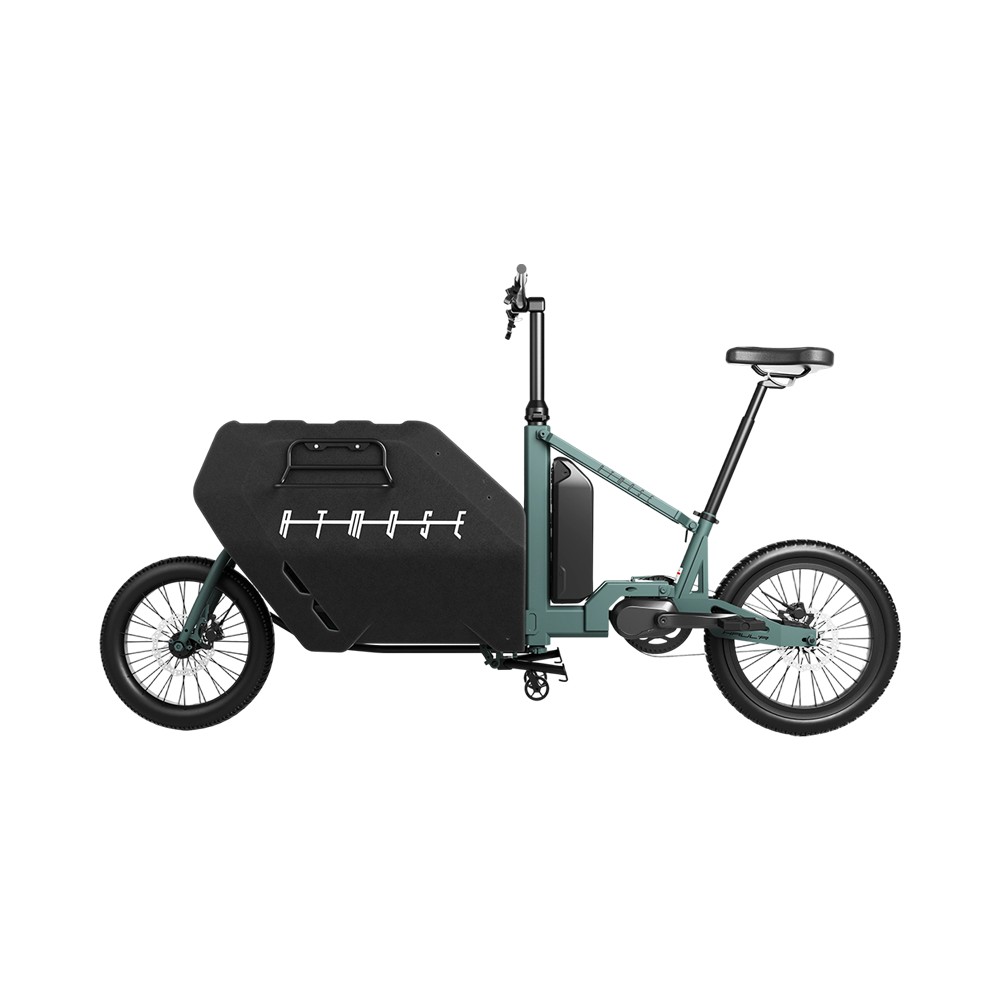
Atmose Model R ESR1 Tri-Fold Cargo E-Bike for Train Commuters and Small Apartments
The word “folding” can describe many different bicycle mechanisms. Some folding bicycles are built around small wheels and a compact central frame. Others use hinged handlebars, collapsible pedals, or removable components. A cargo bike has more difficult packaging requirements because the design must accommodate a long wheelbase, a load platform, steering controls, braking systems, and a frame that can withstand higher operating forces.
The Model R’s tri-fold structure is intended to reduce the 198 cm riding length to 120 cm when folded. The folded width is 44 cm and the height is 85 cm. This creates a package that is substantially easier to place in a hallway, elevator, office, storage room, or apartment corner than a conventional long cargo bicycle.
With the front wheel removed, the folded dimensions become 102 × 44 × 76 cm. This smaller configuration is especially relevant for car transportation. Many owners of ordinary cargo bikes must use a roof carrier, rear rack, or large vehicle to take their bicycle on a trip. The Model R offers another option: remove the front wheel, fold the bicycle, and place it inside a suitable trunk.
This approach can be helpful for riders who live in one city but occasionally travel to another cycling destination. The bicycle can accompany a family holiday, a work trip, a delivery assignment, or a weekend outing without requiring a permanent external carrier. It also reduces the need to lift a long, unwieldy bicycle onto a roof, which can be difficult for one person.
Folding also changes the security equation. A bicycle that can be stored indoors is less exposed to theft than one left on the street. It can be placed beside a desk, inside a private storage area, or in a locked room. Indoor storage may also reduce exposure to rain, ultraviolet light, road salt, and temperature changes, all of which can contribute to long-term wear.
The design is particularly suited to the “last several meters” of a journey. A commuter may ride to a station, fold the bike, roll it through the building, take a train, unfold it at the destination, and continue riding. A business user may transport the bike in a vehicle, unload it at a job site, and use the basket for tools or materials. An apartment resident may roll the folded bike directly from the entrance to a storage corner without carrying it up a staircase.
A cargo bike remains a substantial object even after it has been folded. The practical answer is not to pretend that it becomes weightless, but to make movement easier. The Model R is intended to roll while folded. This enables users to push it across a station hall, through an elevator, along an office corridor, or into a storage space.
Rolling is an important daily-use feature because repeated lifting can quickly discourage riders from folding a bicycle. If the process involves carrying a heavy machine through a building, the theoretical compactness may not translate into real-world convenience. By allowing the folded bike to move on its wheels, the design supports a more natural sequence: fold, stabilize, roll, store.
Users should still be aware of steps, uneven surfaces, crowded platforms, and local railway rules. A rolling system improves handling, but it does not remove the need to control the bicycle carefully. The main benefit is that the rider can avoid unnecessary lifting on smooth surfaces.
Cargo bikes often carry more weight than ordinary commuter bicycles. Rider mass, basket contents, frame mass, battery mass, and accessories all contribute to the total system weight. Starting from a traffic light, climbing a ramp, or accelerating on a slight incline can therefore demand considerable effort.
The Model R uses a 250-watt mid-drive motor with up to 70 Nm of torque. Torque is especially relevant during starts and climbs because it represents the turning force available at the drivetrain. A high-torque mid-drive can help the rider manage a loaded start more comfortably, particularly when the bicycle is operated at lower speeds.
Because the motor is positioned centrally, its assistance works through the bicycle’s gearing. The Shimano Nexus 3 internal gear hub gives the rider three ratios for adapting the pedaling effort to the road. A lower ratio can support starts and inclines, while a higher ratio can be used when the bike is moving more quickly on level ground.
The interaction between motor and gearing is one reason a mid-drive system can be well suited to cargo use. Instead of relying entirely on a fixed wheel-motor ratio, the central drive can benefit from the selected gear. Riders still need to select an appropriate gear and pedal smoothly, but the system is designed to support practical low-speed control and loaded movement.
The 720 Wh battery is a substantial energy reserve for an urban cargo e-bike. Actual range depends on rider weight, cargo weight, terrain, temperature, tire pressure, assistance level, wind, stop frequency, and riding style. The battery capacity should therefore not be treated as a guaranteed distance figure. Its more meaningful advantage is the ability to support repeated urban trips before recharging, especially when the bike is used for errands or commercial work.
A large battery can also reduce charging anxiety for users who make several journeys in one day. A commuter could use the bike for a morning station trip, continue riding after the train journey, and complete errands on the way home. A small business could use it for multiple local stops. The practical value is not only distance but flexibility.
The battery is identified as a Samsung lithium battery with a 36-volt, 20 Ah configuration. Battery quality depends on cell selection, pack construction, battery management, protection systems, charging practices, and environmental conditions. Users should follow the manufacturer’s charging and storage instructions, use the correct charger, and avoid leaving the battery in extreme heat or cold.
Daily cargo-bike use often involves rain, dust, grit, repeated starts, and frequent stops. A traditional chain can perform reliably, but it requires lubrication, cleaning, tension management, and periodic replacement. Chain oil can also attract dirt or mark clothing and cargo.
The Model R uses a Gates belt drive instead of a conventional chain. A belt does not require wet lubricant and is less vulnerable to surface rust. It can provide a clean and quiet drivetrain for commuters who store the bicycle indoors or ride in ordinary clothing. Reduced cleaning requirements are particularly useful for people who want transportation rather than a hobby requiring frequent mechanical attention.
The Shimano Nexus 3 internal gear hub places the three-speed shifting mechanism inside the rear hub. This protects the gearing from many external impacts and reduces exposure to road contamination. It also allows the rider to shift while stationary, a valuable feature at traffic lights or after coming to a complete stop with a heavy load.
The ability to shift while stopped addresses a common cargo-bike situation. A rider may approach an intersection in a higher gear, brake, and then need a lower gear to restart. With an external derailleur system, shifting is generally most effective while the pedals are moving. An internal hub can make the restart process more straightforward, although riders should still avoid forcing the pedals under excessive load while changing gears.
Belt drives and internal hubs do not eliminate maintenance. Belt alignment and tension should be checked, brakes require inspection, tires need correct inflation, and folding joints must be kept clean and properly adjusted. However, the selected drivetrain can reduce routine mess and simplify the ownership experience compared with an exposed chain and derailleur system.
A cargo bicycle needs predictable braking because it may be carrying a heavier total mass than a standard city bike. Hydraulic disc brakes are specified for the Model R, with Tektro or Magura components identified in the product information. Hydraulic systems transmit braking force through fluid rather than a conventional mechanical cable, offering controlled lever action and strong performance when correctly maintained.
Brake performance depends on many factors, including rotor size, pad compound, adjustment, tire grip, surface conditions, rider technique, and total load. The presence of hydraulic disc brakes does not remove the need for safe speed selection. Riders should allow additional stopping distance when carrying a heavy basket, riding downhill, or traveling on wet surfaces.
The front tire is listed as 16 × 2.4 inches and the rear tire as 18 × 2.4 inches. The wide, puncture-proof tires are intended to help the bike deal with common urban surfaces such as painted road markings, drainage covers, uneven asphalt, and occasional gravel. Their volume can also contribute to a more comfortable ride by allowing the tires to absorb some small surface imperfections.
The different wheel sizes support the compact cargo-bike architecture. The smaller front wheel helps keep the front cargo area low and manageable, while the larger rear wheel supports efficient rolling at the drive end. Tire pressure should be maintained according to the manufacturer’s recommendations and adjusted only within safe limits for rider weight and cargo.
When carrying cargo, load placement matters. Heavy objects should be secured low and centered as much as possible. Loose items can shift during braking or cornering, affecting handling. The basket’s broad, low position is useful, but the rider remains responsible for distributing and securing the load appropriately.
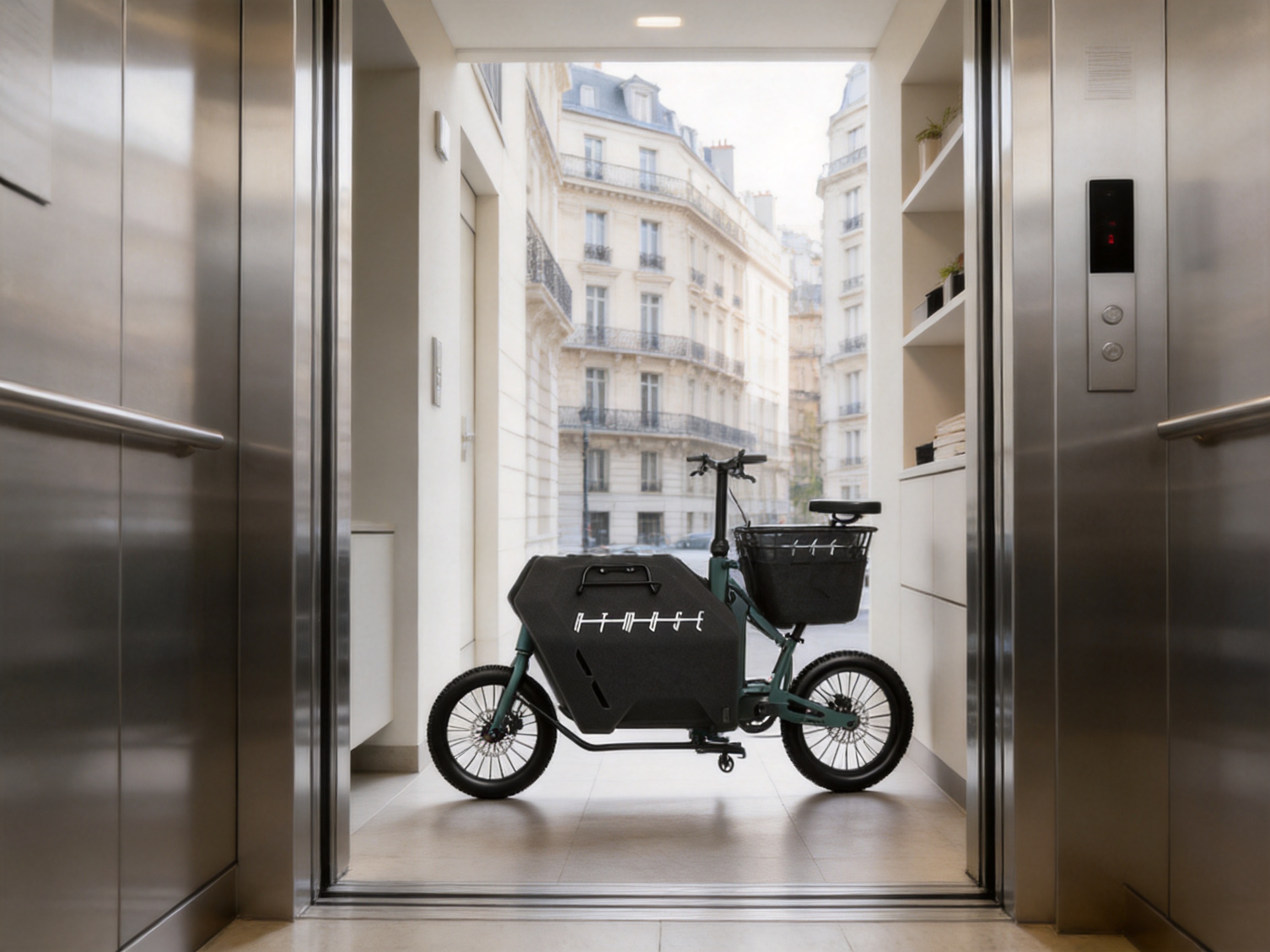
The most visible advantage of the Model R over a conventional long cargo bike is storage. A 198 cm riding length may be practical on the road but difficult inside a building. Reducing that length to 120 cm makes a substantial difference in elevators, hallways, and storage rooms. The ability to reach 102 cm without the front wheel further expands transport options.
A second advantage is multimodal compatibility. Conventional cargo bikes are often used from door to door, but they can be difficult to combine with trains, cars, and office storage. The Model R is specifically configured for a lifestyle in which a single journey may use several forms of transport. The bike can cover the first and last part of a train journey while remaining compact enough to move through a station.
A third advantage is that folding does not require giving up the front-loading cargo concept. A small folding commuter bike may be easier to store, but it usually cannot carry 45 kg in a dedicated front basket. The Model R attempts to combine both functions: a serious cargo area during the ride and a compact footprint afterward.
The belt drive and internal gear hub also provide an advantage over exposed drivetrains for users who prioritize cleanliness and low routine maintenance. Commuters can avoid chain oil on clothing, while apartment residents may appreciate a cleaner bicycle inside the home. Commercial users can spend less time on basic drivetrain cleaning between local trips.
The mid-drive motor provides another distinction from many entry-level utility e-bikes. With up to 70 Nm of torque and a three-speed internal hub, the system is designed for controlled assistance under load rather than only light recreational riding. The 720 Wh battery supports longer or more frequent urban use than a small-capacity commuter battery may allow.
Compared with small-wheel folding bicycles, the Model R offers a far larger cargo platform, higher stated basket capacity, and a more utility-oriented frame. Compared with full-size cargo bikes, it offers a lower storage burden. Its value lies in occupying the space between those two categories rather than matching only one of them.
Not all folding cargo bikes are equally practical. Some designs require extensive disassembly before they can be transported. Others use detachable cargo boxes, removable racks, or separate child and luggage modules. Those systems can be flexible, but they may add steps to everyday use.
The Model R’s intended advantage is integration. Its three-part frame folds in place, and the front-loading arrangement remains part of the bike. This reduces the number of decisions required before storage. The rider does not need to find a separate location for a cargo box or reconfigure the bike into a normal bicycle before taking it indoors.
Another distinction is the rolling function. A compact package that must be lifted can still be inconvenient in a station or apartment building. The ability to roll the folded bicycle is designed to address the handling problem directly.
The product also provides more substantial mechanical equipment than a minimal folding utility bicycle. Hydraulic disc brakes, a mid-drive motor, a 720 Wh battery, puncture-proof tires, a belt drive, and an internal gear hub all point toward regular practical use. The bike is not simply designed to be small; it is designed to remain useful after reaching the destination.
However, buyers should understand the trade-offs. A folding cargo bike still has more structure and mass than a lightweight compact bicycle. Folding mechanisms must be used correctly and inspected regularly. A large battery and cargo frame may make the bike heavier than a basic commuter model. The product is therefore best suited to riders who need genuine carrying capacity and storage flexibility, not those seeking the lightest possible bicycle.
The company behind the product presents itself as an American-origin cargo e-bike brand with design and research development activity in Paris. The company states that its origins are connected to MOTIV, an established American beach cruiser brand, and that its experience includes manufacturing expertise, supply-chain development, and continuous product innovation.
Those foundations are relevant to the Model R because a folding cargo bike requires coordination across several engineering disciplines. The frame must combine structural strength with multiple folding interfaces. The cargo basket must maintain useful dimensions without preventing compact storage. The drivetrain must fit within the folding arrangement. Cable routing, brake lines, steering movement, wheel placement, battery location, and assembly tolerances all influence the final product.
The specified 6061 T4/T6 aluminum alloy frame reflects a material choice appropriate for a product that needs a balance of strength, manageable weight, corrosion resistance, and repeatable manufacturing. Producing a cargo frame with folding points requires careful attention to joints, hinge alignment, weld quality, hardware fit, and load paths. A successful manufacturing process must ensure that the frame behaves consistently across repeated folding and riding cycles.
The company’s stated combination of American product thinking and European design aesthetics suggests an attempt to unite practical utility with urban usability. In this context, design is not limited to appearance. It includes the way the rider approaches the bicycle, loads the basket, folds the frame, moves it through a building, and stores it after use.
The product also reflects supply-chain coordination. The battery is identified as a Samsung unit, the internal hub is from Shimano, the belt drive is from Gates, and the braking specification references Tektro or Magura. Integrating components from established specialist suppliers can support reliable system development, provided that compatibility, assembly, quality control, and service procedures are managed correctly.
A mature supply chain is particularly important for cargo e-bikes because the product contains mechanical, electrical, and structural systems that must work together. The frame, motor, battery, controls, brakes, wheels, and folding components cannot be evaluated independently. Manufacturing strength is demonstrated not only by producing individual parts but also by bringing those parts together into a coherent, serviceable vehicle.
The company states that ATMOSE BIKES INC. was founded in Long Beach, California, in 2023 by Cameron Perstein and Guojie Shen, and that ATMOSE SASU was established in France in 2026 alongside a new design and research development team. This international structure may help the company combine American commercial experience with European urban-mobility requirements. It also places emphasis on the need for clear customer support, parts availability, and region-specific compliance as the brand expands.
Advanced manufacturing should not be understood only as automation or the use of expensive machinery. For a folding cargo e-bike, it also includes disciplined product integration, repeatable frame construction, careful component matching, battery-system management, inspection of folding joints, and validation under realistic load conditions. The Model R’s design priorities indicate that the company is concentrating on these practical aspects of production.
A folding cargo frame experiences different demands from a fixed-frame bicycle. The frame must be stiff during riding but capable of being unlocked and repositioned during storage. The folding points must align correctly, resist unwanted movement, and remain user-friendly. The manufacturing process therefore needs consistent dimensions and accurate assembly.
The use of aluminum alloy can support a relatively manageable frame weight, but aluminum structures require appropriate tube design, joining methods, and stress management. Areas around hinges, welds, mounting points, and load-bearing connections deserve particular attention. Regular inspection remains important for owners, especially those who fold the bike frequently or ride on rough surfaces with heavy cargo.
System integration is another manufacturing strength suggested by the product specification. The Model R places a battery, motor, belt drive, internal hub, hydraulic brakes, folding components, and front cargo structure into one compact vehicle. Each system affects the others. For example, the folding movement must not strain cables, the belt line must remain correctly aligned, and the cargo load must not interfere with steering or brake operation.
Designing around these relationships can produce a more coherent user experience than simply combining unrelated components. The stated product concept—fold, roll, ride—depends on this integration. If the basket were detached, if the steering became unstable when folded, or if the drivetrain required excessive adjustment after each fold, the central purpose would be weakened.
The choice of a belt drive and internal hub also suggests attention to serviceability. These components can reduce the amount of exposed drivetrain maintenance required by the user. Hydraulic brakes and puncture-proof tires are intended to support dependable urban operation, although all wear components still require inspection and replacement over time.
A strong product-development process should include service documentation, replacement-part planning, technician support, and clear owner instructions. This is especially important for a product sold across international markets. Folding cargo bikes are more specialized than basic bicycles, so long-term ownership depends not only on the initial build but also on access to appropriate support.
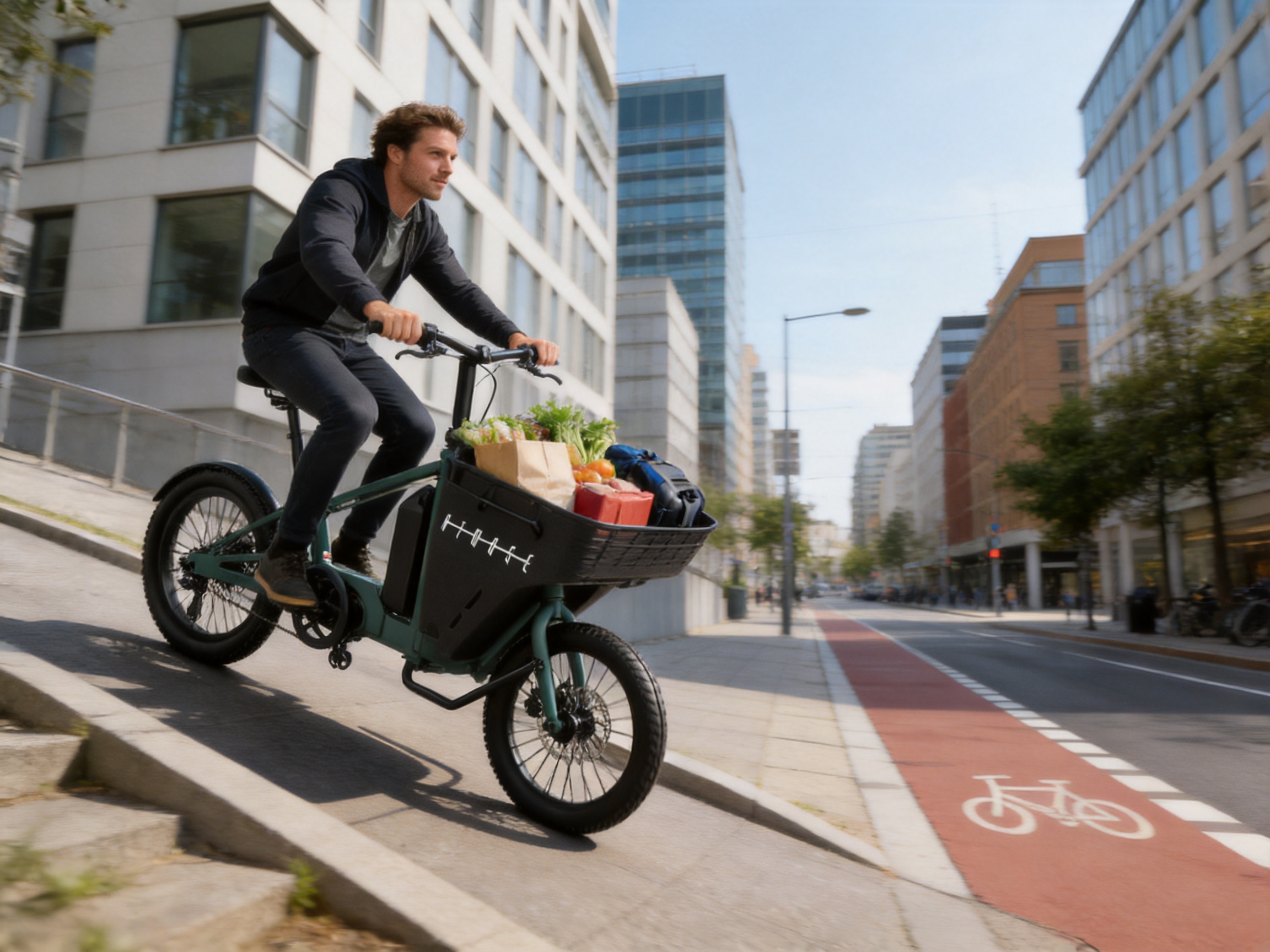
The Model R is well suited to apartment residents who need a cargo bike but cannot store a full-size model. Its folded dimensions may allow it to fit inside an elevator or hallway where a conventional cargo bike would be difficult to maneuver. Riders should measure their own storage areas before purchase, including door openings, elevator interiors, turning spaces, and any narrow sections between the entrance and storage location.
Train commuters are another natural audience. A rider can use the bike for the journey to a station, fold it for the train portion, and unfold it at the destination. Railway policies differ by location, so users must check the relevant rules regarding folded bicycles, dimensions, reservations, and peak-time travel.
Small-business operators may use the bike for local deliveries, mobile services, maintenance work, market trading, or equipment transport. The front basket offers more volume than a typical commuter rack, while the belt drive and internal hub can reduce daily cleaning demands.
Families may appreciate the cargo capacity for groceries, bags, and supplies, although the supplied product information does not state that the basket is configured as a child seat or that a child-restraint system is included. Users should never carry children unless an approved, compatible, and properly installed child-carrying solution is explicitly provided and permitted by local regulations.
Car owners who want a cargo bike at a second location may also benefit. The front-wheel-off folded dimensions are intended to make trunk transport possible in many vehicles, but trunk dimensions vary significantly. Buyers should measure the opening and internal length of their vehicle and consider the weight of lifting or sliding the folded bike into place.
A commuter living in a small apartment can keep the bicycle indoors rather than leaving it on the street. In the morning, the bike can be rolled from its storage position, unfolded, loaded with a work bag, and ridden to the station. At the station, the rider can fold it and roll it through the building. At the destination, the bicycle can be unfolded for the final part of the journey.
The front basket can carry a substantial grocery load while keeping the cargo visible to the rider. The broad upper dimensions can accommodate reusable bags, cartons, and irregular objects. Heavier items should be placed securely and low in the basket. After the trip, the bicycle can be folded and stored inside rather than exposed to weather outside a shop or apartment building.
For local businesses, the bike can provide a compact delivery platform without requiring a permanent garage or large vehicle. A worker can transport supplies to a customer, fold the bike temporarily in a building lobby or office, and continue later. The 720 Wh battery may support multiple trips, while the belt drive can help reduce routine drivetrain cleaning.
The reduced folded dimensions without the front wheel may allow the bicycle to travel inside a car. This can be useful when a rider wants to begin a cycling trip away from home or combine driving with local cargo transport. The owner should protect the interior from dirt and secure the bicycle so that it cannot move during transit.
Every cargo bicycle should be used within its stated limits. The Model R lists a maximum rider weight of 100 kg and a front basket capacity of 45 kg. These figures should not be exceeded, and the combined effect of rider, cargo, accessories, and riding conditions should be considered carefully.
Loads should be secured so that they cannot fall out, shift into the steering area, or contact the wheels. The rider should test the bicycle at low speed after loading, especially when the cargo is heavy or distributed differently from usual. A high or uneven load can affect balance and braking even when the total weight is within the stated capacity.
Folding joints should be fully engaged before riding. The rider should confirm that the frame is locked, the steering operates correctly, the wheels are secure, and cables are not trapped or sharply bent. The front wheel should be installed according to the manufacturer’s instructions before riding in the standard configuration.
Battery charging should take place using the supplied or approved charger in a dry, ventilated location. The battery should not be modified, opened, or exposed to water beyond the product’s specified protection level. Long-term storage should follow the manufacturer’s recommendations for charge level and temperature.
Routine checks should include tire pressure, brake pad condition, rotor condition, belt alignment, hub shifting, wheel attachment, folding hardware, and visible frame damage. Hydraulic brake systems may require professional service if they feel spongy or lose performance. The belt should not be contaminated with unsuitable chemicals or adjusted without the correct procedure.
The Model R’s strengths are closely connected to its purpose, but no bicycle is ideal for every rider. A cargo bike capable of carrying 45 kg and housing a 720 Wh battery will generally be more substantial than a lightweight folding bicycle. Riders seeking a bicycle that can be lifted easily onto public transport may prefer a smaller, lighter model with less cargo capacity.
The folded dimensions are compact relative to a full-size cargo bike, but they are not equivalent to a small suitcase. Users should check local transport rules and ensure that the folded bicycle can be moved safely through the intended route. A station with stairs but no ramp or elevator may still present a challenge.
The three-speed internal hub offers simplicity and useful low-speed gearing, but it does not provide the range of a many-speed derailleur system. Riders who regularly tackle long, steep hills or high-speed open-road routes should evaluate whether the available gearing matches their terrain.
The stated battery capacity is generous, but range is never fixed. Heavy loads, hills, cold weather, frequent stops, low tire pressure, and high assistance levels can reduce distance per charge. Buyers should consider their daily route and charging access rather than choosing solely on the basis of battery watt-hours.
Finally, the product’s long-term value will depend on service availability, replacement parts, software or electrical support where applicable, and local regulatory requirements. Potential buyers should confirm after-sales arrangements in their region before purchase.
The Model R combines a front-loading cargo layout with a tri-fold frame. It is 198 cm long in riding configuration but folds to 120 × 44 × 85 cm. Without the front wheel, the folded size is listed as 102 × 44 × 76 cm. This makes it more suitable for indoor storage, train travel, and car transport than many conventional long cargo bikes.
The product is designed so that the front-loading cargo configuration folds in place. The basket, steering arrangement, and drivetrain remain part of the folding cargo-bike concept rather than requiring the rider to convert the bicycle into a separate non-cargo format.
The stated capacity is up to 100 kg for the rider and up to 45 kg in the front basket. Cargo should be distributed securely and kept within the manufacturer’s limits. Users should also follow local regulations and any additional restrictions listed in the owner documentation.
The bike uses a 36-volt, 250-watt mid-drive motor with up to 70 Nm of torque. Its central location allows the motor to work through the Shimano Nexus 3 internal gear hub.
The Model R uses a Samsung 36-volt, 20 Ah lithium battery rated at 720 Wh. Actual range depends on terrain, rider and cargo weight, assistance level, temperature, tire pressure, wind, and riding style.
The Gates belt drive does not require conventional chain oil and can reduce routine cleaning. It is also quieter and less likely to mark clothing with lubricant. It still requires correct alignment, tension, and inspection.
The compact folded dimensions are intended to support multimodal travel, including train commuting. However, railway policies vary. Riders should check the rules of the relevant operator, including limits on folded bicycle size, peak-hour travel, reservations, and platform access.
With the front wheel removed, the listed folded dimensions are 102 × 44 × 76 cm, which is intended to fit many car trunks. Vehicle openings and internal dimensions vary, so owners should measure their specific vehicle before relying on this transport method.
The mid-drive motor provides up to 70 Nm of torque, and the three-speed internal hub offers a lower ratio for starts and climbs. Suitability depends on hill gradient, rider weight, cargo load, road surface, and local regulations. Riders should select a low gear before a steep climb and avoid exceeding the bike’s limits.
The supplied information describes the basket as a cargo platform and does not identify it as a child seat. Children should not be carried unless an approved child-carrying system is specifically designed for the bike, correctly installed, and legal in the rider’s location.
Although the belt drive and internal gear hub reduce some routine work, the bicycle still needs regular inspection. Owners should check tire pressure, brakes, wheels, belt alignment, folding hardware, battery condition, and frame integrity. Hydraulic brake servicing and other specialized work should be performed by a qualified technician when necessary.
It is especially suited to urban riders who need meaningful cargo capacity but have limited storage space. Train commuters, apartment residents, small businesses, delivery users, and car owners who want to transport a cargo bike inside a vehicle are likely to find its design particularly relevant.
The Atmose Model R ESR1 approaches cargo cycling from a practical urban question: how can a rider enjoy the carrying capacity of a front-loading cargo bike without accepting the storage burden of a long, fixed frame? Its answer is a tri-fold design that preserves the cargo layout during riding and creates a compact package after the journey.
Its main advantages are clear. The bike folds from 198 cm to 120 cm in length, can be reduced further when the front wheel is removed, and is designed to roll while folded. It offers a 45 kg front basket, a 100 kg rider capacity, a 250-watt mid-drive motor with up to 70 Nm of torque, a 720 Wh battery, hydraulic disc brakes, puncture-proof tires, a Gates belt drive, and a Shimano Nexus 3 internal gear hub.
Compared with a conventional cargo bike, it is easier to store and more compatible with trains, elevators, apartments, and car transport. Compared with a small folding bicycle, it provides a substantially more capable front cargo platform. The trade-off is that its utility-oriented construction remains more substantial than that of a lightweight folding commuter bike.
The company’s stated American origins, Paris-based design and research development activity, manufacturing experience, mature supply-chain relationships, and emphasis on practical mobility provide a foundation for this product concept. The most important manufacturing challenge is not simply producing a folding frame; it is integrating the folding structure, cargo platform, drivetrain, battery, brakes, and service requirements into a dependable daily vehicle.
For urban riders who need a bike that can carry serious loads yet live inside a small home, move through a train station, or travel in a car trunk, the Model R represents a focused and distinctive solution. It is a cargo bike designed not only for the road, but also for the spaces before and after the ride.
1. Atmose Model R ESR1 product specifications and supplied technical information.
2. Atmose product description covering the tri-fold frame, front basket, belt drive, internal gear hub, motor, battery, brakes, and tires.
3. General bicycle engineering principles concerning aluminum alloy frames, mid-drive motors, hydraulic disc brakes, belt-drive systems, and internal gear hubs.
4. Manufacturer-provided company background concerning ATMOSE BIKES INC., ATMOSE SASU, MOTIV, and the company’s American and European design-development structure.
5. General urban mobility and multimodal transportation considerations for cargo bicycles, apartment storage, railway travel, and vehicle transport.
Nov 11, 2026
Nov 07, 2026
Nov 05, 2026


info@atmosecargobike.com

200 rue de la Croix Nivert 75015 Paris

Custom Electric Bakfiets
 English
 Français
 Deutsch