Sep 04, 2026
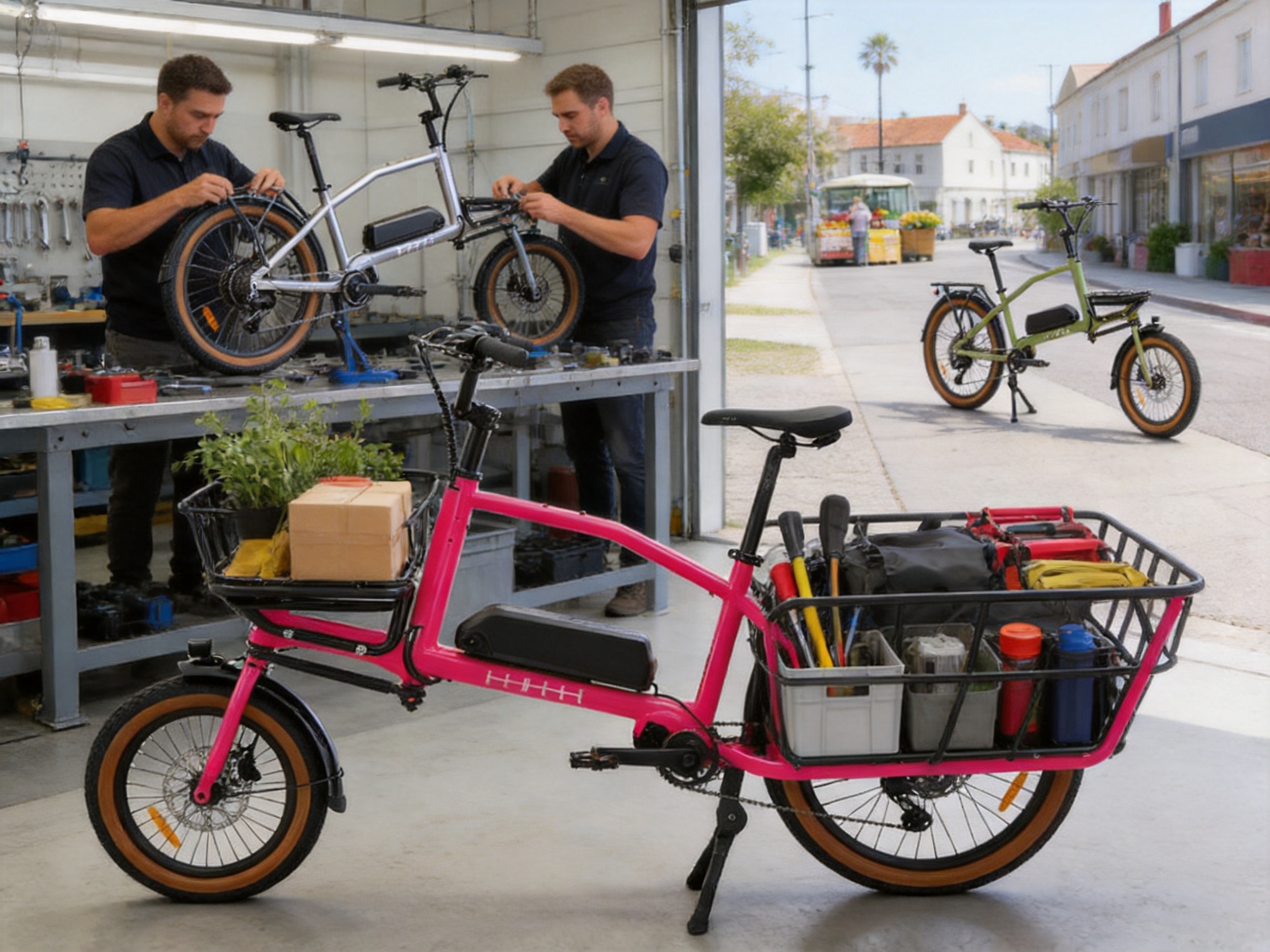
Cargo bikes are often associated with school runs, grocery shopping, neighborhood commuting, and last-mile delivery. Those applications remain important, but the category has expanded considerably. Modern cargo bikes are increasingly being designed for users who want to travel beyond paved streets, carry camping equipment, explore rural roads, and transport substantial loads without using a car. The Adventure Cargo Bike ESV1 belongs to this more versatile generation of cargo bicycles.
Developed as an adventure-oriented model, the ESV1 combines a compact cargo-bike format with an oversized front folding basket, a mid-drive motor, wide puncture-resistant tires, hydraulic disc brakes, and an 11-speed Shimano Cues transmission. Its design objective is straightforward: allow riders to carry bulky outdoor equipment while maintaining stable handling and useful climbing performance.
The model is particularly notable because its cargo space is positioned at the front rather than being limited to a conventional rear rack or small frame-mounted carrier. The front cargo deck measures 470 millimeters in length, 470 millimeters in width, and 375 millimeters in height. This creates a practical loading area for items such as tents, coolers, fishing equipment, backpacks, tools, and other supplies needed for a full day or several days outdoors.
At the same time, the ESV1 is not simply a bicycle with a large basket attached. Its frame, motor, battery, drivetrain, braking system, tires, and dimensions are arranged around the demands of loaded travel. The result is a cargo platform that seeks to balance carrying capacity, off-road confidence, everyday usability, and long-term reliability.
This article examines the ESV1 in detail, including its main advantages over more limited cargo-bike alternatives, the reasons behind its component selection, its potential applications, and the manufacturing and development strengths supporting the product.

Atmose Model V ESV1 Adventure Cargo Bike with Oversized Front Camping Rack
The central idea behind the ESV1 is that cargo capacity should support exploration rather than restrict it. Many standard cargo bikes are optimized for urban streets, where their primary duties include carrying children, shopping, or small commercial loads. Such bikes may be excellent in their intended environments, but their layouts are not always ideal for camping equipment or uneven outdoor routes.
The ESV1 takes a different approach. Its front cargo basket is intentionally oversized and folding. The front position allows the rider to keep bulky equipment directly within view and close to the front wheel. For outdoor users, this can be more convenient than loading long or irregularly shaped objects onto a rear platform. A tent bag, cooler, fishing box, or folded chair can be secured across the wide front deck without requiring a specialized trailer for every trip.
Front cargo placement also supports a lower and more centralized loading strategy when equipment is arranged carefully. Heavy items can be positioned on the deck rather than stacked high on the rider’s back or placed on a tall rear rack. A lower load can help preserve predictable handling, particularly on gravel paths and compacted dirt tracks.
The ESV1 has a listed overall length of 1,910 millimeters, a width of 750 millimeters, and a height of 1,060 millimeters. These dimensions provide a substantial cargo-bike footprint while remaining more compact than many long-tail or front-box cargo bicycles. The relatively manageable width is useful when passing through gates, storing the bicycle, navigating narrow paths, or transporting it in a suitable vehicle.
The folding function of the front basket adds another layer of flexibility. When the basket is not required, folding it can reduce visual and physical bulk. It may also make the bicycle easier to store in a garage, workshop, or commercial environment. For users who alternate between loaded touring and ordinary riding, this adaptability is more useful than a permanently fixed oversized cargo structure.
An adventure cargo bike must do more than carry weight. It must remain controllable when the rider encounters loose gravel, wet ground, inclines, descents, and changing surface conditions. The ESV1’s design addresses this requirement through the combination of wide tires, hydraulic braking, a mid-drive power system, and a geared drivetrain.
The stated maximum load is 170 kilograms. This figure should be understood as a total system capacity rather than simply the amount placed in the front basket. Depending on the manufacturer’s final certification and operating instructions, users should interpret the limit as including the rider, cargo, accessories, and possibly other equipment. Even with that consideration, the specification indicates that the bike is intended to carry significantly more than a lightweight commuter bicycle.
Load distribution remains essential. A rider should place dense items low, secure them against movement, and avoid allowing cargo to obstruct the steering, lighting, braking, or rider’s view. The ESV1 provides the platform, but responsible packing is still necessary to obtain the best handling results.
The ESV1’s specification combines established bicycle components with an electric drive system intended for loaded riding. The following table summarizes the principal information supplied for the model.
| Component or specification | Details | Practical significance |
|---|---|---|
| Product name | ESV1 | Adventure-oriented cargo-bike configuration |
| Frame | 6061 T4T6 aluminum alloy frame | Lightweight structural material suited to a strong utility frame |
| Battery | Samsung 36V 15Ah lithium battery, 540Wh | Provides stored energy for assisted travel and loaded riding |
| Maximum load | 170kg | Supports rider, cargo, and applicable equipment within the approved limit |
| Drivetrain | Shimano 11-speed Cues | Offers a broad range of ratios for flats, climbs, and changing terrain |
| Motor | Starunion CM2503 mid-drive, 3V, 250W | Places assistance near the crank and supports climbing-oriented performance |
| Front folding basket | 470mm long × 470mm wide × 375mm high | Creates a large, practical platform for outdoor equipment |
| Tires | Front 18 × 2.4 and rear 24 × 2.4 puncture-resistant tires | Wide contact patches and additional protection for mixed surfaces |
| Overall dimensions | 1,910mm long × 750mm wide × 1,060mm high | Balances cargo capacity with manageable storage and path clearance |
| Brakes | Tektro hydraulic disc brakes | Controlled stopping performance in wet, muddy, and downhill conditions |
Several points in this specification are especially important for adventure use. First, the combination of a 540Wh battery and a 250W mid-drive motor is intended to provide practical assistance rather than extreme speed. The focus is on helping the rider overcome hills, wind, additional cargo weight, and long-distance fatigue while keeping the vehicle within a utility-oriented power class.
Second, the 11-speed drivetrain gives the rider more control over cadence. A low gear can be used for steep climbs or heavily loaded departures, while higher gears can support efficient progress on level roads. This broad gearing is particularly valuable for a cargo bike because the rider may experience very different demands depending on whether the basket is empty, partially loaded, or packed for an extended outing.
The Starunion CM2503 mid-drive motor is one of the most significant features of the ESV1. A mid-drive motor is mounted near the bicycle’s crank area instead of being installed inside the front or rear wheel hub. This position allows motor assistance to work through the bicycle’s drivetrain.
For a loaded cargo bike, that arrangement offers several potential benefits. The motor’s power can be combined with the selected gear ratio, allowing the rider to use a lower gear on steep terrain. This is different from a simple hub-motor approach, in which the motor’s mechanical relationship with the bicycle gearing is more limited.
The mid-drive configuration can also help centralize mass. A heavy motor mounted near the bottom bracket may contribute to a lower center of gravity than a large motor placed at the outer end of the front cargo structure. Central mass is valuable for a bike carrying equipment because it can help the overall vehicle feel more balanced during steering and changes in direction.
Another benefit is the relationship between rider input and assistance. When the rider shifts appropriately and maintains a comfortable cadence, the motor can support a more natural climbing rhythm. This is especially helpful on back-country hills, where maintaining momentum may be more important than achieving high speed.
The ESV1 is therefore better understood as an assisted utility and touring vehicle than as a high-speed electric machine. Its 250W specification suggests a design centered on controlled, efficient support. Riders still participate actively through pedaling, gear selection, and route planning, while the motor reduces the physical burden associated with cargo and gradients.
The bike uses a Samsung 36V 15Ah lithium battery with a stated capacity of 540Wh. Battery range cannot be represented by a single guaranteed distance because it depends on rider weight, cargo weight, terrain, wind, tire pressure, temperature, assist level, stop-and-start frequency, and riding technique.
Nevertheless, 540Wh is a meaningful capacity for a utility cargo bike. The battery provides a reserve that can be valuable when traveling away from charging infrastructure. Adventure riders may be able to complete longer outings without using maximum assistance continuously, while commercial users may benefit from having energy available for repeated trips.
Efficient range management is particularly important for a heavily loaded bicycle. Riders can conserve energy by selecting a suitable gear, keeping tires correctly inflated, avoiding unnecessary acceleration, and using lower assist levels on flat terrain. Higher assistance can then be reserved for steep hills, soft surfaces, headwinds, or moments when the load would otherwise reduce comfort.
The use of a Samsung battery cell platform is also relevant to buyer confidence, although actual battery safety and performance depend on the complete battery pack, battery-management system, enclosure, assembly, and charging procedures. A responsible owner should follow the manufacturer’s charging guidance, protect the battery from extreme conditions, and use compatible charging equipment.
The ESV1 uses a 2.4-inch-wide front tire on an 18-inch wheel and a 2.4-inch-wide rear tire on a 24-inch wheel. This wheel-size combination reflects the cargo-bike layout. The smaller front wheel can help keep the cargo platform and overall frame geometry compact, while the larger rear wheel supports efficient rolling beneath the rider and rear section of the frame.
The 2.4-inch width provides a broader contact patch than a typical narrow city tire. On gravel, packed earth, and uneven paths, a wider tire can offer greater comfort and improved surface conformity. It may also reduce the likelihood of the tire sinking into softer ground compared with a narrower road-oriented tire.
The tires are described as puncture-resistant, a useful feature for adventure travel. Outdoor routes can contain thorns, sharp stones, broken branches, glass, and other hazards. Puncture resistance does not eliminate the need for inspection or repair equipment, but it can reduce the likelihood of interruptions during a ride.
Correct pressure remains important. Excessive pressure can make the bike feel harsh and reduce grip on uneven surfaces, while insufficient pressure can increase rolling resistance and create a risk of rim damage. The ideal setting should be determined according to the tire manufacturer’s guidance, rider weight, cargo load, terrain, and weather.
Compared with narrow commuter tires, the ESV1’s wide puncture-resistant tires are better aligned with the needs of riders who expect to leave smooth pavement. Compared with extremely specialized mountain-bike tires, they are likely to remain more practical for mixed journeys that include streets, cycle paths, gravel roads, and campground access routes.
Stopping a loaded cargo bike requires more confidence than stopping a lightweight bicycle. Additional mass increases momentum, and downhill travel can place greater demands on the braking system. The ESV1 uses Tektro hydraulic disc brakes, a specification that directly supports its cargo and adventure roles.
Hydraulic brakes transmit lever force through fluid rather than a conventional mechanical cable. This system can provide strong, progressive braking with relatively low hand effort. For riders carrying camping supplies or commercial goods, reduced effort can be valuable during repeated stops or long descents.
Disc brakes also maintain their position away from the tire’s contact surface. In wet, muddy, or dirty environments, this can be advantageous compared with rim brakes, because braking performance is less dependent on a clean and dry wheel rim. The ESV1’s hydraulic disc system is therefore well matched to the stated intention of exploring in changing outdoor conditions.
Brake performance still depends on proper setup and maintenance. Brake pads wear, rotors can become contaminated, and hydraulic systems should be inspected by a qualified technician when service is required. Riders should test the brakes before every loaded journey, especially after transporting or storing the bike.
In comparison with entry-level cargo bikes equipped with basic mechanical brakes, the ESV1 offers a more refined braking specification for heavy or variable use. This does not make the bike immune to stopping-distance limitations; riders must still reduce speed before corners, allow additional distance when loaded, and adapt to loose surfaces.
The ESV1 frame is made from 6061 T4T6 aluminum alloy. Aluminum is widely used in modern bicycles because it offers a useful combination of low weight, corrosion resistance, formability, and structural strength. For a cargo bike, material choice must be considered together with tube shapes, joints, load paths, weld quality, alignment, and testing.
The T4T6 designation indicates a controlled heat-treatment sequence associated with aluminum alloy processing. In practical terms, this reflects an effort to obtain a useful balance between material workability and finished structural properties. The frame’s performance, however, depends on the complete engineering and manufacturing process rather than the alloy name alone.
A cargo-bike frame must manage forces generated by the rider, motor, cargo, braking, turning, and road impacts. The front cargo platform introduces additional steering and structural considerations. Its supports must remain stable when equipment is loaded, while the steering system must continue to respond predictably at low and moderate speeds.
The frame’s 170-kilogram maximum load specification indicates that the ESV1 has been conceived as a substantial utility platform rather than a lightly reinforced recreational bicycle. Owners should still distribute weight correctly and respect all manufacturer instructions. Exceeding the approved load can affect braking, steering, structural durability, and warranty coverage.
Adventure cargo-bike geometry must reconcile several competing objectives. A longer wheelbase can improve stability, but excessive length may reduce maneuverability and storage convenience. A wide cargo deck increases carrying capability, but excessive width can make narrow paths difficult. A compact front wheel can support a lower cargo platform, but steering geometry must be carefully controlled to avoid nervous handling.
The ESV1’s stated dimensions suggest a deliberately compact interpretation of cargo-bike design. Its 750-millimeter width is broad enough to support a large front deck but remains within a manageable range for many residential passages and cycle routes. The 1,910-millimeter length provides cargo-bike capacity without approaching the footprint of some large front-box models.
For buyers comparing the ESV1 with conventional long-tail cargo bikes, the primary distinction is the front loading architecture. Long-tail bikes place their main cargo behind the rider and can be excellent for passengers or rear panniers. The ESV1 instead prioritizes a forward platform, direct visibility of the load, and access to bulky adventure equipment.
The oversized folding front basket is the defining practical feature of the ESV1. Measuring 470 millimeters by 470 millimeters by 375 millimeters, it offers a volume and footprint suited to irregular objects. The basket can be used for equipment that is inconvenient to carry in panniers, including soft bags, compact coolers, rolled sleeping mats, small crates, and maintenance tools.
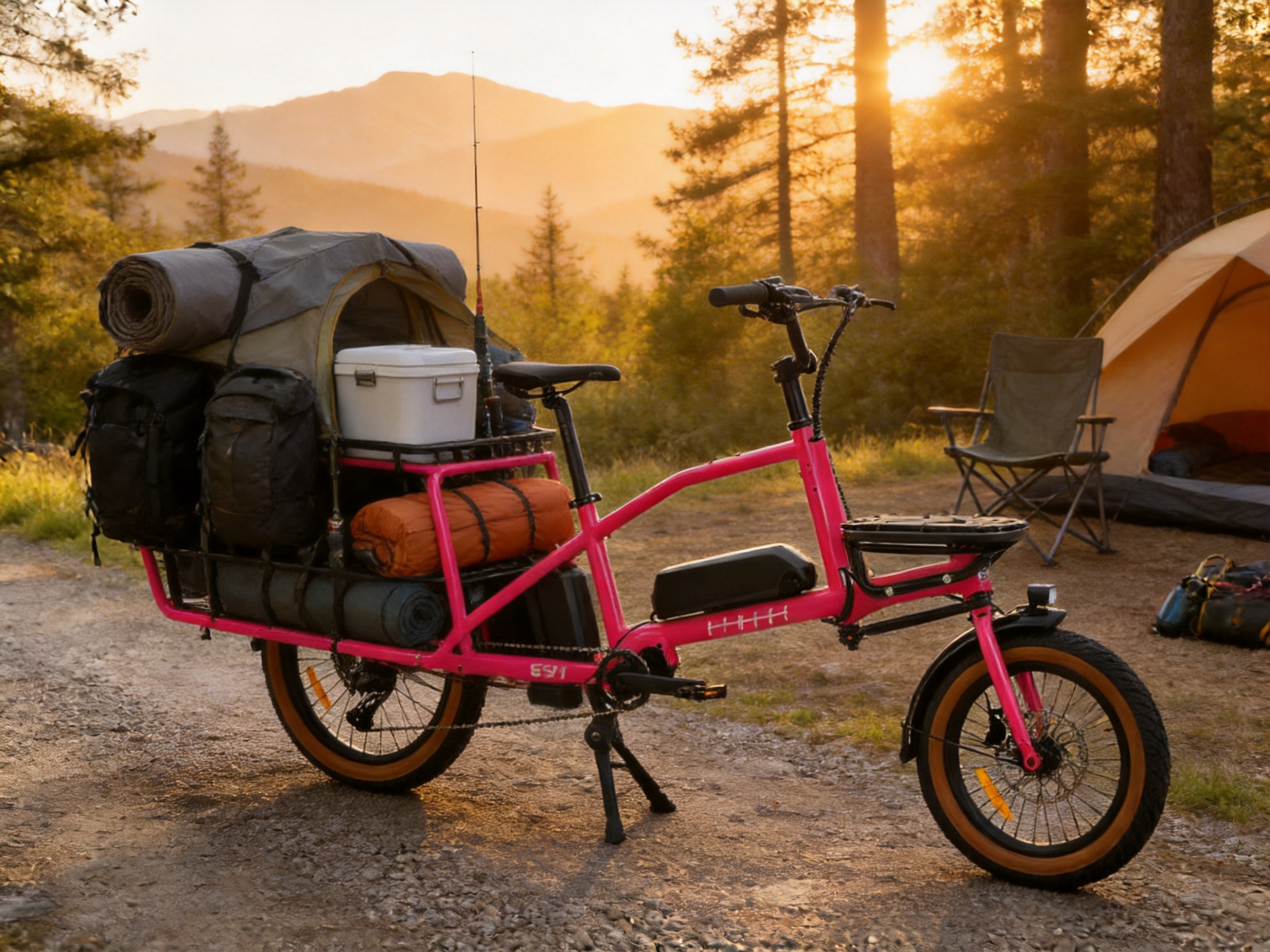
For camping, the deck can accommodate a tent, groundsheet, cooking equipment, clothing, food, and a sleeping bag when these items are packed into suitable waterproof bags. The exact amount will depend on the dimensions and weight of the equipment. Heavy items should be positioned as low as possible and secured with appropriate straps or tie-downs.
For fishing trips, the basket can carry a tackle box, compact cooler, waders, folding seat, and rod accessories, provided that long items do not interfere with steering or create a hazard. For photography and nature observation, the platform can hold protective cases, tripods, field guides, and provisions.
For maintenance and land-management work, the ESV1 can function as a mobile tool carrier. Gardeners, park staff, property managers, and outdoor technicians may find the large front platform useful for transporting hand tools, replacement parts, safety equipment, and supplies over short distances without using a motor vehicle.
The same cargo area can support everyday urban tasks. Grocery bags, reusable boxes, parcels, and market purchases can be loaded directly in front of the rider. This gives the ESV1 a broader operating range than an adventure bike with no practical cargo provision. It can serve as a weekday transport solution and a weekend exploration vehicle.
The ESV1 competes not only with other electric cargo bikes but also with several different forms of transport: conventional bicycles with racks, compact e-bikes, long-tail cargo bikes, front-box cargo bikes, utility tricycles, and small electric delivery vehicles. Its strongest advantages emerge when a buyer needs meaningful cargo capacity without choosing the largest or most specialized vehicle in the category.
Many commuter bicycles offer a rear rack designed for panniers or a small bag. That is sufficient for work clothes and light shopping, but it is less convenient for large outdoor equipment. The ESV1 provides a dedicated, wide front platform that is designed from the beginning for bulky loads.
The difference is not merely a matter of carrying more volume. A purpose-built cargo deck can provide a more stable base, better load visibility, and easier access than a collection of bags attached to narrow racks. This makes the ESV1 more suitable for users whose equipment is irregularly shaped or frequently changed.
Large front-box cargo bikes are useful for transporting children or substantial loads, but they can be physically large and difficult to store. A fixed box may also be excessive for riders who only need extra capacity on selected trips. The ESV1’s folding basket gives it a more adaptable profile.
When the basket is folded or lightly loaded, the bike can be used for simpler errands. When a camping trip or delivery task requires greater capacity, the same platform can be expanded into a practical cargo area. This flexibility may appeal to households and small businesses seeking one vehicle for multiple roles.
Compared with a basic rear-hub electric bicycle, the ESV1’s mid-drive system is better aligned with loaded hill riding. The rider can use the 11-speed drivetrain to select a lower gear and allow the motor to assist through the gearing. This is particularly relevant when the front basket is full or when a route includes sustained climbs.
A hub-motor bicycle can still be effective, but the ESV1’s drive layout offers a more integrated relationship between rider cadence, gear selection, and motor support. The advantage is most apparent on variable terrain rather than on flat city streets.
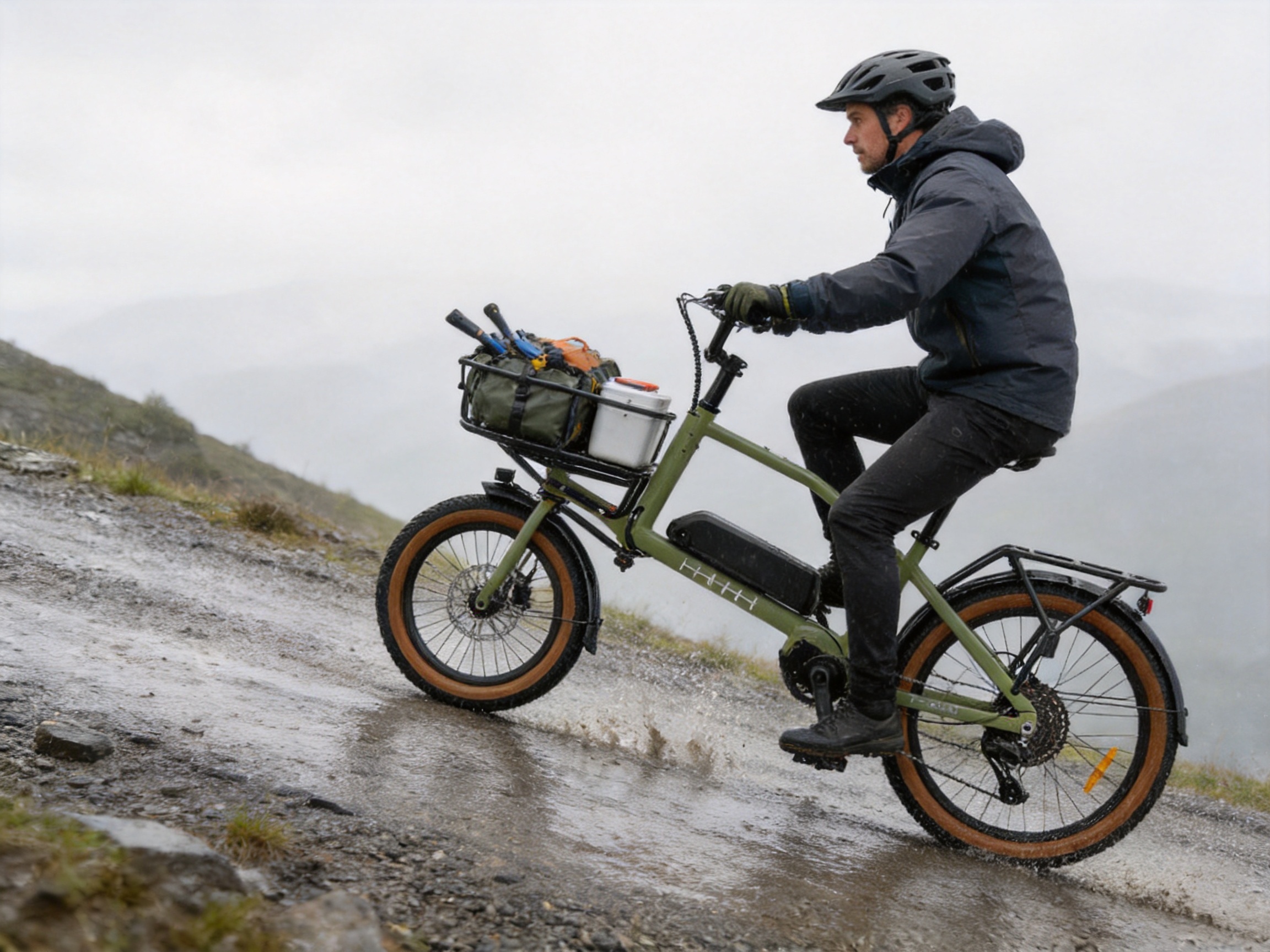
The combination of hydraulic disc brakes and puncture-resistant 2.4-inch tires gives the ESV1 a stronger outdoor specification than many basic urban cargo bicycles. Wide tires can improve comfort and surface contact, while hydraulic brakes provide confident modulation under heavier loads.
This does not mean that every trail is suitable. The ESV1 is a cargo bike, not a technical mountain bike, and riders should avoid terrain beyond the product’s intended limits. Nevertheless, its equipment is clearly selected for mixed roads, gravel, uneven access routes, and wet-weather utility.
Small businesses often need a vehicle that is more capable than a standard bicycle but less costly, bulky, and complex than a delivery van. The ESV1 can carry service tools, packages, food containers, event supplies, and maintenance materials while retaining bicycle-level access to many paths and urban spaces.
Its front loading position may also improve the operator’s awareness of the cargo. A courier or technician can quickly check whether items remain secure without repeatedly looking behind the saddle. For businesses, this can contribute to a more efficient workflow when the route includes frequent stops.
The company behind the ESV1 presents itself as an international cargo e-bike organization with origins in California and design and research-and-development activity based in Paris. This combination is relevant to the product because the ESV1 attempts to merge practical American utility thinking with European attention to compact urban form, visual design, and mobility integration.
The company profile states that Atmose originated in California and was developed by MOTIV, an established American beach cruiser brand with industry experience. It also states that ATMOSE BIKES INC. was founded in Long Beach, California, in 2023 by Cameron Perstein and Guojie Shen, and that ATMOSE SASU was established in France in 2026 with a new design and R&D team.
These origins suggest a development structure that combines product-market experience, international design input, and a supply-chain network capable of supporting cargo-bike production. The company emphasizes manufacturing expertise, mature supply-chain relationships, continuous innovation, and the development of products for family mobility, urban commuting, commercial delivery, and outdoor exploration.
The ESV1’s 6061 T4T6 aluminum alloy frame reflects a practical manufacturing choice. Aluminum alloy frames can be formed, welded, heat-treated, finished, and assembled in repeatable production processes. For cargo-bike manufacturing, repeatability is important because alignment and load-bearing consistency affect steering, braking, and durability.
A strong frame does not result from material selection alone. A capable manufacturing process should include controlled tube preparation, accurate fixture positioning, consistent welding, appropriate heat treatment, surface finishing, and dimensional inspection. The available product information does not provide a factory-by-factory process description, so specific production claims should be verified with the manufacturer. However, the model’s component integration indicates that the design is intended to be produced as a coordinated system rather than as a generic bicycle fitted with an oversized accessory.
The front basket, frame, steering assembly, wheel sizes, motor position, and braking system must work together. This type of integration is a manufacturing strength when it is supported by careful design validation. The basket supports must withstand repeated loading, vibration, braking forces, and uneven surfaces. The frame must maintain alignment under the combined influence of rider and cargo. Cable routing and electrical connections must remain protected during regular use.
The ESV1 uses components from recognized suppliers, including Samsung battery cells, Shimano drivetrain components, and Tektro hydraulic brakes. Brand-name components do not automatically guarantee a perfect product, but they can provide established technical standards, replacement-part familiarity, and service advantages in different markets.
Integration is especially important in an electric cargo bike. The motor must work with the battery, controller, display or control interface, torque delivery, drivetrain, and braking system. A 250W mid-drive system must be tuned for a bicycle that may carry up to the stated maximum load. The gearing needs to support the motor’s operating conditions, and the frame must accommodate the motor without compromising ground clearance or structural strength.
The company’s emphasis on smarter and more efficient mobility solutions is reflected in this system approach. Instead of treating the electric drive as an isolated add-on, the ESV1 places assistance, cargo capacity, braking, and tire selection within one product concept.
California and Paris represent different but complementary mobility environments. California contributes a tradition of recreational cycling, lifestyle-oriented product development, and long-distance outdoor use. Paris provides a dense urban context in which compact dimensions, practical storage, visual refinement, and compatibility with everyday mobility are important.
An adventure cargo bike designed with both environments in mind can serve multiple user groups. It can be used for weekend exploration, but it can also function as a daily transport tool. It can carry camping equipment on rural roads, then return to city streets for shopping or commuting.
The company’s stated philosophy of “Fun & Practical” is relevant here. Cargo bikes sometimes become purely utilitarian products, while recreational e-bikes may prioritize appearance over carrying ability. The ESV1 seeks to combine enjoyment with function by giving the rider a distinctive platform that remains useful outside recreational trips.
Reliability is particularly important for an adventure cargo bike because users may ride farther from repair shops and charging locations. The ESV1’s puncture-resistant tires, hydraulic disc brakes, established drivetrain, aluminum frame, and mid-drive architecture are all selected with regular serviceability and demanding use in mind.
Owners should establish a maintenance routine from the beginning. Tire pressure should be checked before loaded rides. Brake pads and rotors should be inspected for wear or contamination. The chain should be cleaned and lubricated according to riding conditions, particularly after muddy or wet outings. The 11-speed drivetrain should be checked for accurate shifting, and bolts securing the basket and cargo supports should be inspected regularly.
The front basket deserves special attention because it is likely to experience repeated loading and unloading. Riders should use suitable straps rather than allowing equipment to move freely. Loose cargo can affect steering, generate noise, damage components, or fall into the path of the front wheel.
The battery should be charged in a dry, ventilated location using the correct charger. It should not be exposed to unnecessary heat, severe impact, or water beyond the system’s specified protection level. If the battery shows swelling, unusual odor, excessive heat, or physical damage, it should be removed from service and assessed by an authorized professional.
A well-designed product can support reliable use, but reliability is also the result of correct operation. The 170-kilogram maximum load must be respected, and riders should account for the extra distance required to stop a fully loaded bike. On loose downhill surfaces, controlled speed and smooth braking are more important than relying on hardware alone.
The ESV1 is suited to riders who want more than a standard commuter bicycle can provide but do not necessarily need a large passenger-carrying box bike. It is especially relevant to outdoor enthusiasts, campers, anglers, photographers, landowners, mobile workers, and families that want a flexible electric cargo platform.
For campers, the large front basket can reduce dependence on a car for local or semi-rural trips. Riders can carry a tent, food, cooking supplies, and clothing while allowing the bicycle’s motor to compensate for additional load and hills.
For urban families, the ESV1 can serve as a shopping and errand bike. Its cargo design is not limited to recreational equipment. The front deck can carry groceries, reusable containers, parcels, or household supplies. Users should verify whether the particular configuration includes any child-specific seating or safety accessories before transporting passengers; the supplied information describes an adventure cargo rack and does not establish a passenger seat configuration.
For commercial users, the bike can support local delivery, property maintenance, event logistics, plant care, mobile repair, and campus operations. Its electric assistance can reduce fatigue during repeated routes, while its bicycle format may allow access to areas where vans are inconvenient or restricted.
For wholesale buyers and mobility partners, the product may be attractive because it occupies a distinctive market position. The company states that it supports custom design and wholesale orders for global buyers. This creates potential for fleet configurations, branded accessories, cargo solutions, and market-specific adaptations, subject to technical, regulatory, and production review.
Before a long trip, riders should plan the route according to the bike’s dimensions, battery capacity, load, and terrain. A route that appears suitable for a conventional bicycle may become difficult when the basket is full. Narrow gates, steep switchbacks, soft ground, and rough descents should be considered in advance.
Load the heaviest items low and near the center of the basket. Soft equipment can be packed around harder objects to prevent movement, while waterproof bags can protect supplies from rain and spray. Cargo should never block the headlight, interfere with the front wheel, obstruct brake cables, or extend so far forward that it affects steering.
At the beginning of a ride, test the bike at low speed in a safe area. Confirm that the basket remains stable, the load is secure, the brakes operate evenly, and the steering feels predictable. A loaded bicycle may respond differently from an unloaded one, particularly during tight turns and low-speed maneuvers.
On climbs, select a suitable low gear before the gradient becomes severe. Avoid forcing the drivetrain in an excessively high gear. On descents, reduce speed early and use both brakes smoothly. On gravel or mud, braking should be progressive because tire grip is lower than on dry pavement.
Battery management should form part of route planning. Use a moderate assist level where possible, save stronger assistance for steep climbs, and remember that cold weather and heavy loads can reduce practical range. If traveling far from a charging point, carry a route plan that includes an energy reserve rather than relying on the battery’s final percentage.
One of the company’s stated strengths is support for custom design and wholesale orders. This is important because cargo-bike buyers often have needs that vary substantially by market. A family may want a weather-resistant shopping configuration, while a delivery company may require standardized boxes, fleet tracking equipment, or a specific loading arrangement.
The ESV1’s front cargo structure provides a foundation for customization. Possible adaptations could include removable dividers, weather covers, tie-down systems, insulated containers, tool organizers, or modular platforms. Any alteration should be approved or engineered carefully so that it does not exceed the load limit, impair steering, or interfere with braking and electrical systems.
Commercial buyers may also value the bike’s dual-use potential. A fleet could serve different functions during different seasons. In warmer months, the bikes might carry outdoor equipment or market supplies. During the week, they could support local deliveries or maintenance work. A flexible platform can improve asset utilization compared with a vehicle designed for only one task.
For international buyers, the company’s cross-regional structure may provide a useful foundation for communication between product design, sales, and market requirements. Regulations for electric bicycles, power ratings, lighting, braking, and cargo loads differ between jurisdictions, so buyers should request the appropriate compliance documentation for their market before placing fleet orders.
A balanced evaluation should also acknowledge the areas that require confirmation. The supplied information identifies the battery capacity, motor, drivetrain, tires, brakes, dimensions, frame material, and maximum load, but it does not state a guaranteed riding range, charging time, water-resistance rating, suspension specification, lighting equipment, included cargo restraints, or exact weight of the bicycle.
Potential buyers should request these details before purchase, especially if the bike will be used for long-distance touring or commercial service. The rider should also verify the precise interpretation of the 170-kilogram maximum load. It is important to know whether this limit includes the rider and all accessories or refers only to cargo and rider combined under a particular test standard.
The ESV1’s wide front cargo area may make steering feel different from that of a normal bicycle. This is not necessarily a disadvantage, but it creates a learning period. New users should practice with progressively heavier loads and avoid beginning with a fully packed basket on a crowded road.
The bike’s adventure positioning should not be confused with technical mountain-bike capability. Wide tires and hydraulic brakes improve confidence on mixed surfaces, but the model remains a cargo bicycle with a substantial load platform. Extreme jumps, highly technical rock gardens, and terrain outside the manufacturer’s intended use should be avoided.
Finally, regulations must be checked locally. The supplied motor specification is 250W, but legal requirements may also concern assisted speed, throttle operation, lighting, reflectors, helmet use, insurance, and cargo-bike classification. Dealers and institutional buyers should confirm compliance before use on public roads.
The ESV1 is designed as an adventure-oriented electric cargo bike for carrying outdoor equipment and other bulky loads. It can be used for camping, fishing, gravel-road exploration, local errands, commercial service, and general utility transport.
The listed front folding basket measures 470 millimeters in length, 470 millimeters in width, and 375 millimeters in height. Its wide format is intended for tents, coolers, tools, bags, and other equipment that may not fit conveniently in narrow panniers.
The product information lists a maximum load of 170 kilograms. Buyers should confirm with the manufacturer whether this figure includes the rider, cargo, accessories, and any other equipment. The load should always be distributed securely and kept within the approved limit.
A mid-drive motor works through the bicycle’s drivetrain, allowing the rider to use lower gears on steep climbs. This can be helpful when the bike is heavily loaded. The motor is also positioned near the center of the frame, which can support balanced handling.
The Samsung lithium battery is specified as a 36V, 15Ah unit with a stated capacity of 540Wh. Actual range depends on terrain, rider and cargo weight, assist level, wind, temperature, tire pressure, and riding technique.
Yes. Although it is designed for adventure use, its cargo platform and electric assistance also make it suitable for errands, commuting, shopping, and local deliveries. The wide tires may provide a comfortable ride on pavement while retaining versatility on gravel and uneven paths.
The ESV1 is an adventure cargo bike rather than a technical mountain bike. It is better suited to mixed roads, gravel routes, campground access paths, rural lanes, and moderate uneven terrain. Riders should avoid jumps, extreme obstacles, and surfaces beyond the manufacturer’s recommendations.
The ESV1 uses Tektro hydraulic disc brakes. These are appropriate for a loaded bike because they can provide strong, progressive stopping with relatively low hand effort. Brake inspection and maintenance remain necessary, especially after wet or muddy rides.
The front tire is specified as 18 inches by 2.4 inches, and the rear tire is specified as 24 inches by 2.4 inches. Both are described as puncture-resistant. Correct pressure should be selected according to the tire manufacturer’s recommendations and the actual load.
The product is associated with Atmose SASU. The company describes itself as a U.S.-origin cargo e-bike brand with California roots and an international design and R&D team based in Paris. Its company profile also references MOTIV’s manufacturing experience and a mature supply-chain network.
The supplied company information states that Atmose supports custom design and wholesale orders for global buyers. Buyers should discuss technical feasibility, minimum quantities, accessories, compliance requirements, and delivery terms directly with the company.
The specification describes it as a front folding basket. The folding design is intended to provide greater flexibility when the full cargo area is not required. Users should confirm the exact folding procedure and any recommended limits for riding with the basket folded.
Routine maintenance includes checking tire pressure, inspecting brake pads and rotors, cleaning and lubricating the chain, checking shifting performance, inspecting basket fasteners, and examining electrical connections. The battery should be charged with the approved equipment and stored according to the manufacturer’s instructions.
The ESV1 presents a distinctive interpretation of the electric cargo-bike category. Its strongest feature is not a single component but the way the complete package addresses a specific use case: carrying substantial outdoor equipment while retaining the basic practicality of a bicycle.
The oversized folding front basket provides a clear advantage over ordinary commuter bikes and small e-bikes. The mid-drive motor and 11-speed Shimano Cues drivetrain support loaded climbing. The 540Wh battery provides a useful energy reserve for assisted travel. Wide puncture-resistant tires and Tektro hydraulic disc brakes add confidence on mixed and changing surfaces.
Compared with large fixed-box cargo bikes, the ESV1 may appeal to users who want substantial capacity without committing to the largest possible frame. Compared with conventional long-tail bikes, it offers a different loading experience based around a forward platform. Compared with basic electric utility bikes, it provides a more adventure-focused component selection and a more integrated cargo structure.
The company’s California origins, Paris-based design and R&D presence, relationship to MOTIV, manufacturing experience, supply-chain resources, and stated support for customization create a foundation for serving individual, commercial, and wholesale customers. The product’s future success will depend on consistent production quality, clear technical documentation, dependable after-sales service, and continued development of accessories suited to different markets.
For riders who want to travel farther, carry more, and explore routes that exceed the limits of a standard commuter bicycle, the ESV1 offers a compelling platform. It is practical enough for daily transport, capable enough for outdoor equipment, and structured around the idea that cargo mobility can be both useful and enjoyable.
1. Product specification sheet for the ESV1 Adventure Cargo Bike, including frame, battery, load, drivetrain, motor, basket, tire, dimension, and brake information.
2. Product description for the Adventure Cargo Bike Model V, including its intended use for camping equipment, outdoor exploration, steep gradients, wet conditions, and rugged utility.
3. Company profile for Atmose, including its California origins, Paris-based design and research-and-development activity, founding history, product philosophy, manufacturing experience, and custom-order support.
4. General bicycle engineering references concerning aluminum alloy frame construction, bicycle load distribution, drivetrain gearing, hydraulic disc-brake operation, and tire-pressure management.
5. General electric-bicycle maintenance guidance concerning lithium-battery handling, charging practices, drivetrain care, brake inspection, and safe operation of loaded bicycles.
Nov 17, 2026
Nov 03, 2026
Oct 26, 2026


info@atmosecargobike.com

200 rue de la Croix Nivert 75015 Paris

Custom Electric Bakfiets
 English
 Français
 Deutsch