Aug 25, 2026
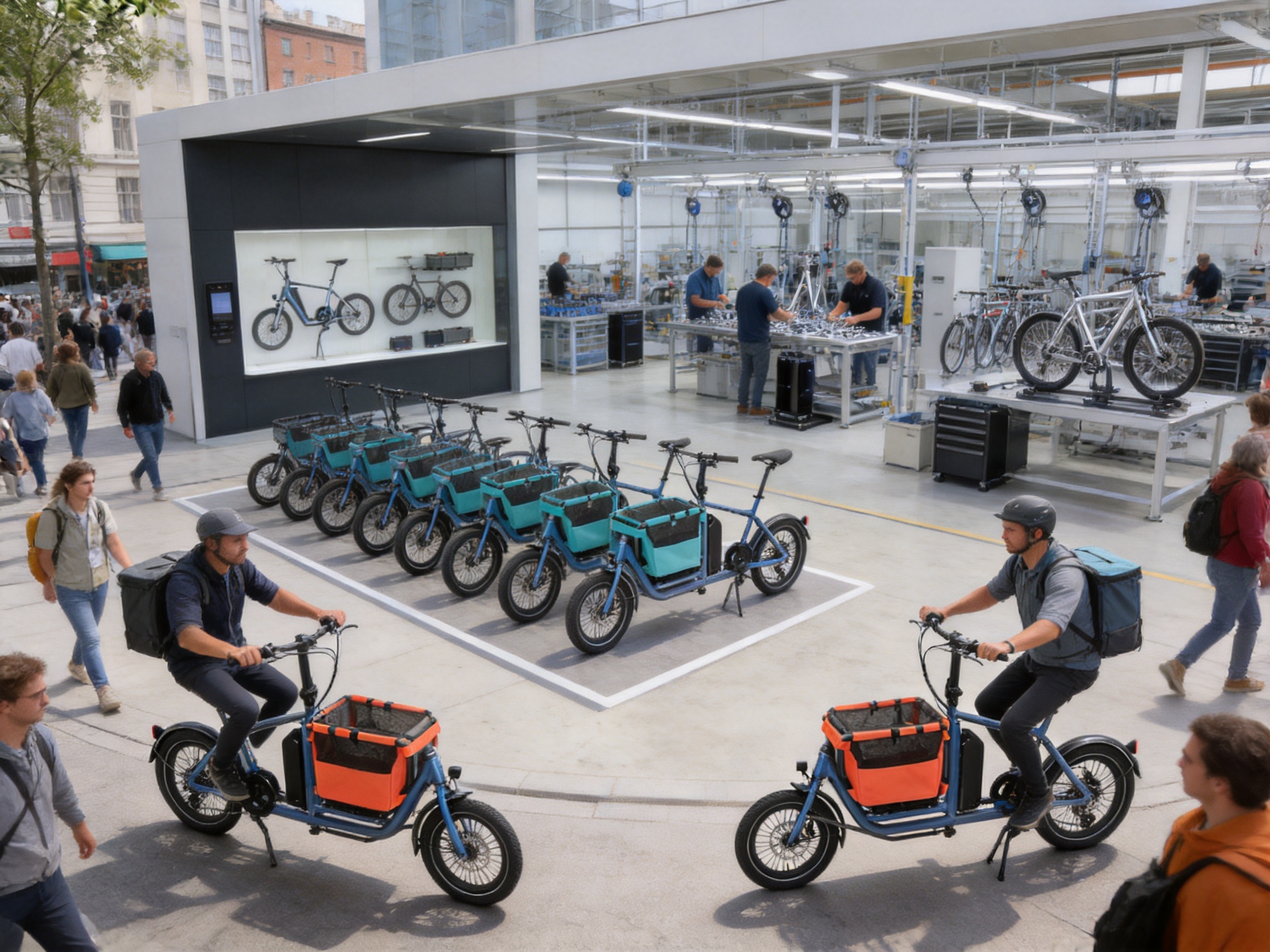
Urban transportation is changing. More people are looking for alternatives to private cars, traditional delivery vehicles, and large cargo bicycles that can be difficult to store or maneuver. At the same time, city riders still need dependable carrying capacity for groceries, work equipment, parcels, personal belongings, and everyday errands. The challenge is to combine useful cargo space with the handling characteristics of a compact bicycle.
The Atmose Model Q ESQ1 is designed to address this challenge. It is a front-loading electric cargo bike developed for agile urban commuting, shopping, light commercial work, and flexible daily transportation. Rather than treating cargo capacity as a reason to make a bicycle excessively long or difficult to handle, the ESQ1 uses a compact frame, a front folding basket, smaller wheels, a mid-drive motor, and a practical step-through layout to create a more approachable urban vehicle.
The result is a cargo bike intended for riders who want more carrying ability than a conventional electric bicycle can provide but do not want the size, turning radius, or storage requirements associated with a larger long-wheelbase cargo platform. Its dimensions measure approximately 1,780 millimeters in length, 620 millimeters in width, and 1,070 millimeters in height. This relatively narrow and compact profile can be especially valuable in apartment buildings, bike rooms, elevators, narrow streets, loading areas, and crowded city routes.
The ESQ1 is categorized as an Urban Companion Cargo Bike because it is built around versatility rather than a single specialized use. It can support routine commuting during the week, shopping and household transportation on weekends, and small-business or delivery tasks when required. Its front basket can be installed or removed quickly, allowing users to change the bicycle’s function without complicated tools or lengthy adjustments.
This article examines the product’s design, equipment, riding advantages, application potential, manufacturing background, quality considerations, and competitive position. It also explains why a compact electric cargo bike can be an effective option for wholesalers, retailers, urban mobility operators, and individual riders.
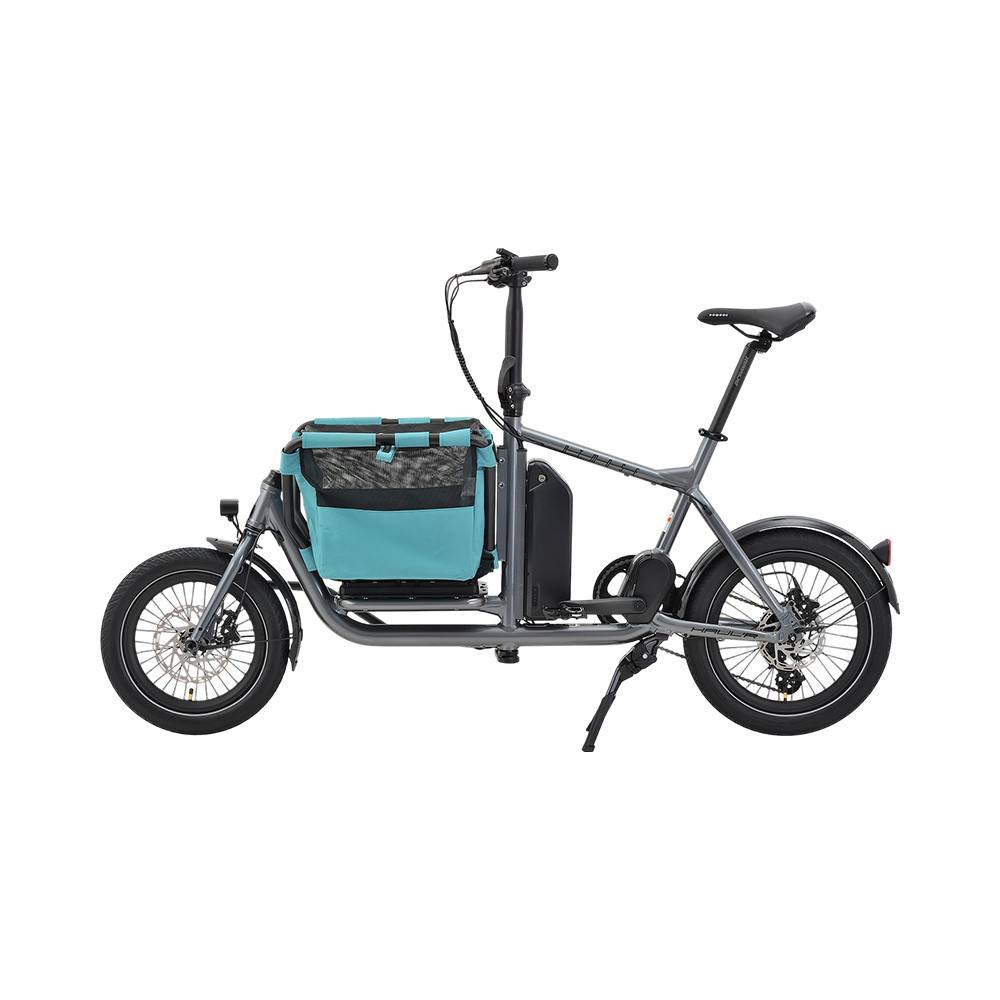
Atmose Model Q ESQ1 Compact Electric Cargo Bike for Agile Urban Commuting
The central design idea behind the Model Q ESQ1 is simple: urban cargo transportation should be capable without becoming cumbersome. Many cargo bicycles offer substantial carrying capacity, but their longer frames and larger overall dimensions may create practical obstacles. They can require more storage space, wider access routes, larger transport racks, and more rider confidence during tight turns.
The ESQ1 takes a different approach. It combines a compact wheelbase with a front cargo basket and electric assistance. The front-loading arrangement allows the rider to keep cargo visible and accessible while maintaining a familiar bicycle-style riding position. This can make it easier to monitor a bag, parcel, or shopping load while moving through traffic.
Its compact structure is particularly suitable for dense urban environments. A 620-millimeter overall width helps the bike fit more comfortably through many common access points than a substantially wider cargo platform. The dimensions are also relevant for retailers and fleet operators that need to store several bicycles in a limited area. For apartment residents, the relatively short length may reduce the difficulty of bringing the bicycle into a lift, hallway, garage, or storage room.
The design also emphasizes approachability. A lower step-through height can be useful for riders who wear work clothing, carry a child’s school items, or frequently mount and dismount during short delivery routes. Smaller wheels contribute to the compact geometry and can make steering feel responsive at lower speeds. This characteristic is important in areas with pedestrians, parked vehicles, bicycle lanes, and frequent intersections.
Instead of presenting cargo cycling as a niche activity, the Model Q positions it as an everyday mobility solution. The bicycle can be used for a morning commute, a grocery trip, a local service route, or a short-distance delivery assignment. This broad usability is one of its primary strengths compared with products designed only for family transport or only for commercial delivery.
Storage is often overlooked when electric cargo bikes are compared. A bicycle may perform well on the road but prove difficult to use if it cannot be parked or stored conveniently. The ESQ1 is designed with this reality in mind. Its compact frame and relatively narrow profile are beneficial for riders living in apartments, shared housing, townhouses, or buildings with limited bicycle facilities.
The front basket can also be removed when additional compactness is required. This makes the bicycle easier to configure for storage, transportation, maintenance, or different types of use. A removable component can be especially useful for retailers and rental operators that need to prepare bikes for shipment, display, or fleet organization.
Compact dimensions do not eliminate the need to check local storage conditions. Users should still confirm lift dimensions, door widths, stair access, parking rules, and charging arrangements. However, compared with a large front-loader, the ESQ1 offers a practical starting point for city environments where every centimeter matters.
A cargo bicycle must remain stable when loaded, but excessive length or width can make it feel slow to react in crowded surroundings. The Model Q is engineered around agile urban handling. Its smaller wheel format, compact wheelbase, and responsive steering are intended to help riders navigate tight corners, narrow lanes, loading zones, and low-speed traffic.
Agility is valuable not only for recreation but also for safety and efficiency. A rider who can make controlled adjustments more easily may be better positioned to avoid opening car doors, temporary road obstructions, pedestrians, and delivery congestion. The front-loading layout keeps the carrying area within the rider’s forward field of view, which can support better awareness of the load and surrounding conditions.
As with any cargo bike, handling changes when the basket is heavily loaded. Riders should begin with light loads, become familiar with braking and steering behavior, and distribute weight evenly. The compact design improves maneuverability, but it does not replace proper load management or responsible riding technique.
The Model Q ESQ1 uses a Bafang CM2503 mid-drive motor rated at 250 watts and designed for a 36-volt electrical system. A mid-drive motor places assistance near the bicycle’s central drivetrain rather than concentrating the motor at one wheel. This layout can help preserve balanced weight distribution and allows the motor to work through the bicycle’s gear system.
For urban riding, the position of the motor is significant. City routes frequently include starts from traffic lights, short inclines, bridges, ramps, and repeated acceleration from low speeds. A mid-drive system can make effective use of the selected gear, giving the rider a more natural relationship between pedaling effort, cadence, and motor assistance.
The 250-watt rating is aligned with common electric bicycle categories in many markets, although local regulations differ. Buyers, wholesalers, and retailers should confirm requirements for assisted speed, equipment, labeling, rider age, helmet use, registration, and road access in their intended market.
Motor performance is only one part of the riding experience. The ESQ1 also uses a Shimano seven-speed Sora speed system. Multiple gears give the rider more control over cadence and effort, particularly when moving between flat streets, slopes, loaded conditions, and stop-and-go traffic. The gearing can also help the rider conserve battery energy by selecting an appropriate ratio rather than relying entirely on motor output.
The bicycle is specified with a Samsung 36-volt, 15-amp-hour lithium battery, listed with a capacity of approximately 540 watt-hours. This capacity is suitable for a wide range of daily urban journeys, although actual range depends on many variables. Rider weight, cargo weight, terrain, wind, tire pressure, temperature, assistance level, stopping frequency, riding speed, and surface quality all influence energy consumption.
For this reason, responsible product communication should avoid presenting one universal range figure for every rider. A lightly loaded bicycle on level roads may travel much farther than a heavily loaded bicycle on hills with frequent acceleration. The 540-watt-hour battery gives the ESQ1 a useful energy reserve for normal urban applications, but customers should plan charging around their real routes and operating conditions.
Battery quality is also important for commercial users. A delivery operator may require predictable daily availability, while a retailer may need a battery platform that is easy for customers to understand and maintain. Using a recognized Samsung battery cell source can support confidence in the battery component, provided that the complete battery pack includes suitable protection, assembly, testing, and charging procedures.
Users should charge the battery with the approved charger, keep charging equipment dry, avoid extreme temperatures, and follow the supplier’s storage guidance. A battery should be inspected if it has been damaged, exposed to water beyond its intended protection level, or subjected to abnormal heat. Proper charging and storage habits help preserve capacity and support long-term usability.
The ESQ1 is not presented as a high-speed performance machine. Its value lies in controllable, efficient assistance for city transportation. The combination of a 250-watt mid-drive system, seven-speed transmission, and 36-volt battery is appropriate for riders who want help with acceleration, moderate inclines, and carrying a useful load without depending entirely on motor power.
This balanced approach can also benefit riders who want exercise as part of their commute. The motor provides support when needed, while the rider can continue contributing through the pedals. Assistance levels can be selected according to traffic, weather, route difficulty, and personal preference.
The front folding basket is one of the defining features of the ESQ1. It measures approximately 470 millimeters in length, 470 millimeters in width, and 375 millimeters in height. This size provides a practical area for shopping bags, parcels, backpacks, work materials, and other everyday items.
The basket’s front position supports easy loading and unloading. A rider can place goods directly into the basket without lifting them over a rear rack or removing a backpack from the body. The forward position also makes it easier to keep visual awareness of the load while riding.
The listed maximum load is 120 kilograms for the rider and 25 kilograms for the basket. These figures should be interpreted as separate product specifications rather than an invitation to exceed the total safe operating limit of the bicycle. The rider, cargo, accessories, and any additional equipment must be managed according to the product’s official load guidance and local regulations.
Load distribution is important. Heavy objects should be positioned securely and as low as practical within the basket. Loose items should be placed in containers or bags that cannot fall into the wheel or interfere with steering. Oversized or unstable objects may affect balance even when they remain below the stated weight limit.
The basket mounting system is designed for quick installation. The process consists of aligning the basket base with the pre-installed mounting holes, lowering the basket vertically until the clips contact the mounting structure, and pushing the basket backward toward the saddle. A clicking sound indicates that the basket has engaged with the mounting system.
This three-step process can be valuable for users who want to switch between cargo and lighter riding configurations. It can also reduce preparation time for retailers, rental providers, and service teams. A removable basket makes it easier to inspect the mounting points, clean the bicycle, transport the bike, or adapt the vehicle for different customer needs.
Installation should never be judged only by the audible click. The user should visually confirm that the basket is seated correctly, check that the retaining mechanism is engaged, and verify that the basket does not move excessively before riding. Routine inspection is especially important after repeated removal, rough roads, or heavy cargo use.
Removal is also designed to be straightforward. The rider locates the pin at the bottom of the basket mount and pulls it downward firmly. The basket is then pushed forward toward the front wheel until it reaches the end of its track, after which it can be lifted upward.
A simple removal process improves the bicycle’s adaptability. A commuter might remove the basket when carrying only a small personal item. A retailer might remove it for packaging or display. A commercial user might maintain more than one basket or cargo module and change configurations according to the route.
Any removable cargo system must be treated as a structural component rather than a decorative accessory. The mounting track, clips, and pin should be kept clean and checked for damage. If the basket does not slide, lock, or release normally, the rider should stop using it until the issue has been inspected.
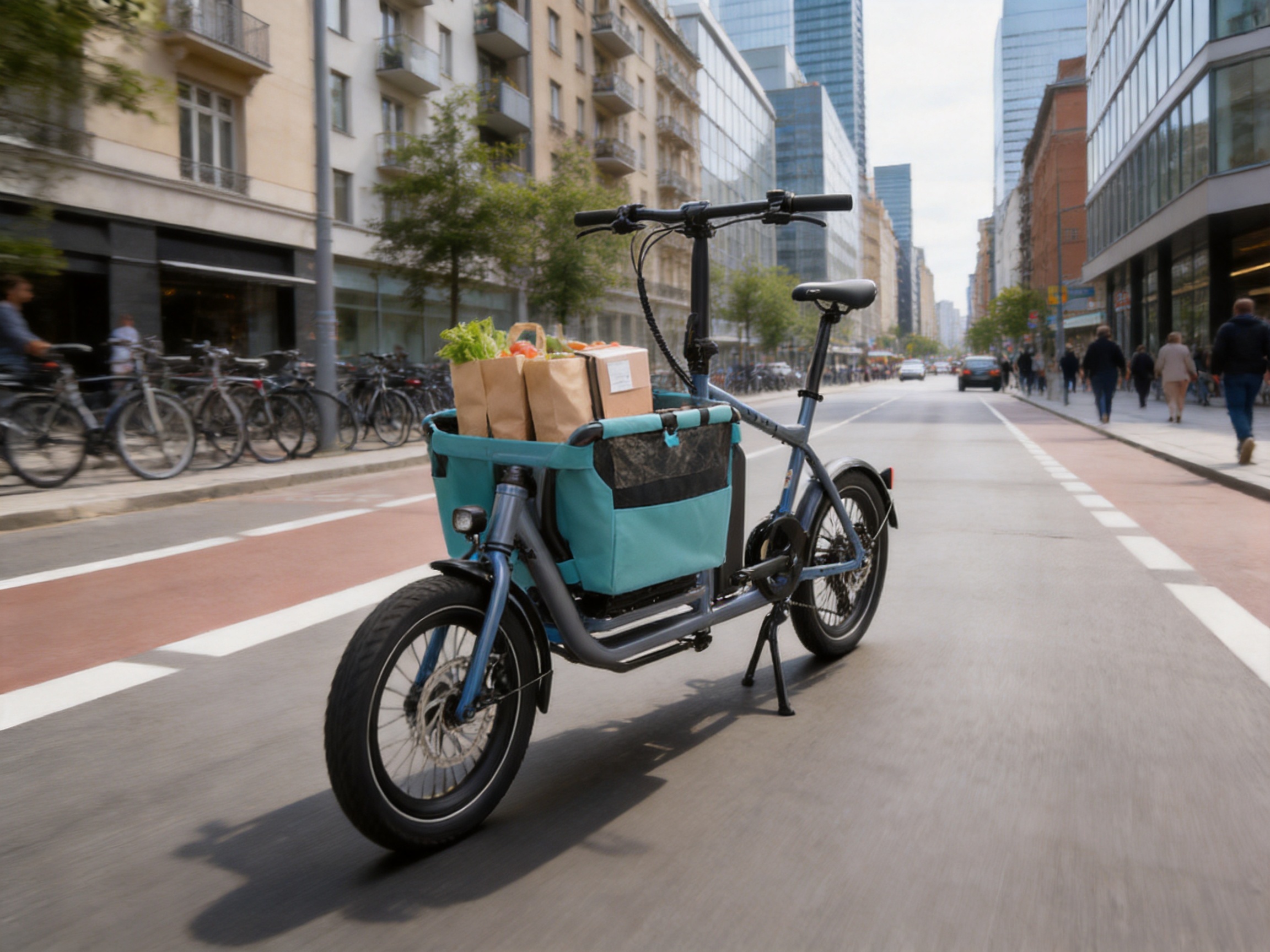
The ESQ1 frame is made from 6061 T4T6 aluminum alloy. This material is widely used in bicycle construction because it can provide a useful balance of low weight, structural performance, corrosion resistance, and manufacturability. For an urban cargo bike, frame design must account for more than the rider’s weight. It must also manage cargo loads, motor forces, braking forces, steering inputs, and repeated starts and stops.
The use of an aluminum alloy frame supports the compact concept. Reducing unnecessary frame weight can make the bicycle easier to move when the motor is not operating, easier to load into a storage area, and more manageable during parking. At the same time, the frame must be designed with appropriate reinforcement around high-stress areas such as the head tube, bottom bracket region, cargo mounting points, and rear dropout area.
The specified tire arrangement uses a 16-inch by 2.4-inch front wheel format and an 18-inch by 2.4-inch rear format. These smaller, wider tires are consistent with the bicycle’s urban handling objectives. Wider tires can provide a more stable contact patch and help absorb small surface irregularities, while the smaller wheel diameter contributes to a lower center of gravity and responsive steering.
The tires are described as puncture-proof. In practical use, this should be understood as puncture-resistant rather than absolutely immune to every sharp object or road hazard. Riders should maintain correct tire pressure, inspect the tread, and remove embedded debris. Proper inflation supports handling, comfort, battery efficiency, and braking performance.
The bicycle uses Tektro hydraulic disc brakes. Hydraulic disc brakes are particularly useful on an electric cargo bike because they can provide controlled stopping in wet conditions, on descents, and when the bicycle is carrying cargo. Compared with basic mechanical systems, hydraulic brakes generally offer smooth lever action and automatic pad movement compensation as the pads wear.
Braking performance still depends on maintenance and riding conditions. Brake rotors must remain clean and free of oil or lubricant. Pads should be replaced when worn, and hydraulic systems should be inspected if the lever feels unusually soft or if fluid leakage appears. Riders should also remember that a loaded front basket may influence weight transfer during braking, making progressive brake control important.
The use of hydraulic disc brakes gives the ESQ1 a meaningful advantage over many basic urban bicycles equipped with entry-level rim brakes or simpler mechanical systems. This does not mean that every competing model has inferior braking, but it does indicate that the product is equipped for a more demanding range of daily conditions.
The Model Q ESQ1 competes in a broad market that includes standard electric bicycles, rear-rack cargo bikes, long-tail cargo bicycles, large front-loaders, compact utility bikes, and commercial delivery platforms. Its advantage is not that it replaces every type of cargo bike. Instead, it offers a particular combination of compactness, cargo access, riding agility, and electric assistance.
A conventional electric bicycle may be lighter and simpler, but it often has limited capacity for groceries, parcels, or work equipment. Riders may need to use a backpack, panniers, or a rear rack, which can affect comfort and weight distribution. The ESQ1 provides a dedicated front basket with a stated capacity of 25 kilograms, allowing users to transport larger and more varied loads.
The front basket also keeps cargo separate from the rider’s back. This can improve comfort during commuting and reduce the need to carry heavy items on the body. For small businesses, the basket offers a more professional and visible way to transport tools, supplies, or packages.
Large front-loading cargo bikes often provide more total volume and may be suitable for carrying children or substantial commercial loads. However, they can be difficult to store, turn, lift, transport, or fit through narrow access points. The ESQ1 is more compact and therefore better aligned with riders who need modest cargo capacity rather than a full-size cargo box.
The shorter dimensions can also reduce the learning curve for riders transitioning from a regular bicycle. The bicycle remains responsive in urban situations, while the rider benefits from cargo functionality without committing to the footprint of a heavy-duty platform.
Rear-loading bicycles can offer effective weight distribution, but the rider may not be able to see cargo as easily. A front-loading basket places the load in the rider’s forward view, which is useful when transporting fragile goods, shopping items, or time-sensitive deliveries.
The ESQ1’s front cargo position also makes loading convenient. Goods can be placed into the basket from the front or side without reaching behind the rider. This can improve efficiency during frequent stops.
Some compact utility bicycles use a single-speed drivetrain to reduce cost and maintenance. While this approach can work on flat routes, it may be less flexible when the rider encounters hills, heavy cargo, or changing road conditions. The ESQ1’s Shimano seven-speed Sora system provides more options for controlling pedal effort and motor usage.
The additional gears may be especially valuable for commercial riders who follow routes with repeated elevation changes. They can also help private users adapt the bicycle to different seasons, loads, and neighborhoods.
Hub motors can be effective and are common in electric bicycles. However, the ESQ1’s mid-drive system offers a different performance philosophy. By working through the bicycle’s gears, the motor can support a broader range of riding conditions while keeping the central frame area relevant to overall weight balance.
Mid-drive systems may require riders and service teams to pay closer attention to drivetrain wear because motor power passes through the chain and gears. This is not a disadvantage unique to the ESQ1; it is a maintenance consideration associated with the architecture. Proper shifting technique, chain lubrication, and regular inspection are important for long-term performance.
The product is supplied by ATMOSE SASU, while the wider Atmose development story combines American product thinking with European design and research and development. The company describes its origin in California and its international design and R&D presence in Paris. This structure gives the product a cross-market perspective: practical utility is considered alongside appearance, urban usability, and European mobility expectations.
The company’s background is connected to MOTIV, an established American beach cruiser brand with manufacturing experience, supply-chain relationships, and knowledge of bicycle product development. That foundation is relevant because cargo e-bikes require coordination across several technical areas, including frame engineering, battery integration, motor systems, braking, drivetrain selection, cargo attachment, packaging, and after-sales support.
Manufacturing an aluminum cargo frame involves more than selecting a material. The frame must be designed for repeatable production, accurate alignment, consistent weld quality, and controlled finishing. A mature production process typically includes tube preparation, fixture-based alignment, welding, surface treatment, paint or coating, component installation, and final inspection.
Fixtures are important because they help maintain consistent geometry across production batches. Alignment affects steering, wheel tracking, braking, drivetrain operation, and rider confidence. For a compact cargo bike, even small deviations can influence how the front basket and steering system behave under load.
Welding quality is another key consideration. Areas exposed to concentrated forces, such as the head tube, bottom bracket, rear stays, and cargo mounting points, require careful design and inspection. Consistent welding procedures help reduce variation and support the structural reliability expected from a bicycle that carries both rider and cargo.
The ESQ1 demonstrates a coordinated component strategy. The 6061 aluminum frame, Bafang mid-drive system, Samsung battery cells, Shimano seven-speed drivetrain, Tektro hydraulic brakes, and wide puncture-resistant tires are not isolated features. They work together as a complete transportation system.
For example, a more powerful motor would have limited value if the brakes, drivetrain, frame, or battery could not support the increased demand. Likewise, a large battery would not automatically create a better product if the frame became too heavy or the bike lost urban agility. The ESQ1’s equipment selection reflects an effort to balance capability, weight, handling, serviceability, and practical cost.
Advanced manufacturing strength should be evaluated through process discipline as well as product specifications. A reliable e-bike production program may include incoming component inspection, frame alignment checks, weld assessment, paint inspection, torque verification, electrical testing, brake adjustment, drivetrain indexing, wheel truing, and road or roller testing.
Electrical systems require particular attention. Battery connections, motor cables, display interfaces, charging ports, and control units should be checked for secure fitment and correct operation. Functional testing before shipment can reduce the likelihood of assembly defects reaching distributors or end users.
For wholesalers and retailers, quality control has a direct commercial impact. Fewer defects can reduce warranty costs, service interruptions, return freight, and customer dissatisfaction. A manufacturer that can provide consistent specifications, clear assembly procedures, spare-part support, and responsive communication offers value beyond the bicycle’s physical components.
Atmose states that it has manufacturing expertise, a mature supply chain, and a commitment to continuous innovation. These capabilities are important for global buyers seeking more than a one-time purchase. A dependable supplier should be able to coordinate component sourcing, production scheduling, packaging, documentation, and after-sales support across different markets.
The company also promotes custom design and wholesale solutions. Customization may involve color, branding, accessory configuration, cargo modules, packaging, regional equipment, or fleet specifications. The exact scope depends on order quantity, engineering requirements, certification needs, and production feasibility. However, the ability to develop a product around a defined market application can help distributors differentiate themselves from sellers offering only generic stock models.
Customization should be managed through a formal process. Buyers should confirm drawings, component lists, minimum order quantities, sample approvals, testing requirements, delivery schedules, warranty terms, and replacement-part availability. Clear documentation protects both the supplier and the customer while reducing misunderstandings during production.
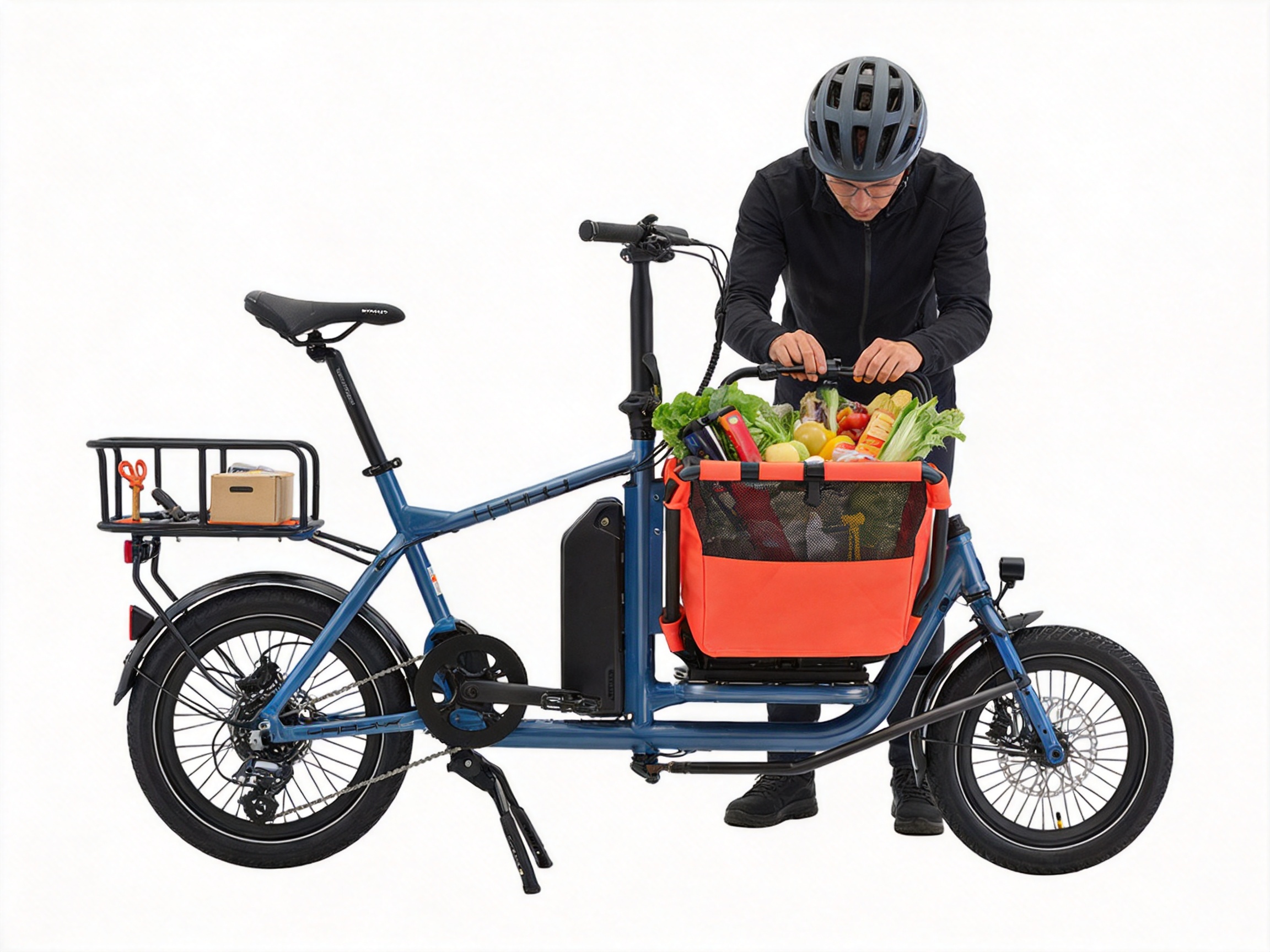
The ESQ1 has potential across several urban mobility segments. Its compact design makes it suitable for bicycle retailers that want to offer a cargo model without requiring extensive showroom or warehouse space. The front basket gives customers an immediately understandable use case, while the electric assistance and seven-speed drivetrain add practical value for daily transportation.
Although the Model Q is not positioned as a large family carrier, it can support household tasks such as grocery shopping, transporting small bags, carrying school supplies, or moving personal equipment. Its compact format may appeal to households that have limited storage and do not need the capacity of a larger family cargo bike.
Retailers can present it as a flexible companion for errands rather than as a specialized cargo vehicle. This broadens its potential customer base to include apartment residents, commuters, students, service workers, and environmentally conscious households.
Small businesses often need a practical way to move items across short distances. Cafes, florists, repair services, photographers, office suppliers, and neighborhood retailers may benefit from a front basket that can carry tools, merchandise, or delivery packages.
The bicycle’s narrow profile can be useful for last-mile routes where vans lose time searching for parking. A rider can often stop closer to a destination, move through bicycle-accessible streets, and avoid fuel costs associated with short vehicle trips. The ESQ1 is not intended to replace every commercial vehicle, but it can complement a larger delivery system or serve as a low-cost option for local routes.
Mobility operators and rental businesses may also consider the ESQ1 for short-term cargo-bike programs. The removable basket simplifies configuration, while the compact size can make storage and redistribution more manageable. Fleet operators should evaluate locking systems, service intervals, battery management, rider education, and local regulations before deployment.
Commercial fleets benefit from standardized maintenance procedures. Brake inspections, tire checks, battery health monitoring, basket-mount checks, and drivetrain servicing should be included in the operating schedule. A product designed for fleet use should be supported by accessible replacement parts and clear technical documentation.
Electric cargo bikes can contribute to more sustainable urban transportation by replacing some short car journeys and reducing dependence on fossil-fuel-powered delivery vehicles. Their environmental value depends on how they are used, how long they remain in service, how batteries are managed, and how responsibly they are manufactured.
The ESQ1 supports this broader mobility shift by combining pedal power with electric assistance. A rider can travel without fuel, avoid some forms of traffic congestion, and carry items that would otherwise require a car. For businesses, replacing repeated short van trips with cargo-bike journeys may reduce operating costs and local emissions.
Durability is central to sustainability. A product that remains useful for many years generally creates less environmental pressure than a product that requires frequent replacement. The ESQ1’s aluminum frame, hydraulic brakes, established drivetrain components, and replaceable accessories can support a maintenance-oriented ownership model. Long-term sustainability still depends on access to service, spare parts, battery replacement, and responsible end-of-life recycling.
The company’s stated philosophy of combining practicality, reliability, and fun also has a sustainability dimension. A bicycle that is enjoyable and convenient is more likely to be used regularly. If a cargo bike remains stored because it is difficult to handle or inconvenient to configure, its potential environmental benefit is reduced. Usability is therefore not merely a comfort feature; it is part of effective sustainable mobility.
Regular maintenance is essential for any electric cargo bike. Before each ride, the user should check tire pressure, brake function, wheel security, steering movement, battery engagement, lighting if fitted, and the basket mounting system. Cargo should be secured so that it cannot shift, fall, or interfere with the front wheel and steering.
The drivetrain should be kept clean and lubricated according to the manufacturer’s recommendations. Because the bicycle uses a mid-drive motor, chain and gear components may experience significant loads, especially when the bike is heavily loaded or ridden on hills. Riders should shift smoothly and avoid forcing the pedals in an unsuitable gear.
Hydraulic brakes require periodic inspection. Brake pads and rotors wear over time, and performance may change after extended use, contamination, or exposure to harsh conditions. Any unusual noise, vibration, reduced stopping power, or soft lever feel should be addressed promptly.
The battery should be protected from impacts, unauthorized modification, extreme heat, and improper charging. It should be stored according to the supplier’s instructions when the bicycle is not used for an extended period. Charging should take place in a suitable location away from combustible materials, with the approved charger and appropriate supervision.
Rider training is also important. New users should practice starting, stopping, cornering, and braking with an empty basket before carrying cargo. They should then add weight gradually and learn how the bicycle responds. The compact design makes the ESQ1 approachable, but any load positioned in front of the rider can influence steering and braking behavior.
| Product | Model Q ESQ1 Compact Electric Cargo Bike |
| Category | Urban Companion Cargo Bike |
| Frame | 6061 T4T6 aluminum alloy frame |
| Battery | Samsung 36V 15Ah lithium battery, approximately 540Wh |
| Motor | Bafang CM2503 mid-drive motor, 36V 250W |
| Drivetrain | Shimano seven-speed Sora system |
| Rider load specification | Up to 120 kilograms, subject to official product guidance |
| Basket load specification | Up to 25 kilograms, subject to official product guidance |
| Front basket dimensions | Approximately 470mm long by 470mm wide by 375mm high |
| Tires | Front 16-inch by 2.4-inch and rear 18-inch by 2.4-inch puncture-resistant tires |
| Brakes | Tektro hydraulic disc brakes |
| Overall dimensions | Approximately 1,780mm long by 620mm wide by 1,070mm high |
| Basket system | Quick installation and two-step removal design |
Specifications may vary according to production batch, regional configuration, component availability, certification requirements, or approved customization. Buyers should confirm the final specification sheet before placing an order.
The bicycle is designed for urban riders who want electric assistance and practical cargo capacity in a compact format. It may suit commuters, apartment residents, shoppers, local business owners, service workers, and riders who need occasional front-loading capability.
No. It is an Urban Companion Cargo Bike rather than a large family carrier. Its front basket is intended for practical daily loads such as groceries, parcels, bags, and work equipment. Buyers who need to transport several children or very large cargo should evaluate a larger dedicated family or heavy-duty model.
The 250-watt mid-drive motor works through the bicycle’s seven-speed drivetrain. This arrangement can help the rider manage hills, starts, and changing loads by selecting an appropriate gear. It also supports a central motor position and balanced overall design.
There is no single range figure that applies to every user. The approximately 540Wh battery’s performance depends on rider weight, cargo, terrain, wind, temperature, tire pressure, assistance level, speed, and stopping frequency. Buyers should request a test condition or range estimate relevant to their intended market and route.
Yes. The basket is designed for quick removal. The user pulls down the retaining pin, pushes the basket forward along its track, and then lifts it upward. The mounting system should be checked before every ride after installation.
Its compact dimensions, relatively narrow width, shorter overall length, and removable basket can make it easier to store in tight urban spaces. Users should still measure elevators, doors, corridors, and storage areas before purchase.
The supplied information does not establish a specific waterproof rating. Users should protect sensitive goods from rain with suitable bags or covers and follow the official care instructions for the basket and bicycle.
Final assembly requirements depend on the delivery configuration and market. Even when installation is straightforward, brake, steering, wheel, drivetrain, and electrical checks should be completed before the first ride. Retailers and fleet operators should use qualified technicians where required.
The supplier combines American product origins, European design and R&D activity, manufacturing experience connected with an established bicycle background, a mature supply chain, and support for custom and wholesale solutions. These strengths can help buyers develop consistent product programs rather than purchasing an isolated generic model.
The company promotes custom design and wholesale support. Custom options should be confirmed directly because availability depends on order quantity, engineering scope, certification, components, branding, and production scheduling.
The chain, cassette, chainring, derailleur, and shifting system require regular cleaning, lubrication, adjustment, and wear inspection. Smooth gear changes and appropriate shifting under load can help protect the drivetrain.
It can be suitable for light urban delivery, local services, and small-business transportation where the 25-kilogram basket specification meets the operational requirement. Businesses should evaluate route length, cargo dimensions, battery charging, rider training, local laws, and service support before deployment.
The Model Q ESQ1 occupies a useful position between a standard electric bicycle and a large cargo platform. It offers more carrying capability than a conventional commuter bike while preserving a compact urban footprint. Its front folding basket makes the cargo function visible and practical, while the removable design allows the bicycle to adapt to different daily requirements.
The 6061 T4T6 aluminum alloy frame supports a balance of strength and manageable weight. The Bafang 250-watt mid-drive motor and Samsung battery provide an electric power foundation suited to everyday city routes. The Shimano seven-speed system helps the rider adapt to gradients and loads, while Tektro hydraulic disc brakes provide controlled stopping performance. Wide, smaller-diameter tires contribute to comfort, traction, and responsive handling.
Its competitive advantage is therefore based on integration. The ESQ1 is not defined by one oversized component or an extreme performance claim. It is defined by the relationship between compact dimensions, usable cargo capacity, electric assistance, maneuverability, storage convenience, and serviceable components.
For retailers and wholesalers, the model also offers a clear market story. It can be presented to customers as an agile cargo bike for apartments, commutes, errands, and light business use. For commercial buyers, it provides a platform that may be adapted through accessories, branding, or approved configuration changes. For individual riders, it offers a practical way to replace some short car journeys without adopting a large and intimidating cargo vehicle.
The company’s broader strengths reinforce this proposition. Its American origin, European design and R&D development, manufacturing background, supply-chain experience, and focus on customization create a foundation for serving global buyers. The emphasis on sustainability, reliability, practicality, and enjoyment reflects the needs of modern urban transportation, where a successful product must be convenient enough to use repeatedly and durable enough to justify ownership.
The Atmose Model Q ESQ1 is a compact front-loading electric cargo bike designed for the realities of urban life. It addresses the needs of riders who require useful cargo capacity but face limitations in storage, access, traffic, and parking. Its compact dimensions, removable folding basket, responsive steering, mid-drive motor, seven-speed drivetrain, hydraulic disc brakes, and wide tires create a balanced platform for daily mobility.
Compared with conventional electric bicycles, it provides a more practical carrying solution. Compared with large cargo bikes, it is easier to store and maneuver. Compared with basic utility models, it offers a more capable power, gearing, braking, and cargo package. These advantages make it relevant to private users, local businesses, retailers, wholesalers, and urban mobility operators.
Its long-term value will depend on correct loading, regular maintenance, responsible battery care, professional assembly, and suitable after-sales support. When those conditions are met, the ESQ1 can serve as a reliable and flexible transportation tool for city commutes, shopping, small deliveries, and everyday errands.
For buyers seeking a compact cargo platform with international development support and customization potential, the Model Q ESQ1 presents a practical and adaptable solution for the continuing growth of electric urban mobility.
1. Product specification sheet for the Model Q ESQ1 Compact Electric Cargo Bike.
2. Manufacturer-provided product description and installation guidance for the front folding basket.
3. General technical literature on 6061 aluminum alloy bicycle frame construction.
4. General technical literature on mid-drive electric bicycle motor systems.
5. General maintenance guidance for hydraulic disc brakes and bicycle drivetrains.
6. Urban mobility studies concerning electric bicycles, cargo bicycles, and last-mile transportation.
7. Manufacturer background information concerning product development, design, research and development, manufacturing experience, and wholesale support.
Nov 17, 2026
Nov 03, 2026
Oct 26, 2026


info@atmosecargobike.com

200 rue de la Croix Nivert 75015 Paris

Custom Electric Bakfiets
 English
 Français
 Deutsch