

Aug 07, 2026
Adventure travel changes when a bicycle is designed around the realities of carrying equipment. A conventional touring bicycle may transport clothing, food, and lightweight camping supplies, but it often requires carefully distributed panniers and a conservative approach to terrain. A standard cargo bike offers more carrying volume, yet many urban-oriented models are optimized for pavement, short journeys, and family transportation rather than uneven trails, steep gradients, wet conditions, and remote destinations.
The Atmose Model V ESV1 addresses this gap with a purpose-built adventure cargo bike that combines a compact long-tail-style footprint, a large front folding basket, a mid-drive motor, hydraulic disc brakes, puncture-resistant tires, and a 170-kilogram maximum load rating. It is intended for riders who want to travel beyond ordinary city routes without giving up the practical advantages of a cargo platform.
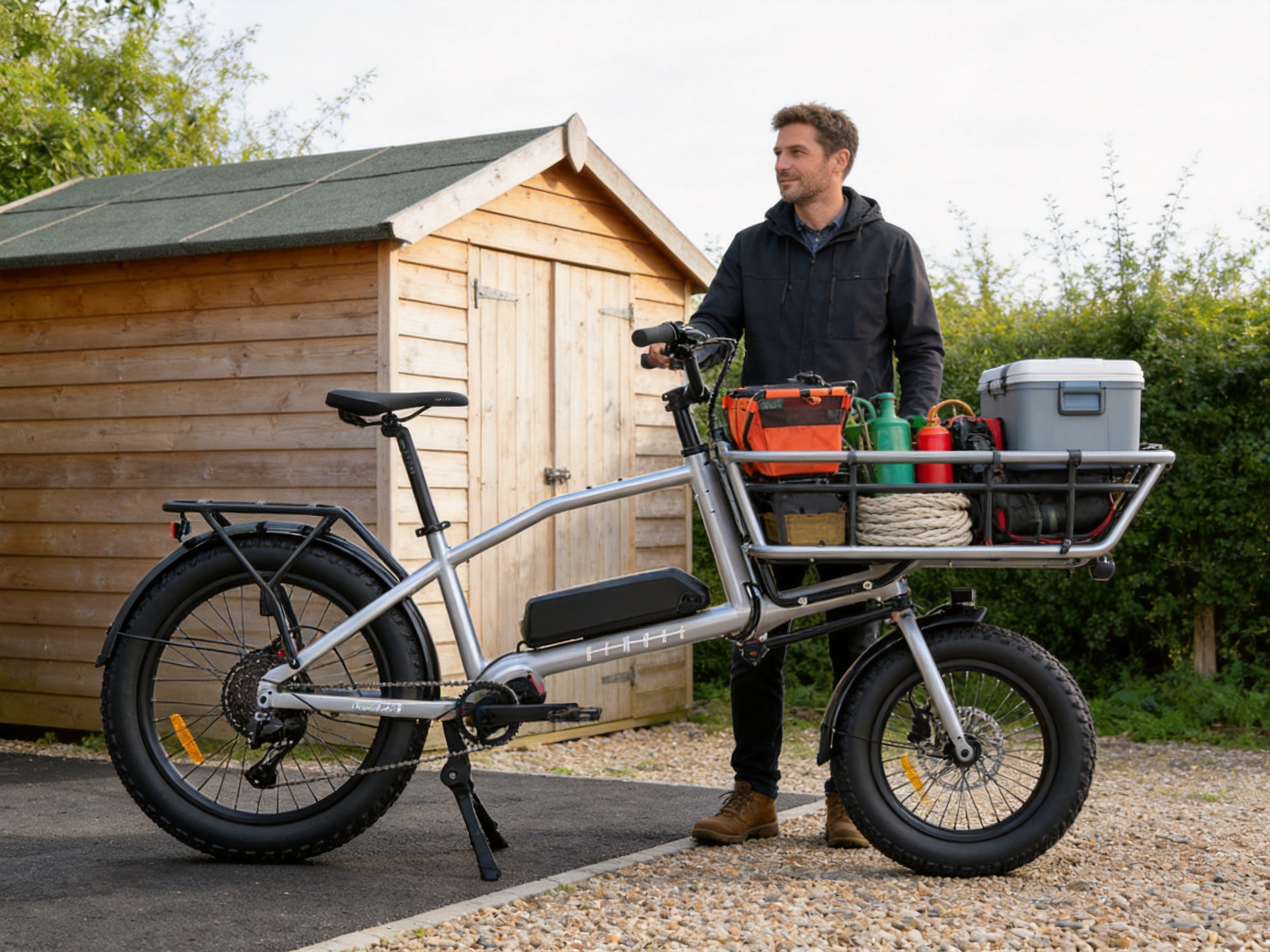
Its central design idea is straightforward: outdoor equipment should be carried securely, positioned low and forward, and supported by a chassis that remains manageable when the bike is loaded. The oversized front rack gives the rider a dedicated place for camping equipment, coolers, fishing supplies, tools, or expedition luggage. Instead of forcing every item into rear bags or onto a high rear carrier, the ESV1 distributes useful storage around the front of the bicycle while preserving a relatively narrow overall width of 750 millimeters.
This article examines the ESV1’s engineering, utility, ride characteristics, manufacturing strengths, customization potential, and position within the broader cargo-bike market. It also explains why the model is particularly suitable for outdoor exploration, mixed-surface travel, commercial field work, and riders who value carrying capacity without moving to a larger vehicle.

Atmose Model V ESV1 Adventure Cargo Bike with Oversized Front Camping Rack
Many cargo bicycles begin with an urban mission. Their priorities are child transportation, grocery shopping, last-mile delivery, or commuting. These uses typically demand a stable frame, easy access, weather protection, and compatibility with city infrastructure. Adventure use introduces a different set of requirements. A rider may need to carry a tent, cooking equipment, water, spare clothing, tools, food, and recreational equipment while climbing hills or crossing rough ground.
The Model V ESV1 is positioned around this more demanding use case. Its oversized front camping rack is not merely a decorative accessory or a small commuter basket. The listed basket dimensions are 370 millimeters in length, 370 millimeters in width, and 375 millimeters in height. This creates a substantial, visible storage compartment that can accept bulky objects that are inconvenient to place inside conventional panniers.
A front storage platform also offers practical loading benefits. Items can be placed directly into the basket without repeatedly removing side bags. A cooler, rolled sleeping mat, compact tent, dry box, or outdoor cooking case can be secured with suitable straps. Since the load is located in front of the rider and near the bicycle’s central structure, the bike can be organized around the actual shape and weight of the equipment rather than around the limited dimensions of standard bags.
Another advantage is visibility. Cargo positioned on a front deck or in a front basket can be monitored more easily than equipment buried behind the rider. This is useful when traveling over uneven terrain, because straps and covers can be checked quickly during rest stops. It also helps riders maintain a clear understanding of how the load is distributed before entering a descent or a technical section.
The design does not turn the bicycle into a motorcycle or an off-road vehicle. Riders must still respect the maximum load, secure all cargo properly, and choose routes appropriate for a bicycle. However, compared with a standard road-oriented electric bicycle, the ESV1 provides a much more suitable foundation for carrying heavy outdoor equipment across mixed terrain.
The front rack is the most distinctive feature of the ESV1. Its dimensions provide room for equipment that would otherwise need to be divided among multiple bags. For camping, this can simplify packing: a tent can remain in its original compression bag, a cooler can remain upright, and a fishing box or tool case can be loaded without being repacked into narrow panniers.
Load management is important because cargo affects steering, braking, acceleration, and climbing. The ESV1’s front storage concept is advantageous when used carefully. Large items can be positioned low enough to reduce excessive high-mounted weight, while the rider retains a direct view of the load. The front area is also useful for objects that need frequent access during a trip.
Competitors that rely exclusively on rear cargo platforms may offer substantial capacity, but they can encourage riders to stack equipment higher or farther behind the rear axle. That arrangement may increase the sensation of rear-end heaviness, particularly when climbing or maneuvering slowly. The ESV1’s front rack gives riders another loading zone and supports a more balanced packing strategy.
At the same time, a front basket requires responsible use. Heavy objects should be centered and secured, and the rider should avoid allowing cargo to interfere with the steering system, brake cables, lighting, or wheel. The cargo should not protrude in a way that creates a hazard for pedestrians, other cyclists, or trail users. A thoughtful loading system is therefore part of the bike’s advantage.
The folding character of the front basket adds another practical benefit. When the basket is not required, its folding function can help reduce obstruction during storage or transport. It can also make the bicycle easier to position in a garage, workshop, service area, or vehicle-loading environment. The exact folded clearance should be confirmed by the owner before transport, but the concept improves flexibility compared with a permanently fixed oversized container.
The ESV1 uses a 6061 T4T6 aluminum alloy frame. Aluminum is widely used in modern bicycle manufacturing because it offers a useful balance of weight, corrosion resistance, stiffness, availability, and design flexibility. For a cargo bicycle, the frame must do more than support the rider. It must manage the combined forces generated by the rider, motor, battery, cargo, braking, cornering, and uneven surfaces.
The use of 6061 aluminum alloy provides a recognized engineering foundation for a durable cargo frame. The T4T6 designation indicates a material and heat-treatment pathway intended to achieve useful structural properties. In practical terms, the frame material supports the ESV1’s role as a load-bearing platform while allowing the manufacturer to shape the tubing and mounting points around cargo-bike requirements.
Frame design is especially important on an adventure cargo bike because the loads are not always static. A rider may cross a shallow rut, descend a gravel road, or stop suddenly on a wet surface. Those actions produce changing forces that are different from simply carrying a grocery load on smooth pavement. A robust frame must work with the fork, wheels, brakes, rack mounts, and tires as one system.
The listed maximum load is 170 kilograms. This figure should be understood as a total system limit unless the manufacturer provides a more detailed breakdown. Riders should account for their own body weight, cargo, accessories, and any additional equipment. Staying within the limit helps preserve braking performance, handling, tire reliability, and long-term component life.
Compared with lighter recreational e-bikes, the ESV1’s load rating and cargo-oriented geometry provide a more appropriate platform for serious carrying. Compared with very large box bikes, its dimensions may be easier to manage on narrow paths, in storage spaces, and on ordinary roads. This balance is one of its important competitive strengths.
The ESV1 is equipped with a Starunion CM2503 mid-drive motor rated at 250 watts. The mid-drive location places the motor’s mass near the center of the bicycle rather than in the front or rear hub. This can contribute to a more centralized feel, especially when the front rack is loaded and the rear of the bicycle carries additional equipment.
Mid-drive systems are particularly suitable for climbing because they can work through the bicycle’s gearing. When the rider selects an appropriate low gear, the motor can help maintain useful torque at the wheel while the bicycle moves slowly up a gradient. This is an important advantage over many hub-motor cargo bikes, which may deliver strong assistance but do not use the bicycle’s mechanical gearing in the same way.
The ESV1 pairs the motor with a Shimano 11-speed Cues transmission. Eleven available gears give the rider a broad range for adapting to changing terrain. Lower gears are useful for steep climbs or heavily loaded starts, while higher gears support efficient progress on flatter roads and gentle descents. The combination of a mid-drive motor and a wide-range transmission is more versatile than a single-speed cargo arrangement or a basic low-range system.
Motor power should not be considered in isolation. A 250-watt rating does not describe every aspect of performance, including torque delivery, control programming, rider input, terrain, battery condition, or total load. The ESV1’s practical climbing ability will depend on how these factors work together. Its design, however, clearly prioritizes controlled assistance on gradients rather than only high-speed cruising.
For adventure riders, smooth assistance is often more valuable than aggressive acceleration. A predictable power response helps maintain traction on loose surfaces and reduces the chance of unsettling a loaded front end. It also allows the rider to contribute through the pedals while the motor supports the effort. This cooperative character suits long-distance exploration, where battery conservation and physical comfort matter as much as immediate speed.
The bicycle uses a Samsung 36-volt, 15-amp-hour lithium battery with a stated capacity of 540 watt-hours. Battery capacity is a central consideration for cargo-bike travel because a heavy load, hills, soft ground, frequent stops, and high assistance levels can increase energy consumption.
A 540-watt-hour battery offers a meaningful energy reserve for a mid-drive cargo bicycle, although actual range will vary substantially. Important factors include rider and cargo weight, gradient, surface quality, wind, tire pressure, temperature, riding speed, cadence, assistance setting, stop-and-go frequency, and battery age. A rider planning a remote journey should not rely on a single theoretical range number. Instead, the route should be evaluated conservatively with charging opportunities and an emergency margin.
The battery’s 36-volt architecture is common in electric bicycles and works with the listed 250-watt power system. The stated Samsung cell source provides a recognizable battery component foundation. As with any lithium battery, responsible charging, storage, inspection, and protection from extreme temperatures are essential. The owner should use the approved charger and follow the manufacturer’s instructions regarding charging locations and long-term storage.
For camping trips, energy planning can be integrated with route planning. Riders may choose a lower assistance level on flat sections, reserve stronger assistance for climbs, and pedal actively where conditions permit. A loaded cargo bike rewards smooth acceleration and appropriate gearing. The 11-speed transmission helps the rider avoid forcing the motor in an inefficient gear, which can support more consistent battery use.
Compared with a smaller commuter e-bike battery, the ESV1’s 540-watt-hour capacity is more appropriate for the additional mass of a cargo frame and outdoor equipment. Compared with some dual-battery expedition bicycles, it may require more careful range management. That distinction does not weaken the product; it clarifies its intended balance between useful capacity, manageable size, and a single-battery configuration.
The ESV1 uses Tektro hydraulic disc brakes. Hydraulic disc brakes are valuable on a cargo bicycle because they can provide strong, progressive braking with relatively low hand effort. This is especially important when the bicycle is carrying a substantial load or traveling downhill after rain.
Wet roads, muddy paths, gravel, and uneven surfaces require a rider to manage speed before a hazard becomes urgent. The braking system supports this approach by giving the rider more control during gradual speed reduction and emergency stops. The benefit is not simply maximum stopping force. Good braking also depends on modulation, lever feel, tire grip, rider technique, and correct cargo distribution.
Compared with basic mechanical rim brakes found on some entry-level utility bicycles, hydraulic discs generally offer stronger consistency in wet and dirty conditions. They also avoid relying on a rim braking surface that may collect water or debris. For an adventure-oriented cargo bicycle, this type of braking equipment is a significant competitive advantage.
Brake performance still depends on maintenance. Pads wear, rotors can become contaminated, and hydraulic systems require inspection. Heavy users should check braking response before every extended trip. Any unusual noise, lever softness, rubbing, vibration, or reduced power should be investigated before riding with a full load.
The ESV1 is specified with wide, puncture-resistant tires measuring 18 inches by 2.4 inches at the front and 24 inches by 2.4 inches at the rear. The combination of different wheel sizes supports the bike’s cargo-oriented geometry while maintaining a relatively low loading height at the front.
A 2.4-inch tire offers more air volume than a narrow road tire. When properly inflated for the rider’s weight and terrain, this can improve comfort and help the tire conform to uneven surfaces. Wider tires can also provide useful stability on gravel, compacted dirt, and rough pavement. Puncture resistance is particularly relevant for adventure travel, where sharp stones, thorns, broken branches, and roadside debris may be more common than in an urban environment.
No bicycle tire is immune to punctures. Riders should carry a suitable repair kit, spare tube or tubeless-repair equipment where applicable, tire levers, and a pump or inflator. Tire pressure should be checked regularly because an underinflated tire may increase rolling resistance and risk rim damage, while an overinflated tire may reduce comfort and traction on loose ground.
The smaller front wheel can contribute to a lower front cargo area and a more approachable load height. The larger rear wheel can support efficient rolling and accommodate the drivetrain. Together, the wheel sizes create a practical compromise between cargo accessibility, stability, and everyday rideability.
Against narrow-tire commuter cargo bikes, the ESV1 is better equipped for rougher surfaces. Against extremely large-wheel off-road bicycles, its cargo-focused proportions may provide easier loading and a more practical center of gravity. This middle position is valuable for riders whose journeys combine roads, paths, campsites, and moderate trails rather than extreme mountain-bike terrain.
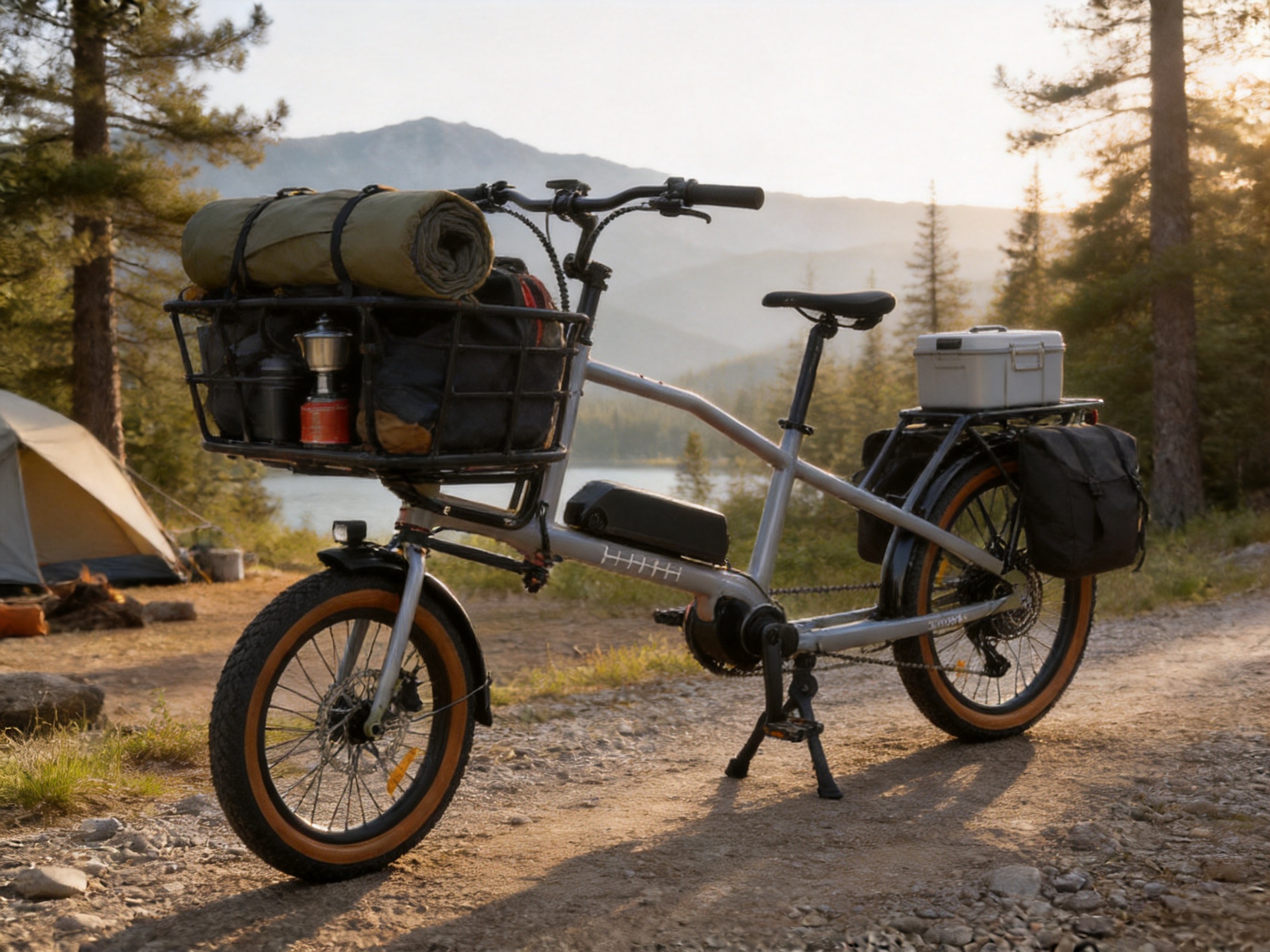
The listed bike dimensions are 1,910 millimeters in length, 750 millimeters in width, and 1,060 millimeters in height. These measurements show that the ESV1 is a substantial utility bicycle, but not an oversized commercial tricycle or a full-length box bike.
A width of 750 millimeters is relevant in real-world use. It may allow the bike to pass through many standard gates and entrances, although riders should measure their own storage areas before purchase. The length provides room for the front cargo system and stable wheel spacing without creating an excessively long vehicle. The height is compatible with a conventional upright riding position and accessible cargo loading.
For home storage, the bike should be placed on a stable surface with enough room to turn the handlebars and access the battery, brakes, tires, and drivetrain. Outdoor riders may also consider a secure cover and a locking system suitable for a high-value electric bicycle. During vehicle transport, the total length and weight must be checked against the capacity of a rack or trailer. A folding front basket can help with clearance, but it does not eliminate the need to verify the complete transport arrangement.
The ESV1’s dimensions also support its role as a bridge between recreational and commercial utility. A delivery operator can use it for equipment transport without requiring the footprint of a cargo trike. An individual can carry camping equipment without dealing with the storage demands of a much larger front-loader. This versatility is one of the product’s strongest advantages over narrowly specialized competitors.
The company behind the ESV1 combines American product origins with European design and research-and-development activity. Atmose originated in California and was developed by MOTIV, an established American beach cruiser brand. The company later established ATMOSE SASU in France in 2026, accompanied by a design and R&D team based in Paris.
This structure gives the product a cross-market perspective. American product thinking often emphasizes approachable usability, leisure, practicality, and straightforward ownership. European design influence can add attention to compact urban dimensions, visual refinement, everyday integration, and the requirements of dense transportation environments. The ESV1 reflects this combination by presenting a rugged cargo concept in a relatively controlled and accessible format.
The company describes its approach through the philosophy “Fun & Practical.” For a cargo bike, this is more than a marketing phrase when it is translated into product decisions. Fun can mean responsive handling, enjoyable exploration, and a sense of freedom beyond car-dependent travel. Practicality means useful storage, durable materials, strong braking, manageable dimensions, serviceable components, and a configuration that works for more than one type of trip.
The company also identifies manufacturing expertise, a mature supply chain, and continuous innovation as important strengths. These capabilities are significant because cargo bicycles require coordination across many product areas. Frame fabrication, battery integration, motor selection, wheel construction, rack design, braking, drivetrain compatibility, and final assembly all need to work together. A weakness in one area can compromise the usefulness of the complete vehicle.
The ESV1’s specification suggests a component-integration approach rather than the simple addition of an oversized basket to an ordinary bicycle. The rack, low front wheel, mid-drive motor, 11-speed transmission, wide tires, hydraulic brakes, battery, and high load rating support a common purpose. This kind of system thinking is an important manufacturing advantage because it aligns individual parts with a defined customer need.
Advanced manufacturing does not necessarily mean that every component is produced in a single factory. In the modern bicycle industry, product quality often depends on engineering coordination, supplier selection, tooling, material control, assembly standards, inspection, and after-sales support. A mature supply chain can help the company source specialized components while maintaining consistency across production runs.
For buyers evaluating a cargo bicycle, useful manufacturing questions include frame welding quality, alignment, paint and corrosion protection, rack attachment strength, battery retention, cable routing, brake setup, wheel tension, torque specifications, and final functional testing. These are the practical points where design becomes a dependable product. The company’s international design and R&D structure provides a foundation for addressing these issues across different markets.
The frame material, drivetrain, motor, battery, brakes, and tires are not independent choices. A 170-kilogram load rating requires the wheel, tire, brake, and frame systems to be treated as a combined structure. A mid-drive motor needs a compatible transmission and suitable chainline. A large front rack needs attachment points and steering behavior that remain predictable when loaded.
The ESV1’s specification demonstrates this coordination. The 6061 T4T6 aluminum frame supports a durable structural base. The Samsung battery provides stored energy for the 250-watt mid-drive system. The Shimano 11-speed Cues transmission provides gear range for climbing and cruising. Tektro hydraulic brakes address the need for controlled stopping. Wide puncture-resistant tires connect the complete system to the ground.
This component strategy gives the bike an advantage over low-cost competitors that may combine a powerful-looking motor with weak brakes, narrow tires, limited gearing, or an underdeveloped cargo structure. A cargo bike should not be judged by motor output alone. It should be judged by whether the complete package remains useful and controlled when carrying people, equipment, or commercial loads.
A high-quality cargo bike requires careful assembly because small errors can have larger effects under load. Wheel alignment, spoke tension, brake rotor positioning, headset adjustment, crank installation, derailleur setup, and rack fastener torque all matter. The heavier the intended load, the more important these details become.
The use of established component suppliers can support serviceability and replacement availability, particularly for the Shimano drivetrain and Tektro braking system. Owners may be able to work with qualified bicycle technicians who are already familiar with these brands. This is an advantage over highly proprietary systems that require specialized parts for routine maintenance.
Buyers should still confirm local service arrangements, warranty terms, replacement-part availability, battery support, and software or diagnostic requirements where applicable. A well-designed product is strongest when it is supported by a practical ownership network.
A standard commuter e-bike is typically lighter, narrower, and less expensive to operate, but it may not have the frame strength, storage capacity, tire protection, or braking equipment needed for serious cargo. The ESV1 is more suitable when the rider regularly carries bulky equipment or wants to travel beyond smooth urban routes.
The trade-off is additional size and weight. Riders who only carry a laptop and a small backpack may not need a cargo platform. The ESV1 becomes more compelling when carrying capacity and route versatility are central requirements.
Traditional touring bicycles can be efficient over long distances, especially when lightly loaded and ridden on paved roads. However, their racks and panniers may not accept bulky objects as easily as the ESV1’s front basket. They also require substantially more human effort when carrying heavy camping equipment up long gradients.
The ESV1 offers electric assistance, a higher utility focus, and a front storage area designed around large gear. It may not match the efficiency or low weight of a conventional touring bicycle, but it provides a more accessible option for riders who want to carry more with less physical strain.
Family cargo bikes often prioritize children, weather covers, low-speed stability, and city convenience. The ESV1 is less focused on enclosed passenger transport and more focused on equipment, outdoor use, and rugged utility. Its large front rack may be more useful for camping and field work than a family cabin designed for children.
A family-oriented buyer should consider whether passenger seating, rain protection, and child-safety accessories are more important than expedition storage. The ESV1’s advantage is specialization: it is designed for people who want a cargo bicycle to function as an outdoor equipment carrier.
Heavy-duty delivery bicycles can carry very large volumes and may be designed for constant professional use. They can also be longer, heavier, and more difficult to store. The ESV1 offers a more compact alternative for smaller commercial loads, mobile technicians, outdoor guides, event crews, estate workers, and field-service personnel.
Its 170-kilogram maximum load rating gives it meaningful utility, while its 1,910-millimeter length remains closer to a personal bicycle than a large freight platform. Operators with oversized parcels or very high daily mileage may need a larger commercial model, but users with moderate equipment loads may find the ESV1 more maneuverable and flexible.
Rear-hub cargo bikes can be mechanically simple and may provide strong assistance on flat roads. The ESV1’s mid-drive system offers a different advantage by working through the Shimano 11-speed gearing. This can improve climbing flexibility when the bicycle is loaded, particularly on routes with changing gradients.
The mid-drive arrangement also keeps the motor weight closer to the bicycle’s center. That can be beneficial when the front rack is carrying substantial equipment. The relative advantage depends on the exact competing model, but the ESV1’s powertrain is well matched to hilly adventure use.
Feature |
Adventure benefit |
Practical consideration |
Oversized front folding basket |
Accepts bulky camping, fishing, cooling, and field equipment |
Heavy items must be centered and securely strapped |
6061 T4T6 aluminum frame |
Provides a durable structural platform with useful corrosion resistance |
Total rider and cargo weight must remain within the stated limit |
250-watt mid-drive motor |
Supports controlled climbing through the bicycle’s gearing |
Range and hill performance vary with load, terrain, and assistance level |
Samsung 36V 15Ah battery |
Offers 540 watt-hours for extended utility and touring |
Route planning and charging discipline remain important |
Shimano 11-speed Cues |
Provides a broad range for climbs, flats, and descents |
Regular drivetrain cleaning and adjustment are required |
Tektro hydraulic disc brakes |
Improve control with heavy loads and wet conditions |
Brake pads, rotors, and hydraulic components need inspection |
18-inch front and 24-inch rear tires |
Combines lower front loading with stable rolling performance |
Pressure should be adapted to weight and terrain |
Although the ESV1 is marketed around adventure, its capabilities extend to many practical activities. A mobile repair worker can transport hand tools, spare parts, protective equipment, and a compact work case. A gardener or groundskeeper can carry supplies between sites. A photographer can load tripods, cases, batteries, and outdoor accessories. A fishing enthusiast can transport tackle, a cooler, and safety equipment without relying on a car.
For event and festival work, the front basket can hold signage, cables, small cases, and setup tools. For rural property owners, the bicycle can serve as a quiet utility vehicle for inspecting paths, moving supplies, or reaching locations where a car is inconvenient. For outdoor educators and guides, it can carry demonstration equipment and emergency supplies.
The ESV1 may also serve as a sustainable alternative for short commercial journeys. A business that currently uses a car for small deliveries may be able to shift selected routes to an electric cargo bike. This can reduce parking difficulties, operating noise, and fuel dependence. The feasibility depends on local regulations, route conditions, weather, security, and the required payload.
For recreational users, the bicycle can support day trips that combine ordinary roads with gravel paths. A rider can carry lunch, spare clothing, repair equipment, and leisure supplies without making the trip feel like a full expedition. This versatility gives the model a broader value proposition than a bicycle designed only for one seasonal activity.
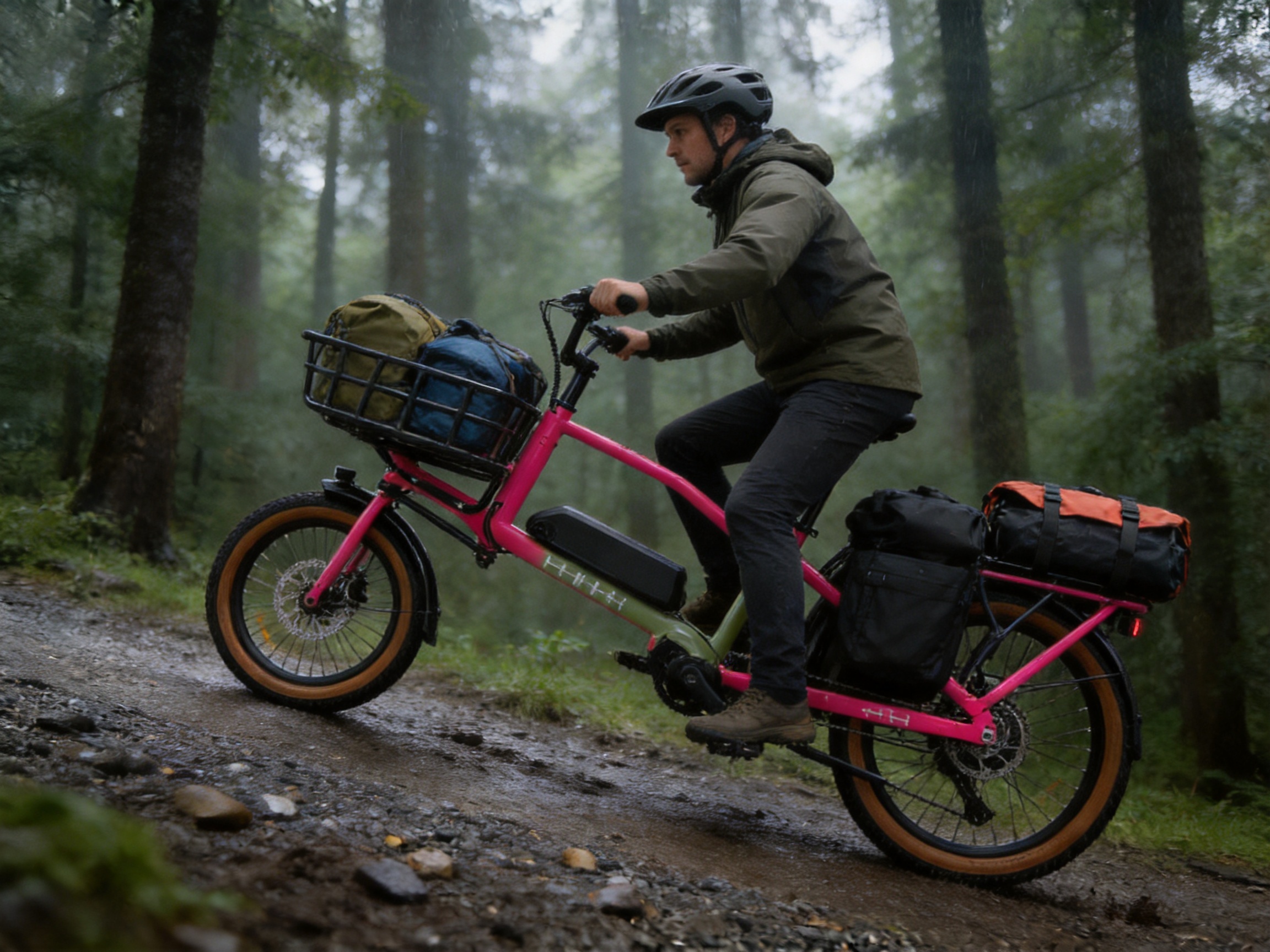
An adventure cargo bike should feel stable without becoming cumbersome. The ESV1’s front storage area and low front wheel are intended to support predictable handling when cargo is correctly loaded. Riders should expect a different experience from a lightweight mountain bike or road bicycle. Steering inputs may need to be smoother, stopping distances may increase with a heavy load, and cornering should be approached with greater awareness.
Before a long journey, riders should practice with progressively heavier loads. Begin with empty-rack handling, then add lightweight equipment, and finally simulate a realistic camping load. This helps identify changes in steering, braking, acceleration, and balance. It also provides an opportunity to test straps and cargo containers before the bike is taken into remote terrain.
The mid-drive motor and broad gear range can make starts more manageable, but the rider should select an appropriate gear before reaching a steep section. Sudden shifts under high force can accelerate drivetrain wear. Smooth pedaling, moderate cadence, and anticipation of terrain are especially important when the bike is loaded.
On descents, the rider should control speed early rather than waiting until a sharp turn or obstacle. Hydraulic brakes offer strong assistance, but they cannot overcome excessive speed, poor tire contact, or badly distributed cargo. Adventure capability is created by the interaction of equipment and rider judgment.
A cargo bicycle used outdoors deserves a regular maintenance routine. After riding through mud or heavy rain, the frame, wheels, drivetrain, and braking surfaces should be cleaned appropriately. Water should not be forced into bearings, electrical connections, or battery interfaces. The chain and other moving parts should be dried and lubricated according to the component manufacturer’s guidance.
Tire inspection is particularly important. Look for embedded thorns, cuts, sidewall damage, and unusual wear. Check pressure before every significant ride. A loaded bike places greater demand on tires and wheels than a lightly used commuter bicycle.
The front basket and its fasteners should be inspected frequently. The rack may experience repeated vibration when traveling on rough surfaces. Any loose bolts, cracks, deformation, or unusual movement should be addressed before carrying valuable or heavy equipment.
Brake pads and rotors should be checked for wear and contamination. Hydraulic brake levers should feel firm and consistent. The drivetrain should be kept clean, especially after dusty or muddy trips. The chain, cassette, derailleur, and chainring all work harder when the bike is loaded and climbing.
The battery should be inspected for damage and stored in a dry, suitable environment. Riders should avoid using a battery that has been crushed, punctured, swollen, overheated, or exposed to water in an unsafe manner. Professional service should be used for electrical faults or battery problems.
Regular servicing is not merely a way to protect the bicycle’s appearance. It preserves the characteristics that make the ESV1 useful: stable handling, dependable braking, efficient shifting, secure cargo support, and predictable electrical assistance.
Atmose identifies custom electric cargo bikes, custom electric bikes, custom electric bakfiets, and wholesale orders as part of its broader business capability. This is relevant for buyers who require more than a standard retail configuration. Businesses, distributors, municipalities, hospitality operators, outdoor organizations, and mobility programs may have different requirements for accessories, branding, carrying systems, or regional specifications.
The ESV1’s modular utility concept provides a logical starting point for customization. Potential adaptations may include different cargo restraints, protective covers, tool mounts, lighting arrangements, signage, delivery containers, or equipment-specific storage. Any modification should be reviewed for compatibility with the frame, steering, braking, electrical system, load rating, and local regulations.
Wholesale customers may also value the company’s international structure. A California-origin brand with a Paris-based design and R&D presence can bring perspectives from multiple mobility markets. The company’s stated mature supply chain and manufacturing experience may support larger purchasing programs, although buyers should verify production lead times, minimum order quantities, regional compliance, warranty procedures, and spare-parts planning directly.
For fleet users, the most important question is not simply how many bicycles can be delivered. It is whether the model can be supported over its entire service life. A fleet program should include operator training, charging procedures, inspection schedules, replacement tires, brake parts, drivetrain components, and a clear process for reporting faults. The use of widely recognized drivetrain and brake components can help simplify service planning.
Electric cargo bicycles can contribute to more sustainable transportation when they replace suitable car trips. They use less physical space, create less local noise, and require no fuel during operation. Their environmental value is greatest when they are used regularly for transportation, deliveries, errands, and field work rather than treated as occasional recreational products.
The ESV1’s ability to carry equipment is important in this context. A bicycle that cannot transport the items required for a journey may not replace a car. The oversized front rack expands the range of trips that can realistically be completed by bicycle. Camping, maintenance, shopping, and small commercial deliveries become more practical when cargo can be carried safely and accessibly.
Sustainability also depends on durability. A product that remains functional for many years can reduce the need for replacement and make the resources used in manufacturing more valuable. The aluminum frame, established component brands, puncture-resistant tires, and serviceable mechanical systems all support a long-term ownership approach when properly maintained.
The company’s stated commitment to reliability, practicality, and ongoing product innovation aligns with this goal. Better mobility is not created by technology alone. It depends on a product that users enjoy, understand, maintain, and choose frequently enough to change transportation habits.
The ESV1 is a strong candidate for riders who want a single electric cargo bike for both everyday utility and outdoor exploration. It suits people who carry bulky equipment, live near hills, travel on mixed surfaces, or want to reduce dependence on a car for short and medium-distance journeys.
It is particularly appropriate for campers, anglers, field technicians, photographers, gardeners, outdoor professionals, and active households. It can also serve small businesses that need a compact equipment carrier rather than a large delivery vehicle.
The model may be less suitable for riders seeking the lightest possible bicycle, the smallest folding e-bike, or a dedicated child-transport system. Its cargo structure, large rack, and heavy-duty components are purposeful additions, but they also mean that the bike is more substantial than a minimalist commuter model.
Potential buyers should evaluate storage space, local terrain, service access, charging arrangements, legal requirements, and expected cargo weight. A test ride with representative equipment is highly recommended. The most useful comparison is not an unloaded test ride against another unloaded bicycle; it is a realistic test with the rider’s actual bags, containers, or tools.
The ESV1 is an adventure-oriented electric cargo bike designed to carry bulky outdoor equipment. Its oversized front folding basket is intended for camping supplies, coolers, fishing equipment, tools, and similar loads, while its motor, gearing, tires, and brakes support mixed-surface travel.
The listed maximum load is 170 kilograms. Riders should interpret this as a total system limit unless a separate manufacturer specification provides individual rider, rack, or component limits. Body weight, cargo, accessories, and equipment should all be included in the calculation.
The listed front folding basket measures 370 millimeters in length, 370 millimeters in width, and 375 millimeters in height. These dimensions make it suitable for larger objects that may not fit conveniently into narrow panniers.
A mid-drive motor is positioned near the bicycle’s center and can use the bicycle’s gearing. With the Shimano 11-speed Cues transmission, the rider can select lower gears for steep climbs and higher gears for flatter sections. This arrangement is well suited to changing terrain and loaded riding.
The bicycle uses a Samsung 36-volt, 15-amp-hour lithium battery with a stated capacity of 540 watt-hours. Actual range depends on load, terrain, wind, temperature, tire pressure, riding style, and assistance level.
Its puncture-resistant tires and Tektro hydraulic disc brakes are selected for demanding conditions, including wet or muddy environments. However, riders should reduce speed, maintain the bicycle carefully, and recognize that no tire or brake system eliminates the risks associated with slippery surfaces.
The basket is specifically intended to accommodate bulky camping and outdoor items. A cooler, tent, dry box, or similar object may fit, but the exact suitability depends on its dimensions and weight. All cargo should be centered, restrained, and kept clear of steering and braking components.
No. The ESV1 can also support field-service work, gardening, photography, small deliveries, event work, and other activities requiring equipment transport. Its value comes from combining adventure capability with everyday cargo utility.
The ESV1 offers a substantial 170-kilogram maximum load while retaining dimensions closer to a personal bicycle. A larger commercial cargo bike may carry more volume or support specialized fleet work, but the ESV1 can be easier to store and maneuver for moderate loads.
Atmose combines American origins, European design and R&D activity, manufacturing experience, a mature supply chain, and a focus on practical mobility. The company’s product philosophy emphasizes usability, comfort, reliability, and enjoyment rather than treating cargo capacity as the only objective.
The company identifies custom electric cargo-bike solutions and wholesale orders among its capabilities. Business buyers should discuss compatible cargo accessories, branding, regional requirements, production quantities, warranty support, and spare-parts planning before placing an order.
Useful equipment includes a pump or inflator, tire levers, a spare tube or approved repair system, basic tools, spare straps, water, a charged phone, lights where required, and route information. Riders should also carry equipment appropriate for weather and remoteness.
The Atmose Model V ESV1 is built around a clear and valuable proposition: an electric cargo bicycle that can carry serious outdoor equipment while remaining practical for ordinary roads and mixed-surface travel. Its oversized front folding basket distinguishes it from conventional commuter e-bikes and many rear-storage cargo models. The rack offers accessible volume for tents, coolers, fishing supplies, tools, and other bulky equipment.
The rest of the specification supports that purpose. A 6061 T4T6 aluminum frame provides a durable structural foundation. A 170-kilogram maximum load rating gives the bicycle meaningful utility. The 250-watt Starunion mid-drive motor works with an 11-speed Shimano Cues transmission to support changing gradients. A Samsung 540-watt-hour battery provides useful energy capacity, while Tektro hydraulic disc brakes and wide puncture-resistant tires address the demands of heavier, wetter, and rougher riding.
Its competitive advantage is not based on one isolated component. It comes from the relationship among the storage design, frame, power system, gearing, braking, tires, and dimensions. The bicycle is more capable than a normal commuter model, more accessible than a highly specialized expedition machine, and more compact than many heavy commercial cargo platforms.
The company’s American origins, Paris-based design and R&D activity, manufacturing expertise, mature supply-chain approach, and commitment to practical innovation provide a strong foundation for the product. For individual riders and professional users who need a reliable way to move equipment without relying on a car, the ESV1 represents a thoughtful combination of utility, adventure readiness, and everyday mobility.
Atmose product specification sheet for the Model V ESV1 Adventure Cargo Bike.
Atmose company information and brand development overview.
Shimano component information for the Cues 11-speed drivetrain family.
Tektro technical information concerning hydraulic disc-brake systems.
General bicycle engineering references concerning 6061 aluminum alloy frame construction.
General electric-bicycle maintenance guidance for lithium-ion batteries, drivetrains, hydraulic brakes, and pneumatic tires.
Nov 23, 2026
Nov 09, 2026
Nov 01, 2026


info@atmosecargobike.com

200 rue de la Croix Nivert 75015 Paris

Custom Electric Bakfiets
 English
 Français
 Deutsch






























