

Aug 11, 2026
Urban transportation is changing quickly. Families want alternatives to second-car ownership, commuters need dependable ways to carry groceries and work equipment, and small businesses are searching for cleaner delivery vehicles that are easier to operate than vans. In this environment, a cargo e-bike must do more than provide electric assistance. It must be dependable, easy to maintain, stable in traffic, comfortable in daily use, practical to store, and affordable enough for regular urban riders.
The Atmose Model Q EQ1 is designed around these priorities. It is a compact urban cargo e-bike equipped with a rear hub motor, a folding front basket, a 36-volt lithium battery, hydraulic disc brakes, and a lightweight aluminum alloy frame. Its configuration is especially well suited to flat and moderately rolling cities where riders need reliable stop-and-go performance, useful carrying capacity, and straightforward ownership.
Rather than competing only through maximum motor output or extreme off-road capability, the EQ1 focuses on a different definition of performance: consistent daily usability. Its design emphasizes practical acceleration from traffic lights, lower drivetrain stress, manageable dimensions, and a purchase price positioned for value-conscious customers. These qualities make it relevant to families, urban commuters, retailers, fleet operators, wholesalers, and mobility partners seeking a customizable electric cargo bike platform.
City cargo riding presents challenges that are different from those faced by recreational electric bicycles. A rider may need to start repeatedly at intersections, maneuver around parked vehicles, carry a large shopping load, and brake safely on wet pavement. The bike may also need to fit beside a building entrance, inside a workshop, or in a narrow storage area.
The EQ1 responds to these conditions with a relatively compact overall size of approximately 1,780 millimeters in length, 620 millimeters in width, and 1,070 millimeters in height. This footprint provides useful cargo capacity without creating the excessive width associated with larger long-tail or box-style cargo bicycles. A narrower platform is easier to guide through city streets, bicycle lanes, residential access points, and loading areas.
Its front folding basket is one of the most visible features of the design. Measuring approximately 370 millimeters in length, 370 millimeters in width, and 375 millimeters in height, the basket provides a practical loading area for groceries, packages, backpacks, tools, and daily supplies. When the basket is folded or not fully loaded, the bike can be easier to park and position in compact spaces.
The product is categorized as an Urban Companion Cargo Bike because it is intended to support frequent, ordinary trips rather than occasional recreational use alone. A rider can use it for commuting, shopping, school-related errands, neighborhood deliveries, market visits, and general urban transportation. This broad usability increases the number of situations in which the bike can replace short car journeys.
Many competing cargo e-bikes focus on large passenger compartments, high-output motors, or long-distance touring. Those features may be valuable for specific users, but they can also increase cost, weight, maintenance requirements, and storage demands. The EQ1 takes a more focused approach by providing a capable front cargo solution in a simpler and more approachable format.
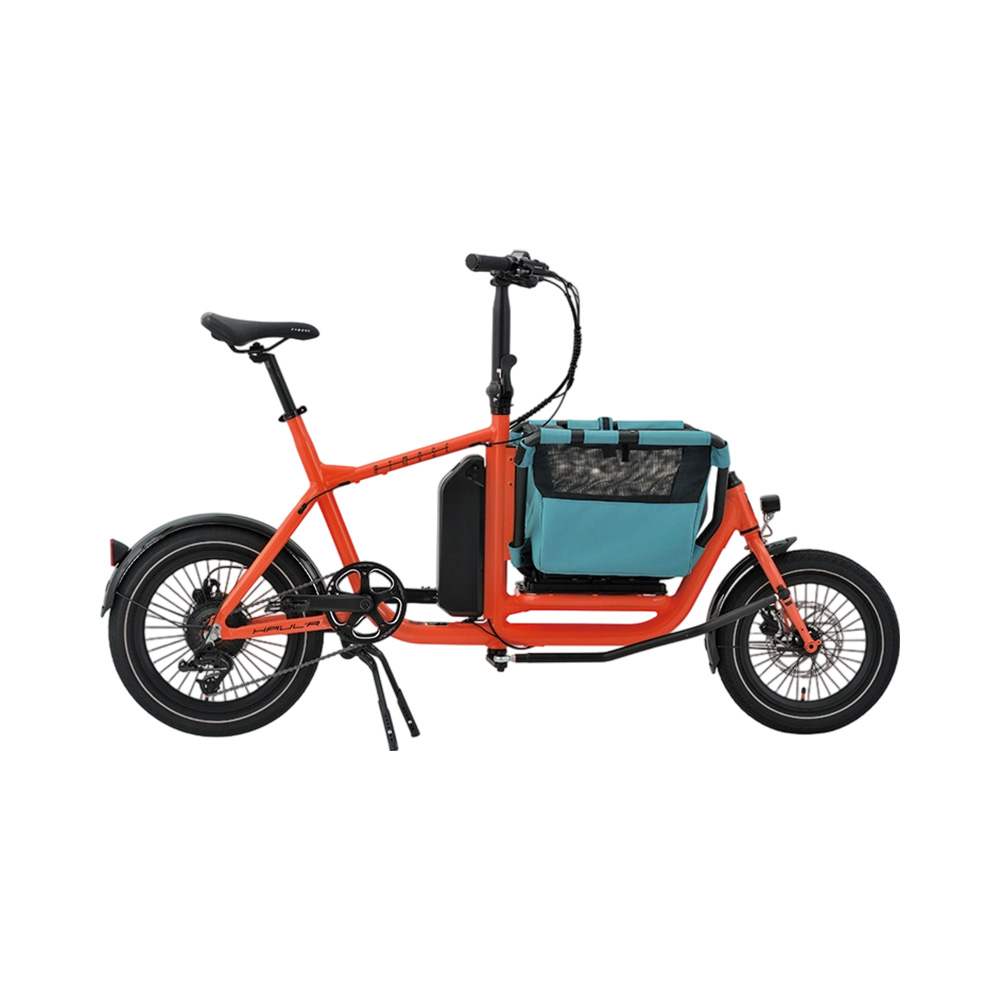
Atmose Model Q EQ1 Reliable Hub-Motor Urban Cargo E-Bike for Flat Cities
The EQ1 uses a Bafang rear motor rated at 36 volts and 250 watts. A rear hub motor places the drive unit directly in the rear wheel hub rather than inside the bicycle’s crank area. This architecture has several advantages for practical urban use.
First, hub motors deliver direct assistance to the wheel. When the rider starts from a stationary position, the motor can provide a noticeable push as the bike moves away from a traffic light or intersection. This is especially useful when the front basket is loaded. The rider does not need to rely entirely on leg force to overcome the initial inertia of the bicycle and its cargo.
Second, the motor is independent of the bicycle’s main drivetrain. The EQ1 uses a Shimano seven-speed Sora shifting system, while the rear motor supplies electric assistance separately. In a conventional mid-drive arrangement, the motor’s power passes through the chain, cassette, and derailleur. That can increase drivetrain stress, particularly when the bike is heavily loaded or the rider changes gears under power.
With a hub-motor configuration, the chain and gears perform their normal mechanical function without carrying all of the motor’s torque. This can help reduce wear on drivetrain components and make routine ownership simpler. The rider still benefits from multiple gears for changing terrain and pedaling preferences, but the system does not depend on the chain to transmit every unit of electric power.
Third, rear hub motors are generally straightforward in concept. Their components are contained in the wheel hub, leaving the bottom bracket and crank area mechanically familiar to bicycle technicians. This can be advantageous for retailers, service centers, and fleet operators that need a platform with understandable maintenance requirements.
The hub-motor design is particularly well matched to flat and moderately rolling cities. In these environments, the bike does not need to rely on extremely high torque to climb long, steep gradients. Instead, it benefits from efficient assistance during repeated starts, moderate inclines, and normal traffic conditions.
It is important to view the EQ1’s motor selection in relation to its intended use. A 250-watt rear motor is not presented as a high-performance mountain-bike power unit. Its strength is balance: sufficient assistance for everyday urban hauling, a familiar electrical system, and a configuration that supports value, reliability, and easier servicing.
Starting a loaded cargo bike can be more demanding than starting a conventional bicycle. The rider must move the bike, the basket, and the contents of the basket at the same time. The rear motor’s direct wheel assistance helps reduce the effort required during this moment.
This benefit is most noticeable in conditions such as busy intersections, repeated delivery stops, and short urban journeys. A delivery rider may stop dozens of times during a route. A parent may need to start on a slight incline after loading supplies. A commuter may want assistance during the first few meters of every journey. Smooth initial support can make these repeated actions less tiring.
Because the hub motor does not transmit its power through the chain, the rider can use the Shimano seven-speed system primarily to select a comfortable pedaling cadence. This helps separate two functions that are often combined in mid-drive systems: electric propulsion and mechanical gear selection.
For the customer, this may mean less frequent replacement of chains and sprockets when compared with a similarly used mid-drive cargo bike. Actual service life depends on riding conditions, load, cleaning, weather, and maintenance, but the basic architecture supports a lower-stress drivetrain strategy.
The EQ1 is equipped with a Samsung 36-volt, 15-ampere-hour lithium battery, specified at approximately 540 watt-hours. This capacity is appropriate for a practical urban cargo e-bike because it provides a useful reserve for daily errands while keeping the electrical system within a familiar voltage class.
Battery range is influenced by many variables. Rider weight, cargo weight, wind, tire pressure, temperature, road surface, assistance level, stop frequency, and terrain all affect energy consumption. For this reason, a responsible range estimate should never be treated as a universal guarantee. However, a 540-watt-hour battery gives the bike a meaningful energy foundation for routine commuting, shopping, and neighborhood delivery work.
For many users, the most important battery characteristic is not maximum theoretical distance but predictable availability. A practical cargo bike needs enough energy to complete common trips without requiring constant charging. The EQ1’s battery specification gives retailers a clear and understandable basis for explaining expected use to customers.
The battery also supports the product’s broader value proposition. A 36-volt system is widely understood by bicycle technicians and electric-bike suppliers. Components in this class are familiar across the industry, which can simplify training, diagnostics, replacement planning, and after-sales support.
For overseas retailers and mobility partners, battery specification is a central part of product planning. A 36-volt, 15-ampere-hour battery can be incorporated into customer education materials, charging instructions, service procedures, and fleet operating policies. Retailers can also present the EQ1 as a practical urban vehicle rather than a high-consumption performance machine.
Fleet operators should establish charging schedules based on route length and working hours. Delivery organizations may benefit from charging during planned breaks, while private users can often recharge after returning home. Battery storage should follow the manufacturer’s safety guidance, and all charging equipment should be used in accordance with applicable local regulations.
For export markets, certification, labeling, charger compatibility, battery transport rules, and local electric-bike regulations must be reviewed before commercial distribution. ATMOSE SASU can support business discussions concerning product configuration and market requirements, but final compliance responsibilities depend on the importing country, distributor, and intended use.
The EQ1 uses a 6061 T4T6 aluminum alloy frame. This material is widely used in bicycles because it offers a useful combination of low weight, corrosion resistance, structural performance, and manufacturing flexibility.
A cargo-bike frame must support more than the rider. It must also manage the forces created by the basket, carried goods, braking, acceleration, turning, and uneven surfaces. Selecting an established aluminum alloy provides a recognized material foundation for this task.
The T4 and T6 designations refer to heat-treatment conditions used to develop specific material properties. In a well-controlled manufacturing process, heat treatment is combined with appropriate tube forming, welding, finishing, and inspection procedures. The final performance of a frame depends not only on the alloy designation but also on wall thickness, joint design, weld quality, alignment, surface treatment, and quality-control standards.
The aluminum frame contributes to the EQ1’s practical character in several ways. It helps keep the vehicle manageable for everyday users, supports resistance to ordinary urban exposure, and provides a platform suitable for repeatable production. It also supports the visual balance between a compact bicycle and a useful cargo carrier.
Advanced manufacturing is not limited to adding electronic features. For a cargo e-bike, manufacturing quality begins with dimensional consistency. The frame must be aligned accurately so that the wheels, brakes, fork, drivetrain, and basket operate together correctly. A repeatable production process helps reduce variation between units.
Frame production typically involves material preparation, tube cutting, fixture positioning, welding, heat treatment or controlled material processing, surface finishing, and final inspection. Each stage can influence the reliability of the finished product. Proper fixtures help maintain geometry during welding. Controlled welding reduces the risk of inconsistent joints. Surface treatment helps protect the frame from normal environmental exposure.
For a company supplying retailers and wholesale customers, a mature supply chain is an important strength. It supports component sourcing, production planning, replacement-part availability, packaging, and technical communication. ATMOSE combines American product development origins with a design and research team based in Paris, creating a product-development structure that connects market understanding, industrial design, and manufacturing coordination.
This international structure is relevant to buyers who need more than a catalog bicycle. Retailers often require product adaptation, documentation, packaging adjustments, component changes, or market-specific specifications. A company with design, research, and supply-chain experience is better positioned to coordinate these requirements than a seller focused only on one-time transactions.
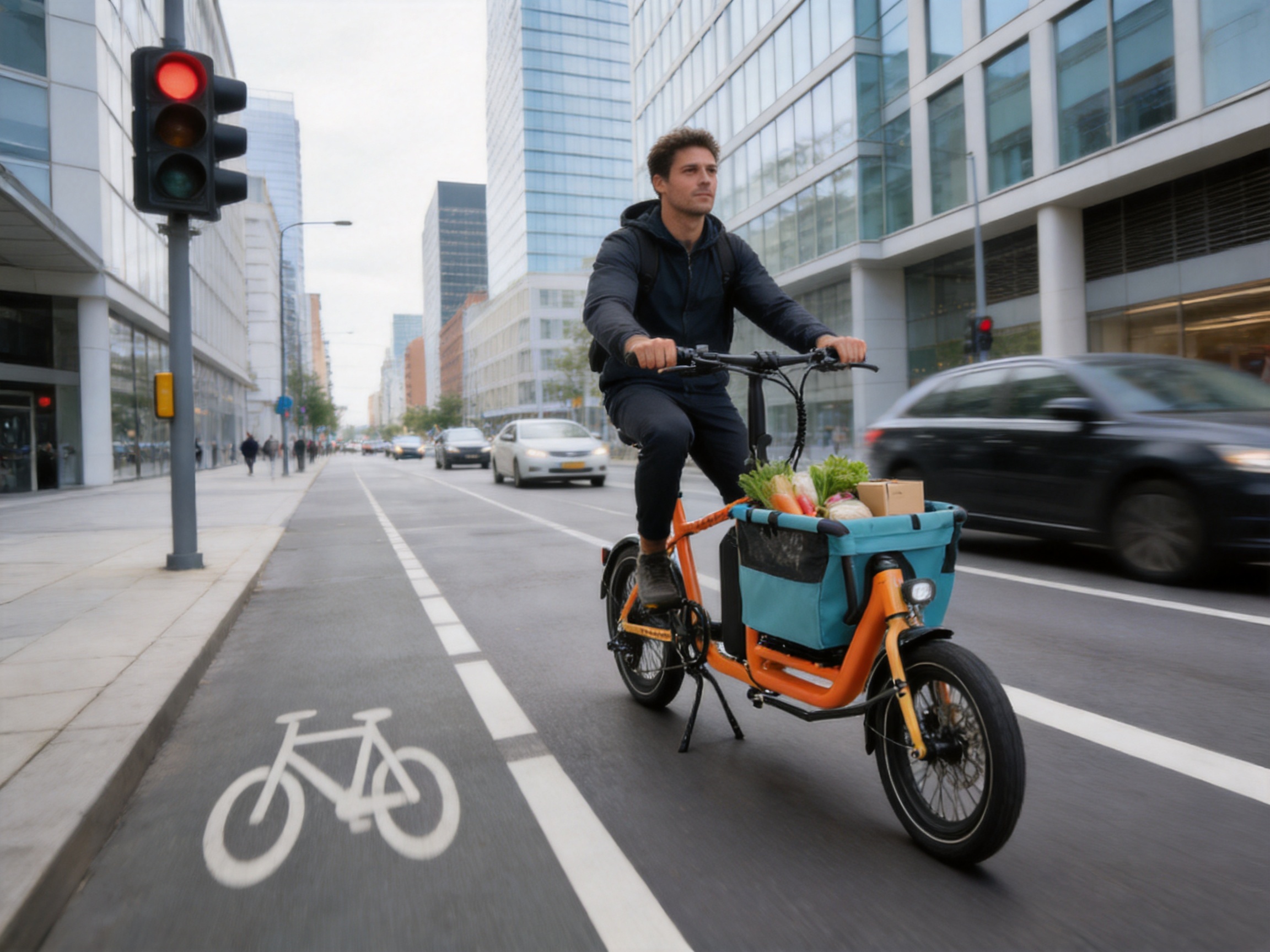
The EQ1 is specified for a maximum rider load of 120 kilograms and a basket load of 25 kilograms. These figures provide a clear starting point for evaluating the bike’s intended use. The combined rider-and-cargo situation should always be considered carefully, and users should follow the manufacturer’s instructions regarding maximum permissible loads.
A 25-kilogram front basket capacity is sufficient for many common tasks. It can accommodate groceries, work supplies, household items, parcels, sports equipment, and other moderate loads. The front basket’s position keeps cargo visible and accessible, which can be useful for shopping and short delivery activities.
Load placement is essential. Heavy objects should be secured and distributed so that they do not interfere with steering, braking, the front wheel, or rider visibility. A cargo bike should never be treated as a simple replacement for a motor vehicle without considering how cargo affects handling. The EQ1’s design provides capacity, but responsible loading remains part of safe operation.
The front-mounted basket also gives the bike a different practical identity from a long-tail cargo bicycle. A long-tail design may be more suitable for carrying passengers behind the rider, while a front basket is often more convenient for visible goods, shopping bags, and delivery parcels. The EQ1 is therefore particularly attractive to riders who want a compact utility bike rather than a large family transport platform.
Families can use the EQ1 for grocery runs, school supplies, park visits, and household errands. Its compact width makes it less intimidating in urban traffic than a very large cargo cycle. Parents can use the basket for bags, jackets, lunch boxes, and other items that normally require a car trunk or several separate trips.
The bike may also serve as a second household vehicle. For short journeys, replacing a car trip with an electric cargo-bike trip can reduce fuel use, parking pressure, and local emissions. The benefit is not limited to environmental performance; it can also make daily travel more active and less dependent on congested roads.
Small retailers, florists, repair services, neighborhood restaurants, property-maintenance teams, and local delivery operators can use a front cargo basket for light commercial transportation. The EQ1’s relatively modest dimensions can make it practical for routes involving narrow streets, pedestrian-oriented districts, and frequent stops.
For commercial buyers, durability and serviceability are often more important than marketing claims about peak speed. A bike that is easy to understand, charge, maintain, and operate can offer better long-term value than a more complicated vehicle that is difficult to support.
The EQ1 uses a 16-inch front wheel with a 2.4-inch tire and a 20-inch rear wheel with a 2.4-inch tire. This mixed-wheel arrangement supports a compact overall frame while maintaining practical contact with the road.
Smaller wheels can help lower the cargo platform and reduce the overall size of the vehicle. A 16-inch front wheel can also contribute to responsive handling within a compact frame layout. The 20-inch rear wheel provides a stable drive-wheel platform and accommodates the rear hub motor.
The 2.4-inch tire width is suited to everyday urban riding. Compared with a narrow road tire, a wider tire can provide additional cushioning over uneven pavement, drainage covers, patched asphalt, and light gravel surfaces. It can also contribute to a more planted feeling when the bicycle is carrying cargo.
The tires are described as puncture-proof, although no pneumatic bicycle tire is completely immune to every possible puncture. The practical value of puncture-resistant construction is reduced risk and improved convenience during normal use. Retailers should explain that riders still need to check tire pressure and inspect the tread regularly.
Correct tire pressure is especially important on a cargo e-bike. Underinflation can increase rolling resistance, reduce range, and affect handling. Overinflation can reduce comfort and grip on rough surfaces. The proper pressure should be selected according to the tire specification, rider weight, cargo load, and riding conditions.
The EQ1 is fitted with Tektro hydraulic disc brakes. Braking is one of the most important systems on a cargo bicycle because a loaded bike carries more momentum than a lightly equipped commuter bike.
Hydraulic disc brakes transmit braking force through fluid rather than a traditional mechanical cable. This design can provide smooth lever action and strong modulation when properly adjusted. Disc brakes also maintain consistent operation across a broad range of weather and road conditions, although their performance still depends on pad condition, rotor alignment, cleanliness, and correct maintenance.
For urban cargo riding, controlled braking is more valuable than simply having a high peak braking force. The rider may need to slow gradually while approaching an intersection, stop quickly when a vehicle turns unexpectedly, or manage speed while descending a moderate hill. Hydraulic systems can help the rider apply braking progressively and confidently.
Brake maintenance remains necessary. Pads wear over time, rotors should be checked for damage or contamination, and hydraulic systems require inspection by trained technicians when service is needed. Fleet operators should establish regular brake checks based on mileage, load, route conditions, and weather.
Carrying cargo changes the behavior of any bicycle. Additional weight increases stopping distance and may affect steering. Riders should begin braking earlier when the basket is heavily loaded and should avoid carrying items that can shift suddenly.
The EQ1’s hydraulic disc-brake equipment provides a strong technical foundation for this use, but braking safety also depends on rider training. New users should practice stopping with different load conditions in a low-traffic area before entering busy streets.
The Shimano seven-speed Sora system gives the rider a range of mechanical gears for different conditions. On flat roads, a higher gear can support efficient cruising. During starts, moderate climbs, or heavier loads, a lower gear can reduce the effort required at the pedals.
The presence of multiple gears is valuable even when the bicycle has electric assistance. Pedaling efficiency depends on cadence, rider preference, and terrain. A rider who selects an appropriate gear can make better use of the battery and maintain a more comfortable rhythm.
The hub motor and seven-speed drivetrain work as complementary systems. The motor helps provide propulsion, particularly during starts and acceleration, while the gears allow the rider to adapt the mechanical input to road conditions. This division of responsibilities is one of the EQ1’s practical advantages over simpler single-speed electric cargo bikes.
Compared with a high-torque mid-drive cargo e-bike, the EQ1 may place less emphasis on climbing steep terrain. However, its hub-motor and seven-speed configuration can be attractive to customers who ride mostly on level streets and want simpler drivetrain operation. Product selection should always match the local geography and intended load.
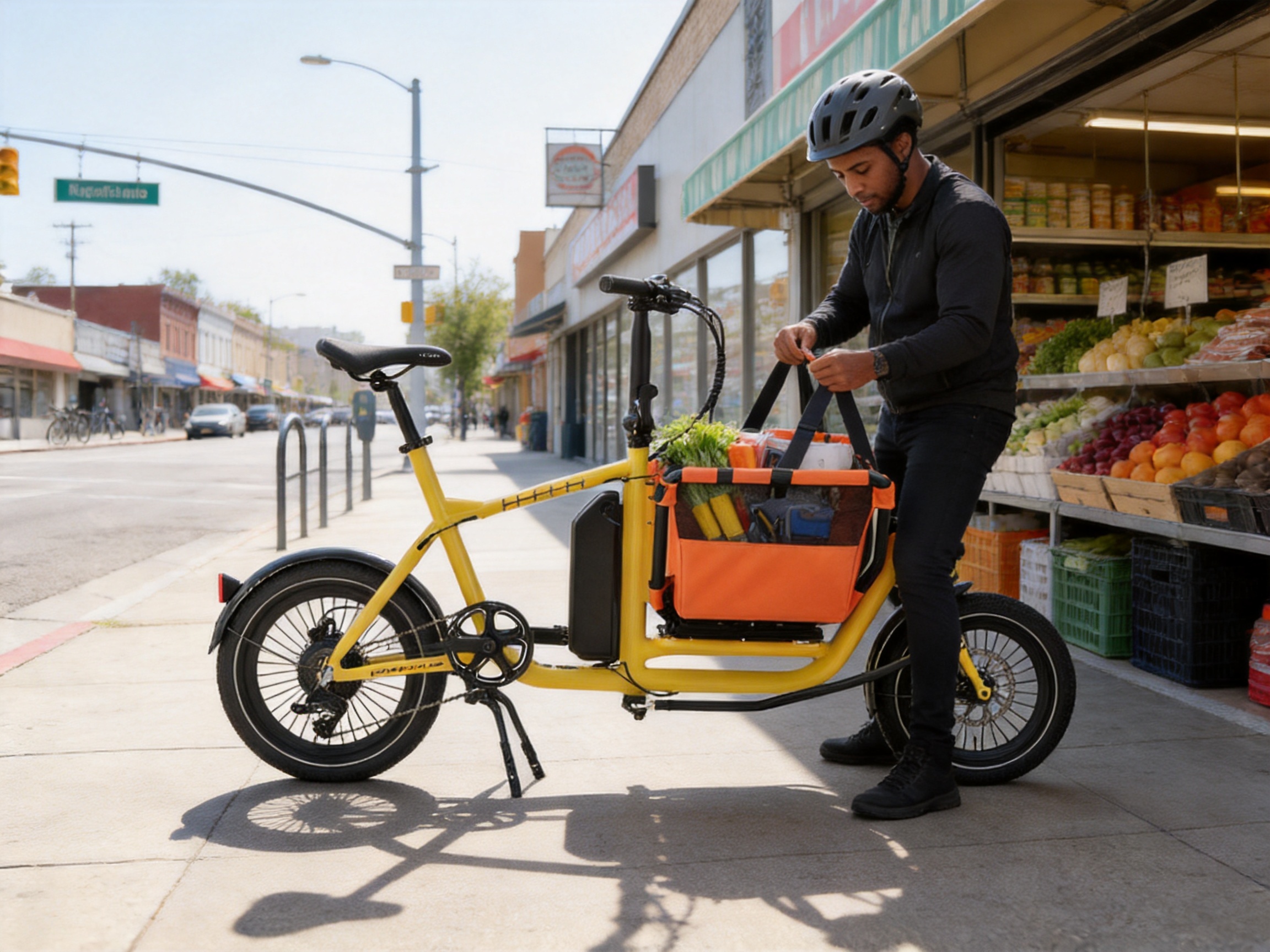
The cargo e-bike market includes several distinct design philosophies. Understanding these differences helps retailers and customers identify the appropriate product rather than assuming that one configuration is ideal for every rider.
| Design factor | EQ1 approach | Typical benefit | Best-suited application |
| Motor position | Rear hub motor | Direct wheel assistance and reduced drivetrain dependence | Flat and moderately rolling urban routes |
| Battery system | 36V, 15Ah, approximately 540Wh | Practical energy capacity for daily city trips | Commuting, shopping, and local delivery |
| Frame material | 6061 T4T6 aluminum alloy | Balanced weight, strength, and corrosion resistance | Regular urban utility riding |
| Cargo format | Folding front basket | Accessible loading and compact storage behavior | Groceries, parcels, tools, and personal items |
| Wheel configuration | 16-inch front and 20-inch rear | Compact handling and practical road contact | Dense city streets and bicycle lanes |
| Brakes | Hydraulic disc brakes | Controlled stopping performance | Loaded urban riding and frequent stops |
| Gearing | Shimano seven-speed system | Flexible pedaling across changing conditions | Flat roads, moderate slopes, and mixed routes |
Mid-drive cargo bikes place the motor near the crank and usually transmit motor torque through the chain and gears. Their strengths can include excellent climbing performance, centralized weight distribution, and sophisticated torque-based assistance. They may be the preferred choice for steep cities or very heavy loads.
The EQ1’s rear hub-motor design offers a different set of advantages. It can be simpler to operate, less demanding on the drivetrain, and more economical for flat-city customers. For a rider whose main concern is starting smoothly at intersections rather than climbing steep hills, the hub motor may provide a more appropriate balance.
Long-tail cargo bikes often carry passengers or large rear loads. Their extended frames can be useful for family transportation, but they may require more parking space and can feel less agile in narrow urban environments.
The EQ1’s front basket configuration is more compact and focused. It is suitable for goods rather than a large passenger platform. This can make it easier to store, turn, and integrate into daily errands. Customers should choose the EQ1 when compact utility is more important than maximum passenger capacity.
A conventional electric city bike may be comfortable for a rider but offer limited space for cargo. Adding a small rear rack or pannier may not provide enough capacity for larger shopping trips or commercial items.
The EQ1 is designed from the beginning around cargo utility. Its frame, basket, motor assistance, tire selection, and braking equipment work together as a transport system. This integrated approach can be more practical than adapting a standard commuter e-bike after purchase.
A successful cargo-bike product depends on more than a list of components. Manufacturing consistency, supplier coordination, product testing, packaging, service documentation, and replacement-part planning all influence the customer experience.
ATMOSE developed from an American product background associated with MOTIV, an established beach-cruiser brand. This history provides experience in bicycle design, consumer-oriented product development, and manufacturing coordination. The company’s international design and research-and-development structure adds a European perspective focused on urban mobility, aesthetics, and practical daily use.
The establishment of ATMOSE SASU in France in 2026 supports a European presence for design, research, business coordination, and international mobility development. A company operating across American and European product environments can observe different expectations concerning comfort, safety, style, urban infrastructure, and sustainability.
For business customers, this background can provide several advantages:
First, it supports product thinking beyond basic component assembly. A cargo bike must be considered as a complete user experience, including rider posture, loading behavior, steering, braking, storage, appearance, and service access.
Second, it supports communication between design teams and manufacturing partners. Clear product specifications, consistent drawings, controlled component selection, and documented changes are important when producing for different markets.
Third, a mature supply chain can improve production resilience. Cargo-bike companies must coordinate aluminum frames, wheels, tires, batteries, motors, brakes, drivetrain components, baskets, chargers, packaging, and replacement parts. Strong supplier relationships help reduce disruption and support more predictable delivery.
Fourth, an established process makes customization more realistic. Retailers and mobility partners may want different colors, logos, basket solutions, accessories, battery arrangements, packaging, or market-specific configurations. Customization must be managed without sacrificing safety-critical standards or production consistency.
Quality control for an electric cargo bike should cover both bicycle and electrical systems. Relevant inspection areas include frame alignment, weld appearance, fork installation, wheel tension, tire condition, brake adjustment, gear shifting, motor operation, battery connection, charger performance, cable routing, fastener torque, and final cosmetic condition.
Electrical inspection is particularly important. Connectors must be properly seated, cables should be protected from abrasion and water exposure, and batteries must be handled according to appropriate safety procedures. A final functional test can confirm that the motor assistance, braking cut-off functions where applicable, display or controls, lights, and charging system operate as intended.
Manufacturing quality is also influenced by packaging. Cargo e-bikes contain large frames and multiple exposed components. Proper protective materials, assembly instructions, and packaging design help reduce transport damage and make dealer assembly more efficient. For international shipments, packaging must be planned around container loading, warehouse handling, and last-mile distribution.
The EQ1 is presented not only as a finished product but also as a potential platform for custom electric cargo-bike projects. This is important for overseas retailers, wholesalers, delivery companies, and mobility partners that need a product adapted to a particular market.
Customization can involve appearance, accessories, cargo solutions, branding, packaging, and selected technical details. For example, a retailer may need a private-label color scheme, a different basket treatment, local language documentation, or an accessory package designed for grocery delivery. A mobility operator may need fleet identification, reinforced loading features, or service kits.
However, customization should be managed carefully. Changes to the frame, brakes, battery, wheels, motor, or load-bearing components can affect safety and certification. A professional customization process begins by defining the intended use, target users, local road conditions, legal requirements, expected load, service network, and annual volume.
ATMOSE’s design and research resources can help business customers evaluate these factors. The goal is not merely to place a logo on a standard frame. A strong custom program should connect brand identity with a coherent user experience and a reliable manufacturing plan.
Retailers need products that are easy to explain. The EQ1 has a clear sales narrative: a compact urban cargo e-bike with a rear hub motor, useful front basket, moderate electrical complexity, hydraulic braking, and a practical battery capacity.
Retail staff can present the bike according to customer priorities. A family may focus on errands and storage. A commuter may focus on sweat-free transportation and traffic-light acceleration. A small business may focus on loading capacity, operating cost, and route access. A wholesale buyer may focus on supply stability, private labeling, and after-sales support.
Training should also cover realistic limitations. The EQ1 is best suited to flat and moderate terrain, not extreme mountain routes. The basket has a defined load limit, and range depends on conditions. Transparent communication helps retailers build trust and reduce unsuitable purchases.
Electric cargo bikes support sustainability by making short-distance transportation more practical without depending on a car for every journey. The environmental benefit of any vehicle depends on manufacturing, electricity generation, maintenance, usage patterns, and end-of-life handling, but replacing repeated short car trips can reduce fuel consumption and traffic pressure.
The EQ1’s utility-oriented design encourages regular use. A product that is comfortable, manageable, and easy to load is more likely to become part of a customer’s routine. Sustainability is strengthened when a vehicle is used frequently and remains serviceable over time.
Reduced drivetrain stress may also support longer component life in appropriate conditions. Maintenance still matters, but a product designed with serviceability in mind can reduce unnecessary replacement and downtime. Retailers can reinforce this benefit by offering inspections, replacement parts, battery-care education, and responsible end-of-life guidance.
ATMOSE describes its broader philosophy through the idea of “Fun & Practical.” This combines enjoyment with usefulness. A sustainable transport product must not feel like a sacrifice. It should be convenient enough for ordinary errands and enjoyable enough that riders choose it willingly.
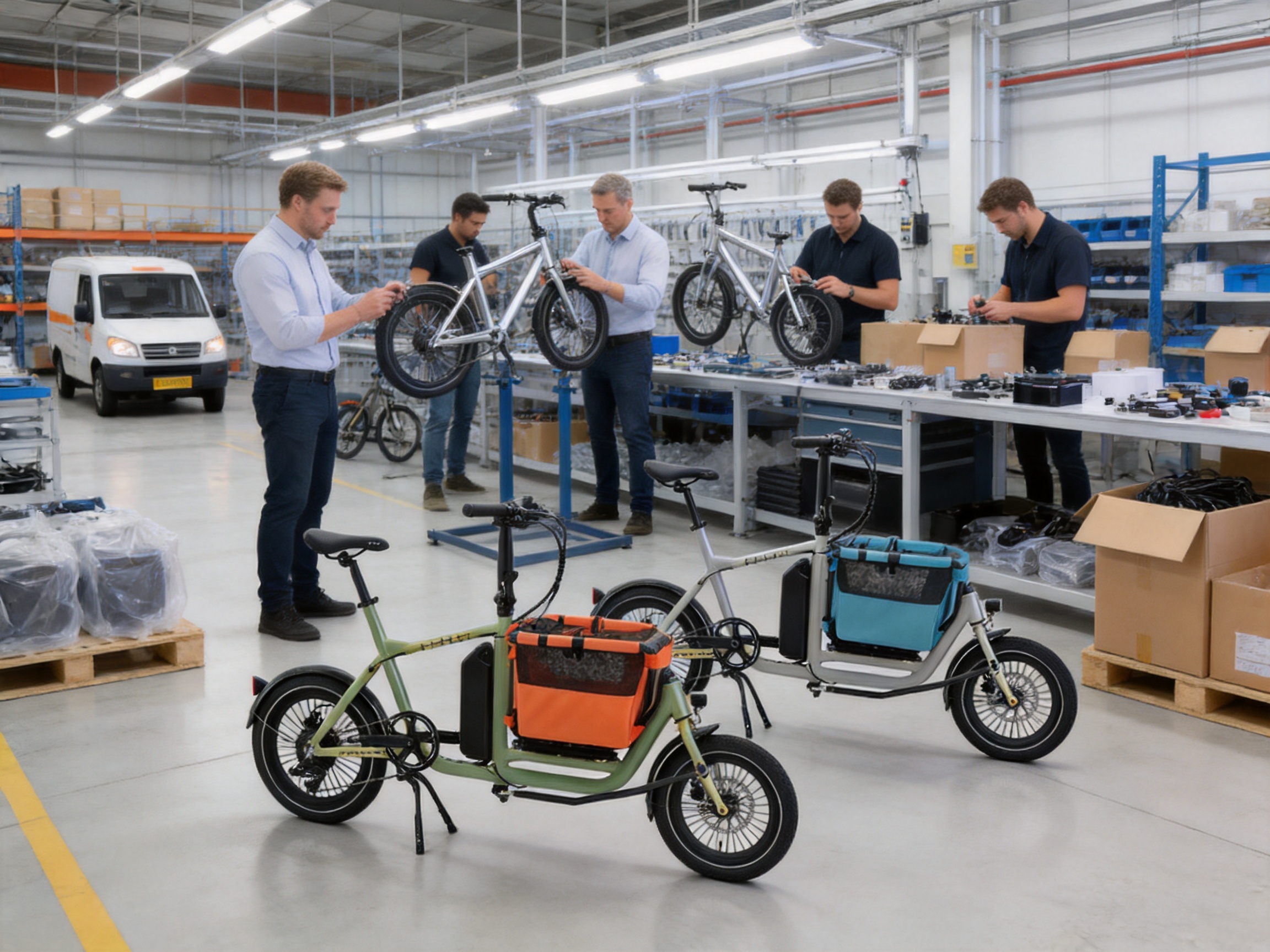
In practical terms, the EQ1 is intended to make ordinary city travel easier. The rider can approach a shop without searching for car parking, carry purchases in the front basket, and continue through streets where a larger vehicle would be inconvenient. Electric assistance reduces the physical effort associated with acceleration and moderate hills.
The upright utility format provides good visibility in traffic, while the compact dimensions help the rider judge available space. The wide tires can soften the impact of rough urban surfaces, and hydraulic brakes provide reassuring control when the bike is carrying cargo.
Its experience is not defined by a single dramatic feature. Instead, it comes from the interaction of several moderate but useful decisions: the basket is large enough for common loads, the motor supports starts, the battery is sized for routine travel, the frame is manageable, the gears provide flexibility, and the brakes are appropriate for a loaded bicycle.
This balanced specification can be more valuable to a daily rider than an expensive collection of high-performance features that are rarely needed. A practical urban cargo bike should be judged by how effectively it handles the repeated tasks of real life.
Although the EQ1 is designed to reduce unnecessary complexity, it still requires regular bicycle maintenance. Riders should check tire pressure, brake pad wear, chain lubrication, gear adjustment, wheel security, basket fasteners, and unusual noises. The bike should be kept clean, especially after exposure to road salt, heavy rain, mud, or industrial dust.
The rear hub motor is independent of the chain-driven gear system, which can help reduce drivetrain stress. Nevertheless, the chain, cassette, derailleur, and shifting cables still need inspection. Correct gear adjustment improves efficiency and prevents premature wear.
Hydraulic brakes should be inspected by a qualified technician if the lever feels unusually soft, braking performance decreases, fluid leakage appears, or the rotor becomes contaminated. Wheels should be checked for looseness or damage, particularly when the bike is used on rough roads or with frequent heavy loads.
Battery care should include using the approved charger, avoiding extreme heat or cold when possible, keeping connectors dry, and following storage recommendations. The battery should not be opened or modified by an unqualified person. Commercial operators should document charging and inspection procedures for staff members.
Regular maintenance is not only a safety requirement. It protects the investment made by the rider or fleet operator. A well-maintained cargo e-bike is more comfortable, efficient, quiet, and reliable than one that is neglected.
The EQ1 is a strong fit for riders who need a compact cargo e-bike for mostly flat or moderately rolling urban routes. It is particularly appropriate for the following groups:
Urban commuters can use the bike to carry work bags, clothing, groceries, and personal items while receiving assistance during traffic-light starts and longer journeys.
Families can use the front basket for shopping, school supplies, household goods, and park equipment. Its compact form may be easier to store than a larger cargo platform.
Independent businesses can use it for local deliveries, service calls, stock transfers, and neighborhood logistics where a car or van would be inefficient.
Retailers can position it as an accessible entry into electric cargo mobility, especially for customers who do not need a high-powered climbing bike or a large passenger carrier.
Wholesalers and mobility partners can consider it as a customizable platform for regional transportation programs, local delivery fleets, and private-label urban mobility products.
The EQ1 may be less suitable for riders who regularly carry very heavy loads, transport multiple passengers, climb steep hills, or need an extended off-road range. Those customers may require a different model category, a more powerful motor system, larger cargo structure, or specialized suspension.
The EQ1 is an urban companion cargo e-bike designed for daily city errands, commuting, shopping, light commercial delivery, and general utility transportation. It uses a front folding basket rather than a large passenger compartment.
It uses a Bafang rear hub motor rated at 36 volts and 250 watts. The motor is intended for flat and moderately rolling urban routes, with particular usefulness during starts and stop-and-go riding.
A rear hub motor provides direct assistance at the wheel and operates independently of the chain and gears. This can reduce drivetrain stress and offer a simpler, value-oriented solution for riders who do not regularly climb steep hills or carry extreme loads.
The battery is a Samsung 36-volt, 15-ampere-hour lithium battery with a stated capacity of approximately 540 watt-hours. Actual range depends on terrain, rider weight, cargo, speed, assistance level, temperature, tire pressure, and riding conditions.
The specified basket load is 25 kilograms. Cargo should be secured and distributed carefully so that it does not interfere with steering, braking, visibility, or wheel movement.
The product information specifies a maximum rider load of 120 kilograms. Users should also account for cargo weight and follow the complete operating guidance supplied with the bicycle.
The approximate dimensions are 1,780 millimeters in length, 620 millimeters in width, and 1,070 millimeters in height. These dimensions give it a relatively compact profile for a cargo-oriented bicycle.
The EQ1 uses Tektro hydraulic disc brakes. They are intended to provide controlled braking for urban riding and loaded conditions, subject to correct adjustment and regular maintenance.
The bike uses a 16-inch by 2.4-inch front tire and a 20-inch by 2.4-inch rear tire. The tires are described as puncture-proof or puncture-resistant and are intended for practical urban road use.
The EQ1 is optimized for flat and moderately rolling cities. Riders who frequently face long, steep climbs or very heavy loads should consider a model specifically designed for high-torque hill performance.
ATMOSE supports custom design and wholesale discussions for international retailers, wholesalers, and mobility partners. Possible areas may include branding, colors, accessories, packaging, and selected market-specific configurations, subject to technical, legal, and production review.
The company combines American product-development origins, a Paris-based design and research-and-development presence, manufacturing expertise, supply-chain coordination, and experience in cargo mobility. These strengths can support product adaptation, wholesale planning, and international market communication.
The Atmose Model Q EQ1 is a practical answer to a clear urban transportation need. It does not attempt to be every type of cargo bike at once. Instead, it concentrates on dependable daily utility for flat and moderately rolling cities.
Its rear hub motor provides useful starting assistance while reducing the motor’s dependence on the chain and gears. The 540-watt-hour battery offers a practical energy foundation for routine city travel. The 6061 T4T6 aluminum alloy frame supports a balance of weight, durability, and manufacturability. The folding front basket gives riders a convenient way to transport groceries, parcels, tools, and personal belongings. Hydraulic disc brakes, wide tires, and a seven-speed drivetrain complete a specification designed for real urban conditions.
Compared with larger or more powerful cargo e-bikes, the EQ1 can be easier to store, simpler to explain, and more approachable in price and operation. Compared with standard commuter e-bikes, it provides a more purposeful cargo platform. Its greatest competitive strength is the balance between useful capacity, straightforward technology, compact dimensions, and manageable ownership.
For retailers, wholesalers, and mobility partners, the product is supported by ATMOSE’s American origins, European design and research presence, manufacturing experience, mature supply-chain relationships, and custom-development approach. These capabilities are important when a business needs more than a generic bicycle and requires a reliable platform for a regional mobility strategy.
As urban communities search for cleaner, more efficient, and more flexible transportation, a cargo e-bike such as the EQ1 can help make short trips less dependent on cars. Its philosophy is simple: make cargo transportation practical, comfortable, accessible, and enjoyable enough to use every day.
1. ATMOSE SASU. Product specification and model information for the Model Q EQ1 Urban Companion Cargo Bike.
2. ATMOSE SASU. Corporate information concerning company history, design activities, research and development, and international mobility solutions.
3. Bafang. General technical documentation for rear hub-motor systems used in electric bicycles.
4. Shimano. Bicycle drivetrain service principles and seven-speed shifting-system guidance.
5. Tektro. Hydraulic disc-brake operating and maintenance principles for bicycles.
6. General bicycle engineering references concerning aluminum alloy frame construction, wheel sizing, tire pressure, braking, and cargo-load management.
7. General urban mobility research concerning electric cargo bicycles, short-distance transportation, sustainable mobility, and local delivery operations.
Nov 17, 2026
Nov 03, 2026
Oct 26, 2026


info@atmosecargobike.com

200 rue de la Croix Nivert 75015 Paris

Custom Electric Bakfiets
 English
 Français
 Deutsch































