Aug 19, 2026
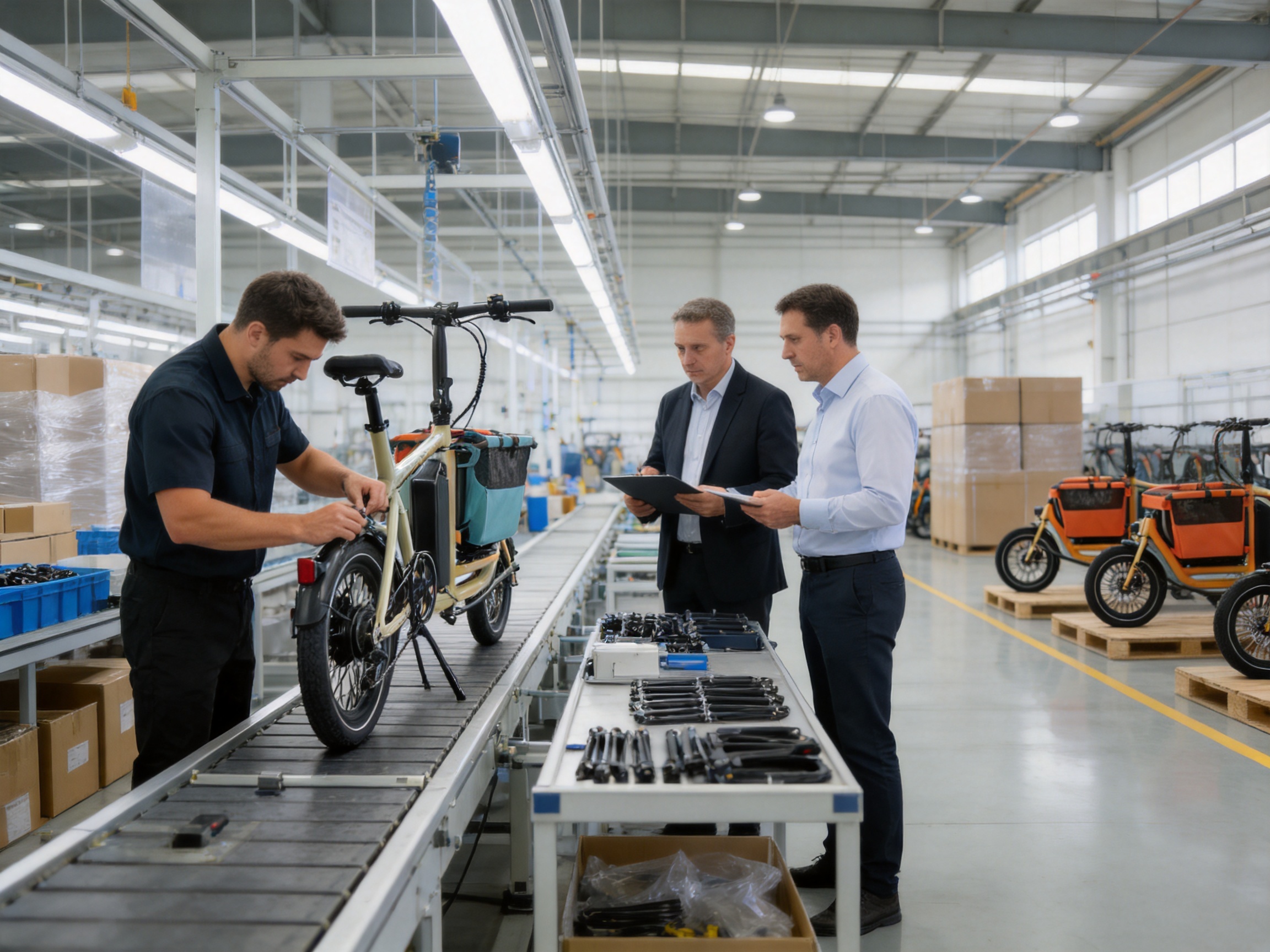
Urban transportation is changing. Families, commuters, small businesses, and local delivery operators are increasingly looking for alternatives to private cars and conventional bicycles. They need a vehicle that can carry everyday goods, remain manageable in busy streets, provide electric assistance when starting from a stop, and avoid the complexity and maintenance burden associated with some high-performance electric bicycles. The Atmose Model Q EQ1 is designed around this practical need.
The EQ1 is an urban companion cargo e-bike developed for flat to moderate city environments. Instead of concentrating on extreme off-road performance or highly complicated drivetrain technology, it focuses on dependable daily transport. Its rear hub motor, aluminum alloy frame, folding front basket, hydraulic disc brakes, puncture-resistant tires, seven-speed transmission, and removable-style cargo equipment create a balanced package for errands, commuting, shopping, and light commercial use.
What makes this model especially relevant to retailers, wholesalers, mobility partners, and private-label buyers is its clear product positioning. It is not simply a bicycle with a motor added to the frame. It is a purpose-built cargo platform developed around urban carrying, simple operation, accessible ownership, and efficient distribution. Its design reflects the practical demands of modern city users while allowing business partners to offer a recognizable and adaptable electric cargo solution.
A cargo bike must solve a different problem from a standard electric bicycle. A conventional e-bike may be optimized for one rider, limited luggage, and a relatively narrow range of uses. An urban cargo bike must carry more, remain stable, provide useful starting assistance, and fit into streets, bicycle lanes, storage spaces, and commercial environments. The EQ1 addresses these requirements with a compact overall footprint and a forward cargo area.
The bike measures approximately 1,780 millimeters in length, 620 millimeters in width, and 1,070 millimeters in height. These dimensions give it useful carrying capacity without making it excessively wide for ordinary city movement. The 620-millimeter width is particularly important for urban users. A cargo bike that is too wide can become difficult to maneuver around parked vehicles, narrow access points, bicycle barriers, and crowded paths. The EQ1 seeks a practical middle ground between carrying ability and daily manageability.
The front folding basket measures approximately 470 millimeters in length, 470 millimeters in width, and 375 millimeters in height. This space is suitable for groceries, work equipment, packages, personal belongings, shopping bags, and other common cargo. The basket’s position at the front allows the rider to keep a direct view of the load, which is helpful when transporting items that need to be monitored during the journey.
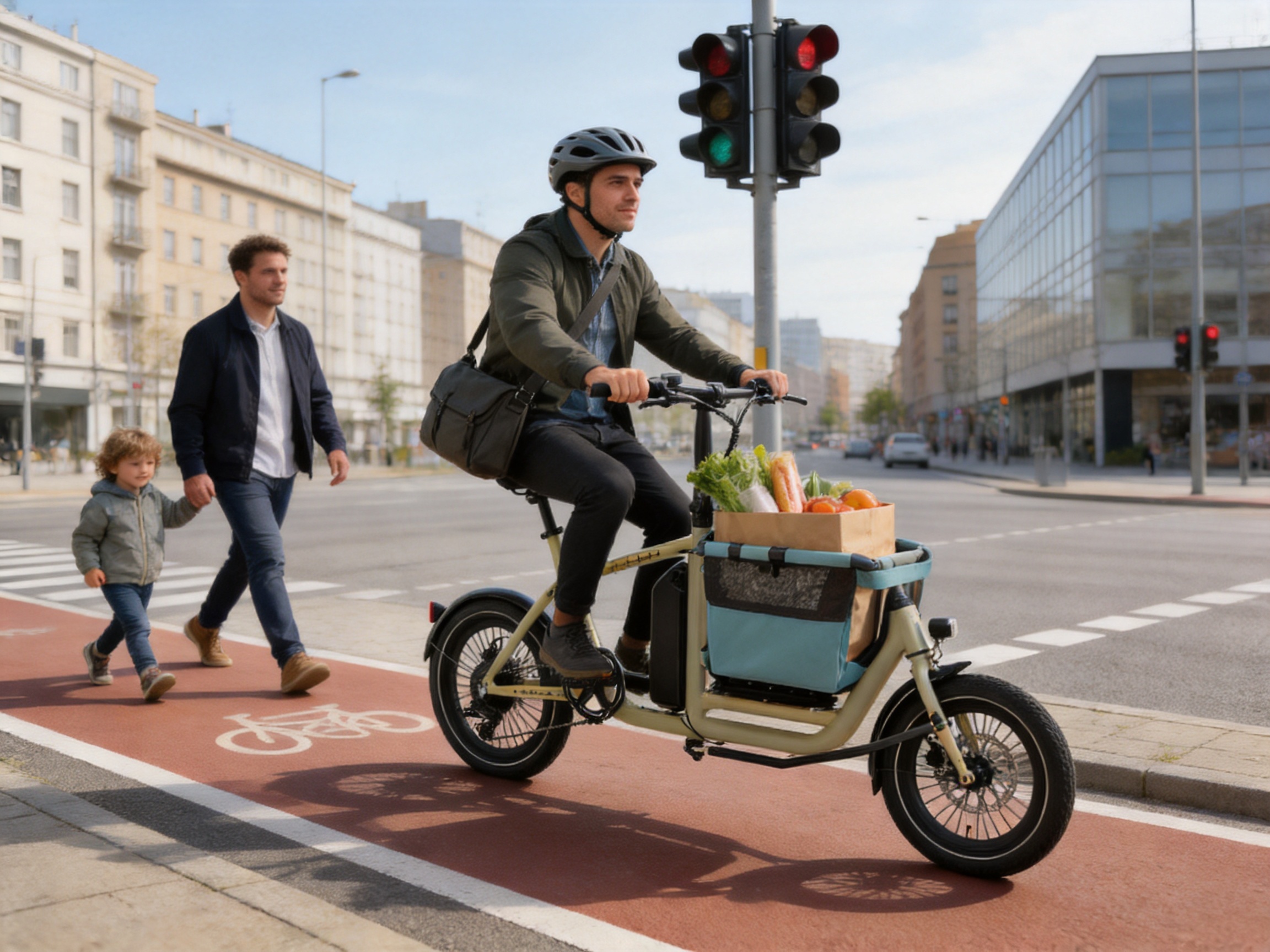
For a household, the bike can replace many short car trips. A rider may use it for grocery shopping, school-related errands, local appointments, market visits, or commuting with work equipment. For a business, the basket can support neighborhood deliveries, maintenance work, service calls, retail replenishment, and light logistics. In both cases, the core value is not maximum speed. It is the ability to move useful cargo efficiently through urban areas.
The EQ1 uses a Bafang rear hub motor rated at 36 volts and 250 watts. This configuration is well suited to the product’s intended environment: flat to moderate terrain and regular urban riding. A rear hub motor delivers assistance directly through the rear wheel. The design is mechanically separate from the bicycle’s chain and gear system, which provides several practical benefits.
One major advantage is drivetrain independence. On a conventional mid-drive cargo e-bike, motor power is transmitted through the chain, cassette, derailleur, and other drivetrain components. This can provide excellent climbing performance, but it also means that the drivetrain may experience additional stress and wear. The hub-motor layout reduces the extent to which motor output passes through those components. For riders and fleet operators who prioritize straightforward ownership, that separation can be valuable.
The rear hub motor also provides a noticeable push when starting from a standstill. Starting is one of the most demanding moments for a loaded cargo bike because the combined mass of the rider, bicycle, basket, and cargo must be accelerated from zero. At traffic lights, intersections, and stop signs, quick and predictable assistance can make the bicycle feel easier to control. This is one reason hub motors remain popular for practical commuter and cargo applications.
The motor system is matched with a 36-volt, 15-amp-hour Samsung lithium battery, listed at approximately 540 watt-hours. Battery capacity is a central consideration for cargo-bike buyers because carrying additional weight and making frequent starts can increase energy consumption. A battery of this size offers a useful balance between range potential, overall bicycle weight, cost, and packaging efficiency.
Actual range will depend on rider weight, cargo weight, terrain, temperature, tire pressure, assist level, wind, stop-and-go traffic, and riding style. It would be inappropriate to promise one universal distance for every user. However, the battery specification gives distributors and customers a clear foundation for evaluating the bike’s suitability for regular urban journeys. Users who charge consistently after daily use can make the battery part of a predictable routine rather than treating it as an occasional emergency resource.
The 250-watt motor rating also supports a sensible market position. It is sufficient for assisted urban travel while keeping the vehicle aligned with the expectations of many city-oriented electric bicycle markets. Retailers can present the EQ1 as an accessible and practical mobility product rather than an extreme-performance machine intended for steep mountain routes or high-speed recreational riding.
Different electric bicycle motor systems have different strengths. Mid-drive systems often perform well on steep gradients and can use the bicycle’s gearing to multiply torque. However, they may involve more complex integration, greater drivetrain loading, and higher service requirements. A rear hub motor follows a different philosophy. It emphasizes independent propulsion, predictable operation, and simplified maintenance.
For flat-city riders, a hub motor may provide all the assistance they need without paying for performance that they rarely use. The EQ1 is therefore well positioned against more expensive cargo bicycles whose specifications are aimed at steep hills, long off-road climbs, or heavy touring. A city retailer can offer a lower-maintenance alternative to customers whose main routes consist of streets, cycleways, neighborhood roads, and moderate inclines.
The hub motor can also be attractive to fleet operators. A commercial fleet benefits from products that are easy to explain, straightforward to use, and economical to keep in service. When the motor is independent of the gear system, certain drivetrain wear patterns may be reduced. This does not eliminate the need for regular inspection, but it can make routine ownership more manageable.
Another advantage is product clarity. The EQ1 has an understandable specification: a rear motor, a 36-volt battery, a seven-speed transmission, hydraulic disc brakes, and a front cargo basket. This clarity can improve the sales process because customers can quickly understand what the bike is designed to do. Rather than presenting a large number of advanced features that may not be relevant to everyday users, the model concentrates on the functions that make a practical difference.
The frame is made from 6061 T4T6 aluminum alloy. This material is widely used in bicycle manufacturing because it combines relatively low weight with useful structural strength, corrosion resistance, and good suitability for formed and welded frame components. For a cargo bike, the frame must support not only the rider but also the stresses created by cargo weight, braking, acceleration, turning, and repeated use on imperfect urban surfaces.
The selection of 6061 aluminum alloy reflects a balanced engineering approach. A frame made for urban cargo use cannot be judged only by its empty weight. It must also offer appropriate stiffness, stable handling, practical corrosion resistance, and reliable connection points for the basket, fork, wheels, brakes, and drivetrain. The EQ1’s material platform gives the manufacturer a suitable foundation for these requirements.
The stated load capacity is up to 120 kilograms for the rider and 25 kilograms for the basket. These figures should be understood as product-use limits rather than invitations to exceed the rated capacity. Correct loading is essential. Cargo should be distributed evenly, secured against movement, and kept within the basket’s physical dimensions. A well-distributed load helps preserve steering response and braking stability.
Manufacturing quality in an aluminum cargo frame depends on more than the alloy designation. It also involves dimensional control, tube preparation, fixture accuracy, weld consistency, surface treatment, and final inspection. The company’s broader product development structure combines American product thinking with European design and research and development activities based in Paris. This international organization supports a process in which product usability, visual design, engineering practicality, and market requirements can be considered together.
The company also benefits from an established manufacturing background, a mature supply chain, and continuing product-development experience. These strengths are important for business buyers. A cargo-bike supplier must do more than produce a visually attractive prototype. It must coordinate frame materials, motor systems, batteries, brakes, wheels, tires, baskets, packaging, assembly, and after-sales support in a consistent manner. A mature supply chain helps reduce unnecessary variation and improves the possibility of stable production for wholesale programs.
The EQ1’s manufacturing philosophy can be understood as integration rather than feature accumulation. Every major component supports the same urban mission. The aluminum frame provides a solid platform, the battery supplies practical electrical assistance, the hub motor reduces drivetrain complexity, the basket adds utility, and the braking and tire systems support controlled everyday riding. This coordinated approach is a strength compared with products that combine unrelated components without a clear use case.
The EQ1 uses 16-inch by 2.4-inch front tires and a 20-inch by 2.4-inch rear tire. This combination is notable because it supports a compact cargo-bike format while providing relatively wide contact patches. The smaller front wheel can help keep the front cargo section low and manageable, while the larger rear wheel contributes to rolling comfort and rear-section stability.
The 2.4-inch width provides additional air volume compared with narrow road-oriented tires. In normal conditions, wider tires can improve comfort over rough pavement, painted road markings, drainage covers, and minor surface imperfections. They can also contribute to a planted feel when the bike is carrying a load. The tires are described as puncture proof in the product information, which is particularly relevant to city riders who may encounter glass, metal fragments, and other road debris.
No tire can eliminate every possible puncture, and riders should still check inflation pressure, tread condition, sidewalls, and embedded debris. Nevertheless, a puncture-resistant design can reduce interruptions for commuters and delivery users. For a commercial operator, avoiding a flat tire during a working shift has practical value beyond convenience: it can prevent missed deliveries, service delays, and additional labor costs.
The wheel configuration also contributes to the EQ1’s visual identity and intended handling. The model is compact enough for urban use while retaining the stance of a cargo vehicle. This balance helps distinguish it from standard e-bikes with small rear racks. The front basket is integrated into the overall riding concept rather than treated as an afterthought.
The bike is equipped with a Shimano seven-speed Sora transmission. A multi-speed system gives the rider flexibility when conditions change. Lower gears can assist when moving away from a stop with cargo or approaching a moderate incline. Higher gears can support more efficient pedaling when the bicycle is moving at a steady urban pace.
The presence of gears also means that the rider is not required to rely entirely on the motor. Pedaling in an appropriate gear can improve energy efficiency, make the bike feel more responsive, and help the rider maintain control in changing traffic conditions. The transmission is therefore complementary to the hub motor rather than competing with it.
For retailers, the seven-speed system offers a familiar ownership experience. Many customers already understand the basic operation of a derailleur-equipped bicycle. This can reduce the learning curve compared with a single-speed cargo model, while avoiding the additional complexity of a high-count performance drivetrain that may offer limited value on flat urban routes.
Regular care remains important. The chain should be kept clean and lubricated, gear shifting should be checked, and the derailleur should be inspected after impacts or transport. Because the motor is located in the rear wheel rather than within the crank area, the drivetrain is not responsible for transmitting all motor torque. This separation is one of the central maintenance advantages of the EQ1’s architecture.
Cargo bikes require dependable braking because their total moving mass can be higher than that of a standard bicycle. The EQ1 uses Tektro hydraulic disc brakes, a specification that supports controlled stopping in everyday conditions. Hydraulic systems transmit braking force through fluid, generally providing smooth lever action and consistent modulation.
Good braking is especially important when the front basket is loaded. Cargo changes the bicycle’s balance, stopping distance, and steering behavior. Riders should use both brakes progressively, avoid sudden movements, and adjust their riding speed to weather, traffic, visibility, and load conditions. Hydraulic disc brakes do not replace safe riding practices, but they provide an appropriate braking platform for a practical cargo e-bike.
Disc brakes also perform well in conditions where rim brakes may be less desirable. Because the braking surface is positioned at the hub rather than on the wheel rim, wet or dirty rims have less direct influence on braking operation. Regular inspection is still required. Pads, rotors, hoses, calipers, and lever feel should be checked according to the maintenance schedule recommended by the distributor or service technician.
For business buyers, brake serviceability is part of total product value. A model that uses recognizable, established components can be easier for qualified bicycle technicians to inspect and maintain. Component familiarity can support after-sales service, spare-parts planning, and customer confidence in different markets.
The folding front basket is one of the EQ1’s most important practical features. A cargo bike is useful only when its cargo area can be used conveniently. The basket provides a dedicated space for goods while preserving the rider’s ability to observe the load during travel. Its folding design can also help when the bicycle needs to be stored, transported, or positioned in a tighter space.
The basket is designed for fast installation. The process consists of aligning the basket base with the pre-installed mounting holes, lowering the basket vertically until the clips contact the mounts, and then pushing the basket backward toward the saddle. A clicking sound indicates that the basket has engaged successfully. This design reduces the need for complex tools or a lengthy assembly procedure.
A simple installation sequence has value at several stages of the product lifecycle. Dealers can prepare bicycles more efficiently. Customers can understand the fitting process more quickly. Fleet managers can remove or reinstall baskets according to operational needs. A clear mechanical engagement point also helps users confirm that the basket is secured before riding.
The removal process is similarly straightforward. The user pulls down the pin at the bottom of the basket mount, pushes the basket forward along its track, and lifts it upward when it reaches the end. This two-step release arrangement supports convenient handling while helping prevent accidental detachment during ordinary riding.
Users should always confirm that the basket is fully locked after installation and before every ride. Cargo should not obstruct the rider’s view, interfere with the handlebar, touch the front wheel, or exceed the specified load limit. Heavy items should be positioned low and centrally where possible. Fragile goods should be secured against bouncing, while loose straps, bags, and cords should be kept away from moving components.
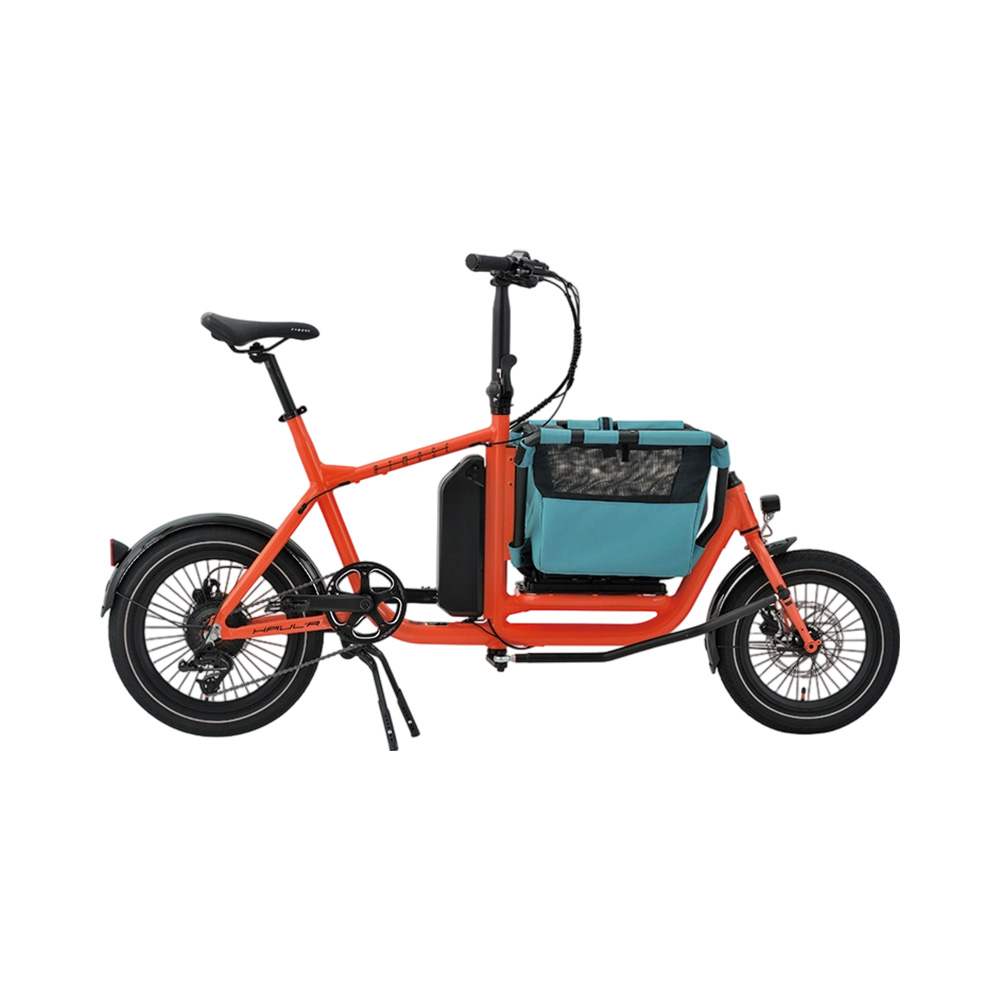
Atmose Model Q EQ1 Reliable Hub-Motor Urban Cargo E-Bike for Flat Cities
The EQ1 competes in a broad market that includes traditional bicycles with racks, compact electric bicycles, longtail cargo bikes, front-loader cargo bikes, and premium electric cargo models. Its advantages are clearest when evaluated against the everyday needs of the intended customer rather than against products designed for entirely different purposes.
Compared with a standard e-bike equipped with a rear rack, the EQ1 offers a substantially more useful front cargo area. A conventional rack may carry a bag or panniers, but it often does not provide the same visual access, loading flexibility, or dedicated volume as a front basket. The EQ1 is designed from the beginning as a cargo platform, so the frame, motor assistance, tires, braking system, and load rating are considered together.
Compared with a large longtail cargo bike, the EQ1 may appeal to users who prefer a shorter front-loading layout. A forward basket can be convenient for groceries and work materials because the rider can see the load. The compact width may also be attractive in cities where bicycle lanes, storage rooms, and access paths are limited.
Compared with premium mid-drive cargo bicycles, the EQ1 emphasizes affordability and mechanical simplicity. A premium model may be the better choice for steep hills, extreme loads, or demanding off-road travel. However, those capabilities can increase purchase price and maintenance complexity. For flat-city customers, the EQ1 offers a more focused specification that may deliver better value for the actual use case.
Compared with low-cost electric bicycles that use generic components and limited cargo integration, the EQ1 benefits from a more defined product architecture. The model combines a Samsung battery, Bafang motor, Shimano transmission, Tektro hydraulic brakes, a 6061 aluminum frame, wide tires, and a purpose-designed basket. Recognizable component suppliers and a coherent frame concept can help support retailer trust and customer acceptance.
The model’s greatest competitive advantage is its balance. It does not attempt to be the fastest, most powerful, or most technologically complicated cargo bicycle. Instead, it brings together useful load capacity, accessible electric assistance, practical dimensions, low-maintenance motor architecture, and a price-conscious specification. This balance is particularly suitable for markets where buyers want reliable transportation rather than a recreational luxury product.
The Samsung 36-volt, 15-amp-hour battery is a significant part of the EQ1’s value proposition. Battery quality affects more than riding range. It also influences the consistency of electrical performance, customer confidence, replacement planning, and the long-term ownership experience. A known battery-cell supplier provides a clearer foundation for product communication than an unspecified battery source.
Battery management should be treated as part of normal ownership. Users should follow the supplied charging instructions, use the correct charger, protect the battery from excessive heat and moisture, and avoid storing it for long periods in a completely discharged condition. Retailers and distributors should provide clear guidance on charging, storage, transport, and end-of-life handling.
From a business perspective, battery capacity must be considered alongside the operating pattern. A rider who travels short distances with moderate cargo may value the compactness and cost balance of the EQ1. A delivery operator with long daily routes may need planned charging points, spare batteries, or scheduled charging breaks. The model can support different applications, but the operating plan should always be based on actual route conditions rather than a theoretical maximum.
The hub-motor system may also contribute to ownership economy by reducing the amount of motor torque transmitted through the chain and gears. Lower drivetrain stress can help extend service intervals in some use patterns, although chain and gear maintenance remains necessary. Total cost of ownership will depend on mileage, load, riding conditions, maintenance quality, battery replacement timing, and local labor costs.
An advanced manufacturing process begins before the first production frame is made. It starts with defining the user, the environment, the load requirement, the expected riding behavior, and the commercial position of the product. The EQ1’s development is based on a practical urban brief: create a reliable electric cargo bicycle for flat to moderate terrain, provide useful carrying capacity, keep maintenance manageable, and make the product accessible to a broad market.
The next stage is system architecture. Engineers and product designers must determine how the frame, basket, motor, battery, wheels, brakes, and transmission will interact. The rear hub motor influences rear-wheel construction, cable routing, controller placement, and weight distribution. The front basket affects steering, frame geometry, mounting strength, and cargo clearance. The battery affects center of gravity, electrical routing, charging access, and overall appearance.
Frame engineering then converts the concept into manufacturable components. Aluminum tubing and formed sections must be prepared to consistent dimensions. Jigs and fixtures help maintain alignment during welding. Mounting points must be positioned accurately so that the basket, brake components, wheels, and drivetrain can be assembled without excessive adjustment. Consistency at this stage is essential because a small alignment error can affect handling, braking, shifting, or component life.
Welding quality is especially important for an aluminum cargo frame. Weld zones must be prepared correctly, and the finished joints should be inspected for appearance, continuity, alignment, and potential defects. Production teams need repeatable procedures, trained operators, appropriate fixtures, and defined inspection standards. These processes support not only structural performance but also the repeatability required for wholesale production.
After frame construction, surface treatment and finishing protect the aluminum structure and create a consistent appearance. Finishing work may include cleaning, preparation, coating, curing, and visual inspection. A professional finish helps protect the product during transport and use while reinforcing the brand’s design language. For international buyers, consistent color, graphics, and surface quality are important elements of retail readiness.
Component integration follows. The motor wheel, battery system, display or control equipment, wiring, brakes, transmission, tires, basket, and accessories must be installed in a defined sequence. Electrical cables should be routed to reduce exposure to abrasion and movement. Mechanical fasteners should be tightened according to appropriate procedures. Brake hoses and gear cables must be positioned so they do not interfere with steering or folding and removal functions.
Assembly is not complete when all parts are attached. A market-ready bicycle requires functional testing. Wheels should rotate correctly, brakes should operate smoothly, gears should shift through their intended range, the motor should respond appropriately, and the basket should lock and release as designed. The battery and charging system should be checked, while the finished bicycle should receive a visual inspection for scratches, loose components, incorrect routing, or packaging risks.
The company’s international structure is a manufacturing strength because it combines product-development perspectives from the United States and Europe with established production capabilities and supply-chain resources. The California origin of the brand contributes a practical, user-oriented product philosophy, while the Paris-based design and research and development activity supports attention to European urban mobility, visual refinement, and market requirements. The establishment of ATMOSE SASU in France expands this international development structure.
For distributors, this combination can be valuable. A supplier with product design, engineering coordination, manufacturing experience, and international business capability can offer more than an off-the-shelf frame. It can support product adaptation, market-specific configuration, packaging coordination, documentation, and potential private-label or custom-development discussions.
Quality control should be understood as a sequence rather than a single final inspection. Incoming components need to match defined specifications. Frame dimensions and mounting points need to be controlled during production. Electrical and mechanical assemblies require functional checks. Finished bicycles need inspection before packing. This layered approach is especially important for cargo bikes because they carry higher loads and perform more demanding tasks than ordinary bicycles.
For the EQ1, key quality checkpoints include frame alignment, weld appearance, basket mounting security, wheel installation, tire condition, brake performance, gear shifting, motor operation, battery connection, and overall fastener security. These checks support both safety and customer satisfaction. A well-controlled process reduces the likelihood of avoidable defects reaching retailers or end users.
Production consistency is also important for spare parts and after-sales service. If a product is supplied to different markets over several production batches, the manufacturer must maintain clear component records and communicate any approved changes. A mature supply chain and established manufacturing background can help coordinate these requirements, especially when a buyer needs repeat orders or a long-term product program.
Retailers should still conduct their own pre-delivery inspection. The bicycle should be assembled correctly, the battery should be charged according to instructions, the basket should be secured, and the customer should receive practical guidance on loading, braking, charging, and maintenance. Manufacturer quality and dealer preparation work together to create the final ownership experience.
The EQ1 is suitable for families who need a practical vehicle for short and medium urban journeys. Its basket can carry groceries, backpacks, parcels, sports equipment, or daily necessities. The rider can use electric assistance to reduce exertion, particularly when the bike is loaded or when repeated stops make a journey tiring on a conventional bicycle.
For commuters, the model can transport a laptop bag, clothing, lunch, tools, or work supplies. The electric system helps reduce the effort associated with starting and stopping in traffic. The compact dimensions make it more suitable for city streets than oversized cargo platforms, while the folding basket may help with storage arrangements.
For small businesses, the EQ1 can support local delivery and service work. Florists, bakeries, cafés, repair technicians, property managers, retailers, and community organizations may use a front cargo platform for neighborhood operations. The bike can support a more visible and lower-emission delivery image while reducing dependence on cars for short trips.
It may also be useful for mobility programs, hospitality operations, campuses, and local government initiatives. The simple operating concept allows a wide range of users to understand the vehicle quickly. Organizations can develop standard procedures for charging, inspection, cargo loading, and parking.
Its strongest applications are in relatively flat environments. Buyers in steep or mountainous regions should evaluate route gradients, cargo weight, rider requirements, and local regulations before selecting a hub-motor model. Product suitability depends on context, and the EQ1 is most convincing when used within its intended urban design envelope.
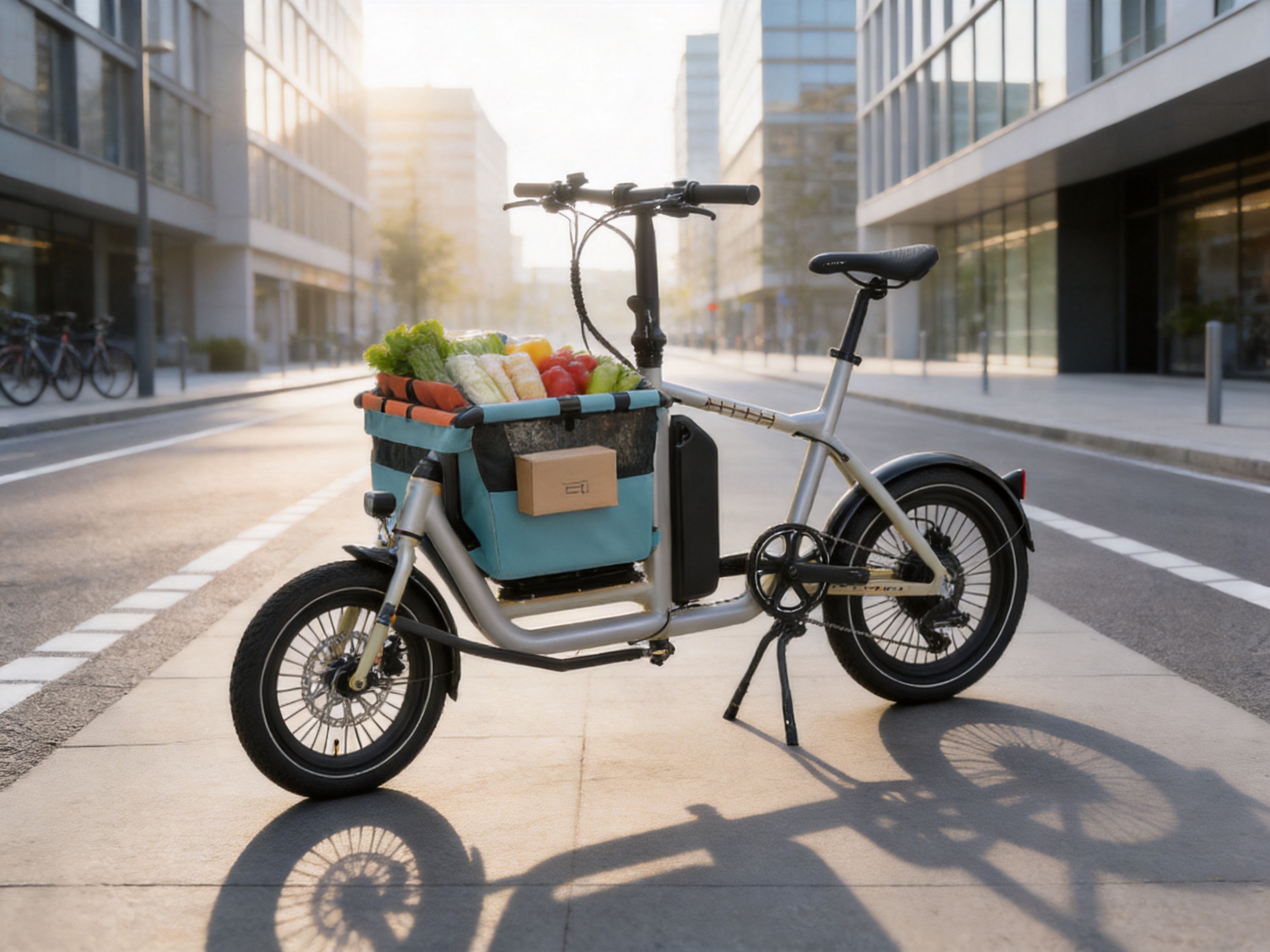
The removable front basket is designed to reduce installation time. The three-step installation sequence—aligning the holes, lowering the basket, and pushing it backward until it clicks—can be demonstrated easily in a showroom or delivery session. A short demonstration can improve customer confidence and reduce the risk of incorrect fitting.
Basket removal follows a release-pin and forward-slide procedure. Dealers should show customers how to pull the pin, move the basket forward, and lift it away only after it has reached the end of its track. Users should never force the basket sideways or attempt to ride with an incompletely engaged mount.
Routine service should include tire-pressure checks, brake inspection, chain lubrication, gear adjustment, wheel and axle checks, battery inspection, and examination of the basket mounting hardware. Cargo bicycles often experience more frequent starts, heavier loads, and more utility-focused use than recreational bicycles. A regular inspection schedule is therefore recommended.
Service technicians should pay attention to the rear hub motor and its electrical connections. The motor itself is designed as a relatively enclosed unit, but the axle area, cable exit, connectors, and controller-related wiring should be checked for damage or looseness. The battery should be removed and stored according to the product instructions when necessary, particularly during transport or extended periods without use.
Dealers serving commercial customers may wish to create maintenance packages. A basic package can cover safety checks and adjustments. A fleet package can include scheduled inspections, brake-pad monitoring, tire replacement planning, battery condition tracking, and fast turnaround for operational bicycles. Such services can increase the practical value of the product and create long-term customer relationships.
Urban cargo riding is not only about technical specifications. The rider must feel comfortable controlling the bicycle while carrying unfamiliar or uneven loads. The EQ1’s front basket places cargo in a visible location, helping the rider monitor whether bags are shifting or items are protruding. This visibility can make loading decisions more intuitive.
The bike’s compact width helps the rider judge clearance around parked cars, bollards, doorways, and other urban obstacles. Wide tires provide a stable contact patch, while the hydraulic brakes provide controlled stopping input. The rear hub motor’s starting assistance can reduce the physical effort required to move away from a traffic light.
New riders should practice in an open area before entering busy traffic. They should begin with a light, evenly distributed load and become familiar with acceleration, turning, braking, and the effect of different assist levels. A cargo bike may handle differently from a standard bicycle, particularly when the basket is full.
Rider confidence also depends on reliable fit and setup. The saddle height should allow a comfortable pedaling position, the handlebar should be correctly positioned, and brake levers should be reachable. Dealers can add meaningful value by completing a proper handover rather than treating the bicycle as a boxed product.
The EQ1 is positioned as a practical platform for overseas retailers, wholesalers, and mobility partners. Its clearly defined application makes it suitable for businesses that need a city cargo product without developing a complete bicycle from the beginning. The supplier’s custom design service can help partners explore practical electric cargo-bike solutions for different markets.
Customization may involve visual identity, accessories, cargo equipment, packaging, documentation, market-specific component choices, or configuration adjustments. Any proposed change should be evaluated for compatibility with frame strength, load distribution, braking performance, electrical safety, and local regulations. A custom cargo bike should remain a coherent engineered system rather than a collection of decorative additions.
For retailers, the model can be presented under several sales themes: affordable family cargo transport, daily urban utility, low-maintenance electric mobility, compact neighborhood delivery, or practical business transportation. The same underlying product can therefore serve multiple customer segments while maintaining a consistent technical foundation.
Wholesale buyers should assess order quantities, lead times, packaging requirements, spare-parts availability, warranty procedures, assembly responsibilities, and technical documentation. They should also confirm the regulatory requirements of the destination market, including motor-power limits, speed-assistance rules, lighting, reflectors, battery transport, and cargo-bike classification.
The company’s combination of international design, research and development, manufacturing experience, and supply-chain coordination supports these business discussions. A supplier capable of working with global buyers can help translate a general cargo-bike concept into a product program that reflects local customer expectations.
Cargo e-bikes can contribute to more sustainable transportation by replacing some short car journeys and reducing the need for motor vehicles in dense neighborhoods. Their value is particularly visible when they are used for routine trips that do not require a full-size vehicle. A family may use a cargo bike for shopping, while a business may complete local deliveries without sending a van through congested streets.
The sustainability benefits of an electric cargo bike depend on how it is used, maintained, charged, and eventually recycled. Extending product life is important. Durable components, serviceable systems, replacement parts, and responsible battery management all contribute to a better lifecycle outcome.
The EQ1’s practical design supports this approach. A repairable drivetrain, established component ecosystem, hydraulic brakes, replaceable tires, and a separate hub motor can help keep the bicycle in service when individual wear components need attention. A product that remains useful for many years can provide greater environmental value than one that is discarded after a minor failure.
Atmose’s stated philosophy of “Fun & Practical” also reflects an important aspect of sustainable mobility: people are more likely to use an alternative transport product when it is enjoyable, convenient, comfortable, and dependable. Practical design can therefore support behavioral change. The goal is not merely to provide another vehicle, but to make everyday journeys easier enough that users choose the bicycle more often.
| Item | Specification | Urban Benefit |
|---|---|---|
| Product model | EQ1 | Focused urban companion cargo e-bike |
| Frame | 6061 T4T6 aluminum alloy frame | Balances structural strength, weight, and corrosion resistance |
| Battery | Samsung 36V 15Ah lithium battery, approximately 540Wh | Supports practical assisted commuting and cargo trips |
| Motor | Bafang rear hub motor, 36V 250W | Provides direct starting assistance and independent propulsion |
| Rider load | Up to 120kg | Suitable for a broad range of adult urban riders |
| Basket load | Up to 25kg | Supports groceries, parcels, tools, and daily supplies |
| Transmission | Shimano seven-speed Sora system | Offers flexibility for starts, steady riding, and moderate inclines |
| Brakes | Tektro hydraulic disc brakes | Supports controlled stopping with a practical cargo load |
| Front tires | 16-inch by 2.4-inch puncture-resistant tires | Compact front profile with wide urban contact area |
| Rear tire | 20-inch by 2.4-inch puncture-resistant tire | Supports rear stability and comfort over imperfect pavement |
| Front basket | Approximately 470mm × 470mm × 375mm | Provides dedicated forward cargo capacity and direct visibility |
| Overall dimensions | Approximately 1780mm × 620mm × 1070mm | Designed for practical movement and storage in urban environments |
Before purchasing, users should consider their typical terrain, daily distance, expected cargo weight, storage space, charging arrangements, and local electric-bike regulations. The EQ1 is best suited to flat or moderately undulating city routes. Customers who regularly ride on steep hills or carry loads near the maximum rating should discuss whether another motor configuration would better meet their needs.
Retailers should communicate realistic range expectations. Battery performance varies with conditions, and a responsible sales process should explain the factors that influence energy consumption. Customers should also understand that the basket load limit, rider load limit, and total bicycle capacity are not interchangeable. Safe operation requires staying within the specified limits and distributing cargo carefully.
Assembly quality is another important consideration. The bike should be inspected after unpacking, with particular attention to wheel security, brake function, handlebar alignment, gear operation, electrical connections, and basket engagement. If a retailer supplies the bike directly to an end user, professional assembly and a short operating demonstration can significantly improve satisfaction.
Commercial operators should consider how the bicycle will be secured outside, where batteries will be charged, how often it will be inspected, and who will perform repairs. They should also establish a loading procedure so that employees do not place unstable or excessive cargo in the basket. Training is especially important when several riders share one bicycle.
The EQ1 is designed for urban riders who need practical electric assistance and front cargo capacity. It is suitable for commuters, families, shoppers, local service providers, and light delivery operators. Its most appropriate environment is a city with flat to moderate terrain.
The rear hub motor provides direct assistance through the rear wheel and operates independently of the chain and gear system. This arrangement can reduce drivetrain stress compared with systems that transmit motor power through the bicycle’s gears. It also provides useful push when starting from a stop.
The model is intended primarily for flat to moderate terrain. Riders in steep areas should evaluate gradient, rider weight, cargo weight, local regulations, and expected riding frequency before purchasing. A more powerful or different motor architecture may be more appropriate for demanding hills.
The listed basket capacity is up to 25 kilograms. Cargo should be evenly distributed, secured against movement, and kept within the basket’s physical dimensions. The rider should confirm that the load does not obstruct visibility, steering, braking, or the front wheel.
Yes. The basket can be released by pulling down the mounting pin, sliding the basket forward along its track, and lifting it upward after it reaches the end. Users should verify the release procedure and avoid forcing the basket if it does not move smoothly.
The installation process has three basic steps: align the basket with the pre-installed mounting holes, lower it vertically until the clips make contact, and push it backward toward the saddle until it clicks into place. The basket should always be checked for secure engagement before riding.
The EQ1 uses a Samsung 36-volt, 15-amp-hour lithium battery with an advertised capacity of approximately 540 watt-hours. Actual riding range depends on terrain, rider and cargo weight, assist level, temperature, wind, tire pressure, and stop-and-go traffic.
Yes. Regular maintenance should include tire-pressure checks, brake inspection, chain lubrication, gear adjustment, wheel checks, battery inspection, and examination of the basket mounting hardware. The hub motor simplifies the drivetrain architecture, but it does not eliminate routine bicycle and electrical-system care.
The 6061 T4T6 aluminum alloy frame provides a practical balance of strength, weight, corrosion resistance, and manufacturability. Cargo-bike performance also depends on frame geometry, weld quality, mounting design, and inspection, not only on the material designation.
The EQ1 is built around cargo use rather than ordinary personal transport. It includes a dedicated front basket, a stated basket load rating, cargo-oriented dimensions, wide tires, hydraulic disc brakes, and a motor system selected for loaded urban starts. These features make it more suitable for carrying goods than a standard e-bike with a simple rear rack.
The product is presented for overseas retailers, wholesalers, and mobility partners. Custom design support is available for businesses seeking practical electric cargo-bike solutions for different markets. Any customization should be reviewed for structural, electrical, regulatory, and service compatibility.
The product benefits from an international design and research and development structure, established manufacturing experience, a mature supply chain, and component integration around a defined urban-use case. These strengths can support consistent production, product adaptation, and cooperation with global business buyers.
The Atmose Model Q EQ1 is a focused answer to a clear urban transportation requirement. It is designed for riders who want to carry useful cargo without moving to a large, expensive, or highly complicated vehicle. Its rear hub motor provides direct starting assistance and reduces dependence on the bicycle drivetrain. Its Samsung battery offers a practical electrical foundation, while the seven-speed transmission gives the rider flexibility across ordinary city conditions.
The 6061 aluminum alloy frame, wide puncture-resistant tires, hydraulic disc brakes, compact dimensions, and folding front basket work together as a coherent system. The model’s competitive strength lies in this balance: practical cargo capacity, accessible electric assistance, manageable maintenance, and a price-conscious specification.
For retailers and mobility partners, the EQ1 also represents a commercially adaptable platform. Atmose combines American product origins, European design and research and development activity, manufacturing experience, and international supply-chain capability. This combination supports a product development approach centered on usability, reliability, sustainability, and everyday enjoyment.
For families, commuters, and small businesses in flat or moderately rolling cities, the EQ1 can transform short journeys. It offers a realistic alternative to many car trips while retaining the convenience and flexibility that make bicycles attractive. When properly loaded, maintained, and operated within its intended environment, it can serve as a dependable daily driver for modern urban mobility.
1. Atmose EQ1 Product Specification and Product Description Materials.
2. Atmose Company Information and Product Development Overview.
3. Bicycle Frame Materials: Aluminum Alloy Selection and General Engineering Principles.
4. Urban Cargo Bicycle Design: Load Distribution, Handling, and Braking Considerations.
5. Electric Bicycle Battery Use, Charging, Storage, and Maintenance Guidance.
6. General Bicycle Workshop Practices for Hydraulic Disc Brakes, Derailleur Systems, and Hub Motors.
7. Sustainable Urban Mobility Principles for Bicycle and Electric Cargo Transport.
Nov 17, 2026
Nov 03, 2026
Oct 26, 2026


info@atmosecargobike.com

200 rue de la Croix Nivert 75015 Paris

Custom Electric Bakfiets
 English
 Français
 Deutsch