Oct 16, 2026
Cargo bikes are often associated with large frames, electric motors, substantial batteries, and the ability to carry heavy loads over long distances. Those capabilities are valuable, but they are not necessary for every rider or every journey. Many urban trips are short, relatively flat, and simple: collecting groceries, carrying a small parcel, visiting a local shop, transporting work equipment, or moving everyday items across a neighborhood. For these journeys, a lighter and more direct solution can be more enjoyable than a highly equipped electric vehicle.
The Atmose Model Q Q1 is designed around that idea. It is a manual mini cargo bike that combines the familiar feeling of a traditional bicycle with the practical carrying capacity of a front cargo basket. It does not use a battery, motor, or electronic drive system. Instead, it focuses on low weight, straightforward maintenance, responsive handling, and regular human-powered riding.
This approach gives the Q1 a distinct position in the cargo-bike market. It is not intended to compete with a long-range electric cargo bike by replicating its power system. Rather, it serves riders who prefer simplicity, exercise, easier storage, and a direct connection with the road. Its front folding basket provides useful carrying space without requiring the rider to manage charging routines or complex electrical components.
With a 6061 T4T6 aluminum alloy frame, a three-speed Shimano Sora speed system, Tektro hydraulic disc brakes, and wide puncture-resistant tires, the Q1 is configured for practical urban use. Its compact dimensions and relatively light manual design make it particularly relevant to people who live in apartments, use wall racks, navigate narrow residential streets, or want to combine transportation with everyday fitness.
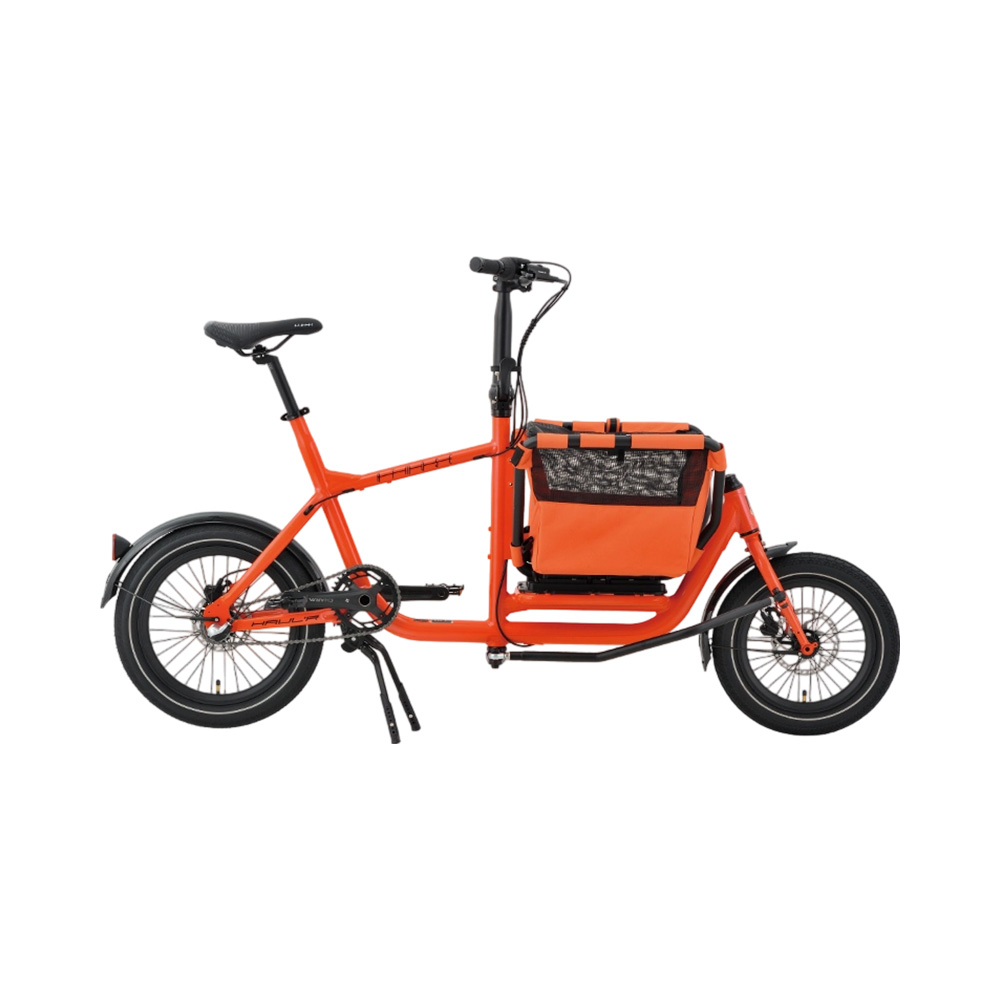
Atmose Model Q Q1 Lightweight Manual Mini Cargo Bike for Fitness and Errands
The central principle of the Q1 is reduction. By removing the battery and motor, the design eliminates several systems that can add weight, cost, charging requirements, and maintenance considerations to a bicycle. This does not mean that the Q1 is a basic or unfinished product. It means that its equipment is concentrated on the functions most relevant to short-distance cargo cycling.
A manual cargo bike must be efficient in a different way from an electric cargo bike. Instead of relying on motor assistance, it must offer manageable weight, usable gearing, stable load support, dependable braking, and tires capable of coping with ordinary urban surfaces. The Q1 addresses these needs through a compact aluminum frame, a three-speed drivetrain, a front basket, hydraulic disc brakes, and wide tires.
This configuration is especially suitable for flat or gently rolling routes. A rider can use the bicycle for grocery trips, local errands, school-related tasks that do not require carrying several passengers, commuting with a work bag, or transporting small business supplies. The riding experience remains close to that of a conventional bicycle, while the front cargo area adds a practical level of utility.
The Q1 is also designed for riders who enjoy the physical element of cycling. Every trip can become a moderate form of daily movement. Instead of treating exercise as a separate activity that requires additional time, the rider can incorporate it into transportation. This is one of the strongest reasons to select a manual cargo bike over an assisted alternative.
Urban mobility is not one single category. Some riders need to travel many miles, climb steep hills, carry heavy loads, or transport several children. Others need a reliable vehicle for journeys of only a few minutes. The Q1 is aimed at the second group.
Short urban journeys are often affected by factors that have little to do with maximum speed. Easy storage, quick preparation, low maintenance, convenient loading, and the ability to move through local streets can matter more. A manual bike is ready whenever the rider is ready. There is no battery state to check, no charger to pack, and no waiting period before a ride.
That simplicity can also encourage more frequent use. A bicycle that is easy to take from a storage area and easy to put away after a trip is more likely to become part of a daily routine. The Q1 therefore supports a practical pattern of repeated local travel rather than occasional long-distance expeditions.
The Q1 uses a 6061 T4T6 aluminum alloy frame. Aluminum is widely used in modern bicycles because it can provide a useful balance between structural strength, weight, corrosion resistance, and manufacturing flexibility. The selected alloy platform is appropriate for a lightweight manual cargo bike, where the frame must support the rider, the cargo basket, and the forces generated by frequent starting, stopping, steering, and loading.
The frame is one of the most important differences between a lightweight cargo bike and an ordinary bicycle with a temporary rack. A cargo-oriented structure needs to accommodate a front carrying area while maintaining predictable steering and sufficient rigidity. The Q1 is built around an integrated front basket arrangement, allowing the cargo function to be part of the bicycle’s design rather than an afterthought.
The stated maximum load is 120 kilograms for the rider and 25 kilograms for the basket. These figures should be understood as operating limits, not as a recommendation to carry the maximum amount on every trip. Correct loading, balanced placement, and appropriate riding speed remain important. Cargo should be secured so that it cannot shift into the steering area or interfere with the wheels, brakes, or rider position.
The front basket measures approximately 470 millimeters in length, 470 millimeters in width, and 375 millimeters in height. This creates a useful open area for groceries, bags, boxes, parcels, and other everyday items. The basket’s size is large enough to provide practical value, while the overall bike dimensions remain compact for a cargo model.
The complete bicycle measures approximately 1,780 millimeters in length, 620 millimeters in width, and 1,070 millimeters in height. These dimensions place the Q1 in a relatively compact category for a front-loading cargo bicycle. The 620-millimeter width is especially relevant in urban environments, where storage rooms, elevators, gates, cycle lanes, and narrow passageways can limit the usefulness of larger cargo platforms.
Although exact storage conditions vary, a compact structure can make it easier to place the bicycle in a hallway, garage, shared bicycle area, or apartment storage space. The product description also emphasizes that the lightweight design is easier to carry up a few steps or hang on a wall rack than heavier electric cargo alternatives.
Weight is not merely a convenience specification. It influences the entire ownership experience. A lighter bicycle can be easier to maneuver when parking, easier to turn around in a confined area, and easier to move without riding. This is particularly valuable for users who must carry a bicycle through a building or lift it into a storage position.
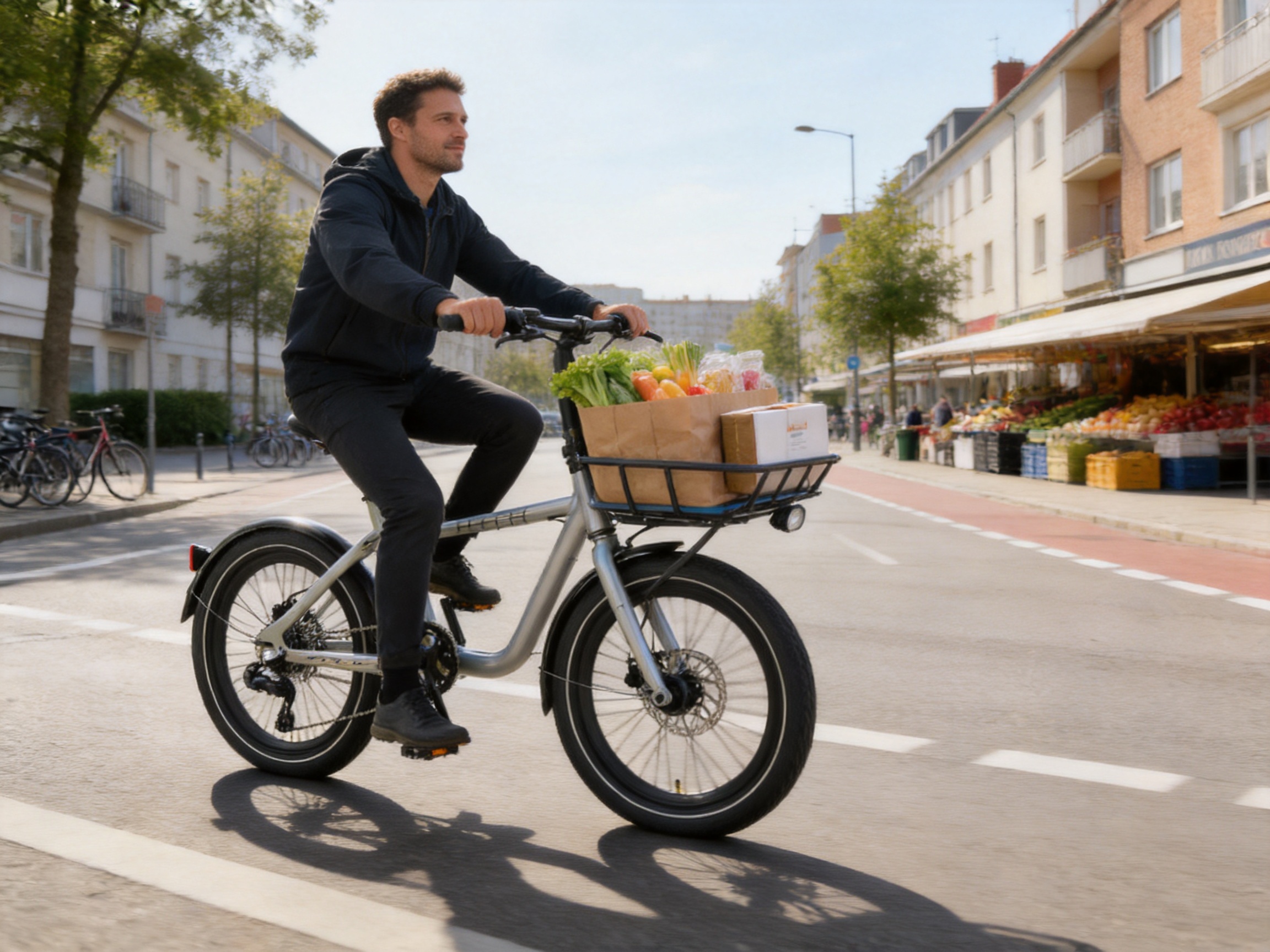
The Q1 has no battery and no power system. This is a deliberate product decision that gives the bicycle a clear identity. Riders who want an assisted bicycle may prefer an electric model, especially on hills or when carrying heavy loads. However, riders who want to remain physically active may find that motor assistance removes some of the effort they enjoy.
With the Q1, the rider controls the complete propulsion experience. Pedaling intensity depends on route conditions, cargo weight, gearing, and personal preference. A short trip to the market can therefore provide light daily activity without requiring a separate workout schedule. Over time, this can support a healthier and more active transportation routine.
The fitness benefit is also connected to the bike’s intended environment. On flat routes, a manual cargo bike can be practical and comfortable, especially when the load is moderate. The rider can select an easier gear when starting or carrying additional items and use a higher gear when traveling at a steady pace.
It is important to match the Q1 to the appropriate use case. A rider who regularly travels through steep terrain, needs to carry very heavy cargo, or wants to maintain high speed over long distances may be better served by an electric cargo bike. The Q1 is strongest when its manual character is considered an advantage rather than a limitation.
The Q1 uses a Shimano three-speed Sora speed system. A three-speed arrangement offers a relatively simple operating experience while providing more flexibility than a single-speed bicycle. The rider can choose a lower setting for starting, inclines, or heavier loads, a middle setting for ordinary urban movement, and a higher setting for efficient cruising on level roads.
Compared with a bicycle equipped with a much larger number of gears, a three-speed system can be easier for riders who do not want to manage frequent gear changes. It supports the Q1’s simple, approachable character. There are fewer controls to think about, and the rider can focus on road awareness, cargo stability, and the surrounding environment.
The gearing is particularly appropriate for the product’s stated purpose: short-distance errands and flat commuting. The system does not attempt to transform the Q1 into a high-performance touring bicycle. Instead, it provides a practical range for everyday movement while preserving a clean and uncomplicated riding experience.
Carrying cargo changes the way any bicycle accelerates, steers, and stops. A front basket makes loading convenient, but riders should still distribute weight carefully. Heavy objects should be placed low and centered whenever possible. Loose items should be contained in bags or boxes, and the total basket load should remain within the stated 25-kilogram limit.
When the basket is loaded, the rider should begin slowly and check how the bicycle responds. Smooth starts and gradual turns help maintain control. The hydraulic disc brakes provide strong stopping capability, but braking behavior can still change when additional weight is carried. A careful riding technique is therefore an important part of using a manual cargo bike safely.
The Q1 is equipped with Tektro hydraulic disc brakes. Hydraulic disc brakes are valued for their consistent control and responsive operation. They can provide useful braking performance in varied urban conditions, including frequent stop-and-go traffic, intersections, and routes where the rider may need to slow down while carrying cargo.
For a cargo bike, dependable braking is particularly important because the total moving mass can increase when the basket is loaded. Hydraulic operation can also offer a smooth lever feel, allowing the rider to modulate braking pressure rather than relying only on abrupt stopping force.
The bicycle uses wide tires measuring 16 inches by 2.4 inches at the front and 20 inches by 2.4 inches at the rear. The product information identifies these as puncture-resistant tires. Their width is useful for comfort and stability on ordinary urban surfaces. Wider tires can help absorb small surface imperfections and provide a broad contact area with the road.
The different front and rear wheel sizes contribute to the Q1’s compact cargo-bike geometry. The smaller front wheels can support a practical front-loading design, while the larger rear wheel can assist normal pedaling efficiency and rolling behavior. Tire pressure should be maintained according to the manufacturer’s guidance and adjusted only within an appropriate range for rider weight, cargo, and surface conditions.
The front folding basket is the feature that converts the Q1 from a regular bicycle into a practical compact cargo bike. It offers a direct place for groceries, packages, personal belongings, and small equipment. Because the basket is positioned in front of the rider, cargo can remain visible during the trip, making it easier to monitor the load.
The folding design adds flexibility. When installed, the basket provides the main carrying area. When removed or folded according to its intended mechanism, the bicycle can be adapted for situations in which the rider does not need cargo capacity. This makes the Q1 useful as both an errand vehicle and a more conventional bicycle for local riding.
The product includes a three-step installation process. First, the rider aligns the basket base with the pre-installed mounting holes on the handlebar. Second, the basket is lowered vertically until the clips make contact. Third, the basket is pushed backward toward the saddle. A click indicates that the basket has been installed successfully.
This process is significant because a removable cargo component is only useful when it can be attached securely and without unnecessary effort. The described click confirmation gives the rider a simple indication that the basket has reached its intended position. Nevertheless, users should always inspect the attachment before riding, particularly after repeated removal and installation.
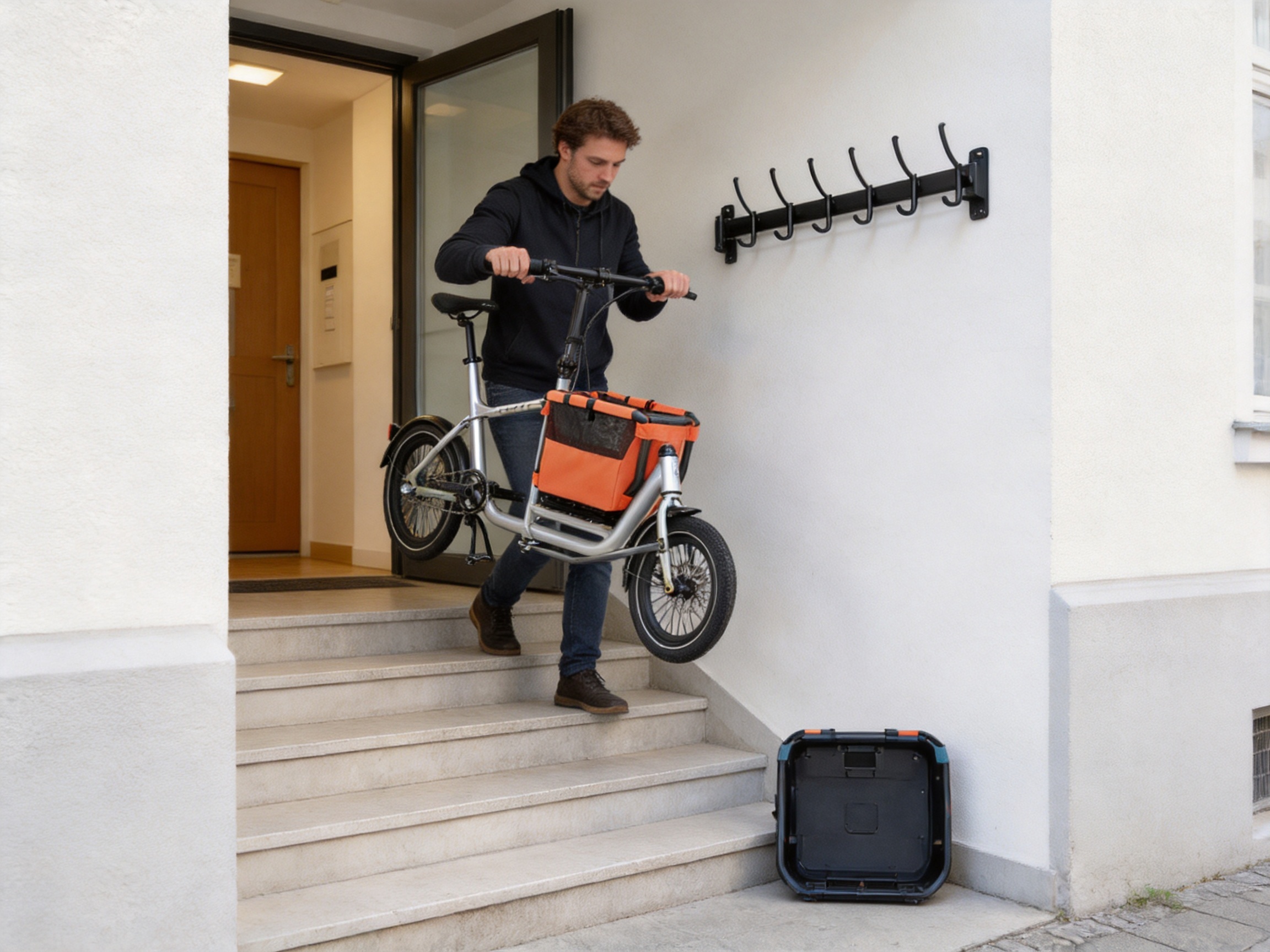
Removing the basket requires two main movements after locating the pin at the bottom of the basket mount. The rider pulls the pin downward, pushes the basket forward toward the front wheel until it reaches the end of its track, and then lifts it upward to complete removal.
This arrangement can be useful for owners who do not want to keep the cargo basket installed at all times. For example, a rider may use the bicycle for shopping in the morning, remove the basket before storing it, and use the bicycle in a lighter configuration later. The removal procedure also makes cleaning, inspection, and storage more manageable.
As with all removable bicycle equipment, the attachment points should be kept clean and checked regularly. The basket should not be used if it is not fully seated, if the pin does not operate correctly, or if any component appears damaged. A secure connection is essential because front-mounted cargo can affect steering and because a loose basket may become a hazard to the rider and surrounding traffic.
The Q1’s main advantage over many electric cargo bikes is its lower level of system complexity. Electric models typically require a battery, motor, controller, wiring, charging equipment, and additional electronic interfaces. These systems can provide valuable assistance, but they also add components that must be charged, stored, inspected, and eventually serviced.
The Q1 removes those requirements. There is no battery charging schedule, no range calculation, and no concern about arriving home with insufficient electrical power. The bicycle is ready to ride as long as its mechanical components are in good working condition. This can be especially convenient for spontaneous short trips.
A manual configuration may also reduce ownership weight. The Q1 is described as significantly lighter than its electric siblings, making it easier to carry up steps or place on a wall rack. This distinction can matter more than motor power for people who live in buildings without ground-level bicycle storage.
Another advantage is the directness of maintenance. The Q1 still requires normal bicycle care, including tire inflation, brake inspection, drivetrain cleaning, and attention to wear components. However, it does not have the electrical systems associated with an e-bike. For riders who prefer familiar mechanical maintenance, this can make ownership easier to understand.
At the other end of the comparison, the Q1 offers more integrated carrying utility than a standard bicycle fitted with a small rear rack or handlebar basket. Its front cargo structure is designed as part of the product concept, with a larger basket and a stated load capacity of 25 kilograms.
A conventional bicycle can be excellent for personal transportation, but its frame and handling may not be designed around front cargo. The Q1 begins with cargo use as one of its primary purposes. This supports a more practical relationship between the rider, the front basket, the wheel arrangement, and the frame.
The Q1 therefore occupies a useful middle ground. It is more capable for errands than a basic city bicycle, while remaining simpler and lighter than a full-size electric cargo bike. This balance is its strongest competitive position.
The company’s product development approach combines American product thinking with European design aesthetics. Atmose originated in California and has an international design and research-and-development team based in Paris. This combination gives the Q1 a design context that is both practical and visually considered.
The company also describes itself as being supported by extensive manufacturing expertise, a mature supply chain, and continuous innovation. These strengths are relevant to a product such as the Q1 because a compact cargo bike requires coordination among frame construction, basket integration, wheel sizing, braking, drivetrain selection, and final assembly.
Advanced manufacturing does not necessarily mean adding the greatest number of electronic functions. In the case of a manual cargo bike, manufacturing strength is demonstrated through the controlled integration of mechanical parts and the consistent production of a frame that is light, stable, and suitable for daily use. Material selection, component compatibility, dimensional accuracy, and assembly quality all contribute to the finished product.
The use of 6061 T4T6 aluminum alloy indicates attention to a recognized bicycle-frame material. A frame made from aluminum alloy must be designed and processed with care because the benefits of low weight depend on appropriate tube profiles, joints, alignment, finishing, and quality control. The manufacturing process must support both structural reliability and the compact geometry needed for front cargo use.
The integrated basket mounting system is another example of product engineering. Rather than relying only on a loose accessory, the Q1 includes pre-installed mounting holes and a guided attachment process. This requires the frame and mounting components to work together accurately. The installation click, sliding track, and retaining pin are small details, but they influence daily convenience and user confidence.
A cargo bicycle is a system of interdependent parts. The frame must accept the wheels and braking hardware. The fork and front structure must support the basket arrangement. The drivetrain must provide useful gearing. The tires must suit the wheel sizes and intended surfaces. The brakes must be compatible with the overall load and riding environment.
A mature supply chain helps coordinate these requirements. It can support component sourcing, production scheduling, inspection, replacement-part planning, and consistent assembly. The company’s stated manufacturing background and ongoing innovation provide a foundation for developing products that combine multiple functions without making the user experience unnecessarily complicated.
For international buyers, a company with design, research, development, and manufacturing coordination can also be better positioned to support product adaptation and wholesale requirements. Atmose identifies global buyers, custom design, and wholesale orders as areas of support. The Q1’s straightforward mechanical platform may be particularly suitable for organizations seeking a practical fleet or a compact cargo model for local mobility programs.
The Q1 is suited to a variety of local transportation tasks. A person can use it for a market visit, carrying food in the front basket instead of balancing bags on a handlebar. A small business owner can transport tools, supplies, or packaged goods over a short route. A commuter can carry a laptop bag, lunch, clothing, or personal equipment while avoiding the inconvenience of a conventional backpack.
It can also support neighborhood-based family mobility when the load remains within the basket’s intended capacity. Parents may use it for small shopping trips or for carrying children’s belongings, although users must follow applicable safety requirements and should not assume that the basket is designed as a passenger seat. The stated product information identifies the basket as a cargo area, not a child restraint system.
For recreational riding, the basket can be removed so that the bike becomes lighter and more streamlined for local exploration. This flexibility is valuable for households that want one bicycle to perform several everyday roles rather than owning a separate vehicle for each task.
The Q1 may also appeal to older riders or people who want a practical bicycle without the weight and complexity of an electric system. However, suitability depends on individual fitness, route conditions, and the ability to handle a loaded front basket. A test ride on a familiar, flat route is a sensible way to evaluate comfort and control.
| Feature | Specification or Product Position | Practical Relevance |
|---|---|---|
| Product | Atmose Q1 manual mini cargo bike | Human-powered urban errands and short-distance transportation |
| Frame | 6061 T4T6 aluminum alloy | Supports a lightweight and practical frame design |
| Battery | Not included | No charging schedule or battery-related maintenance |
| Power system | Not included | Direct pedal-powered riding and fitness-oriented use |
| Maximum rider load | 120 kilograms | Defines the stated rider capacity |
| Maximum basket load | 25 kilograms | Suitable for groceries, parcels, and everyday equipment within the limit |
| Speed system | Shimano three-speed Sora | Simple gearing for starts, ordinary riding, and level-road cruising |
| Front basket size | 470 mm long by 470 mm wide by 375 mm high | Provides a dedicated front cargo area |
| Front and rear tires | 16 by 2.4 inches front; 20 by 2.4 inches rear | Wide, puncture-resistant tires for urban stability and comfort |
| Brakes | Tektro hydraulic disc brakes | Responsive braking for everyday riding and moderate cargo loads |
| Overall dimensions | 1,780 mm long by 620 mm wide by 1,070 mm high | Compact proportions for urban maneuvering and storage |
| Basket attachment | Guided slide-in installation with retaining pin | Allows the basket to be installed or removed as needed |
Although the Q1 does not have electrical components, it still deserves regular care. The tires should be checked before rides, especially when the basket is loaded. The hydraulic brake system should be inspected for proper operation, and the brake pads should be replaced when worn. The drivetrain should be kept clean and lubricated according to normal bicycle maintenance practice.
The basket mount should receive particular attention because it is a central part of the cargo function. Users should check the mounting clips, sliding track, and retaining pin. Any unusual movement, noise, or difficulty during installation should be investigated before the bicycle is used with cargo.
Aluminum frames generally resist corrosion well, but the bicycle should still be cleaned after exposure to heavy rain, road salt, mud, or abrasive dirt. Keeping the frame and moving parts clean can help protect the finish and make inspection easier. Storage in a dry location is recommended, especially when the basket is removed and the bicycle is kept for an extended period.
The absence of a motor and battery reduces the number of specialized systems that require attention, but it does not eliminate responsibility. Simple products often deliver their best performance when owners follow consistent basic maintenance routines. In this respect, the Q1 is designed to be straightforward rather than maintenance-free.
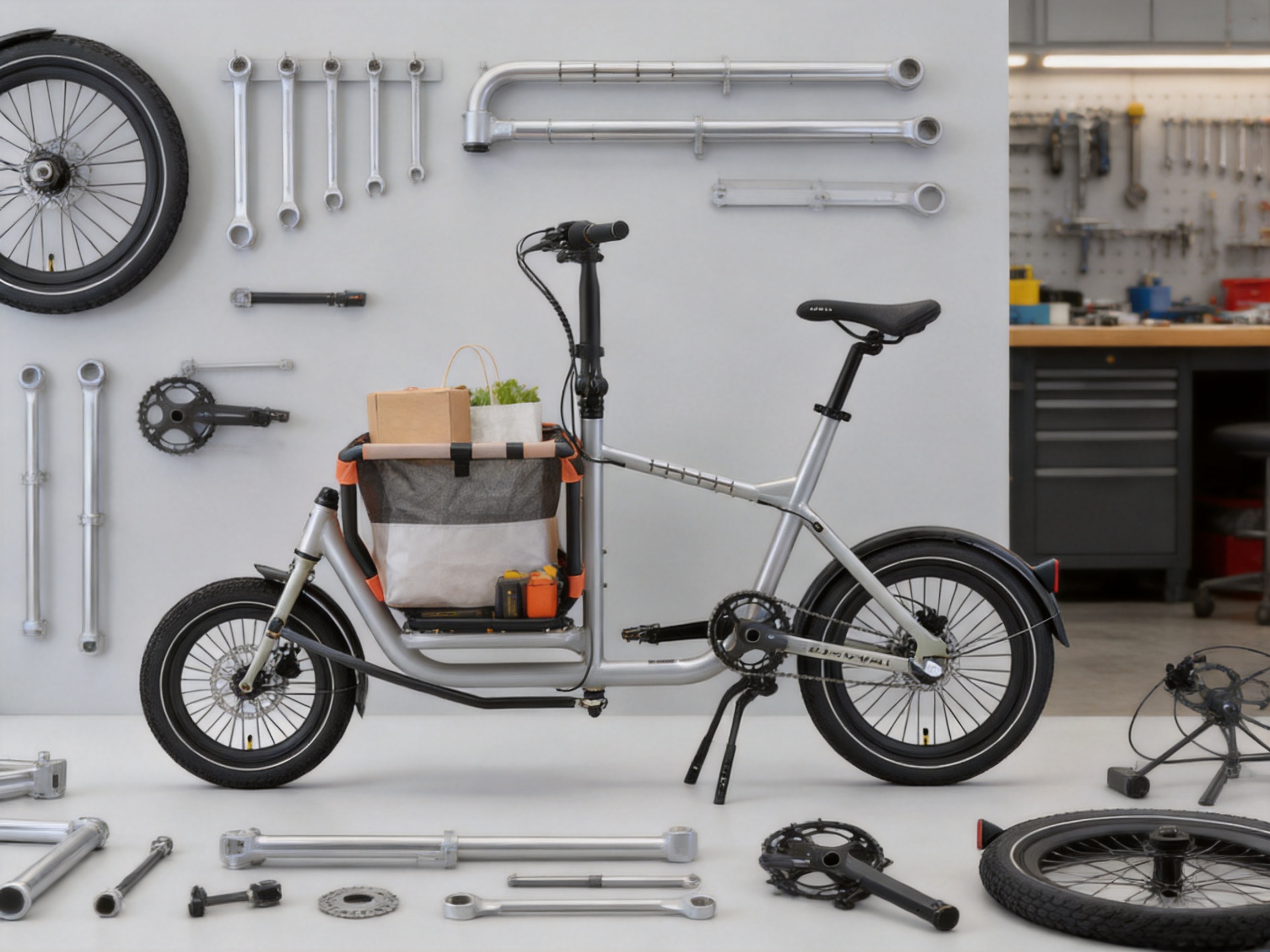
The Q1 is a strong choice for riders who live in flat or moderately easy urban areas and want to replace short car trips with bicycle journeys. It is also appropriate for people who want a front cargo basket but do not want the size, weight, or charging requirements of an electric cargo model.
Fitness-focused riders may appreciate the manual drivetrain because it turns transportation into regular physical activity. Apartment residents may value the lighter frame and compact dimensions. Minimalist users may prefer a product with fewer systems to charge, update, or troubleshoot. Small businesses with local delivery needs may find the basket and simple mechanical operation practical for short routes.
The bicycle may be less suitable for users who regularly face steep hills, carry loads close to the maximum, travel long distances, or require motor assistance because of physical limitations. It is also not a substitute for a heavy-duty cargo bike when the task involves large commercial loads. Choosing the correct vehicle depends on matching the product to the route and the cargo requirement.
Before the first ride, the owner should confirm that the handlebars, saddle, wheels, brakes, drivetrain, and basket are correctly installed. The basket should be tested with a light load before it is used for heavier items. Riders should become familiar with the bicycle’s turning response and braking distance in an open, low-traffic area.
Loads should be placed so that they do not block the rider’s view or interfere with steering. Tall, loose, or unstable objects should be secured or avoided. The 25-kilogram basket limit should never be exceeded, and the rider should consider how cargo weight changes acceleration and stopping behavior.
In traffic, the Q1 should be ridden at a speed appropriate to conditions. Extra care is advisable around parked cars, pedestrians, doorways, intersections, wet surfaces, and uneven pavement. The wide tires can help provide stability, but they do not remove the need for attention and control.
No. The Q1 is a manual cargo bike. It has no battery and no motor, so all propulsion comes from the rider. This makes it appropriate for users who prefer exercise, mechanical simplicity, and a bicycle that is always ready without charging.
It is designed primarily for short-distance urban trips, errands, local commuting, and flat or gently rolling routes. Typical uses include grocery shopping, carrying small parcels, transporting personal equipment, and completing neighborhood tasks.
The stated maximum basket load is 25 kilograms. The rider should distribute cargo evenly, keep it secure, and remain within this limit. The basket is intended for cargo and should not be treated as a passenger seat.
The stated maximum rider load is 120 kilograms. This figure applies to the rider and should be considered together with safe riding practices, correct assembly, and appropriate maintenance.
Yes. The basket can be installed using the guided mounting system and removed by operating the lower pin, sliding the basket forward, and lifting it away. Users should confirm that the basket is fully secured whenever it is installed.
No. Because the Q1 has no battery or motor, it does not require a charger, charging location, or battery management routine.
The Q1 uses Tektro hydraulic disc brakes. These are intended to provide controlled braking for everyday riding and moderate cargo use. Brake operation should be checked regularly, particularly when the basket is loaded.
The front tires are 16 inches by 2.4 inches, and the rear tires are 20 inches by 2.4 inches. The product information identifies them as puncture-resistant tires.
The Q1 can be used according to the rider’s ability and local conditions, but it is primarily intended for flat or relatively easy urban routes. Riders who regularly face steep hills or heavy loads may prefer an electric cargo bike with motor assistance.
The Q1 offers a more integrated cargo function, a larger front basket, and a stated basket load capacity. Compared with a standard bicycle with a small accessory rack, it is designed more specifically around carrying everyday items. At the same time, it retains a manual riding experience.
The Q1 is lighter and mechanically simpler, but it does not provide motor assistance. It is more appropriate for short, flat trips and riders who value exercise and easy storage. A full-size electric cargo bike may be better for long distances, steep terrain, or heavier loads.
The company combines California origins, Paris-based design and research-and-development resources, manufacturing experience, a mature supply chain, and an emphasis on practical mobility. These strengths support the integration of frame design, cargo hardware, components, and user-focused functionality.
The Atmose Model Q Q1 presents a focused alternative to the assumption that every cargo bike needs electric assistance. Its design is based on a clear idea: many daily urban journeys can be handled with a lighter, simpler, human-powered bicycle that carries useful cargo and encourages regular activity.
Its 6061 T4T6 aluminum alloy frame, compact dimensions, three-speed drivetrain, wide puncture-resistant tires, hydraulic disc brakes, and removable front basket form a coherent package for local transportation. The product’s strengths are particularly evident in flat neighborhoods, short commutes, grocery trips, apartment living, and fitness-oriented cycling.
Compared with heavier electric cargo bikes, the Q1 avoids charging and reduces system complexity. Compared with a conventional bicycle carrying an aftermarket rack, it offers a more purpose-built cargo structure and a higher stated basket capacity. Its competitive advantage is therefore not maximum power or maximum carrying volume. It is balance: useful cargo space, manageable weight, simple ownership, and an engaging manual ride.
The company’s design resources, manufacturing expertise, mature supply chain, and international development structure provide a foundation for producing practical cargo bicycles that combine function with visual simplicity. In the Q1, those strengths are expressed through careful component selection and an accessible product architecture rather than through unnecessary technological complexity.
For riders whose priorities are fitness, convenience, storage flexibility, and short-distance utility, the Q1 offers a credible and distinctive urban mobility solution. It is a cargo bike for people who want to carry more without losing the direct, active, and uncomplicated character of cycling.
Atmose Q1 Product Information Sheet. Frame, load capacity, drivetrain, basket, tire, brake, and dimensional specifications.
Atmose Q1 Product Description. Product positioning for manual urban errands, fitness-oriented riding, and lightweight cargo transportation.
Atmose Company Information. Corporate history, California origins, Paris-based design and research-and-development activities, manufacturing expertise, and supply-chain capabilities.
Atmose Q1 Basket Installation and Removal Instructions. Three-step installation procedure and two-stage basket removal process.
General Bicycle Engineering Principles. Aluminum frame construction, cargo-bike load distribution, hydraulic disc braking, tire maintenance, and urban cycling practices.
Nov 17, 2026
Nov 03, 2026
Oct 26, 2026


info@atmosecargobike.com

200 rue de la Croix Nivert 75015 Paris

Custom Electric Bakfiets
 English
 Français
 Deutsch