Sep 24, 2026
Urban transportation is changing. More people are combining cycling with trains, elevators, shared vehicles, and compact apartments rather than relying on a single mode of transport. For these riders, a cargo bike must do more than carry shopping, work equipment, or daily essentials. It must also fit into the practical spaces of city life: a narrow hallway, a small lift, a railway platform, an office, or a car trunk.
The Atmose Model R ESR1 is designed around this challenge. It is a front-loading electric cargo bike that retains its useful cargo configuration during normal riding but folds into a significantly smaller package when storage or transportation becomes necessary. Its tri-fold frame, removable front wheel, mid-drive motor, large battery, belt drivetrain, hydraulic disc brakes, and 45-kilogram front basket capacity position it as a mobility tool rather than simply a bicycle.
Many cargo bikes are excellent at carrying loads but difficult to store. Many folding bikes are easy to store but provide little practical carrying capacity. The Model R attempts to bridge that gap. It offers the carrying format associated with a compact bakfiets while addressing the space limitations that prevent some urban residents from owning a conventional long-tail or box-style cargo bicycle.
This article examines the Model R ESR1 in detail, including its construction, folding system, electric assistance, carrying ability, maintenance requirements, multi-modal usefulness, manufacturing strengths, and advantages over more conventional cargo-bike designs.
The central problem addressed by the Model R is not simply lack of cycling infrastructure or insufficient motor power. It is the physical inconvenience of owning a full-size cargo bike in a dense city. A bike that is too long for an elevator, too wide for a hallway, or too heavy to move indoors may be difficult to use consistently, even if it performs well on the road.
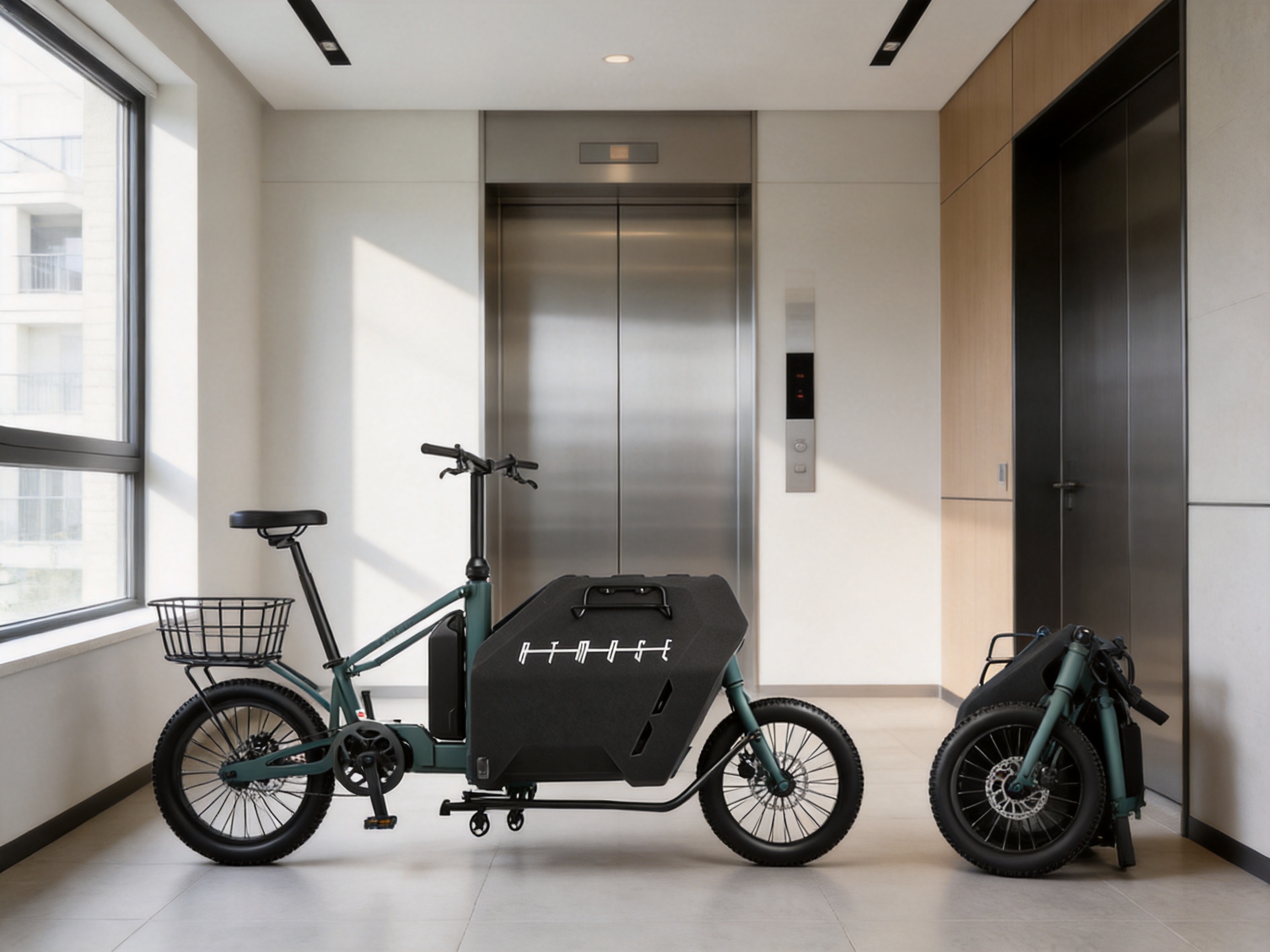
The Model R has a riding length of 198 centimeters. That length gives it the proportions needed for a front-loading cargo layout, but it can be reduced to 120 by 44 by 85 centimeters when folded. With the front wheel removed, the folded dimensions become 102 by 44 by 76 centimeters. This second configuration is particularly relevant for car owners who want to carry the bike without a roof carrier or rear rack.
The importance of these figures is practical rather than theoretical. A reduction from nearly two meters in riding length to approximately 1.2 meters can determine whether the bike fits inside an elevator or can be stored along a wall. The further reduction achieved by removing the front wheel can make the difference between transporting the bike in a vehicle and leaving it at home.
Unlike a traditional folding bicycle, this is not a small-wheel commuter bike with a narrow rack added as an afterthought. It begins with a front-loading cargo concept. The basket remains ahead of the rider, and the design is intended to carry a meaningful load low and visibly in front of the bicycle. Folding is therefore integrated into the cargo-bike architecture rather than treated as a separate accessory feature.
This approach gives the Model R a distinctive position in the market. Conventional cargo bikes generally prioritize load volume, stability, and a long wheelbase. Compact folding bikes prioritize storage and portability. The Model R seeks to preserve the cargo-bike experience while adding a level of storage flexibility normally associated with folding commuter bicycles.
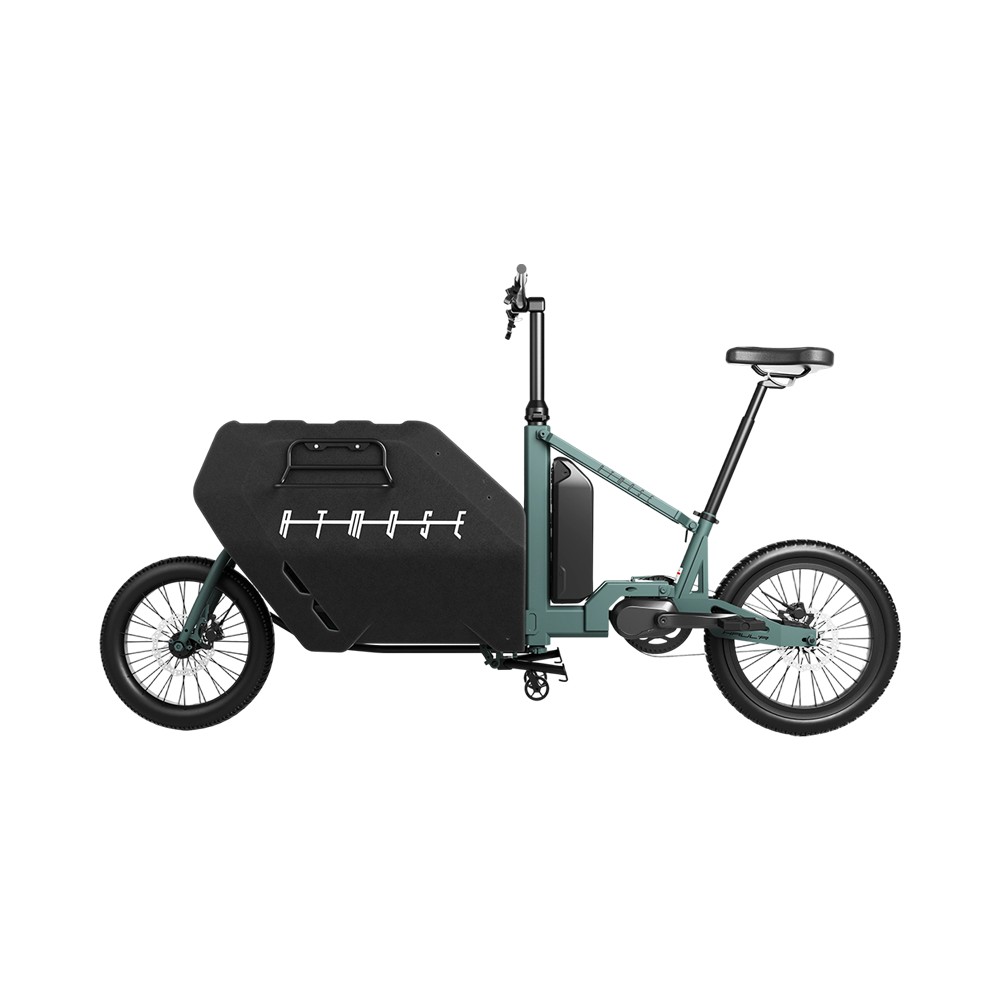
Atmose Model R ESR1 Tri-Fold Cargo E-Bike for Train Commuters and Small Apartments
The front basket is one of the most important elements of the Model R. It provides a top opening measuring 70 by 50 centimeters and a lower area measuring 50 by 36 centimeters. The basket is rated to carry up to 45 kilograms, while the rider capacity is specified at up to 100 kilograms.
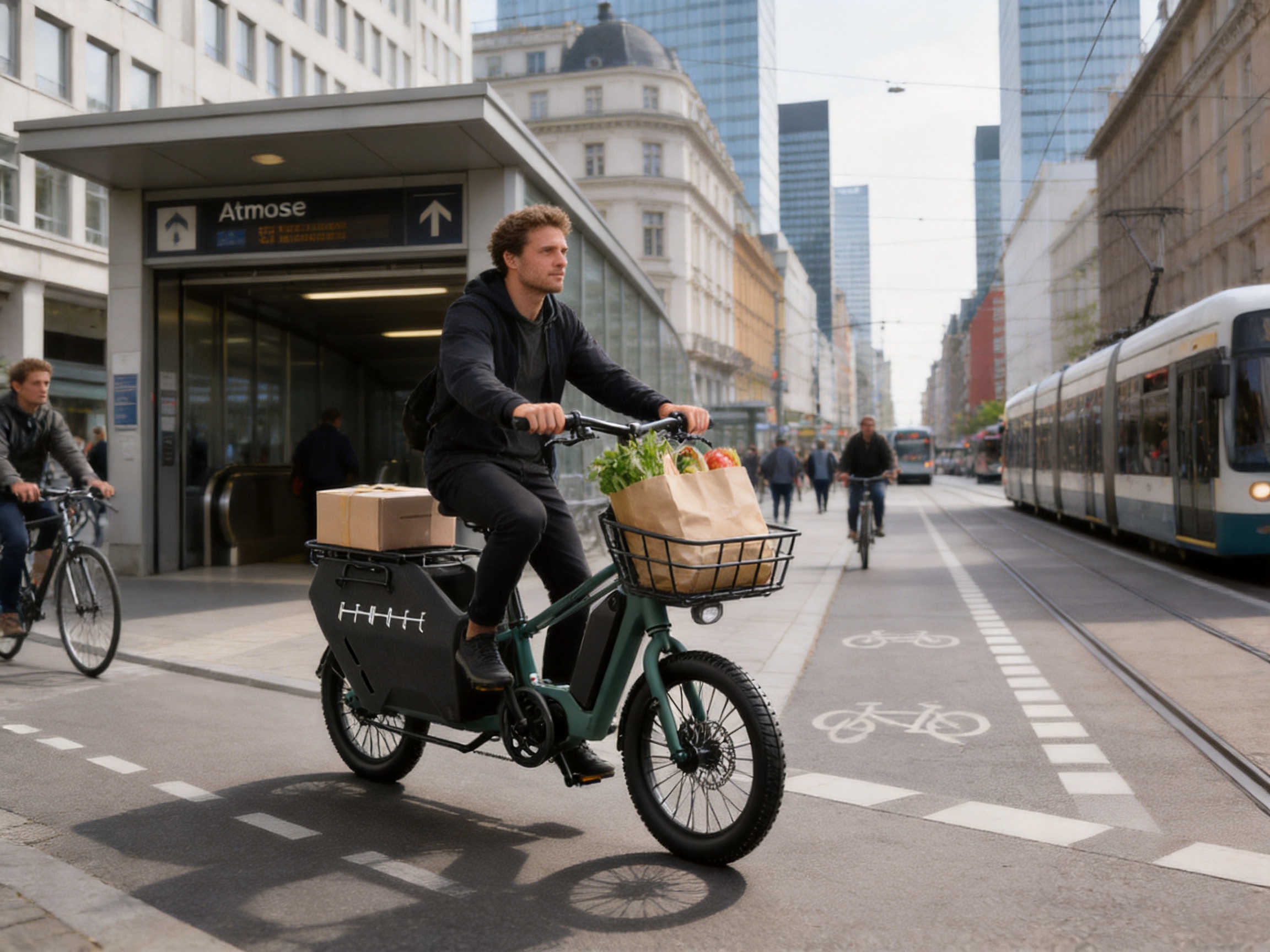
This arrangement allows the rider to carry groceries, parcels, equipment, delivery items, or daily personal belongings directly in front of the handlebars. A front-loading design can also make the load easier to monitor than a rear rack or pannier system. The rider can see the cargo while maneuvering, which is useful when carrying irregularly shaped items or when navigating busy streets.
The basket is mounted low relative to the rider. Keeping the load low helps limit the effect of a high center of gravity, particularly when the cargo is dense. A lower load can also make loading and unloading more convenient because heavy items do not need to be lifted to shoulder height.
The 45-kilogram capacity is substantial for a compact cargo bike. It is suitable for large grocery trips, work equipment, courier parcels, or a mixture of smaller loads. The stated capacity should always be treated as a maximum rather than a target for every ride. Load distribution, road surface, braking conditions, and local regulations should be considered before carrying a particularly heavy or bulky item.
Compared with a standard city bicycle equipped with a front basket, the Model R offers a much more capable load platform. A conventional basket is often suitable for a backpack or light shopping. The Model R’s basket is designed as a structural part of the bicycle’s cargo system, with dimensions and capacity intended for serious everyday transport.
Compared with a large box bike, the advantage is compactness. A full-size box often provides more volume, especially for families carrying several passengers or very large loads, but it also demands more storage space and may be more difficult to maneuver indoors. The Model R is aimed at riders who need meaningful carrying ability without committing their entire home, garage, or workplace to bicycle storage.
The Model R uses a three-part folding frame. The purpose of this arrangement is to allow the bike to fold without abandoning the basic front-loading cargo configuration. The riding length is 198 centimeters, while the folded length is 120 centimeters. This reduction is especially valuable in buildings where the main obstacle is length rather than width.
The folded width is 44 centimeters and the folded height is 85 centimeters. These dimensions are suitable for storage in many indoor environments, although actual fit will depend on doorways, lift dimensions, stairwell geometry, and the presence of other objects. The bike is not intended to disappear into a small backpack-sized package. Its advantage is that it becomes a manageable rolling object while preserving the capabilities of a cargo bike.
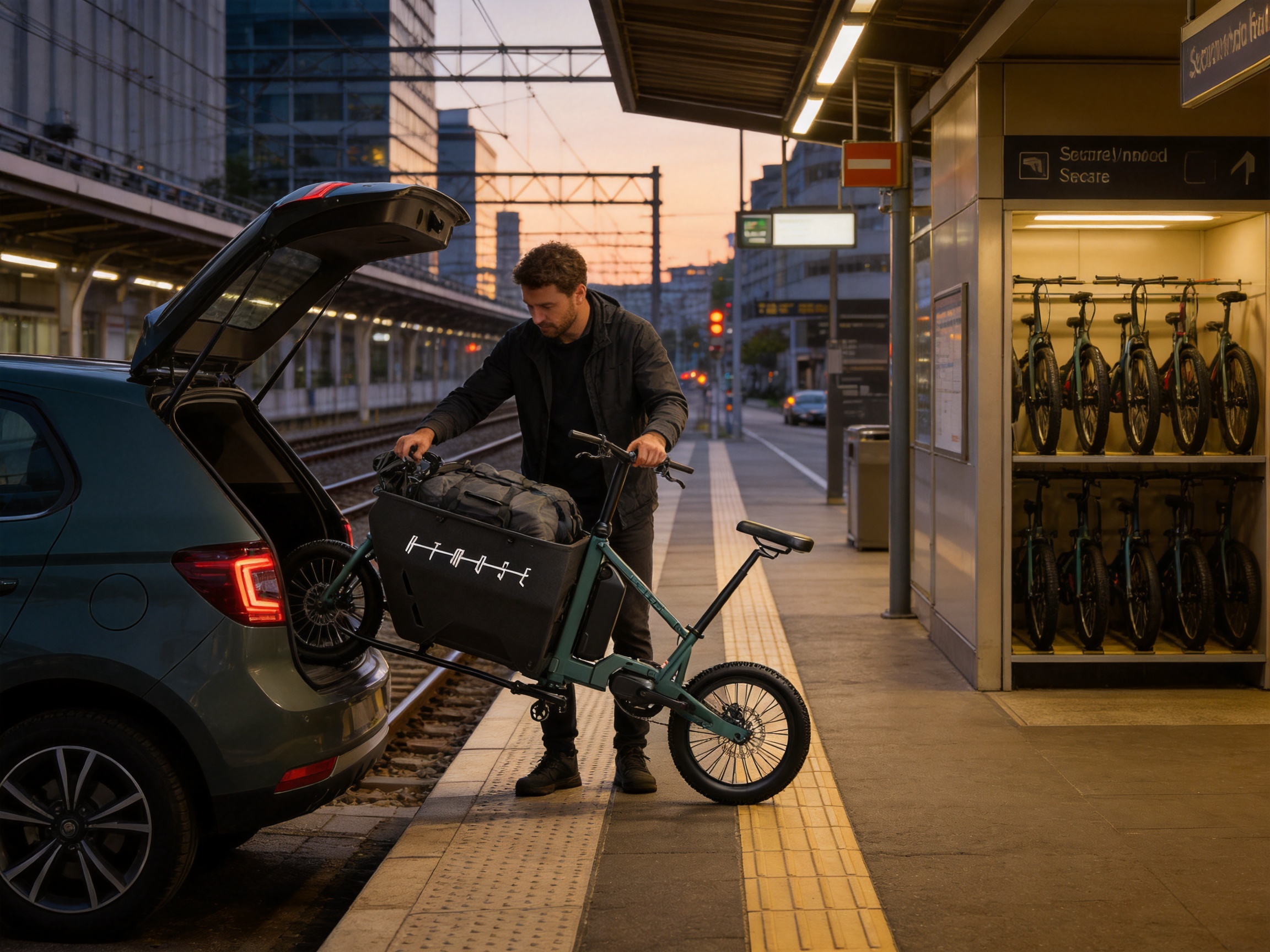
The design also supports a second folded configuration. Removing the front wheel reduces the package to 102 by 44 by 76 centimeters. This creates an option for vehicle transport. A rider who drives to a destination, parks outside a dense center, and then cycles the final distance can use the bike as a last-mile vehicle. The same approach can support weekend trips, train-station access, or occasional travel between homes and workplaces.
Many cargo bikes are difficult to combine with cars because they require a specialist rack. Roof-mounted systems can increase vehicle height and require lifting. Rear carriers can be expensive and may not support a long or heavy cargo frame. By contrast, the Model R is designed to enter the vehicle itself after folding and wheel removal, subject to the dimensions of the specific trunk and the weight the user can safely manage.
Its folding function also supports indoor storage. Keeping a cargo bike inside reduces exposure to rain, road salt, ultraviolet light, and theft. Indoor storage can help preserve components and reduce the frequency of cleaning, particularly in climates with wet winters or coastal air. It also makes the bike more visible and accessible, which may encourage more frequent use.
A crucial usability detail is that the folded bike is designed to roll rather than be carried continuously. A folded cargo bike is naturally more substantial than a compact folding commuter bike. Expecting users to lift it through a station or carry it across a long platform would reduce the value of the folding feature. Rolling allows the bike to be pushed through a station hall, into an elevator, or toward an office without requiring the rider to carry the entire package for an extended distance.
This roll-when-folded concept is an important distinction between occasional folding and genuinely multi-modal use. A bicycle that folds but is awkward to move may be practical only for storage. A bicycle that folds and rolls can become part of a daily transportation chain.
The Model R is equipped with a 36-volt, 250-watt mid-drive motor that delivers up to 70 newton-metres of torque. A mid-drive motor places the assistance near the bicycle’s crank and uses the bike’s gearing to help propel the bicycle. This arrangement can be particularly useful when carrying cargo or climbing urban inclines because the motor can work through the selected gear rather than driving only through a wheel hub.
Torque is important for cargo-bike performance. A lightly loaded bicycle may feel responsive with modest assistance, but a rider carrying a dense grocery load or business equipment will notice the effect of hills, starts, and repeated stops. Up to 70 newton-metres gives the Model R a strong assistance specification for urban cargo use, especially when combined with a low gear from the Shimano Nexus 3 internal gear hub.
The 250-watt rating is consistent with the power category commonly used for regulated electric bicycles in many markets, although local requirements differ. Riders must check the laws that apply to speed limits, equipment, road access, helmet use, and motor assistance in their location. The motor specification does not by itself determine legal classification in every country.
The motor is supported by a Samsung 36-volt, 20-amp-hour lithium battery with a stated capacity of 720 watt-hours. Battery capacity is one of the most significant factors in cargo-bike usability. A large battery can provide greater flexibility for longer trips, frequent starts, heavier loads, and hilly routes, although actual range depends on rider weight, cargo, terrain, temperature, tire pressure, assistance level, speed, and riding conditions.
A 720-watt-hour battery gives the rider more energy reserve than many lightweight urban electric bicycles. This is valuable because cargo bikes often work harder than ordinary commuters. They carry more mass, use wider tires, and may experience more frequent acceleration from traffic lights. A larger battery can reduce the need to recharge after every short journey and provide more confidence when the day includes multiple destinations.
The battery also supports the Model R’s role as a transport substitute. If the bike is used for shopping, commuting, school-related errands, or commercial deliveries, daily mileage may be spread across several separate rides. The larger energy reserve is useful for this type of irregular but demanding use.
Motor assistance should not be understood as a replacement for sensible gearing and riding technique. Starting in an appropriate gear, avoiding unnecessary acceleration, maintaining correct tire pressure, and distributing cargo evenly all contribute to better performance. The mid-drive system and internal gear hub provide a strong technical foundation, but efficient use still depends on the rider.
One of the strongest practical features of the Model R is its Gates belt drive paired with a Shimano Nexus 3 internal gear hub. This combination is particularly well suited to riders who want an everyday utility vehicle rather than a bicycle that demands frequent mechanical attention.
A belt drive replaces the conventional metal chain with a toothed belt. It does not require chain oil, and it is less likely to transfer black lubricant onto clothing, hands, luggage, or the frame. This is a meaningful advantage for commuters who ride to an office or use the bike in clean indoor environments.
Reduced lubrication requirements can also simplify ownership. The belt still needs to be kept clean and correctly tensioned, and the rest of the drivetrain requires appropriate inspection. However, the routine process is generally less messy than cleaning, degreasing, and lubricating a chain exposed to rain and road debris.
The Shimano Nexus 3 internal gear hub places the gear mechanism inside the rear hub. This protects much of the shifting hardware from direct exposure to dirt and impact. It also allows the rider to shift while stationary. The ability to select a lower gear at a traffic light is especially useful on a loaded cargo bike, where starting in a high gear can require unnecessary effort.
Internal gearing is different from a wide-range derailleur system. Three gears may not provide the same total range as a high-end multi-speed derailleur, but the system emphasizes simplicity and durability for urban riding. The Model R is intended primarily for city commuting, errands, and practical transport rather than extreme mountain climbing or high-speed touring.
Compared with a traditional chain and derailleur setup, the belt and internal hub reduce the number of exposed moving parts. This can be an advantage in wet cities, areas with winter grit, and workplaces where riders do not want to arrive with a dirty trouser leg. It also complements the folding concept: a compact bike that is frequently taken indoors benefits from a clean drivetrain.
Routine maintenance remains important. Belt tension should be checked according to the manufacturer’s instructions, the belt should not be bent or twisted, and the internal hub should be serviced at the recommended intervals. Brake pads, cables or hydraulic lines, tires, bearings, fasteners, and folding joints should also be inspected regularly.
The frame is made from 6061 T4/T6 aluminum alloy. This alloy family is widely used in bicycle construction because it offers a useful combination of low weight, corrosion resistance, manufacturability, and structural performance. The T4 and T6 designations refer to different heat-treatment states used in aluminum processing. The exact manufacturing sequence and treatment parameters are determined by the producer and its manufacturing partners.
For a folding cargo bike, the frame must do more than support the rider and cargo. It must also accommodate folding joints, alignment requirements, steering forces, motor loads, braking loads, and repeated opening and closing cycles. The structure therefore needs to balance rigidity with practical weight and manufacturability.
A cargo bike can feel unstable if the frame flexes excessively under a heavy load. It can also become uncomfortable if the steering responds unpredictably to uneven weight distribution. The Model R’s front-loading layout, wide tires, hydraulic braking system, and rigid alloy structure are intended to make loaded city riding more controlled.
The stated dimensions are 198 centimeters long, 38 centimeters wide, and 108 centimeters high in riding form. The relatively narrow overall width is useful in urban traffic and storage areas. Width affects whether a rider can pass through bollards, bike gates, narrow corridors, and standard doors. It also affects how much road space the bike occupies when sharing lanes with other vehicles.
The folding mechanism must be treated as a structural system rather than merely a convenience feature. Hinges, locking points, and frame interfaces should be kept clean and checked for secure engagement. Riders should never operate the bicycle unless the frame is fully locked in the riding position. As with any folding bicycle, correct use of the locking system is essential to safe performance.
The frame material and component selection indicate a design approach focused on long-term utility. The product does not rely only on a small size or a low purchase price. Its usefulness comes from the integration of a folding cargo frame, a high-capacity battery, a mid-drive motor, internal gearing, a belt drive, hydraulic brakes, and a substantial basket.
The Model R uses Tektro hydraulic disc brakes. Hydraulic braking systems transmit force through fluid rather than a traditional mechanical cable. They can provide consistent lever feel and strong braking performance, which is particularly important when a bicycle carries both a rider and a heavy front load.
Stopping a loaded bicycle involves more than stopping the bicycle itself. The rider must control additional momentum, and braking may be required repeatedly in traffic. Hydraulic discs are therefore a sensible specification for a cargo bike designed for daily urban use. They can also offer useful performance in wet conditions, although all braking systems require appropriate inspection and maintenance.
The tires measure 16 inches by 2.4 inches at the front and 18 inches by 2.4 inches at the rear. The tires are described as puncture-proof, a feature intended to reduce interruptions caused by common urban debris such as glass, wire, and sharp fragments. No tire is completely immune to every puncture, but protective construction can improve reliability for regular commuting and delivery work.
The wide tire profile provides a larger contact area than a narrow road tire. It can add comfort on uneven pavement and help the bike feel planted when carrying cargo. The different front and rear wheel sizes are part of the vehicle’s overall geometry and folding architecture. Riders should use compatible replacement tires and maintain suitable pressure for the combined rider and cargo load.
Tire pressure has a direct effect on handling, comfort, rolling resistance, and puncture protection. Underinflation can increase tire flex and rim impact risk, while excessive pressure can reduce comfort and traction. The appropriate pressure should be selected according to the tire specification and the actual load carried.
Braking and tire performance are closely connected to load distribution. A front basket loaded with dense objects should be packed so that items cannot shift during braking or cornering. Unsecured cargo can change balance unexpectedly. The rider should also allow greater stopping distance when the basket is heavily loaded, particularly on wet or downhill roads.
Long-tail cargo bikes are popular because they can carry passengers or luggage behind the rider while retaining familiar bicycle handling. However, their extended rear structure can be difficult to store indoors. A long-tail may fit a garage but not a narrow apartment hallway or a small elevator.
The Model R’s key advantage in this comparison is its front-loading format combined with folding storage. It is not necessarily a replacement for every long-tail application. A family transporting two older children may prefer the seating area and accessory ecosystem of a large long-tail. However, a solo commuter, delivery rider, or apartment resident may value the Model R’s ability to fold and roll more than additional rear seating.
Box bikes offer exceptional carrying volume and can be highly practical for families, businesses, and heavy transport. Their long wheelbases often deliver a stable ride, and many provide weather protection or child seating. Their disadvantages are size, storage demands, turning radius, and transportation difficulty.
The Model R competes through flexibility rather than maximum volume. Its 45-kilogram basket capacity is substantial, but the bike remains more compact than a large family box bike. Its folded dimensions make indoor storage and car transport more realistic. For riders whose main problem is not maximum capacity but lack of space, this distinction is significant.
A conventional folding bicycle is easier to store and transport, but it usually offers only limited carrying ability. Small front racks or rear panniers can handle everyday items, but they are not equivalent to a dedicated front cargo basket rated for 45 kilograms.
The Model R offers a more capable utility platform. It can carry larger and heavier loads while still offering a folding system. Its trade-off is that it remains larger and heavier than a compact commuter folder. This is expected because cargo capacity, motorization, battery size, hydraulic brakes, and a reinforced frame all add substance.
Hub-motor cargo bikes can be mechanically simple and effective on flat roads. The Model R’s mid-drive system offers a different advantage: torque is delivered through the bicycle’s gearing. This can be useful on inclines and during loaded starts, where gear selection helps the motor operate effectively.
The mid-drive configuration also works naturally with the Shimano Nexus 3 hub. The rider can select a lower ratio for hills or a higher ratio for steady travel, while the motor assists through the drivetrain. This integrated approach is well suited to a cargo bike that must start, stop, and climb in city conditions.
The Model R is especially relevant to multi-modal travel. A rider may cycle from home to a train station, fold the bike, roll it through the station, board a suitable train according to local rules, and unfold it at the destination. The same bike can then cover the final distance to an office, campus, or delivery point.
Train compatibility always depends on the operator’s policies. Some services require folding bicycles to be enclosed, some restrict them during peak hours, and some do not permit cargo bikes on particular services. The Model R’s compact folded dimensions may improve practical compatibility, but users must verify the applicable rules before traveling.
In an office environment, a folded and rolled cargo bike can be easier to store than a full-size bicycle. Indoor storage may reduce theft concerns and protect the bike from weather. The belt drive is also beneficial here because it is cleaner than an exposed chain.
The car-trunk configuration expands the bike’s travel range. A rider can drive to the edge of a congested area, remove the front wheel, place the folded bike in the trunk, and complete the final journey by bicycle. This arrangement can reduce the need to drive into city centers and can make cycling practical in locations that are too far away for a direct ride from home.
The Model R can also serve as a practical vehicle for mixed households. One person may use it for commuting while another uses it for errands. When not in use, the folded bike occupies less space than a conventional cargo bike, making shared ownership more realistic for apartment residents.
The value of the Model R is not based on a single component. Its usefulness depends on the integration of frame engineering, folding geometry, electric assistance, cargo structure, braking, drivetrain, and storage dimensions. This type of product requires coordinated development because changes in one area affect others.
The company behind the product combines American product thinking with European design and research-and-development activity in Paris. The brand originated in California, while a design and R&D team was established in France. This international structure supports a product philosophy that combines practical utility with urban design requirements.
The company’s background also includes experience connected with MOTIV, an established American beach cruiser brand. That history provides a foundation in bicycle product development, supply-chain coordination, and manufacturing relationships. The company describes its strengths as including mature manufacturing expertise, an established supply chain, and continuous product innovation.
These strengths are particularly relevant to an electric cargo bike because the product must be assembled from multiple specialized systems. The frame must be structurally accurate. The folding joints must align correctly. The motor and battery must be integrated with the electrical system. The belt drive requires correct alignment and tension. The hydraulic brakes need appropriate routing and assembly. The basket must be securely connected to the front structure without compromising steering.
A mature supply chain can help coordinate these different requirements. It may support consistent access to aluminum frame production, drivetrain components, electrical systems, battery cells, tires, braking equipment, and folding hardware. The specific suppliers and factory procedures are not detailed in the provided product information, so no unsupported claims should be made about automated production, particular inspection machinery, or formal certifications. Nevertheless, the product’s component integration reflects a development process more involved than simply adding a motor to a standard bicycle.
Material selection is also part of the manufacturing strategy. The use of 6061 T4/T6 aluminum alloy provides a balance between structural performance and manageable frame weight. The choice of a Gates belt and Shimano internal hub shows attention to the ownership experience, not only the headline electrical specifications. Tektro hydraulic brakes and puncture-resistant tires similarly indicate that the bike was developed as a complete transport system.
Continuous innovation is particularly important for a folding cargo bike. The design challenge is not merely to reduce the dimensions of a normal cargo bike. The folding process must remain practical, the bike must still roll when folded, the front cargo area must remain useful, and the folded package must be small enough to address real storage barriers.
The company’s stated “Fun and Practical” philosophy is visible in this balance. Practicality appears in the basket capacity, belt drive, battery size, and folding dimensions. Enjoyment appears in the effort reduction provided by the mid-drive motor, the clean operation of the belt system, and the freedom to use the bike in more situations.
The Model R is suited to people who do not have a private garage or secure outdoor bicycle room. Its folding dimensions can make storage possible in a hallway, closet area, elevator, or office. Indoor storage is particularly valuable in buildings where leaving a high-value electric bike outside is undesirable.
Riders who combine cycling with rail travel may benefit from a bike that can be folded and rolled through a station. The design is especially relevant when the first and last portions of a journey are inconvenient by foot but too short or congested for a car.
A clean belt drive, internal gearing, and indoor storage capability make the bike practical for people who want to arrive at work without handling a greasy chain. The front basket can hold a work bag, equipment, lunch, or small parcels.
The 45-kilogram front basket and electric assistance can support local delivery work, service calls, market shopping, and business errands. The folding ability may be useful for businesses that need to store the vehicle indoors or transport it between locations.
The reduced dimensions achieved by removing the front wheel make the bike relevant to drivers who want to park outside congested centers and continue by bicycle. This can be useful for commuters, travelers, and visitors to areas where parking is limited.
Prospective owners should measure their actual storage spaces before purchasing. The stated folded dimensions are 120 by 44 by 85 centimeters, or 102 by 44 by 76 centimeters without the front wheel. Door clearances, stair turns, elevator doors, and vehicle trunk openings should all be checked. The rider should also consider whether they can safely remove and reinstall the front wheel.
Weight is another important consideration. The supplied specifications identify the rider and basket capacities but do not provide a complete bicycle weight. Because the bike includes a cargo frame, a mid-drive motor, a 720-watt-hour battery, hydraulic brakes, a belt drive, and a folding structure, it should not be assumed to be as light as a small folding bicycle. The rolling function is therefore an important practical feature.
Load placement should be deliberate. Heavy objects should be positioned low and centered in the basket. Loose items should be secured to prevent movement. The rider should avoid allowing cargo to obstruct the front wheel, steering movement, lights, or braking components.
Folding and unfolding should be performed on stable ground, away from traffic. The frame should be fully locked before riding. The front wheel should be attached securely after transport, and the brake system should be checked before the first ride following reassembly.
Battery care also affects long-term ownership. The battery should be charged using the appropriate charger, protected from extreme temperatures, and stored according to the manufacturer’s instructions. The rider should avoid leaving a lithium battery exposed to excessive heat or freezing conditions for extended periods.
Regular checks should include tire pressure, brake pad condition, hydraulic lever feel, belt tension, wheel security, folding locks, basket attachment points, lighting, and fasteners. A cargo bike experiences higher loads than a standard commuter bicycle, so preventive maintenance is especially important.
| Specification | Model R ESR1 |
|---|---|
| Frame material | 6061 T4/T6 aluminum alloy |
| Motor | 36-volt, 250-watt mid-drive motor |
| Maximum motor torque | Up to 70 newton-metres |
| Battery | Samsung 36-volt, 20-amp-hour lithium battery |
| Battery capacity | 720 watt-hours |
| Rider capacity | Up to 100 kilograms |
| Front basket capacity | Up to 45 kilograms |
| Drivetrain | Gates belt drive and Shimano Nexus 3 internal gear hub |
| Front basket dimensions | 70 by 50 centimeters at the top; 50 by 36 centimeters at the bottom |
| Front tire | 16 by 2.4 inches, puncture-resistant design |
| Rear tire | 18 by 2.4 inches, puncture-resistant design |
| Brakes | Tektro hydraulic disc brakes |
| Riding dimensions | 198 by 38 by 108 centimeters |
| Folded dimensions | 120 by 44 by 85 centimeters |
| Folded dimensions without front wheel | 102 by 44 by 76 centimeters |
| Design priority | Model R advantage | Important consideration |
|---|---|---|
| Storage | Folds to 120 by 44 by 85 centimeters and rolls when folded | It remains larger than a small folding bicycle |
| Car transport | Front wheel removal creates a smaller 102 by 44 by 76 centimeter package | Trunk fit must be confirmed for the individual vehicle |
| Cargo carrying | Front basket rated for up to 45 kilograms | Heavy cargo must be packed securely and evenly |
| Urban assistance | 250-watt mid-drive with up to 70 newton-metres of torque | Local electric-bike laws apply |
| Battery reserve | 720-watt-hour battery supports demanding urban use | Actual range varies with load, terrain, speed, and assistance level |
| Maintenance | Gates belt and internal gear hub reduce exposed drivetrain maintenance | Belt tension and hub servicing still require attention |
| Braking | Hydraulic disc brakes provide strong, controlled braking | Hydraulic systems require proper inspection and service |
| Ride stability | Wide tires and low front cargo positioning support predictable handling | Rider technique and load distribution remain important |
The primary purpose is to provide front-loading cargo capacity in a bicycle that can be folded and stored more easily than a conventional full-size cargo bike. It is aimed at urban riders who need to combine carrying ability with apartment, train, office, or car-trunk storage.
The front basket is rated for up to 45 kilograms. The rider capacity is specified separately at up to 100 kilograms. The cargo should be distributed evenly and secured so that it cannot shift during braking or cornering.
The folded dimensions are 120 by 44 by 85 centimeters. When the front wheel is removed, the folded dimensions become 102 by 44 by 76 centimeters.
The product is designed to roll when folded, which allows the rider to push it through a station, hallway, elevator, or office. Its cargo-bike construction means it should not be expected to handle like a lightweight folding bicycle when lifted.
It uses a 36-volt, 250-watt mid-drive motor with up to 70 newton-metres of torque. The mid-drive configuration works through the bicycle’s gearing and is suitable for loaded starts and urban inclines.
The battery is a Samsung 36-volt, 20-amp-hour lithium battery with a stated capacity of 720 watt-hours. Actual riding range varies according to load, terrain, weather, speed, tire pressure, and assistance level.
No. The drivetrain uses a Gates belt drive paired with a Shimano Nexus 3 internal gear hub. This removes the need for chain lubrication and helps keep the drivetrain clean during daily use.
Its folding and rolling design is intended to support multi-modal travel, including train commuting. However, train operators have different rules regarding folded bicycles, cargo bikes, peak-hour travel, and protective covers. The applicable operator policy should be checked before travel.
The main advantages are reduced storage dimensions, the ability to roll when folded, the option to remove the front wheel for car transport, and a drivetrain that is relatively clean and low maintenance. A full-size cargo bike may still be preferable for larger family loads or maximum cargo volume.
The Model R provides a dedicated front cargo basket rated for up to 45 kilograms, a powerful cargo-oriented mid-drive system, and a larger battery. A normal folding bicycle is usually lighter and smaller, but it generally cannot carry comparable loads.
It may suit small-scale delivery, mobile services, market transport, and business errands because of its basket capacity, motor assistance, and indoor storage potential. Commercial riders should evaluate local regulations, route conditions, daily mileage, and service requirements.
Buyers should check storage and trunk dimensions, local electric-bike regulations, the availability of service support, charging conditions, expected cargo weight, and the train policies relevant to their routes. They should also confirm that the folding process and front-wheel removal are comfortable for their intended use.
The Atmose Model R ESR1 occupies a distinctive space between a full-size cargo bike and a compact folding commuter bicycle. Its central advantage is not one isolated specification but the way its features work together. The front-loading basket provides meaningful carrying capacity. The tri-fold frame reduces storage length. The front wheel can be removed for a smaller vehicle-friendly package. The bike rolls when folded. The mid-drive motor and 720-watt-hour battery support loaded city riding. The belt drive and internal gear hub reduce everyday drivetrain mess. Hydraulic disc brakes and wide puncture-resistant tires provide equipment appropriate for practical urban transport.
Its manufacturing and product-development strengths are similarly integrated. The 6061 T4/T6 aluminum frame, established component selection, international design perspective, manufacturing experience, and mature supply-chain foundation support a product intended for repeated everyday use. While it is not designed to replace every large family cargo bike or every lightweight folding bicycle, it addresses a clear and growing need: carrying more while occupying less space.
For apartment residents, train commuters, urban professionals, small businesses, and car owners seeking a last-mile solution, the Model R offers a compelling combination of flexibility and utility. It is a cargo bike for riders who want the capacity of a practical transport bicycle without accepting the storage demands of a permanently full-size machine.
Atmose Model R ESR1 product specifications and technical information.
Atmose product development and company information supplied for this article.
General bicycle engineering principles concerning aluminum alloy frames, belt drives, internal gear hubs, hydraulic disc brakes, and cargo-bike load distribution.
General guidance on lithium-ion battery care and electric-bicycle operating practices.
General urban mobility research concerning cycling, public-transit integration, last-mile transportation, and indoor bicycle storage.
Nov 17, 2026
Nov 03, 2026
Oct 26, 2026


info@atmosecargobike.com

200 rue de la Croix Nivert 75015 Paris

Custom Electric Bakfiets
 English
 Français
 Deutsch