Aug 29, 2026
Atmose Model V V1 Manual Adventure Cargo Bike with Oversized Front Rack
Adventure cycling is often associated with electric assistance, large batteries, sophisticated displays, and access to regular charging infrastructure. Those technologies have transformed cargo bikes, making it easier to carry heavy equipment over long distances and steep terrain. However, they are not ideal for every rider or every environment. Remote trails, wilderness camps, long expeditions, transport by small aircraft, and locations far from electrical infrastructure create a different set of priorities. In these situations, simplicity, serviceability, low weight, and mechanical dependability can matter more than motor power.
The Atmose Model V V1 Manual Adventure Cargo Bike is designed around that alternative philosophy. It removes the motor and battery while retaining the practical cargo architecture, oversized front rack, wide tires, multi-speed drivetrain, hydraulic disc brakes, and reinforced frame required for serious outdoor use. The result is a mechanically powered cargo bike intended for riders who want to carry substantial equipment into places where charging stations, replacement batteries, and electronic diagnostics may not be available.
Rather than presenting itself as a reduced version of an electric cargo bike, the V1 is better understood as a purpose-built expedition platform. Its character comes from the combination of a high-capacity front deck, a relatively light mechanical configuration, a wide-range Shimano 11-speed Cues drivetrain, puncture-resistant tires, and a robust aluminum frame. These features allow it to serve as a camping hauler, a bikepacking companion, a remote-work transport vehicle, or a practical utility bike for difficult terrain.
This article examines the product’s design, capability, manufacturing strengths, competitive advantages, practical applications, limitations, maintenance requirements, and the company philosophy behind its development.
Performance in an urban cargo bike is often measured by acceleration, battery range, motor torque, and the ability to keep pace with traffic. Adventure performance has a broader definition. It includes the ability to function far from support, carry essential supplies, remain controllable on uneven ground, withstand repeated impacts, and be repaired with tools that a rider can realistically carry.
The V1 Manual Adventure Cargo Bike addresses these requirements by eliminating the electrical systems that can become difficult to support in remote areas. There is no traction motor, battery pack, charging port, controller, display, or electronic assistance system. The rider supplies the energy, while the mechanical drivetrain converts that effort into forward motion through a range of gears.
This approach offers a clear benefit: fewer systems can mean fewer specialized failure points. A rider may still experience a flat tire, worn chain, damaged cable, or brake adjustment issue, but these are familiar bicycle maintenance tasks. They do not require battery diagnostics, firmware updates, proprietary chargers, or access to a motor service center.
The absence of a battery also produces practical advantages in transport. A manual cargo bike is easier to lift, position, and secure than a comparable electric model. For expeditions involving boats, trains, vans, mountain aircraft, or difficult portages, every kilogram matters. The V1’s mechanical configuration gives riders more flexibility when the route includes obstacles that cannot be crossed while riding.
This is not a product intended to make difficult terrain effortless. Its purpose is to give capable riders a dependable platform for carrying equipment through difficult terrain. The physical effort is part of the experience, while the bike’s engineering helps make that effort productive and controlled.
The V1 uses a 6061 T4T6 aluminum alloy frame. This material is widely valued in bicycle construction because it combines relatively low weight with good structural strength, corrosion resistance, and suitability for precision fabrication. The frame forms the foundation of the cargo system, supporting the rider, front load, steering structure, wheel assemblies, and braking forces generated during descents.
The product has a maximum rider load specification of 145 kilograms and a basket capacity of 25 kilograms. These figures should be interpreted as operating limits rather than invitations to exceed the bike’s design envelope. Load distribution, terrain, speed, tire pressure, braking technique, and the condition of the bike all affect safe handling. A properly balanced load is especially important on a cargo bike because weight positioned over the front wheel can influence steering response.
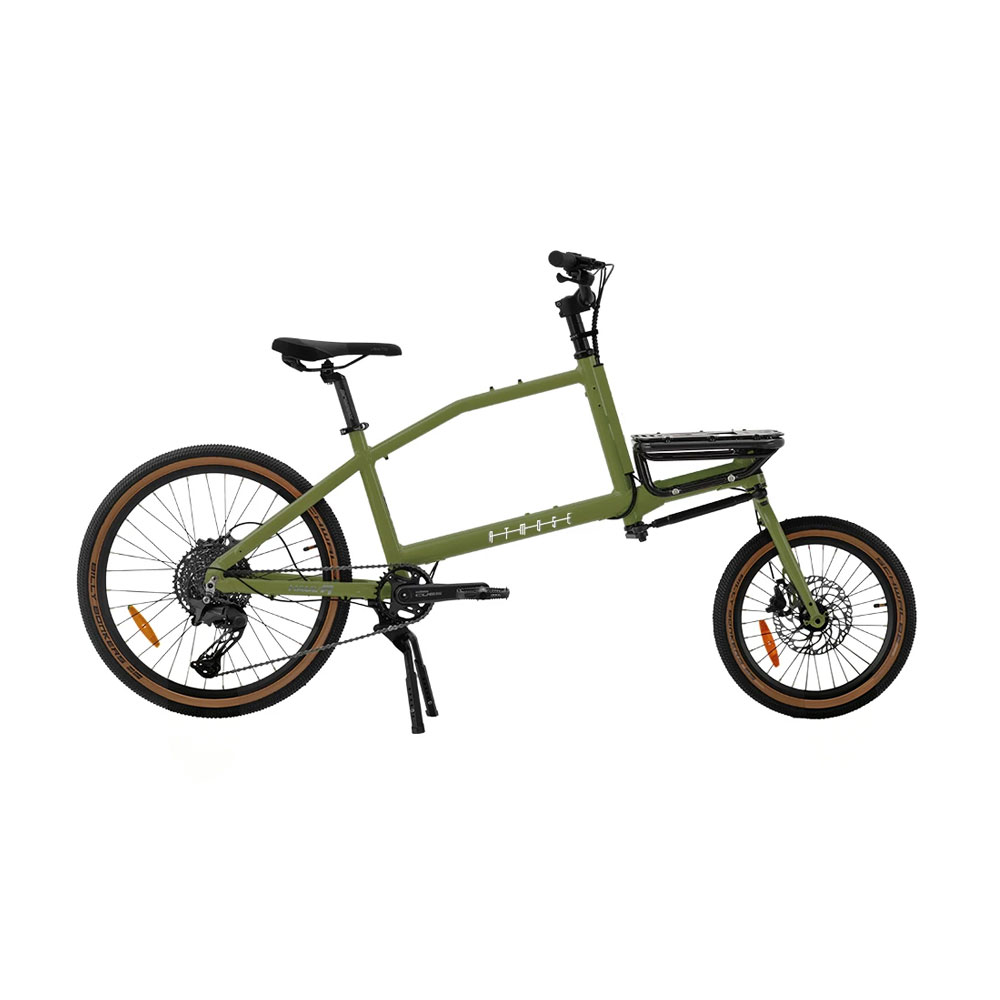
The front folding basket measures approximately 470 millimeters in length, 470 millimeters in width, and 375 millimeters in height. This provides a substantial loading area for outdoor equipment, groceries, tools, camping containers, or expedition supplies. Unlike a narrow handlebar bag or small rear rack, a front cargo deck can accommodate bulky items that are difficult to secure elsewhere.
The bike’s overall dimensions are approximately 1,910 millimeters long, 750 millimeters wide, and 1,060 millimeters high. The 750-millimeter width creates a stable platform while remaining manageable on many roads, paths, and transport systems. Riders should still check the width of gates, storage rooms, public transport spaces, and narrow trail sections before planning a route.
The wheel configuration combines 18-inch front tires and a 20-inch rear tire, each approximately 2.4 inches wide. The wide, puncture-resistant tires are intended to provide a larger contact patch, better comfort, and improved traction over loose or irregular surfaces. Smaller cargo-bike wheel sizes can also help keep the load platform low and reduce the bike’s overall center of gravity.
Stopping power comes from Tektro hydraulic disc brakes. Hydraulic braking can provide consistent control, smooth modulation, and strong braking force, particularly when the bike and its cargo are heavily loaded. The system remains mechanical in the sense that it does not depend on a battery for operation, although it does require proper fluid, hose, pad, and rotor maintenance.
The drivetrain is a Shimano 11-speed Cues system. Its wide gear range is particularly relevant to an unassisted cargo bike. Lower gears help the rider climb with a heavy load, while higher gears allow efficient progress on flatter sections and descents. The number of available gears does not remove the physical challenge of climbing, but it helps the rider select a cadence and mechanical advantage appropriate to the terrain.
| Component or specification | V1 product detail | Practical significance |
|---|---|---|
| Frame | 6061 T4T6 aluminum alloy | Balances structural strength, corrosion resistance, and manageable weight |
| Power system | Manual drivetrain; no motor | Removes dependence on electrical assistance and charging infrastructure |
| Battery | Not equipped | Reduces weight and eliminates battery storage and charging requirements |
| Drivetrain | Shimano 11-speed Cues | Provides a broad range for climbing and loaded riding |
| Maximum rider load | 145 kilograms | Supports substantial rider weight within the stated limit |
| Front basket capacity | 25 kilograms | Allows carriage of camping, work, shopping, or utility equipment |
| Front basket dimensions | 470 × 470 × 375 millimeters | Creates a large, practical loading area |
| Wheel and tire size | 18-inch front and 20-inch rear, 2.4-inch width | Supports stability, traction, and comfort on uneven surfaces |
| Braking system | Tektro hydraulic disc brakes | Improves control under load and during descents |
| Overall dimensions | 1,910 × 750 × 1,060 millimeters | Defines storage, transport, and route-clearance requirements |
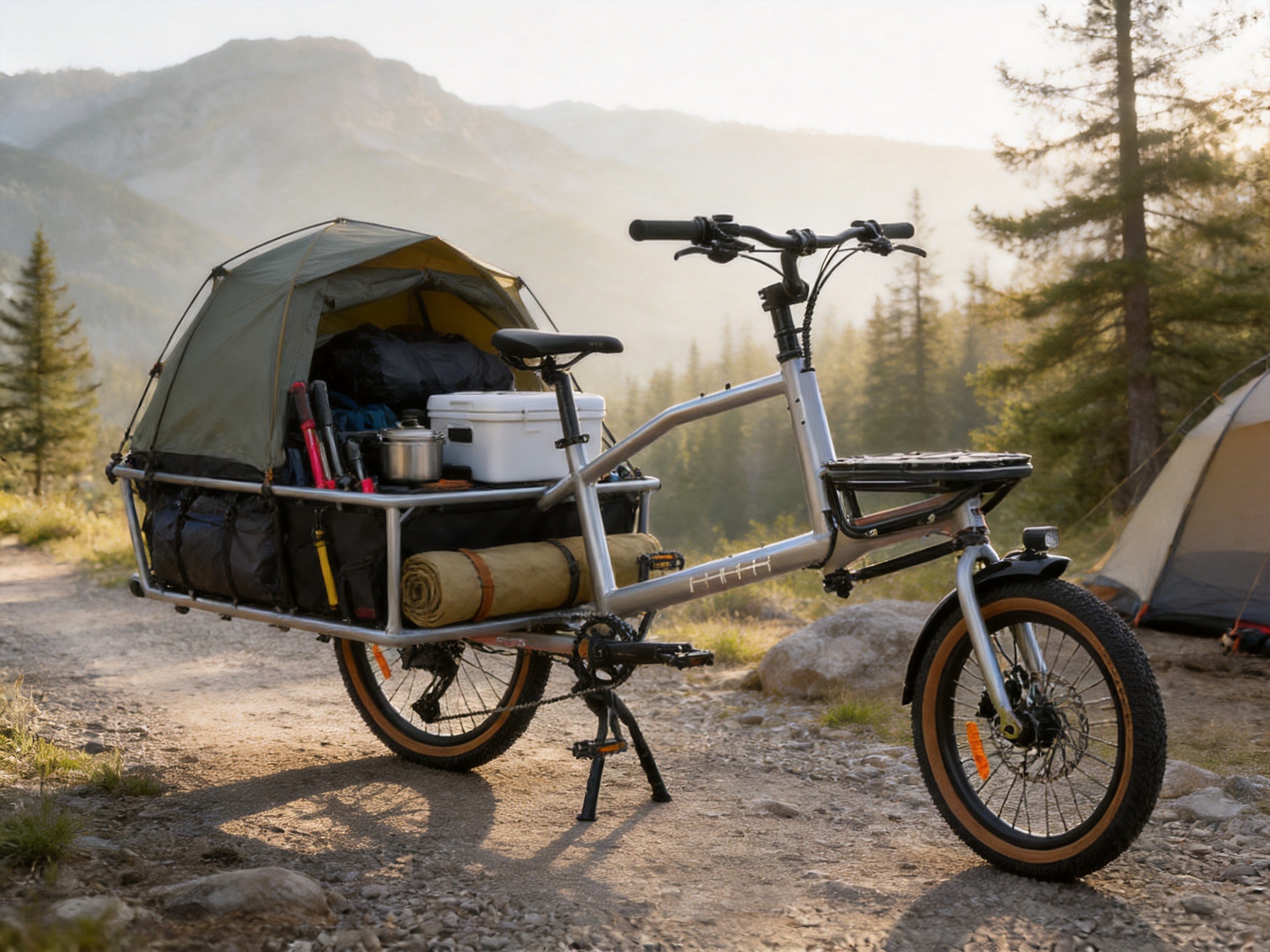
The most visible feature of the V1 is its oversized front cargo basket. Many bicycles can carry small bags, panniers, or a modest rear load, but expedition riding often involves equipment that is too large, too irregularly shaped, or too fragile for a conventional rack. A tent packed in a long bag, a cooler, cooking equipment, repair tools, water containers, or field supplies may be easier to organize on a broad front platform.
A large front deck also makes loading more accessible. Riders can place equipment directly into the basket without lifting it high over a rear rack or saddle. This is useful when loading heavy items repeatedly, especially at a campsite, workshop, market, or delivery point. The lower loading position can reduce lifting strain and make it easier to inspect, strap, or remove cargo.
However, a large cargo area must be used intelligently. The heaviest items should be positioned low and close to the center of the basket. Soft goods can fill open spaces, while rigid containers should be secured so that they cannot shift during braking or cornering. Loads should not obstruct the rider’s view, interfere with steering movement, cover the front lighting area if lights are installed, or extend beyond safe legal limits for the intended riding location.
The front basket’s folding design adds another layer of practicality. When folded, it can simplify storage, transport, and access to narrow spaces. A folding structure is particularly useful for riders who move the bike between a garage, vehicle, storage shed, or temporary camp. It also reflects the product’s broader emphasis on flexibility rather than single-purpose use.
Compared with a standard longtail cargo bike, the V1’s front-loading configuration keeps the primary cargo visible to the rider. This can help with monitoring valuable or delicate equipment. It may also make loading more intuitive for users who prefer to place gear in front of them rather than behind the saddle.
One of the V1’s strongest competitive advantages is its electrical independence. Electric cargo bikes are highly useful for commuting, family transport, and delivery work, but their convenience depends on a functioning energy system. A battery must be charged, stored within appropriate temperature conditions, and maintained over time. A motor and controller add additional components that require specific replacement parts and technical knowledge.
In a city, these requirements are usually manageable. In remote terrain, they can become a logistical problem. A rider may have no access to an electrical outlet for several days. A damaged charging connector can end a trip even when the mechanical components remain functional. A depleted battery can also make a heavy electric cargo bike difficult to move manually.
The V1 avoids these concerns. Its operating range is determined by the rider’s physical capacity, food and water supply, route planning, and mechanical condition rather than by a battery’s watt-hours. This makes the product attractive for journeys where the route cannot be predicted precisely or where access to electricity is uncertain.
Mechanical simplicity does not mean maintenance-free operation. Chains need lubrication, tires require inflation, brake pads wear, and cables or hydraulic components may need inspection. The difference is that these systems are familiar to bicycle mechanics throughout the world. A rider who knows how to repair a puncture, adjust a derailleur, replace a chain, or align a brake can address many common issues without specialized electronic equipment.
The absence of a motor also reduces the risk of damage caused by water, mud, impact, or extreme operating conditions to sensitive electronic components. This does not make the bike indestructible, and riders should still avoid unnecessary immersion, protect bearings, and clean the bike after muddy rides. Nevertheless, a simpler architecture can be a significant advantage when reliability and field repair are more important than assisted speed.
Carrying cargo without motor assistance makes drivetrain selection especially important. A rider who carries a light backpack may manage a steep hill in a high gear, but a rider transporting camping equipment, water, food, and tools needs a much lower ratio. The V1’s Shimano 11-speed Cues drivetrain provides multiple steps between climbing and cruising gears.
Low gears reduce the force required at the pedals by allowing the rear wheel to turn more slowly for each revolution of the crank. This helps the rider maintain a manageable cadence on slopes. The bike will travel more slowly, but the rider can distribute effort more effectively and avoid exhausting the muscles too quickly.
On flatter terrain, intermediate gears can support steady progress without excessive spinning. Higher gears are useful on paved sections, gradual descents, or open roads where the rider can safely increase speed. The broad range makes the bike more adaptable to routes that combine forest tracks, gravel roads, paved connectors, and mountain approaches.
Gearing is most effective when paired with thoughtful riding technique. Riders should shift before a climb becomes too steep, maintain a smooth cadence, and avoid forcing the pedals in an overly high gear. Under heavy load, early shifting reduces stress on the chain, cassette, derailleur, and rider. A well-organized load also improves climbing because less energy is lost to unnecessary movement or poor balance.
Compared with a single-speed utility bike, the V1 is better suited to varied terrain and changing cargo weights. Compared with an electric cargo bike, it requires more rider input, but its gearing gives the rider greater control over effort and pace without relying on a motor.
The V1 uses wide 2.4-inch tires on 18-inch front wheels and a 20-inch rear wheel. Wide tires can improve stability by increasing the contact area between the bike and the ground. They can also provide additional cushioning when ridden at appropriate pressures on gravel, hard-packed trails, compact soil, and uneven pavement.
The smaller wheel format is relevant to cargo-bike handling. A smaller wheel can make it easier to keep the cargo deck low, which helps lower the center of gravity. It can also contribute to a compact frame profile and responsive acceleration from a standstill. These advantages are valuable when maneuvering a loaded bike through a campsite, narrow track, or busy loading area.
There are trade-offs. Smaller wheels may roll over large obstacles less easily than larger wheels, and wide tires can create additional rolling resistance on smooth pavement if inflated for maximum off-road comfort. The appropriate tire pressure depends on rider weight, cargo weight, terrain, and tire construction. Riders should follow the tire manufacturer’s pressure guidance and adjust carefully within the approved range.
The reference to puncture-resistant tires is especially important for adventure use. Sharp stones, thorns, broken branches, and rough trail edges can create problems far from a repair shop. Puncture resistance does not eliminate the need for spare tubes, tire levers, a pump, and a patch kit, but it can reduce the frequency of punctures and improve confidence on unpredictable surfaces.
A cargo bike’s braking requirements increase as its total weight increases. The rider, bicycle, cargo, and equipment all contribute to momentum. Descending a hill with a loaded front basket requires smooth speed control and careful use of both brakes. The V1’s Tektro hydraulic disc brakes are designed to provide responsive stopping power and modulation.
Hydraulic systems transmit hand pressure through brake fluid rather than a mechanical cable. This can produce a smooth lever feel and consistent application across the brake pads. Hydraulic disc brakes also perform well in conditions where rim brakes may be affected by wet rims, mud, or wheel contamination.
Riders should still use proper braking technique. Both brakes should be applied progressively, with attention to weight transfer during deceleration. Sudden front-brake input on loose terrain can cause the front wheel to lose traction, while excessive rear-brake use can cause skidding. Heavy cargo should be secured because movement during braking can affect stability.
Before an expedition, riders should inspect the rotors, check pad thickness, confirm that the levers feel firm, and look for signs of fluid leakage. Brake components should be kept free of oil and unsuitable cleaning products. Long descents should be managed with controlled braking rather than continuous dragging, which can generate heat and accelerate wear.
The 6061 T4T6 aluminum alloy frame is a central part of the V1’s balance between strength and weight. Aluminum alloy is commonly used in modern bicycles because it offers a favorable strength-to-weight ratio and strong resistance to ordinary corrosion. It is also compatible with established fabrication methods, allowing manufacturers to create shaped tubes, brackets, mounts, and cargo-support structures suited to a particular design.
The T4T6 designation indicates a controlled heat-treatment condition associated with the alloy. In practical terms, the material choice reflects an effort to achieve dependable structural performance while avoiding the excessive mass that would make a manual cargo bike difficult to handle. This matters because the V1 is intended to be lifted over obstacles and transported without the assistance of a motor.
Frame performance depends on more than the alloy specification. Tube geometry, weld quality, joint design, alignment, load paths, fastener selection, surface finishing, and inspection all contribute to the final result. A cargo-bike frame must manage forces from the front deck, steering assembly, wheels, braking system, and rider. It also needs to remain stable when the load is not perfectly uniform.
The product’s design philosophy emphasizes precision engineering and mechanical reliability. The most meaningful interpretation of that philosophy is not that the bike cannot be damaged, but that its structure is designed to perform consistently when used within its stated limits. Riders should therefore respect the maximum load specifications, inspect the frame after significant impacts, and avoid unauthorized modifications that could change the way forces are distributed.
The company behind the V1 combines American product development experience with European design and research-and-development activity. The brand originated in California and was developed from the experience of MOTIV, an established American beach cruiser brand. A design and R&D team based in Paris adds a European perspective focused on usability, proportions, urban practicality, and visual refinement.
This international structure can be valuable in cargo-bike manufacturing. The American product background contributes experience in recreational cycling, comfort, and lifestyle-oriented design. European development experience is relevant to dense urban environments, practical transportation, compact storage, and the regulatory and usage expectations associated with bicycle mobility in European cities.
The V1 demonstrates how that combination can be applied beyond ordinary urban commuting. Its design is practical enough for everyday utility but specialized enough for outdoor exploration. The frame and rack are not merely decorative elements; they serve a defined cargo function. The lack of a battery is also a deliberate product decision rather than an accidental omission.
Manufacturing strength is additionally supported by a mature supply chain and accumulated production knowledge. A cargo bike requires coordinated sourcing and assembly across frame components, wheels, tires, braking systems, drivetrain parts, cargo structures, fasteners, and finishing processes. Consistency between these systems is essential. A high-quality drivetrain cannot compensate for poor frame alignment, and a strong frame cannot provide a satisfactory ride if the wheels are improperly tensioned or the brakes are inadequately set up.
A responsible manufacturing process should include incoming component checks, frame alignment inspection, weld and finish review, torque verification, brake testing, gear adjustment, wheel inspection, and a final road or functional test. While not every internal procedure is publicly detailed, these are the types of quality-control stages that support the product’s stated emphasis on reliability and precision engineering.
The company’s focus on custom design and wholesale orders is another indication of manufacturing flexibility. Cargo bikes are often purchased for specific use cases, and different customers may need different racks, colors, accessories, load configurations, or branding treatments. The ability to support custom projects can help a manufacturer understand commercial and institutional needs that differ from those of individual recreational riders.
For the V1 specifically, manufacturing discipline is important because the bike’s value depends on integration. The frame must support the front basket, the steering must remain predictable with cargo, the wheel sizes must match the intended geometry, the drivetrain must handle loaded climbs, and the brakes must provide confidence on descents. A product built for remote adventure cannot be evaluated by appearance alone; its components must work together under sustained use.
A conventional bicycle may be lighter and faster when carrying only a small personal load, but it is not designed to carry a large, stable cargo volume. Adding racks, panniers, trailers, and straps can increase complexity and still leave the rider without a convenient loading platform. The V1 begins with cargo capacity as a primary design objective.
Its oversized front basket can hold items that would be awkward on a standard frame. The dedicated cargo structure also makes loading and unloading more straightforward. For expedition riders, this can reduce the need to distribute numerous small bags across the frame and saddle.
Many cargo bikes are optimized for city errands, family transportation, or delivery work. They may use narrower tires, electric assistance, enclosed passenger areas, or fixed cargo boxes. The V1 is differentiated by its manual configuration and outdoor-oriented specification.
Its wide tires, hydraulic disc brakes, folding front basket, and low-maintenance electrical profile make it more suitable for riders who expect mixed terrain and limited support. It is not necessarily the fastest option in an urban environment, but it offers a broader margin of practical independence for off-grid use.
An electric cargo bike generally has a major advantage on steep climbs, long commutes, and frequent heavy-load trips. Motor assistance can reduce rider fatigue and make cargo transport accessible to a wider range of users. The V1 does not attempt to outperform an electric model in motorized acceleration or hill assistance.
Its advantage lies elsewhere. It is lighter than comparable electric cargo bikes, does not require charging, avoids battery degradation, and has fewer electronic components. It can be transported more easily and may be more appropriate for areas where energy access is unreliable. Riders who prioritize repairability and expedition independence may prefer these characteristics over electric assistance.
Single-speed bikes can be reliable and easy to maintain, but they often provide limited flexibility when terrain changes or cargo weight increases. The V1’s 11-speed drivetrain gives it a more useful range for climbs, flat roads, and descents. This makes it more adaptable to long-distance routes and changing conditions.
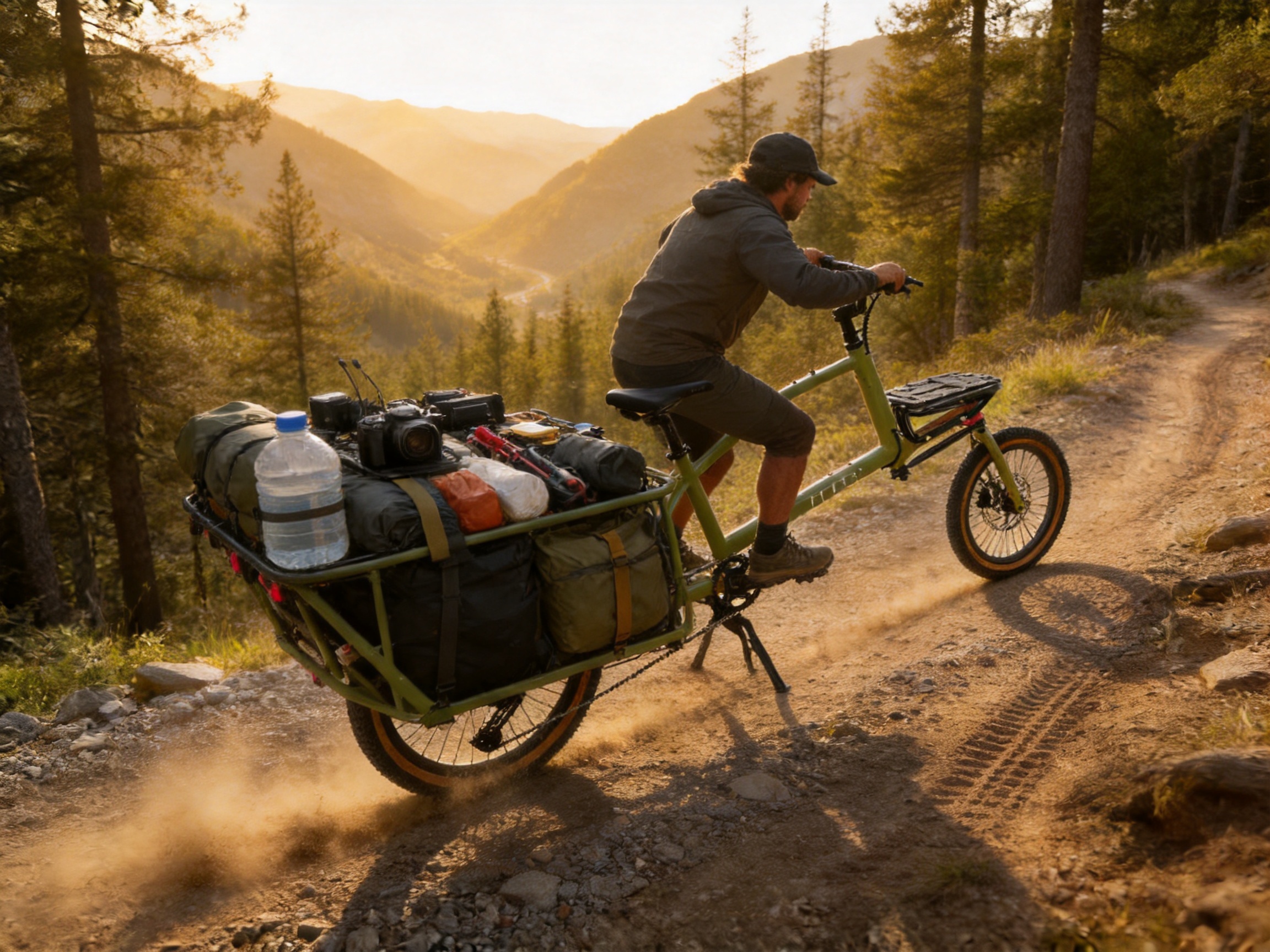
The V1 is naturally suited to bikepacking because its front basket can carry a tent, sleeping system, cooking equipment, food, water, and repair supplies. The rider can organize equipment in waterproof bags or modular containers, keeping frequently accessed items near the front of the bike.
Its lack of a battery is useful on multi-day routes. There is no need to plan daily charging stops or carry a backup battery. Riders can choose remote campsites based on terrain and water access rather than proximity to electrical infrastructure.
Outdoor professionals, field researchers, park workers, photographers, and conservation teams may need to move equipment along roads or trails where a motor vehicle is unsuitable. A cargo bike can provide quiet, low-impact transport while carrying more equipment than a standard bicycle.
The V1’s mechanical format may be especially useful in locations where charging facilities are unavailable or where quiet operation is desirable. It allows a rider to approach a site without the sound of a motor and without producing direct operating emissions.
Riders living in rural areas may travel across a mixture of pavement, gravel, farm tracks, and compact dirt. The wide tires and multiple gears can help the V1 handle these transitions. It can carry groceries, tools, parcels, or agricultural supplies while remaining smaller and more maneuverable than a utility vehicle.
Organizers of long-distance rides and outdoor events may use a bike such as the V1 to transport water, equipment, medical supplies, or maintenance tools. The large front rack gives support staff a practical way to carry supplies without using a motor vehicle on restricted paths.
Although the product is designed for adventure, it can also serve everyday purposes. A rider may use it for market trips, hardware purchases, gardening supplies, or weekend recreation. The absence of a battery means that the bike can remain ready to ride without a charging routine, provided the tires, brakes, and drivetrain are maintained.
Riding technique has a major influence on the V1’s performance. The first step is to distribute weight carefully. Heavy objects should be placed toward the center and bottom of the basket, while lighter or bulky items can be secured above them. Straps should be tight enough to prevent movement but should not damage soft equipment.
Before setting off, the rider should turn the handlebar fully in both directions to confirm that the load does not interfere with steering. The front wheel, brake rotor, and tire should also be checked for clearance. If the cargo is tall, the rider should consider how it affects wind resistance and visibility.
Starting from a complete stop requires more effort than starting an unloaded bicycle. Selecting a low gear before stopping can make departure easier. The rider should apply steady pedal pressure and avoid sudden steering inputs until the bike is balanced.
Cornering should be smooth and deliberate. A high or poorly secured load can raise the center of gravity and make the bike feel less stable. Riders should reduce speed before corners rather than braking sharply while turning. On loose surfaces, gentle steering and balanced braking help preserve traction.
Climbing with cargo requires pacing. A rider should select a low gear early, maintain a consistent cadence, and remain seated when traction is limited. If the slope becomes too steep, dismounting and pushing is a normal part of adventure cycling. The V1 is designed to be easier to move than a heavily equipped electric cargo bike, so walking the bike over a difficult section remains a practical option.
Descending requires equal attention. Cargo increases momentum, so riders should inspect the route, control speed before sharp turns, and use both hydraulic brakes progressively. Long descents should include pauses when necessary to manage fatigue and inspect the equipment.
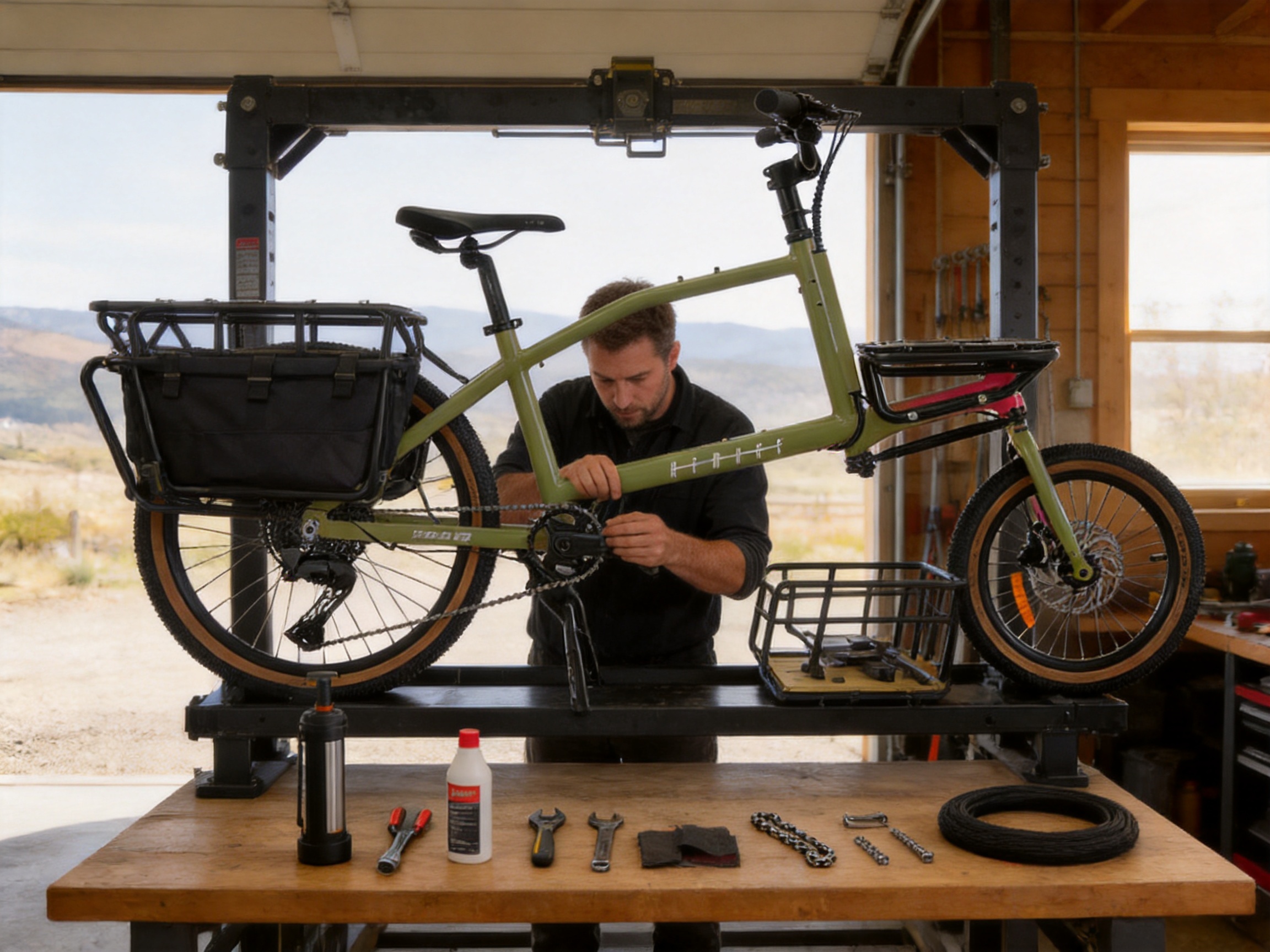
Regular maintenance begins with basic inspection. Before each ride, the rider should check tire pressure, visible frame condition, quick-release or axle security, brake lever feel, chain condition, and cargo fasteners. These checks take only a few minutes but can prevent small issues from becoming serious problems far from assistance.
The chain should be cleaned and lubricated according to riding conditions. Dusty trails may require more frequent cleaning, while wet or muddy environments can accelerate corrosion and contamination. Excess lubricant should be wiped away because it attracts grit and can reduce drivetrain efficiency.
Brake pads and rotors should be inspected regularly, particularly after heavily loaded descents. A soft brake lever, unusual noise, vibration, or reduced stopping performance should be treated as a service warning. Hydraulic systems may require professional bleeding if air enters the lines or the fluid becomes contaminated.
Tires should be checked for cuts, embedded thorns, worn tread, and sidewall damage. Adventure riders should carry a pump or inflator, tire levers, spare tubes, patches, and a tool capable of removing the wheel if necessary. Puncture-resistant construction improves reliability but does not eliminate the possibility of a flat.
The 11-speed drivetrain should be kept correctly adjusted. Slow or noisy shifting may indicate cable tension problems, derailleur damage, a bent hanger, or excessive drivetrain wear. Riders planning remote journeys should complete a full inspection before departure and replace worn consumables in advance.
The frame and cargo basket deserve special attention because they carry the expedition load. Check weld areas, mounting points, folding hinges, bolts, and strap contact zones. After a crash or major impact, the bike should be inspected by a qualified technician before continued use.
A basic field kit may include a multi-tool, spare tube, patch kit, tire levers, compact pump, chain quick link, spare derailleur cable, brake-related essentials, zip ties, tape, and a small selection of replacement bolts. The precise kit depends on the route and the rider’s technical ability.
Sustainability is not limited to the energy used while riding. Product longevity, repairability, material efficiency, and replacement-part availability also influence environmental impact. A manual cargo bike has no battery pack to replace or recycle, and it consumes no electrical energy during operation.
Its mechanical systems can be serviced over time, allowing the product to remain useful rather than being discarded because of a failed integrated electronic system. A durable frame paired with replaceable tires, brake pads, chains, cables, and drivetrain components can support a long service life when properly maintained.
The company’s stated commitment to sustainability and practical mobility aligns with this approach. The V1 encourages transport by human power and can replace short vehicle trips in appropriate settings. For camping and outdoor recreation, it can also reduce dependence on fuel-powered transport along permitted routes.
Responsible use remains essential. Riders should respect trail regulations, avoid sensitive habitats, carry out all waste, and use established paths where required. A low-emission vehicle is most sustainable when it is operated thoughtfully and maintained for many years.
The company describes its guiding philosophy as “Fun & Practical.” The V1 illustrates both sides of that idea. The practical side is visible in the cargo platform, folding structure, load specification, wide-range gearing, and hydraulic brakes. The fun side comes from the freedom to explore, travel without charging anxiety, and use a capable bicycle in places that ordinary urban models may not reach comfortably.
The product also reflects a willingness to serve different mobility needs through a broader cargo-bike range. Family, urban companion, adventure, heavy-duty, children’s learning, and flexible mobility categories each address different riders and applications. The V1 occupies the adventure category by focusing on independence, equipment carrying, and rugged mechanical use rather than passenger transport or delivery specialization.
This category-based approach can help a manufacturer avoid forcing every customer into one universal design. Cargo bikes vary significantly in their requirements. A family bike may prioritize seating and protection, while a commercial bike may prioritize payload and service intervals. An adventure bike must balance load capacity with maneuverability and transportability. The V1’s specifications reflect that particular balance.
Prospective riders should first consider whether they genuinely want a manual cargo bike. The V1 is a strong choice for those who value exercise, simplicity, remote access, and lower system complexity. It may not be the best choice for riders who regularly need to carry very heavy loads up steep urban hills with minimal physical effort.
Route planning is also important. The bike’s dimensions should be compared with the rider’s storage space, vehicle racks, gates, elevators, and transport arrangements. The folding front basket can help, but the complete bike remains a substantial cargo platform rather than a compact folding bicycle.
Load requirements should be evaluated realistically. The 25-kilogram basket capacity is generous, but the rider should account for the weight of containers, straps, water, food, and accessories. The total system should remain within the stated specifications, and the load should be balanced rather than concentrated at the highest or farthest point of the basket.
Riders should also plan for local safety and equipment requirements. Depending on the country or region, lighting, reflectors, bells, helmets, visibility equipment, and cargo restraints may be required or strongly recommended. Adventure routes may additionally require navigation devices, weather protection, first-aid supplies, and emergency communication equipment.
Finally, dealer and service support should be considered. Even a mechanically simple bike benefits from access to replacement tires, brake components, drivetrain parts, and qualified service. The V1’s use of recognized components such as Shimano and Tektro can be advantageous because riders may find compatible maintenance knowledge and replacement parts more readily than with obscure systems.
No. The V1 is a manual cargo bike. It does not include a motor, battery, or electrical power system. Propulsion comes entirely from the rider through the Shimano 11-speed drivetrain.
A manual model can be lighter, easier to transport, and less dependent on charging infrastructure. It may also be easier to diagnose and repair in remote locations. The trade-off is that the rider must provide all propulsion, especially when climbing or carrying heavy cargo.
The stated maximum basket load is 25 kilograms. Cargo should be evenly distributed, securely fastened, and positioned so it does not interfere with steering, braking, visibility, or wheel clearance.
The listed maximum rider load is 145 kilograms. Riders should also account for clothing, carried personal equipment, and any accessories when evaluating the total operating load.
Yes. The oversized front basket is designed to carry bulky equipment such as tents, coolers, cooking systems, food, tools, and outdoor supplies. The wide-range drivetrain and wide tires further support loaded travel over mixed surfaces.
Yes. It can be used on paved roads, gravel, compact dirt, and other suitable surfaces. Tire pressure, cargo weight, and riding speed should be adjusted to the conditions. Local road regulations and required safety equipment must always be followed.
The available product information identifies the basket as a folding front basket. It does not specify a complete removal procedure. Riders should consult the product documentation or an authorized service provider before attempting modifications.
The 18-inch front and 20-inch rear wheels help support a low cargo position and compact cargo-bike geometry. Combined with wide tires, they can provide stability and cushioning while keeping the bike manageable in tight spaces.
The bike is equipped with Tektro hydraulic disc brakes, which are selected to provide strong, controllable braking. Riders must still maintain the brake system, observe load limits, and use appropriate braking technique on descents.
Before an expedition, inspect the frame, basket mounts, folding mechanism, tires, wheels, drivetrain, brake pads, rotors, hydraulic lines, and fasteners. Replace worn parts before departure and carry tools and spares suitable for the planned route.
For suitable distances and loads, it can replace some short vehicle trips. It is particularly useful for shopping, equipment transport, local errands, and recreational travel. Weather, terrain, rider fitness, and local infrastructure will determine how practical it is for a specific household.
It is best suited to riders who prioritize mechanical simplicity, cargo capacity, outdoor capability, and freedom from charging requirements. It is especially appropriate for bikepacking, camping, rural utility, wilderness logistics, and human-powered adventure.
The Atmose Model V V1 Manual Adventure Cargo Bike occupies a distinctive position in the cargo-bike market. It does not compete with electric cargo bikes by attempting to match their motor assistance. Instead, it offers a different form of capability based on human power, mechanical reliability, manageable weight, and practical cargo volume.
Its oversized folding front basket is the central feature, giving riders a stable platform for bulky equipment and daily utility loads. The 6061 T4T6 aluminum alloy frame provides the structural basis for the cargo design, while the 18-inch and 20-inch wide tires support traction and comfort across varied surfaces. The Shimano 11-speed Cues drivetrain gives the rider the gearing needed for loaded climbs, and Tektro hydraulic disc brakes provide controlled stopping on demanding descents.
The product’s greatest advantage is its independence from charging infrastructure. For remote exploration, expedition riding, and transport through areas without reliable electricity, this can be more valuable than motor assistance. Its lighter mechanical configuration also makes lifting and transport easier, particularly when routes include obstacles or when the bike must be loaded onto another vehicle.
Atmose’s broader strengths come from combining American cycling experience, European design and R&D, manufacturing knowledge, a mature supply chain, and a product philosophy centered on practical enjoyment. The result is a cargo bike designed not merely to carry more, but to expand where and how riders can travel with equipment.
The V1 is not a shortcut around physical effort. It is a tool for using that effort efficiently. For riders who want a robust, serviceable, and electrically independent cargo platform, it provides a compelling foundation for journeys beyond the reach of ordinary urban bicycles.
Atmose product specification sheet for the Model V V1 Manual Adventure Cargo Bike.
Atmose product description and technical information for the oversized front cargo basket.
Atmose corporate information regarding company history, design, research and development, sustainability, and mobility applications.
Shimano technical materials relating to the Cues 11-speed bicycle drivetrain family.
Tektro technical materials relating to hydraulic disc-brake systems.
General bicycle engineering references concerning 6061 aluminum alloy, cargo-bike load distribution, tire pressure, and hydraulic brake maintenance.
Nov 23, 2026
Nov 09, 2026
Nov 01, 2026


info@atmosecargobike.com

200 rue de la Croix Nivert 75015 Paris

Custom Electric Bakfiets
 English
 Français
 Deutsch