Sep 14, 2026
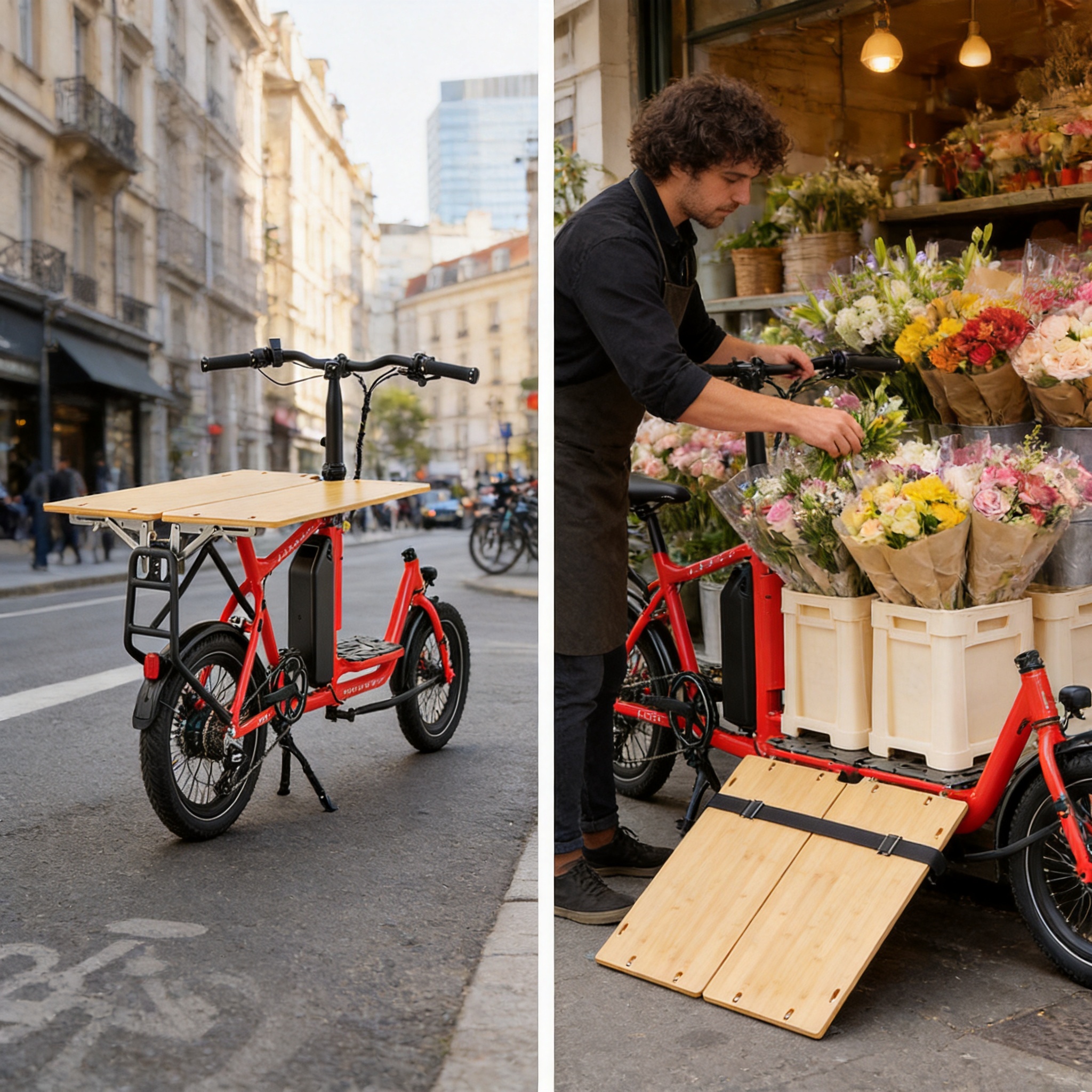
Urban cargo bikes are increasingly being used for more than commuting, family transportation, and parcel delivery. They are also becoming practical tools for independent businesses, local retailers, market vendors, mobile food operators, florists, and service providers who need to move products while maintaining a visible presence in busy urban environments. The Bamboo Folding Deck Kit 33.5 × 24 inches for Model Q E-Cargo Bike is designed for this changing mobility landscape. It enables a compact front-loading cargo e-bike to shift quickly between everyday transportation and mobile vending without requiring permanent modifications to the vehicle.
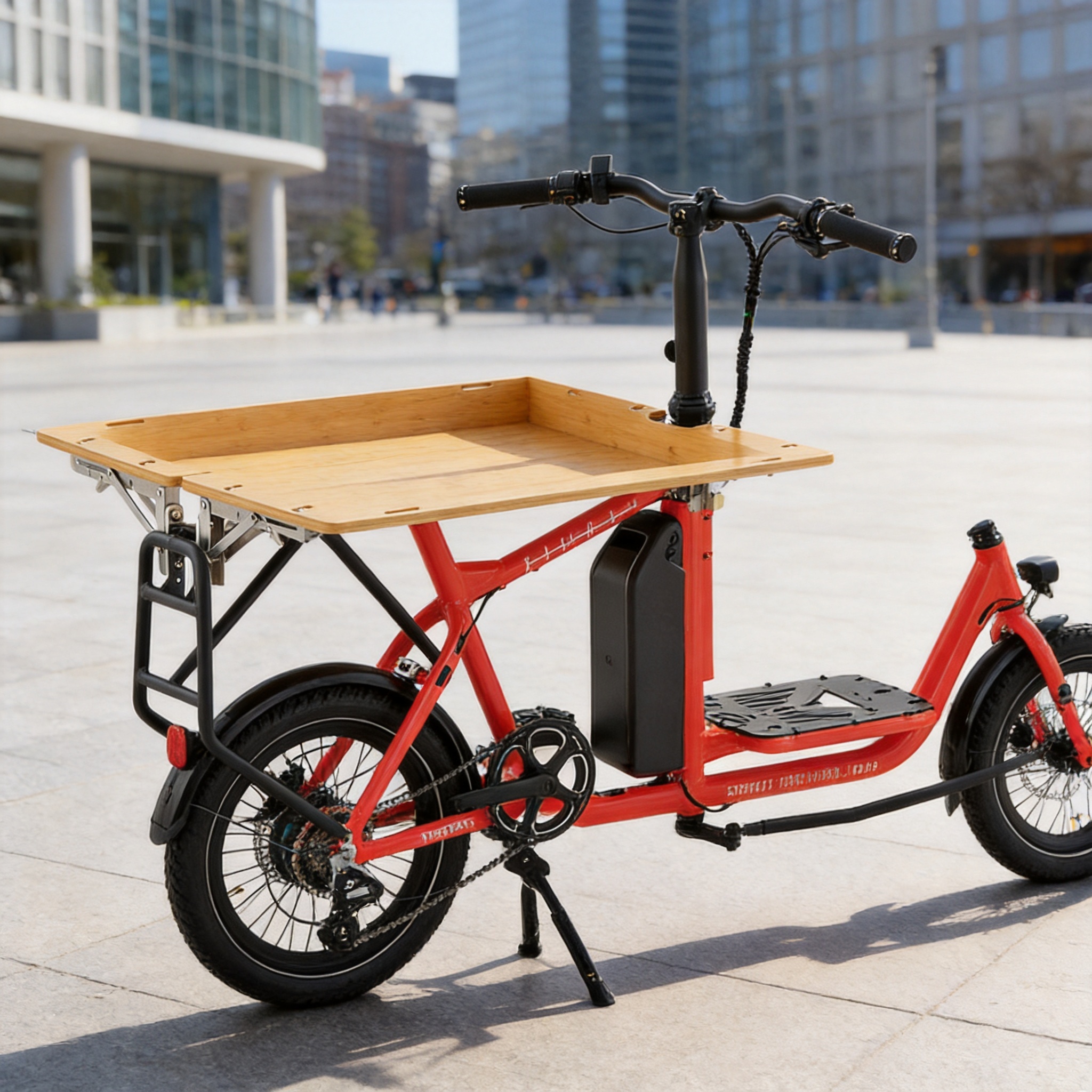
The kit combines a natural bamboo deck, a powder-coated steel support frame, stainless steel hinges, and locking folding brackets. Together, these elements create a stable, adaptable, and space-efficient platform for displaying goods, carrying containers, or organizing merchandise during pop-up retail activities. When the deck is not required, it folds flat, allowing the bicycle to return to a more streamlined commuting or transport configuration.
Rather than treating a cargo bike as only a carrying device, this platform turns it into a flexible business asset. A rider can use the bicycle in the morning for commuting, load it with coffee equipment or flowers for a daytime sales activity, and fold the platform away when traveling home. This multi-purpose capability is one of the kit’s most important advantages over fixed cargo boxes, permanently installed vending structures, and bulky trailer-based solutions.
Traditional retail spaces provide visibility and storage, but they also involve rent, utilities, fixed opening locations, and long-term commitments. A mobile vending model offers a different approach. Vendors can travel to neighborhoods, office districts, parks, markets, events, and pedestrian areas where demand changes throughout the day. However, mobility alone is not enough. A practical mobile business platform must also provide organization, stability, display space, and a professional appearance.
Many standard cargo bikes are optimized for transporting bags, boxes, children, or delivery containers. Those functions are important, but they do not always provide a suitable surface for displaying products. A delivery box may protect goods, yet it can hide them from potential customers. A simple flat board may offer surface area but lack reliable folding hardware or integrated attachment points. A trailer can provide capacity, but it may increase turning difficulty, storage requirements, and overall operating complexity.
The Bamboo Folding Deck Kit addresses this gap by creating a dedicated platform for visible, organized, and temporary commercial use. Its 85 × 61 centimeter deck provides a substantial working area while remaining integrated with a compact front-loading cargo bicycle. The low-mounted position helps keep the load close to the ground, and the folding structure supports a quick transition between business and personal use.
This approach is particularly suitable for operators who do not need a permanent food truck or a large commercial vehicle. A small coffee seller, flower merchant, bakery representative, farmers’ market vendor, or craft seller can use the bike as both transportation and a mobile point of sale. The result is a more efficient use of equipment, especially for businesses that operate at different locations or only need vending capability on selected days.
The Bamboo Folding Deck Kit is developed specifically for the Urban Companion Cargo Bike, Model Q. It is a bolt-on accessory designed to attach without permanent bike modification. This installation method allows the owner to add commercial functionality while preserving the underlying vehicle. The bicycle can therefore remain adaptable rather than being permanently converted into a dedicated vending unit.
The main deck is made from natural bamboo. Bamboo offers a warm, approachable visual character that is well suited to market selling, food presentation, flowers, handmade products, and community-oriented retail. Its appearance is notably different from an all-metal platform, which may look more industrial and less inviting. The natural deck can help a mobile business create a friendly and recognizable presentation while still being supported by a robust steel structure.
Underneath the deck, the powder-coated steel support frame provides the structural foundation. Powder coating is widely used for metal components because it creates a durable, even finish and adds a protective layer over the steel surface. In an urban environment, where equipment may be exposed to moisture, dust, handling, and frequent loading, a finished support structure is preferable to untreated steel.
The folding mechanism uses stainless steel hinges and locking folding brackets. Hinges allow the platform to fold into a compact position, while locking brackets help hold the deck securely in its working configuration. This combination is important because a vending platform must be convenient without becoming unstable or difficult to manage. A folding system that lacks positive support could compromise confidence during loading and unloading. The locking hardware is intended to provide a more dependable transition between folded and deployed positions.
Integrated strap and banner anchor points further extend the usefulness of the platform. Straps can help secure merchandise containers, coolers, display trays, and sample boxes. Banner points can be used for temporary branding, pricing information, menu boards, or visual communication. These details transform the deck from a simple carrying surface into a more adaptable merchandising area.
| Product Feature | Specification | Practical Benefit |
|---|---|---|
| Deck dimensions | 85 × 61 cm / 33.5 × 24.0 in | Provides space for merchandise, containers, trays, and display equipment |
| Main deck material | Natural bamboo | Offers a warm appearance and practical working surface |
| Support structure | Powder-coated steel frame | Creates a strong and finished structural base |
| Hardware | Stainless steel hinges and locking folding brackets | Supports repeated folding and secure deployment |
| Folding style | Flat folding design | Reduces storage space when the platform is not in use |
| Installation | Bolt-on attachment | Avoids permanent modification to the bike |
| Attachment features | Integrated strap and banner anchor points | Supports cargo restraint and temporary visual displays |
| Recommended activities | Mobile vending, pop-up retail, and cargo transport | Expands the bicycle’s use beyond ordinary commuting |
The deck dimensions are carefully suited to small-scale mobile commerce. At 33.5 × 24 inches, the platform is large enough to accommodate product trays, insulated containers, beverage carriers, sample boxes, and small retail displays. At the same time, it remains more compact than many fixed commercial installations. This balance is important for riders who must operate in narrow streets, cycle lanes, pedestrian areas, courtyards, and crowded market spaces.
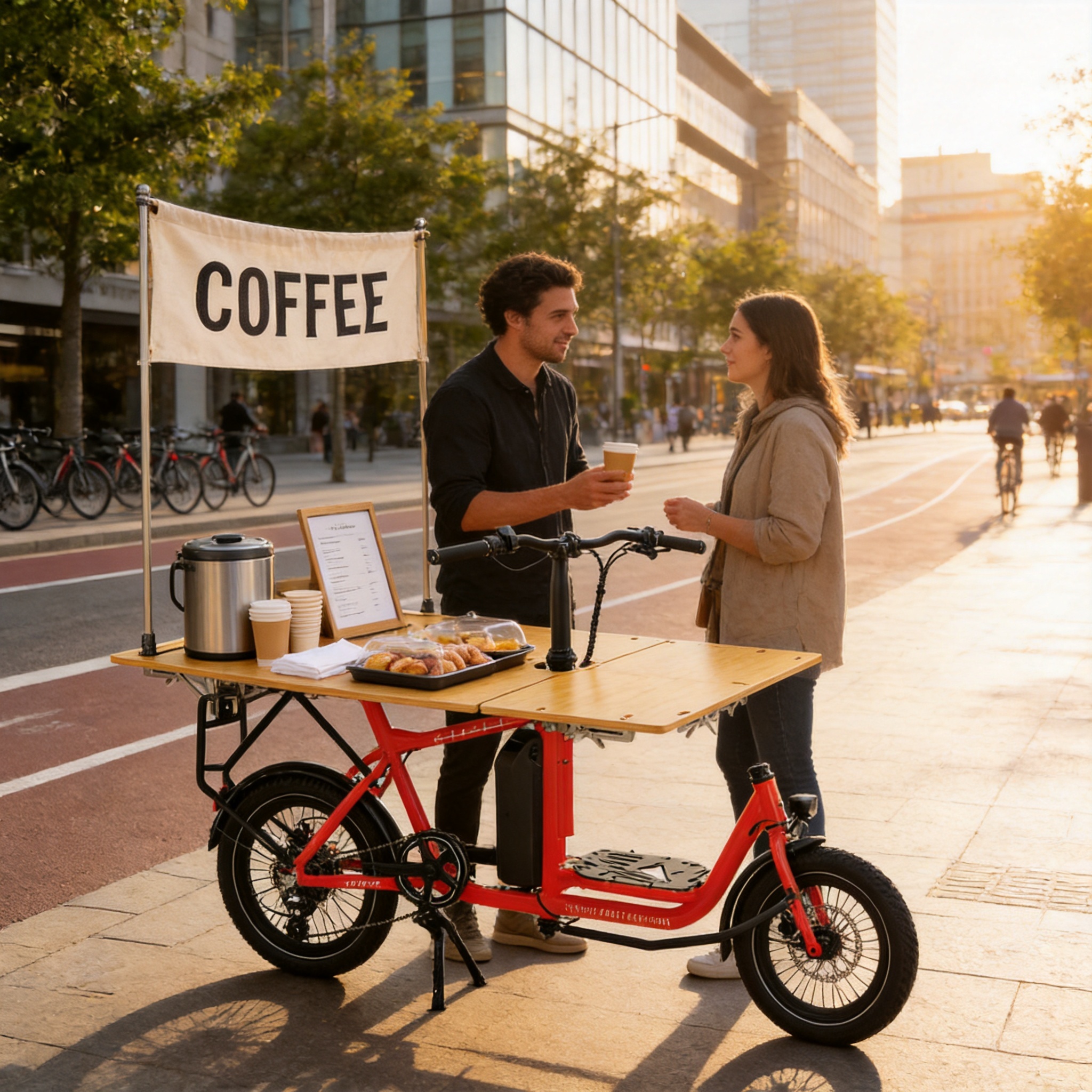
A vendor can organize the platform according to the nature of the business. A coffee seller may place an insulated beverage container, cups, napkins, and a small menu board on the deck. A florist may arrange buckets, wrapped bouquets, and water-resistant containers. A baker may use covered trays or food-safe boxes. A farmer’s market operator may display packaged produce, preserves, bread, or seasonal goods. A craft seller may arrange small products in shallow trays with a banner or sign positioned above the deck.
The platform is also useful when the bicycle is not functioning as a sales stand. It can carry coolers, delivery boxes, sample materials, event supplies, or equipment for a temporary work assignment. This makes it more valuable than an accessory designed for only one commercial application. The owner can use the same bike for personal transportation, local logistics, and business operations.
The bolt-on installation is especially useful for businesses that are testing a new concept. A vendor may want to evaluate different locations, product categories, or operating schedules before investing in a permanent vehicle conversion. A removable or non-permanent accessory reduces the commitment associated with that experiment. It allows the bicycle to retain its original identity and gives the owner more flexibility if business requirements change.
Fixed cargo boxes are useful when maximum enclosure, weather protection, or security is the priority. However, they can limit product visibility and may permanently define the bicycle’s role. Once a box is installed, changing from delivery work to display-oriented selling may require additional shelves, lids, signs, or attachments.
The folding deck takes a different approach. Instead of enclosing products, it places them on an accessible surface where they can be arranged for immediate viewing. This can be beneficial for impulse purchases and face-to-face selling. Customers can see the products without the vendor repeatedly opening a container. The open deck may also make loading and unloading faster when the same goods must be moved several times during a working day.
Another distinction is adaptability. A fixed box occupies the cargo area continuously, while the folding platform can be stored flat when not in use. This is valuable for riders who alternate between cargo transport and ordinary travel. It also helps owners who have limited garage, apartment, or shop storage space.
The deck does not attempt to replace every type of cargo box. Weather-sensitive goods may still require covers, insulated containers, or waterproof packaging. Instead, the platform serves as a versatile foundation that can support such containers while also providing room for display and customer interaction.
Trailers can offer significant capacity, but they introduce another articulated connection behind the bicycle. In dense urban environments, this may affect turning, parking, reversing, and maneuvering through narrow spaces. A trailer also requires additional storage and may be inconvenient when a vendor needs to leave the bicycle unattended or move through a crowded location.
A front-loading cargo bike with a low-mounted folding deck keeps the commercial surface integrated with the bicycle. The rider can see the cargo area more directly and maintain a compact footprint. This is advantageous for short-distance trips, frequent stops, and routes involving tight corners or constrained access points.
Large mobile stalls provide more display space, but they typically require a van, truck, or dedicated structure. Such solutions involve higher purchase costs, more difficult parking, greater energy consumption, and more complicated logistics. The Bamboo Folding Deck Kit is designed for a smaller and more agile category of operation. It is not intended to compete with a full-size food truck in capacity; its strength lies in providing useful commercial functionality with the efficiency and maneuverability of a cargo e-bike.
For micro-businesses, seasonal sellers, and independent operators, this distinction can be significant. The platform provides a way to begin with a manageable investment in equipment, scale gradually, and operate closer to customers in areas where larger vehicles are impractical.
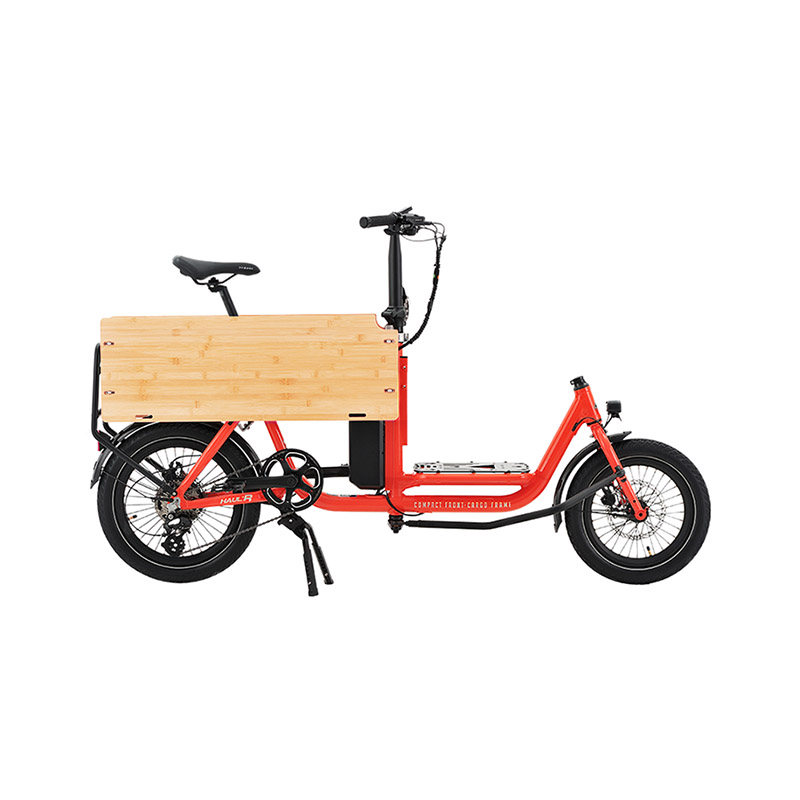
Bamboo Folding Deck Kit 33.5x24in for Model Q E-Cargo Bike Street Vending
Load placement has a direct effect on the behavior of any bicycle. High or poorly distributed loads can make a vehicle feel less predictable, especially during starting, stopping, cornering, and low-speed maneuvering. The Bamboo Folding Deck Kit is designed as a low-mounted platform, helping keep the center of gravity closer to the ground than a high rack or elevated display structure.
A lower cargo position can make it easier for a rider to manage the bicycle when the deck is carrying containers or merchandise. It can also make loading more convenient because goods do not need to be lifted to excessive height. This is particularly helpful when handling coolers, product boxes, or equipment that may be heavy even if the overall load remains within the bike’s approved operating limits.
Riders should always distribute items evenly and secure them before moving. The presence of a large platform does not mean that every available area should be filled without regard to weight or balance. Heavy items should be placed low and centrally where possible, while fragile or frequently accessed goods can be arranged toward the upper layer or accessible side. Straps and anchor points should be used to prevent movement during travel.
The folding deck also supports operational confidence because it provides a defined working surface. Instead of balancing multiple loose bags or boxes on an improvised board, the vendor can organize goods within a predictable area. This improves the transition between transport mode and selling mode and can reduce unnecessary handling during setup.
Material selection affects both function and presentation. Natural bamboo gives the platform a visually warm and distinctive character. For businesses that emphasize local production, handmade goods, fresh food, flowers, or environmentally conscious positioning, a bamboo surface may complement the product range better than a plain metal panel.
The deck’s appearance can help create a more welcoming customer experience. A mobile stall often has only a few seconds to attract attention as pedestrians pass. The contrast between a natural deck and a bicycle’s metal support elements can produce a clean, practical, and approachable presentation. This is useful for sellers who want the vehicle to look like a small shop rather than only a transport machine.
Bamboo is also relatively light compared with many solid structural materials, making it suitable for an accessory that must fold and remain manageable. The deck is supported by steel rather than expected to provide structural strength alone. This division of functions allows the bamboo to serve as the visible working surface while the steel frame and locking hardware provide the underlying support.
Owners should maintain the bamboo according to the care instructions supplied with the product and protect it from prolonged exposure to standing water or harsh conditions. Covered storage, routine cleaning, and prompt drying can help preserve its appearance. As with any natural material, visual changes may occur over time depending on use, climate, cleaning methods, and exposure.
The support frame uses powder-coated steel, a material and finishing combination selected for demanding everyday use. Steel provides a strong foundation for the folding deck and the loads associated with product display, food containers, coolers, and sample boxes. The powder-coated finish gives the frame a consistent surface and helps protect the metal from ordinary environmental exposure.
Powder coating is applied as a dry finish and cured to form a continuous coating. Compared with a basic untreated metal surface, this process can offer improved resistance to scuffing, surface wear, and general handling. It also allows the frame to maintain a clean appearance over repeated use, which matters for commercial equipment that is visible to customers.
The manufacturing value of this construction lies in the cooperation between material choice, shaping, finishing, and assembly. A support frame is not simply a piece of metal placed under a board. It must align with the bicycle, support the folding action, accommodate hardware, and maintain a consistent relationship with the deck during repeated deployment. Attention to these interfaces is important because commercial users may fold and unfold the platform frequently over the product’s service life.
Atmose’s background in cargo-bike development, supported by manufacturing experience and a mature supply chain, enables the company to coordinate these different stages. The product is part of a broader cargo mobility system rather than an isolated universal board. Its design is associated with the dimensions, structure, and intended use of Model Q, which helps create a more integrated result than a generic platform assembled without reference to the vehicle.
Folding accessories depend heavily on their hardware. The deck must move smoothly between positions, remain supported when open, and stay compact when folded. Stainless steel hinges are used to support the folding movement and provide a hardware solution suited to repeated handling and exposure to everyday urban conditions.
The locking folding brackets are equally important. They help hold the deck in the open position and provide a clear mechanical transition between storage and working modes. A vendor should verify that the brackets are fully engaged before loading the platform. Correct operation of the locking mechanism is part of safe and reliable use.
Using stainless hardware at the hinge points can also help reduce concerns associated with ordinary steel hardware in damp environments. While no component should be neglected during maintenance, stainless steel is a practical choice for areas that experience repeated movement and may be exposed to moisture, food residue, dust, or outdoor storage conditions.
The hardware illustrates a broader manufacturing principle: product reliability is often determined by small interfaces. A broad deck may look impressive, but the hinges, brackets, bolts, frame connections, and mounting points determine how effectively it functions in daily use. The kit’s design brings these components together in a purpose-built folding system.
The bolt-on installation format is one of the kit’s strongest commercial advantages. Permanent vehicle modifications can reduce resale flexibility, complicate maintenance, and make it difficult to return the bicycle to its original configuration. A purpose-designed bolt-on accessory avoids that level of commitment while still expanding the bicycle’s capabilities.
Non-permanent installation is valuable for several types of users. A private owner may want a weekend vending setup without changing the bicycle permanently. A small company may operate several seasonal campaigns and need to alternate between a delivery box and a display platform. A rental or shared fleet operator may require accessories that can be installed, removed, or transferred according to demand. A bicycle dealer may offer the kit as an optional business package rather than a fixed configuration.
Installation should be carried out using the supplied hardware and appropriate tools. The mounting points should be checked periodically, especially after the first few uses and after carrying loads over uneven surfaces. Bolted accessories benefit from routine inspection because vibration and repeated loading can gradually affect fastener tightness.
Because the kit is intended for Model Q, compatibility should be confirmed before purchase or installation. The platform should not be treated as a universal accessory for unrelated bicycles unless the manufacturer specifically confirms compatibility. Correct fit is necessary for proper alignment, folding operation, and safe load distribution.
The deck can support insulated beverage containers, coffee accessories, packaged snacks, menus, cups, and serving materials. Its flat surface makes it easier to arrange items in a logical sequence, with frequently used goods placed within quick reach. A banner anchor point can support a menu or temporary sign, while straps can stabilize coolers and containers during travel.
Operators should use suitable food-safe containers and follow all local hygiene, licensing, and food-handling rules. The platform is a transport and display accessory; it does not itself replace refrigeration, insulation, sanitation equipment, or regulatory compliance.
Florists and plant sellers can use the platform for bouquets, small potted plants, seasonal arrangements, and display materials. The natural bamboo surface complements the visual character of flowers and can provide a more attractive base than an enclosed delivery compartment. Containers should be secured and protected against spills, while water-filled vessels should be positioned carefully to avoid uneven weight distribution.
Fresh produce, baked goods, preserves, herbs, and packaged local products can be arranged in shallow trays or baskets. The platform allows the vendor to display a limited but curated selection rather than transporting an entire shop. This approach can be effective for neighborhood delivery routes, market-day sampling, and direct-to-customer sales.
Craft sellers can use the deck for ceramics, textiles, small artworks, candles, accessories, or seasonal products. The integrated banner points create opportunities for simple signage, while the flat-folding design makes it easier to transport the platform to and from events. Fragile products should be placed in protective containers and secured during movement.
Businesses, cultural groups, and community organizations can use the bike as a mobile information point. The deck may carry brochures, sample materials, educational displays, or event supplies. A compact bicycle-based station can reach places where a vehicle cannot easily park and can be repositioned throughout an event.
The Bamboo Folding Deck Kit reflects the design philosophy of Atmose, a cargo e-bike brand focused on practical, enjoyable, and efficient mobility. The company combines American product thinking with European design aesthetics through an international structure that includes a design and research team based in Paris. This combination supports a product approach that considers both utility and visual integration.
Atmose originated in California and developed from the experience of MOTIV, an established American beach cruiser brand. That background provides a foundation in bicycle manufacturing, product development, and consumer-oriented design. The company’s cargo-bike work extends this experience into family mobility, urban commuting, commercial delivery, and outdoor use.
The creation of ATMOSE BIKES INC. in Long Beach in 2023 and the establishment of ATMOSE SASU in France in 2026 represent an international development structure. The company’s design and R&D activities in Paris support attention to European urban conditions, where compact streets, cycle infrastructure, limited storage, and mixed-use mobility are important considerations. These factors are relevant to a folding vending accessory because its value depends on more than cargo capacity; it must also suit the realities of daily urban movement.
Advanced manufacturing is expressed through the coordination of materials and production processes. The natural bamboo deck must be prepared to fit the support structure. The steel frame must be formed, finished, and aligned. The stainless steel hinges and locking brackets must be integrated with sufficient precision for consistent folding. The bolt-on mounting system must correspond to the Model Q cargo bike. These operations require product-specific design control and quality management across the supply chain.
Atmose identifies manufacturing expertise, a mature supply chain, and continuous innovation as important company strengths. For an accessory such as this, supply-chain maturity can support consistent sourcing of bamboo, steel, stainless hardware, fasteners, and finishing services. It can also help coordinate production volumes for individual customers, dealers, fleet operators, and wholesale buyers.
The company’s emphasis on sustainability and practical mobility is also relevant to the product’s purpose. By enabling one bicycle to perform several roles, the kit can help users avoid purchasing separate equipment for commuting, delivery, and small-scale vending. This does not eliminate the need for responsible material care or appropriate replacement of worn components, but it supports a broader use model in which a vehicle remains useful across changing activities.
One of the main differences between a purpose-designed kit and a generic accessory is the relationship between the accessory and the bicycle. A generic platform may technically provide a flat surface but create problems with clearance, mounting, folding, visibility, or balance. A product developed for a specific model can address these issues as part of the original design process.
The Model Q platform is intended to work with a compact front-loading cargo format. Its low position supports the central cargo concept of the bicycle, while its folding action preserves a more compact configuration when the commercial surface is not required. This integration helps the accessory feel like part of a broader mobility system rather than an improvised attachment.
The design also recognizes that commercial users need more than a load-bearing board. They need a platform that can accept straps, banners, containers, trays, and signs. Integrated anchor points reduce the need to drill holes or invent attachment methods. This improves convenience and may help preserve the clean appearance of the installation.
Before starting a vending route, the rider should inspect the deck, frame, hinges, brackets, bolts, and anchor points. The folding brackets should be fully locked, and all merchandise should be secured. Items should be distributed across the deck rather than concentrated at one edge. Containers should be positioned so they do not interfere with steering, braking, rider visibility, or access to the bicycle controls.
For a professional presentation, products can be arranged by height, category, or customer use. A lower front row may hold larger containers, while smaller products can be placed in trays above or behind them. Signage should remain visible without blocking the rider’s view. If a banner is used, it should be secured firmly and positioned so it does not catch excessively in strong wind.
When changing from vending mode to transport mode, the rider should remove or secure loose items before folding the deck. The folding action should be performed according to the installation and operating instructions. The platform should not be forced if a hinge or bracket feels obstructed. Regular cleaning is recommended, particularly after transporting food containers, soil, flowers, or materials that may leave residue.
At the end of the day, the deck should be stored in a dry and reasonably protected location. Bamboo is a natural material, and the steel and hardware also benefit from reduced exposure to prolonged moisture. Routine care can help maintain both the appearance and the operating quality of the platform.
The product information identifies recommended uses including product display, food containers, sample boxes, coolers, mobile vending, pop-up retail, and cargo transport. It does not state a specific maximum load rating in the supplied specifications. Users should therefore follow the manufacturer’s official load guidance for Model Q and the kit, rather than estimating capacity solely from the deck dimensions.
Deck area and load capacity are not the same thing. A platform may have room for several containers, but the combined weight must remain within the approved limit for the accessory and bicycle. Weight distribution is also important. A heavy cooler placed at one side may affect handling more than the same cooler placed in a balanced central position.
Riders should check local rules concerning bicycle cargo, food sales, street vending, signage, and commercial operation. The kit provides a physical platform, but legal requirements vary by location. Appropriate packaging, weather protection, visibility, and secure loading are the responsibility of the operator.
For a small business, equipment efficiency can have a direct effect on operating costs. A vehicle that serves only one purpose may remain unused outside a narrow schedule. A bicycle equipped with a folding commercial platform can be used more frequently and in more ways. The same asset can support commuting, supply collection, local delivery, event participation, and direct sales.
The platform can also reduce setup time. A fixed stall may require transport, assembly, and dismantling of multiple components. With a folding deck, the bicycle itself becomes the base of the operation. The vendor can travel to a chosen location, deploy the deck, arrange products, and begin serving customers. At the end of the session, the display can be cleared and folded for the return trip.
This flexibility is useful for businesses that follow changing demand. A vendor may serve an office district during the morning, a park during lunchtime, and a community event in the afternoon. The compact form of a cargo e-bike allows the operator to move between areas without relying on a van or fixed shop.
The platform may also support brand visibility. A clean bamboo surface, organized merchandise, and a well-positioned banner can create a recognizable mobile identity. In crowded urban markets, the bicycle itself can become part of the customer experience. Because the display is close to pedestrian level, products and signs can be presented directly to people rather than viewed from a distant vehicle.
| Approach | Strength | Limitation Compared with the Folding Deck Kit |
|---|---|---|
| Permanent cargo box | Enclosed storage and protection | Less visible for open display and less adaptable for non-commercial use |
| Rear rack | Simple additional carrying area | Usually offers less display space and may place weight higher or farther from the rider |
| Unsecured flat board | Low-cost surface area | May lack model-specific mounting, folding support, and integrated anchors |
| Trailer | Can provide larger capacity | Requires additional storage and may complicate maneuvering in dense areas |
| Van or truck stall | High capacity and weather protection | Higher operating costs, larger footprint, and less bicycle-level access |
| Folding bamboo platform | Combines display space, compact storage, and bicycle integration | Requires careful load planning and suitable protection for sensitive goods |
The table illustrates that no single solution is best for every business. A large catering operation may require a van, while a parcel company may prefer enclosed boxes. The Bamboo Folding Deck Kit is most advantageous when the user values compact mobility, quick conversion, open display, and the ability to use one bicycle for multiple tasks.
Cargo e-bikes can contribute to lower-impact urban transportation by replacing some short vehicle trips, consolidating local deliveries, and enabling direct access to areas where cars are inconvenient. A folding commercial platform extends these benefits into small-scale retail and service activity. Instead of transporting products by car to a fixed location, an operator can move a smaller inventory directly by bicycle.
The accessory’s multi-use design also supports product longevity. A permanently specialized vehicle may be unsuitable when business conditions change. A folding platform allows the bicycle to remain useful for everyday transport even when no vending activity is scheduled. This adaptability can reduce the pressure to purchase multiple specialized vehicles.
Sustainability also depends on maintenance and responsible use. Owners can extend the useful life of the product by inspecting fasteners, protecting the bamboo, cleaning the deck, and replacing worn hardware when necessary. Choosing appropriate loads and avoiding misuse helps protect the frame and folding mechanism.
The kit is suitable for independent entrepreneurs who want a low-footprint sales format. It can also serve established companies testing local activation campaigns, retailers creating neighborhood delivery services, and event organizers seeking mobile information points. Because installation does not require permanent bike modification, the platform can be considered for pilot programs and temporary commercial projects.
Wholesale buyers and fleet operators may also find value in a standardized accessory. A group of Model Q bicycles can be configured for different roles according to demand. Some units may carry delivery containers, while others use folding decks for retail events. This kind of modular approach can improve fleet utilization and simplify the process of adapting bicycles to new assignments.
For dealers, the kit provides an opportunity to present the Model Q as more than a family or commuting bicycle. It demonstrates how the same platform can support professional activity without becoming a large commercial vehicle. The accessory can be offered as part of a broader package for mobile food, local retail, flower delivery, community engagement, or market participation.
The strongest value of the Bamboo Folding Deck Kit is not limited to the surface area of the deck. Its long-term value comes from modularity. As an owner’s needs change, the bike can move between roles rather than being replaced immediately. A commuter may later begin a weekend business. A small retailer may add local delivery. A family may use the bicycle during the week and participate in community markets on weekends.
This flexibility is consistent with Atmose’s stated focus on practical, reliable, and enjoyable mobility. The product is designed around the idea that a cargo bicycle should fit into real life, where transportation, work, family, and business activities often overlap. The folding platform provides a physical expression of that principle by allowing one vehicle to support several patterns of use.
For buyers comparing accessories, it is useful to consider the entire operating cycle rather than only the initial purchase. The platform can affect setup time, storage, visual presentation, handling, and the ability to change applications. A product that performs well across these areas may provide greater value than a lower-cost board that lacks a secure folding structure or model-specific compatibility.
It is designed to convert the Model Q Urban Companion Cargo Bike into a flexible mobile display and vending platform. Recommended applications include street food, coffee, flowers, produce, handmade goods, pop-up retail, sample distribution, and general cargo transport.
The deck measures 85 × 61 centimeters, or 33.5 × 24.0 inches. This provides space for trays, containers, coolers, sample boxes, and selected merchandise.
No. The supplied product information describes the installation as bolt-on and states that no permanent bike modification is required. Compatibility with the Model Q should be confirmed before installation.
Yes. It uses a flat-folding design. Stainless steel hinges and locking folding brackets support the transition between the working and folded positions.
Natural bamboo provides a warm, distinctive appearance that suits food, flowers, crafts, and local retail. It also serves as a practical working surface while the powder-coated steel frame supplies the primary structural support.
The powder-coated steel frame supports the bamboo deck and connects it to the folding and mounting system. It provides the structural foundation needed for a stable commercial platform.
The kit uses stainless steel hinges, which are selected for durability in hardware applications and ordinary outdoor exposure. Users should still keep the mechanism clean, inspect it regularly, and follow the manufacturer’s care instructions.
Coolers and food containers are listed among the recommended uses. They must be secured correctly, distributed evenly, and kept within the official load limits for the kit and Model Q bicycle.
The supplied specifications do not state a numerical maximum load rating. Buyers should consult the official manufacturer documentation for the applicable limit and should not infer capacity solely from the deck size.
Yes. The deck includes integrated strap and banner anchor points. Any banner or sign should be attached securely and positioned so that it does not interfere with steering, braking, visibility, or safe riding.
It is intended for compact mobile vending and pop-up retail rather than replacing a full-size food truck or commercial kitchen. Operators must provide any required food storage, preparation, sanitation, licensing, and weather protection equipment separately.
The integrated front-loading platform keeps the commercial surface on the cargo bicycle itself. This can provide a more compact footprint and simpler maneuverability than a trailer, although a trailer may offer greater total capacity for some operations.
Yes. The folding design allows the platform to be stored flat when it is not needed, supporting a transition between vending, cargo transport, and everyday riding.
It is particularly suitable for independent vendors, small retailers, florists, coffee sellers, craft businesses, event operators, local delivery services, and Model Q owners who need a flexible commercial accessory.
Users should check the locking brackets, hinges, mounting bolts, deck condition, frame connections, anchor points, and cargo restraints. Merchandise should be balanced and secured before riding.
The Bamboo Folding Deck Kit 33.5 × 24 inches for Model Q E-Cargo Bike provides a focused solution for urban users who need more than ordinary cargo capacity. It transforms a compact front-loading cargo e-bike into a mobile display platform while preserving the flexibility to return to commuting and everyday transport. The low-mounted deck, natural bamboo surface, powder-coated steel frame, stainless steel hinges, locking folding brackets, and integrated anchor points work together to support practical commercial use.
Compared with fixed cargo boxes, the platform offers greater display visibility and easier adaptation. Compared with trailers, it maintains a more integrated bicycle footprint. Compared with large mobile stalls, it offers a lower-complexity path to neighborhood vending and pop-up retail. Its purpose is not to replace every commercial transport solution, but to provide a balanced option for small-scale businesses that value mobility, presentation, and flexibility.
The product also reflects Atmose’s broader strengths in cargo-bike design, international research and development, manufacturing coordination, and practical urban mobility. By combining American product experience with European design perspectives and a mature supply chain, the company develops accessories that respond to real-world use rather than focusing only on appearance or basic carrying capacity.
For vendors, entrepreneurs, families, and fleet operators seeking a multi-purpose cargo-bike configuration, the folding bamboo platform offers a way to make one bicycle more useful throughout the day and across changing business needs. With appropriate installation, load planning, maintenance, and compliance with local regulations, it can serve as a compact foundation for mobile commerce and modern urban transport.
Atmose product specification sheet, Bamboo Folding Deck Kit for Model Q E-Cargo Bike.
Atmose cargo-bike product information, Urban Companion Cargo Bike, Model Q.
Atmose company information concerning product design, research and development, manufacturing expertise, and supply-chain capabilities.
General principles of cargo-bike load distribution, bicycle stability, and urban cargo transport.
General material information concerning bamboo deck construction, powder-coated steel frames, and stainless steel hardware.
Nov 27, 2026
Nov 25, 2026
Nov 21, 2026


info@atmosecargobike.com

200 rue de la Croix Nivert 75015 Paris

Custom Electric Bakfiets
 English
 Français
 Deutsch