Sep 30, 2026
Urban families are increasingly looking for transportation that can handle school runs, grocery shopping, pet travel, commuting, and weekend trips without depending on a second car. A family cargo bike can answer that need, but not every cargo bicycle offers the same combination of stability, carrying capacity, electric assistance, safety, and everyday usability. The Atmose Model P ESP3 is designed specifically for riders who need one dependable vehicle for several daily responsibilities.
Built around a long-tail cargo format with a spacious front basket, the Model P combines a 6061 T4T6 aluminum alloy frame, a Bafang M430 mid-drive motor, a Samsung 36V 15Ah battery, a Shimano nine-speed drivetrain, hydraulic disc brakes, and puncture-resistant wide tires. Its purpose is not simply to carry more weight than a conventional bicycle. It is intended to make family mobility more practical by giving riders a stable, assisted, and adaptable platform for children, pets, groceries, and work equipment.
The bike is especially suitable for households that need to replace short car journeys with a cleaner and more flexible form of transport. It can help parents travel through school-zone traffic, allow pet owners to carry a dog safely, and support shopping trips without requiring a large vehicle. At the same time, its folding front basket and relatively narrow overall width make it easier to manage in urban spaces than many bulky cargo bicycles.
This article examines the Model P ESP3 in detail, including its design, engineering, manufacturing strengths, carrying system, electric powertrain, safety features, comfort, maintenance requirements, and advantages over less specialized alternatives.
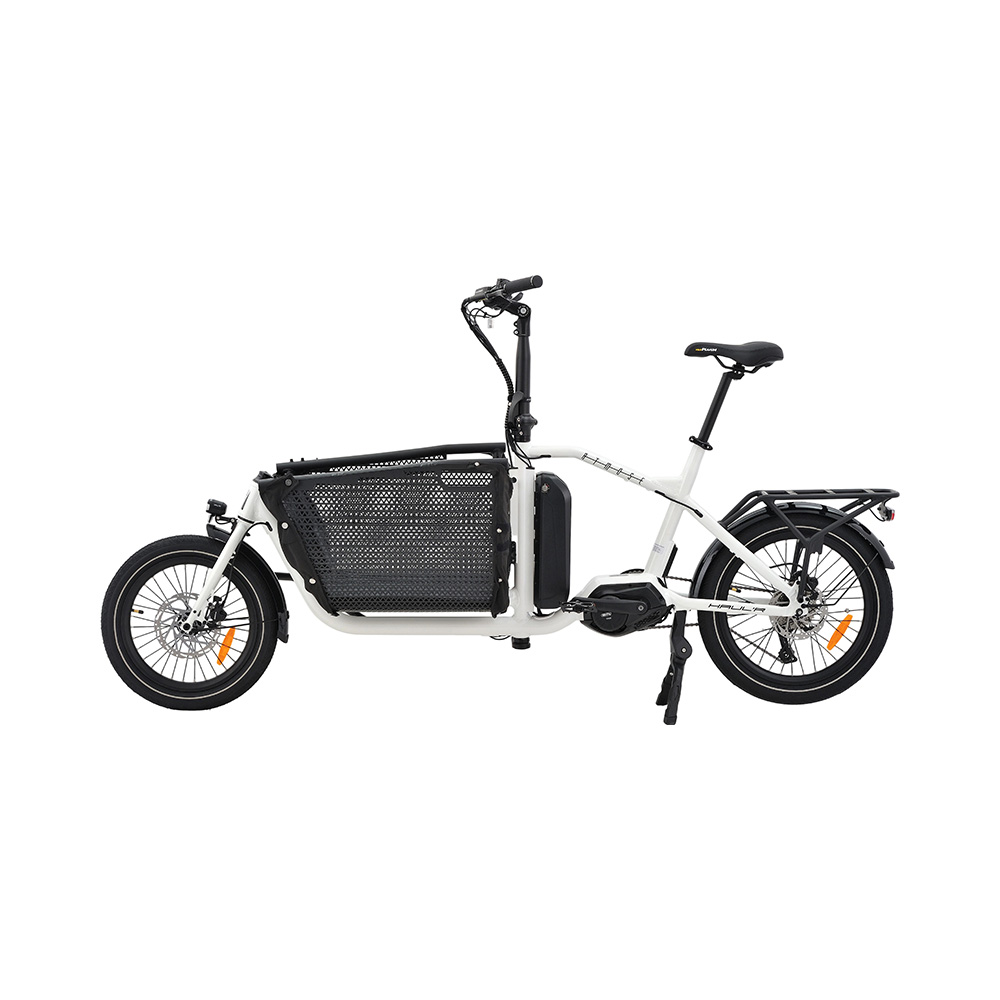
Atmose Model P ESP3 Electric Family Cargo Bike for Kids and Pet Transport
The main strength of the Model P is its focus. It is not presented as a general-purpose bicycle with a small rack added to the back. Its structure, basket, motor, battery, brakes, and geometry are arranged around the needs of family and pet transportation.
A normal city bicycle can carry a backpack or a few shopping bags, but it becomes difficult to control when the load is bulky, unbalanced, or placed too high. A standard bicycle may also lack room for a child seat, a pet carrier, or a rain cover. The Model P approaches the problem differently by providing a dedicated front cargo area with a broad loading surface and a rated basket capacity of up to 35 kilograms.
The front basket measures approximately 64.5 centimeters by 62 centimeters at the top and 50 centimeters by 39 centimeters at the bottom. This shape provides useful space for everyday cargo while keeping the load positioned low and close to the center of the bicycle. It can be used for groceries, school bags, small pets, child seating equipment, outdoor supplies, or delivery items.
The basket can also be folded. When folded, it becomes approximately 365 millimeters wide, helping the bicycle occupy less space when parked, stored, or moved through a narrow area. This is an important advantage over fixed cargo boxes, which can remain wide even when the bike is empty. The folding design gives the rider a choice between maximum carrying space and a more compact profile.
For family use, the basket is compatible with accessories such as child seats and rain covers. These accessories can help protect passengers from changing weather and provide a more secure seating arrangement. Pet owners can use the same front area for a suitable carrier or restraint system, making it possible to include a dog or other small companion in everyday trips.
The usefulness of a family cargo bike depends on how easily it moves between different tasks. The Model P is designed for more than one fixed application. In the morning, it can support a school journey. During the day, it can carry groceries or work materials. In the afternoon, it can transport a pet to a veterinary appointment. At the weekend, it can be used for a park visit or a short recreational ride.
This flexibility gives the bike an advantage over highly specialized transport equipment. A dedicated child trailer may be excellent for children but less suitable for shopping. A rear rack may carry bags but cannot provide the same level of volume or organization. A compact utility bicycle may be easy to store but may lack the stability needed for a larger load. The Model P is positioned between these categories, combining a family-oriented cargo area with the performance of an electric bicycle.
The frame uses 6061 T4T6 aluminum alloy, a material widely valued in bicycle manufacturing for its balance of strength, weight, corrosion resistance, and manufacturability. For a cargo bicycle, the frame must do more than support the rider. It must handle repeated braking, acceleration, steering changes, uneven pavement, and the movement of cargo or passengers.
Aluminum alloy construction helps keep the bicycle more manageable than an equivalent steel design while still providing the rigidity required for a high-load platform. The T4T6 designation indicates a controlled heat-treatment approach intended to improve the material’s mechanical performance. In practical terms, this supports the creation of a frame that is stiff enough for confident handling while remaining suitable for repeated daily use.
The frame development process is supported by fatigue testing and safety certification claims. The product information states that the frames pass 300,000-cycle fatigue tests and meet TUV and EN17860 safety certifications. Fatigue testing is particularly relevant to cargo bicycles because the frame is exposed to repeated loading rather than a single static event. Every acceleration, curb crossing, braking maneuver, and turn contributes to the long-term stress cycle.
A fatigue-tested frame offers a meaningful advantage over low-cost cargo bikes that may be assembled around generic tubing or insufficiently validated joints. Certification does not eliminate the need for correct loading, inspection, and maintenance, but it indicates that the design has been assessed against recognized safety expectations rather than being developed only around appearance or initial cost.
The structural design also contributes to rider confidence. Cargo bicycles can feel intimidating when the load is positioned far forward or when the frame flexes during steering. The Model P’s geometry is optimized to help new cargo-bike riders feel more in control. This is important for families, because the primary rider may not have previous experience with long-wheelbase or front-loading bicycles.
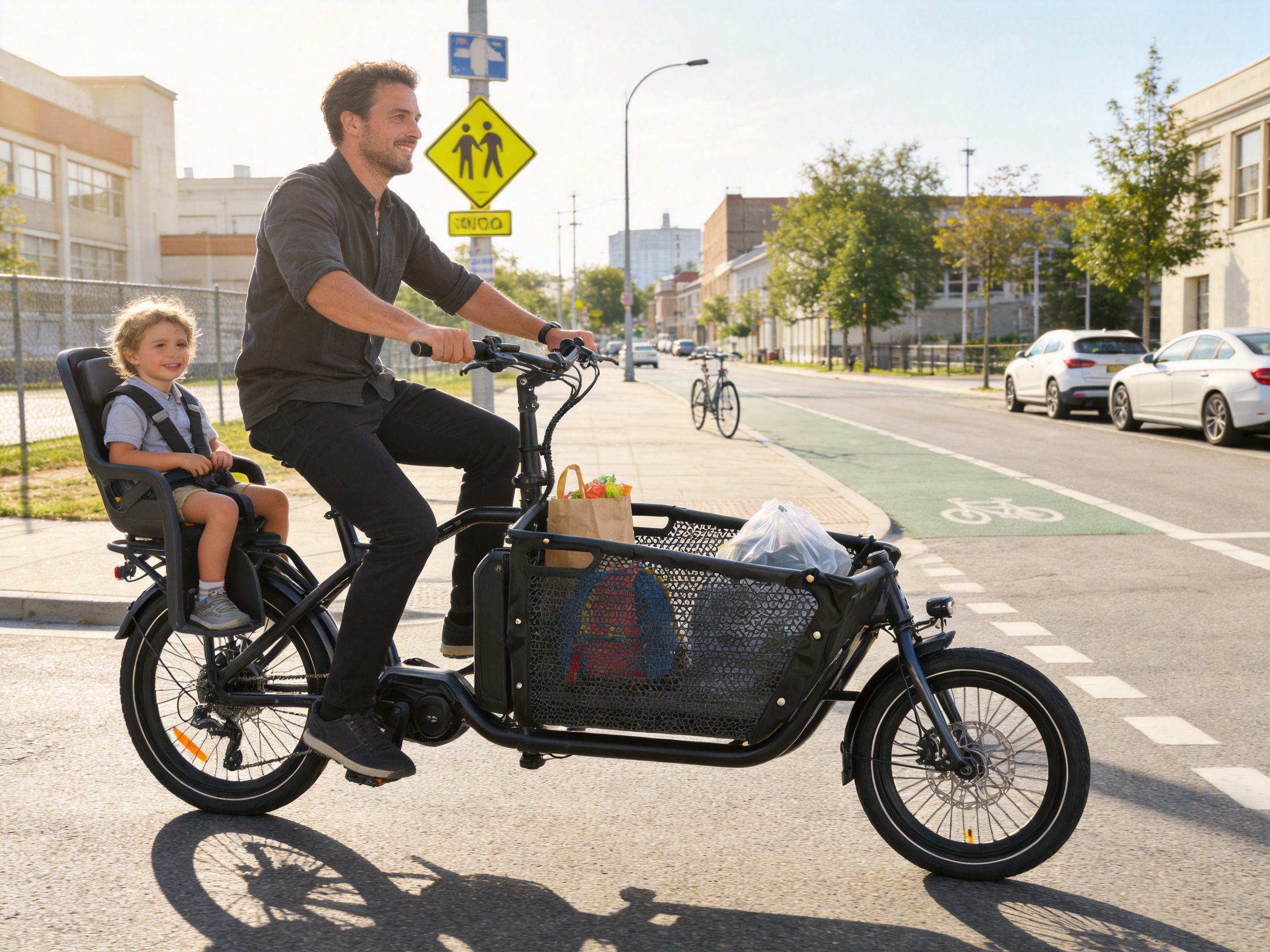
The Model P ESP3 measures approximately 2,130 millimeters in length, 680 millimeters in width, and 1,130 millimeters in height. These dimensions give it the stability expected from a cargo bicycle while keeping its width suitable for many urban streets, cycle paths, entrances, and storage areas.
The listed maximum load ratings are 145 kilograms for the rider and 35 kilograms for the front basket. These figures should be understood as separate product specifications rather than an invitation to exceed the bicycle’s total approved operating limit. Riders should always follow the final load guidance supplied with the bicycle, including any limits for accessories, child seats, pet carriers, or individual components.
A 35-kilogram basket rating is useful for family life because everyday cargo can become surprisingly heavy. A full grocery trip may include drinks, vegetables, household supplies, and bags. A child seat, protective cover, and personal items can also add weight. By providing a dedicated 35-kilogram cargo rating, the bike is designed for more than light personal luggage.
Good load distribution remains essential. Heavy objects should be placed as low as possible and centered within the basket. Loose items should be secured so they cannot shift during braking or cornering. Children and pets should use appropriate seats, harnesses, or carriers that are compatible with the bicycle and installed according to the accessory manufacturer’s instructions.
| Specification | Model P ESP3 Detail | Everyday Benefit |
| Frame | 6061 T4T6 aluminum alloy | Combines structural strength, corrosion resistance, and manageable weight |
| Battery | Samsung 36V 15Ah, 540Wh lithium battery | Supports extended daily trips and regular electric assistance |
| Motor | Bafang M430 mid-drive, 36V, 250W listed system rating | Centralized drive position and natural climbing assistance |
| Drivetrain | Shimano nine-speed Sora | Provides multiple ratios for streets, hills, and varying loads |
| Brakes | Tektro hydraulic disc brakes | Strong, controlled braking in everyday riding conditions |
| Front basket | Up to 35 kilograms; folding format | Supports groceries, children’s equipment, pets, and utility cargo |
| Tires | 18-inch front and 20-inch rear, 2.4-inch puncture-resistant tires | Wide contact patches and added protection against urban debris |
| Bike dimensions | 2,130 mm long, 680 mm wide, 1,130 mm high | Stable cargo layout with a practical urban footprint |
The bicycle uses a Bafang M430 mid-drive motor with a listed 36V and 250W system rating. Product information also describes a 500W motor output and torque of up to 110 Nm. Because motor specifications can vary according to regional configuration, software settings, and regulatory requirements, buyers should confirm the exact version supplied for their market. The key design feature is the motor’s mid-drive location, which places the drive unit near the center of the bicycle.
Compared with a basic hub motor, a mid-drive system can provide several advantages for a cargo bike. It works through the bicycle’s drivetrain, allowing the rider to use the Shimano gear system to select an appropriate mechanical ratio. This can improve climbing performance and efficiency when carrying a heavy load, particularly on changing terrain.
Central motor placement also helps keep the bicycle’s weight distribution balanced. A rear hub motor concentrates additional weight at the back wheel, while a front hub motor may affect steering and traction. A mid-drive unit keeps the motor close to the bicycle’s center, supporting more predictable handling when the front basket is loaded.
The reported torque level of up to 110 Nm is particularly relevant to family transport. Cargo-bike riders often start from a complete stop with a heavy load, climb ramps, or negotiate short but steep urban hills. High torque can make these moments easier, reducing the need for excessive physical effort and helping the rider maintain a controlled cadence.
The motor is described as delivering smooth, linear assistance. This matters when carrying children or pets because abrupt power delivery can feel unsettling. A progressive response allows the rider to start gently, maintain a steady pace, and make small adjustments without sudden surges.
The motor also includes an integrated 6V lighting supply and is described as having IP6X protection against dust and splash exposure. Riders should still avoid unnecessary immersion and follow the operating and cleaning instructions supplied with the bicycle. Electrical components perform best when connectors, wiring, and battery mounts are kept clean, dry, and properly secured.
The Samsung 36V 15Ah lithium battery has a stated capacity of 540Wh. The product information indicates a range of up to 80 kilometers. Actual range will vary according to rider weight, cargo weight, terrain, temperature, tire pressure, assist level, wind, stop-and-go traffic, and riding style.
For a family user, a large-capacity battery is valuable because cargo bikes are often used for several trips in one day. A rider may travel to school, continue to work, shop on the way home, and then make another short journey in the evening. A 540Wh battery provides more flexibility than a small commuter battery and can reduce the need for frequent charging.
Battery performance can be improved by selecting an appropriate assistance level, using the mechanical gears effectively, maintaining correct tire pressure, and avoiding unnecessary rapid acceleration. Charging should be carried out with the approved charger in a dry, ventilated location. The battery should be inspected regularly for damage, unusual heat, swelling, or loose mounting.
The Shimano nine-speed Sora drivetrain gives the rider a useful range of gears for different conditions. Lower gears make it easier to climb or start with a heavy load, while higher gears help maintain speed on level roads. The availability of multiple ratios is an important advantage over single-speed cargo bicycles, particularly in cities with bridges, ramps, or variable gradients.
Using the gears effectively also reduces strain on the motor and battery. A rider who selects a lower gear before a climb can maintain a smoother cadence and avoid forcing the system to deliver maximum assistance unnecessarily. On flat roads, higher gears can support efficient cruising.
The bicycle uses wide 2.4-inch tires, with an 18-inch size at the front and a 20-inch size at the rear. Wide tires can offer a larger contact patch and improved stability, which is helpful when the bicycle is loaded. They can also absorb some vibration from rough pavement and provide more confidence on streets with imperfect surfaces.
The listed tires are puncture-resistant. This feature is useful for urban riders who may encounter glass, thorns, gravel, and other debris. Puncture resistance does not make a tire immune to damage, so regular inspection and proper inflation remain important. Correct pressure should be selected according to rider weight, cargo weight, terrain, and the tire manufacturer’s recommendations.
Tektro hydraulic disc brakes provide braking force through a sealed hydraulic system. Compared with basic mechanical rim brakes, hydraulic disc brakes can offer more consistent control in wet conditions and require less hand effort. This is especially important on a cargo bike, where the total moving mass is greater than that of a standard bicycle.
Brake performance should be checked before every significant journey. Riders should monitor pad wear, rotor condition, lever feel, and any unusual noise or vibration. Hydraulic systems should be serviced by a qualified technician when bleeding or component replacement is required.
Safety is central to the Model P’s intended use. A family cargo bike carries people and animals who may not be able to protect themselves through balance or braking decisions. The bicycle therefore needs predictable handling, secure accessory compatibility, strong braking, and a frame that can withstand repeated loading.
The front basket is designed to work with child seats and rain covers. A properly installed child seat can provide a more secure seating position, while a rain cover can help protect passengers from wind and precipitation. Families should use only compatible accessories and ensure that all fasteners, straps, and mounting points are correctly secured before riding.
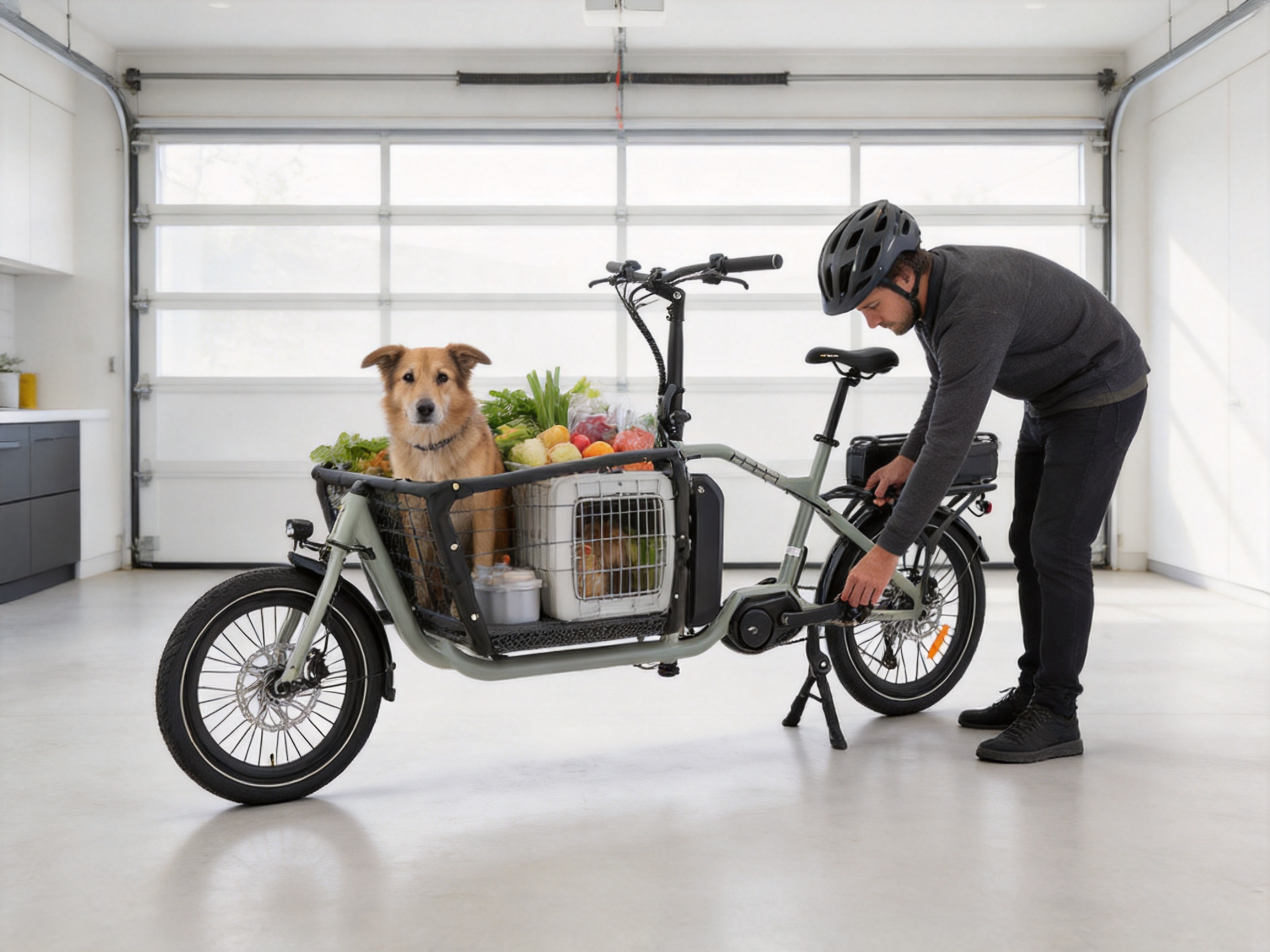
Pet transport requires similar care. A dog should not be allowed to move freely in the basket, jump out, or interfere with steering. A suitable pet carrier, protective enclosure, or restraint system should be selected according to the animal’s size and behavior. The animal should be introduced gradually to the stationary bicycle before beginning longer trips.
Rider training is also important. A loaded cargo bike accelerates, turns, and stops differently from an empty bicycle. New users should practice in a quiet area, first without cargo, then with a light and stable load. They should practice starting, stopping, slow-speed balance, cornering, emergency braking, and placing the bicycle on its stand if one is included in the final configuration.
The frame’s stated 300,000-cycle fatigue testing and TUV and EN17860 certification claims offer additional reassurance. These references suggest that the design has been evaluated against recognized structural and safety criteria. Nevertheless, certification should complement—not replace—responsible use. Riders must respect local laws, approved passenger limits, speed regulations, accessory instructions, and helmet requirements.
Stable handling is one of the most important differences between a properly designed cargo bicycle and a modified standard bike. The Model P uses geometry intended to help the rider remain confident when the front basket is loaded. A longer and more stable cargo platform can reduce the nervous steering feeling that sometimes occurs when heavy objects are placed on a conventional front rack.
Even with stable geometry, handling depends on how the load is arranged. Heavy items should not be placed high above the basket or allowed to move from side to side. Children should remain seated and properly restrained. Pets should be contained and introduced to the motion gradually. A balanced load makes steering, braking, and low-speed maneuvering more predictable.
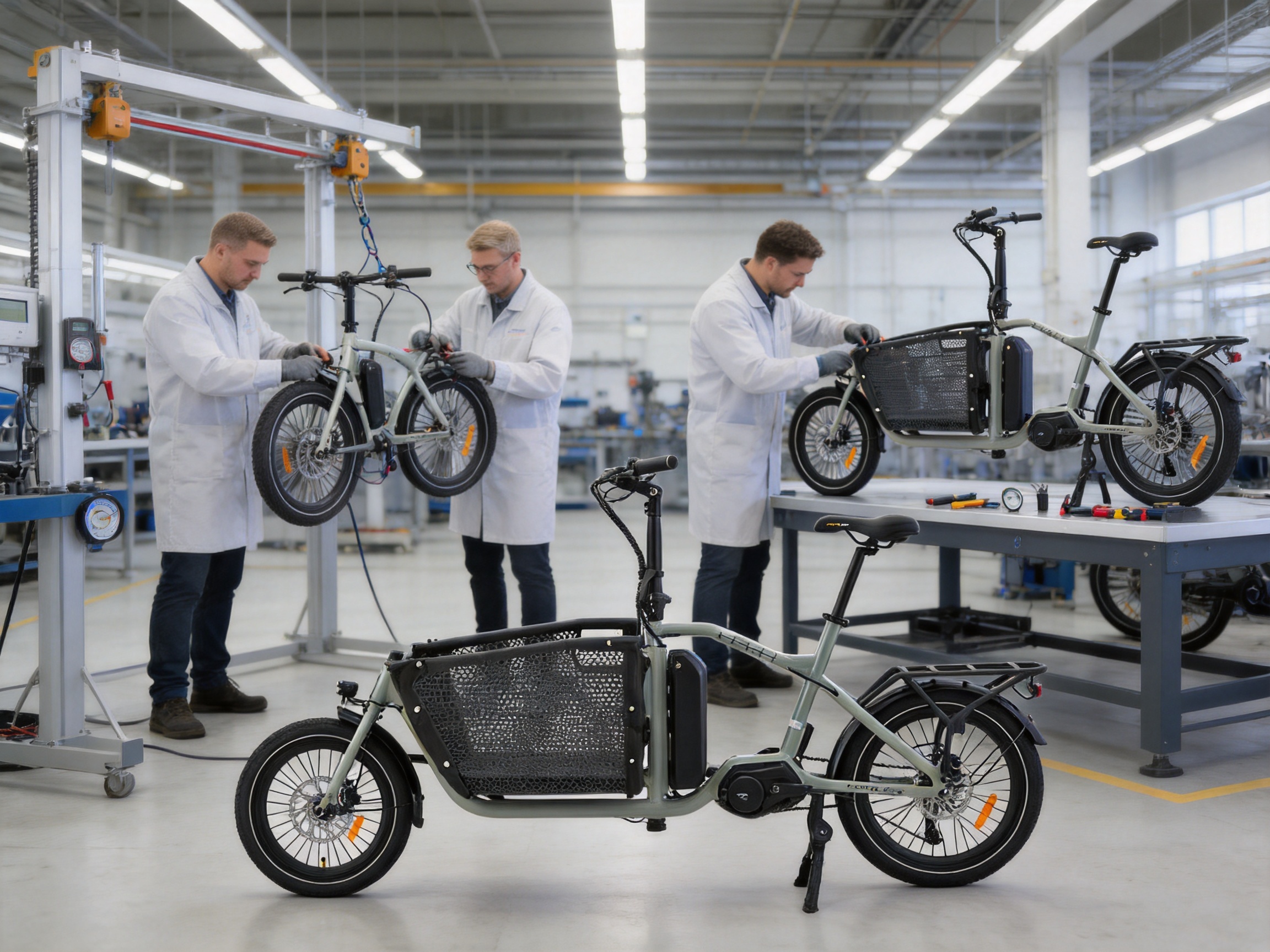
The quality of a cargo bike is determined not only by its visible components but also by how the product is designed, tested, assembled, and supported. The information provided about this model indicates a development approach that combines international design, engineering input, manufacturing expertise, and a mature supply chain.
The company behind the model describes an American product origin, a Paris-based design and research team, and manufacturing experience connected with an established beach-cruiser business. This combination can be valuable because cargo bicycles require a balance between utility and user experience. Engineering must address load, braking, durability, and electrical performance, while design must make the bicycle approachable for families and practical in everyday environments.
A mature supply chain can also improve consistency. Reliable access to recognized component suppliers such as Samsung, Bafang, Shimano, and Tektro helps support dependable battery, motor, drivetrain, and braking performance. Component integration is still essential; a high-quality motor or battery cannot compensate for poor wiring, weak mounting points, incorrect alignment, or inadequate final inspection. A strong manufacturing process therefore includes both component selection and system-level quality control.
Frame production should include accurate cutting, forming, welding, heat treatment, alignment inspection, and finishing. Cargo-bike frames require careful control of weld quality because the load-bearing structure experiences substantial repeated stress. Alignment is equally important. Small inaccuracies can affect steering, wheel tracking, brake performance, drivetrain operation, and long-term tire wear.
The stated fatigue testing provides evidence that the design process considers long-term structural durability rather than only static appearance. A high-cycle test places repeated stress on the frame and helps reveal weaknesses that may not be visible during a short road test. Product validation should ideally be accompanied by dimensional inspection, weld inspection, torque verification, electrical safety checks, and road testing of completed bicycles.
Quality manufacturing also involves repeatability. The first prototype may perform well, but a commercial product must maintain similar results across many production units. Standardized assembly procedures, documented torque values, trained technicians, inspection checkpoints, and traceable component batches can help reduce variation.
The company’s stated commitment to custom design and wholesale supply is another strength for distributors and professional buyers. Retailers may need different accessory packages, regional specifications, branding arrangements, shipping configurations, or service documentation. A manufacturer with design and research capability is better positioned to adapt a platform than a supplier that only resells an unchanged generic bicycle.
For distributors, the Model P offers a clear retail story. It addresses several visible customer needs: family mobility, pet transport, grocery carrying, electric assistance, compact storage, and safety-oriented construction. These use cases can be explained easily in a showroom or online product page.
The specification package also supports professional comparison. The frame material, battery capacity, motor placement, brake type, drivetrain, tire dimensions, cargo rating, and certification claims give retailers concrete points to discuss with buyers. Products are easier to position when their benefits are connected to measurable features rather than vague lifestyle language.
Wholesale buyers may also benefit from a product family strategy. A family-oriented Model P can sit alongside urban companion, adventure, heavy-duty, kids-learning, and flex-and-fold cargo models. This allows retailers to serve different customer profiles while maintaining a coherent cargo-bike category.
After-sales support remains essential. Retail partners should have access to replacement wear parts, battery and charger guidance, diagnostic procedures, accessory information, assembly instructions, and warranty policies. A good cargo-bike program is not complete when the bicycle leaves the factory; it continues through setup, customer education, maintenance, and service.
A conventional city bicycle is usually lighter, shorter, and less expensive, but it lacks the dedicated space and structural capacity required for family cargo. A rider may add a rack or panniers, yet these solutions often provide less volume and can affect balance when heavily loaded.
The Model P is more specialized and therefore larger, but it offers a stronger cargo platform, electric assistance, a more substantial braking system, and compatibility with child and pet transport equipment. For users who regularly carry people or bulky goods, the additional capability can justify the larger frame.
Rear-load cargo bikes place passengers or goods behind the rider. They can provide good capacity, but the rider may need to turn around or use a mirror to monitor children. A front cargo basket keeps the load within the rider’s forward field of view, which can make communication and observation easier.
The front-loading layout also offers direct access to the cargo area. Parents can place bags, supplies, or a pet in front without reaching around the rider. However, the rider must still practice low-speed handling and understand how front loading affects steering.
A fixed cargo box may provide excellent protection and a finished appearance, but it can be wide and difficult to store when empty. The Model P’s folding basket offers greater flexibility. It can expand for cargo use and become more compact for storage or narrow passages.
Low-cost alternatives may appear attractive because of their initial price, but they may use less suitable frames, smaller batteries, basic mechanical brakes, low-capacity racks, or unclear certification. They may also offer limited accessory compatibility and weaker after-sales support.
The Model P differentiates itself through its stated fatigue testing, safety certifications, aluminum alloy frame, hydraulic disc brakes, mid-drive system, Samsung battery, puncture-resistant tires, and established component selection. Buyers should still compare the final configuration, warranty, local compliance, and service network, but the product specification reflects a more complete cargo-bike design philosophy.
On a typical school or grocery journey, the Model P’s most noticeable benefit is reduced effort. The rider does not need to avoid hills or limit purchases because of the load. Electric assistance helps maintain a practical pace, while the nine-speed drivetrain allows the rider to select a suitable gear for each section of the route.
The wide tires and stable frame can make uneven streets feel less demanding. Hydraulic brakes provide controlled stopping when traffic conditions change. The front basket keeps bags, equipment, or a pet in a visible and accessible position. Together, these features reduce the compromises that often discourage families from replacing short car journeys with bicycles.
The bicycle’s range claim of up to 80 kilometers may cover several days of short trips for some users, but riders should plan realistically. Families who use maximum assistance on hills, carry heavy cargo, or ride in cold weather may experience a shorter range. A practical commuting routine should include a charging plan and an awareness of the nearest safe charging location.
Storage should also be considered before purchase. The bicycle is 680 millimeters wide and more than two meters long. It may fit in a garage, courtyard, commercial storage room, or dedicated bicycle area, but owners should measure doorways, elevators, ramps, and turning spaces. The folding basket helps, but it does not turn the complete bicycle into a compact folding bike.
Regular maintenance protects both safety and performance. Before each ride, the rider should check tire pressure, wheel security, brake operation, steering movement, cargo fasteners, accessory mounts, and battery engagement. A short inspection is especially important when carrying children or pets.
The chain, cassette, derailleur, and gear cables should be kept clean and lubricated according to the component manufacturer’s recommendations. Cargo bikes place greater demands on drivetrains because they often operate under higher loads. Timely replacement of worn chains and brake pads can prevent damage to more expensive components.
Hydraulic brake systems should be checked for leaks, reduced lever pressure, contaminated pads, and rotor wear. Tires should be examined for cuts, embedded debris, sidewall damage, and tread wear. Puncture-resistant construction reduces risk but does not remove the need for inspection.
The battery should be stored in accordance with the manufacturer’s temperature and charging instructions. It should not be exposed to extreme heat, freezing conditions, water ingress, or physical impact. The charger should be used only with the approved battery system. Any swelling, unusual odor, smoke, or excessive heat requires immediate discontinuation of use and professional inspection.
Long-term ownership also depends on software, electrical connectors, and display or control-system maintenance if these are included in the regional configuration. Electrical troubleshooting should be performed by a qualified technician, particularly when the issue involves the battery, motor controller, wiring harness, or charging system.
Individual buyers should begin by identifying their most common journeys. If the bicycle will mainly carry groceries, the standard folding basket may be sufficient. If it will carry a child or pet, buyers should verify the exact compatible seat, harness, carrier, rain cover, and protective accessories before ordering.
Families should also consider rider height, parking space, route gradients, traffic conditions, and local electric-bike regulations. A test ride is highly recommended. The rider should practice with a representative load because an empty cargo bike does not feel the same as a fully equipped one.
Distributors should request the complete technical configuration for their market. This includes motor rating, speed settings, battery certification, charger specification, lighting equipment, accessory compatibility, packaging dimensions, assembly requirements, warranty terms, and replacement-part availability.
Professional users such as delivery operators, pet-care businesses, retailers, and community organizations should evaluate total operating cost rather than purchase price alone. Battery durability, brake wear, tire replacement, service access, load stability, and downtime can have a greater financial effect over several years than the initial difference between competing products.
It is intended for family transportation, grocery carrying, pet transport, urban commuting, and other everyday utility tasks. Its front cargo basket and electric assistance make it particularly suitable for riders who need to carry people or bulky goods.
The listed maximum basket load is 35 kilograms. The load should be distributed evenly, secured properly, and used with compatible accessories. The final approved load must always follow the product manual and local regulations.
The front basket is described as compatible with child seats and rain covers. Parents should use an approved, correctly installed child seat and follow all safety instructions. Children should be secured and supervised throughout the ride.
Yes, the front cargo area is designed to support suitable pet-transport equipment. A dog should be secured in a compatible carrier or restraint system and introduced gradually to bicycle travel. The animal must not be allowed to interfere with steering or jump from the basket.
It uses a Bafang M430 mid-drive motor. The product information lists a 36V, 250W system rating and also describes output of up to 500W and torque of up to 110 Nm. Buyers should confirm the precise regional specification because legal motor limits and software configurations can differ.
The battery is a Samsung 36V 15Ah lithium battery with a stated capacity of 540Wh. The claimed maximum range is up to 80 kilometers, although real-world distance depends on load, terrain, assistance level, weather, tire pressure, and riding style.
A mid-drive motor places power near the center of the bicycle and works through the gear system. This can improve climbing support, weight distribution, and control when the bike is carrying a heavy load.
Yes. It uses Tektro hydraulic disc brakes. These are intended to provide controlled braking with reduced hand effort, which is valuable when the bicycle and cargo have a high combined weight.
The product information describes it as a folding front basket. When folded, it is approximately 365 millimeters wide, allowing the bicycle to occupy less space than it does in full cargo configuration.
Its geometry is optimized for stable and confident handling, making it approachable for first-time cargo riders. However, every new rider should practice progressively, beginning in a quiet area and learning how the bicycle behaves when loaded.
The frame is made from 6061 T4T6 aluminum alloy, and the product information states that it passes 300,000-cycle fatigue testing. It is also described as meeting TUV and EN17860 safety certifications. Correct loading and regular maintenance remain essential.
It can be suitable for light commercial delivery, pet services, retail errands, and other professional applications that fit within its load ratings. Commercial buyers should confirm duty-cycle requirements, accessory options, local regulations, and after-sales service arrangements.
Buyers should confirm the exact motor and battery configuration, local compliance, included accessories, child-seat or pet-carrier compatibility, warranty coverage, delivery assembly requirements, and service support. They should also measure their intended storage area.
The Model P ESP3 is designed around a clear practical objective: helping families and urban users replace short car journeys with a stable, capable, and electrically assisted bicycle. Its strongest qualities are the combination of a large folding front basket, mid-drive power, a high-capacity battery, hydraulic brakes, wide puncture-resistant tires, and a frame developed for repeated cargo use.
Its advantages over simpler alternatives are found in the complete system rather than one isolated feature. The cargo area is more useful than a standard rack, the mid-drive system is better suited to loaded climbing than a basic single-speed arrangement, the hydraulic brakes provide stronger control than entry-level rim brakes, and the stated fatigue testing and certification claims offer additional structural reassurance.
The manufacturing and development approach also supports the product’s position. International design input, research and development capability, established component partnerships, supply-chain experience, and a focus on testing can help create a more consistent and serviceable cargo-bike platform. For distributors, the model offers a clear family-transport proposition with applications in shopping, school travel, pet care, commuting, and light utility work.
No cargo bicycle removes the need for responsible loading, correct maintenance, rider training, and compliance with local rules. When used within its specifications, however, the Model P ESP3 provides a compelling combination of capacity, stability, comfort, and practical electric assistance. It is a strong option for households and organizations seeking a versatile mobility solution that is safer and more useful than a conventional bicycle while remaining more efficient and accessible than a car for many everyday journeys.
1. Product specification sheet for the Model P ESP3 electric family cargo bike.
2. Technical information for 6061 T4T6 aluminum alloy bicycle frames.
3. Bafang M430 mid-drive motor technical documentation.
4. Samsung lithium-ion battery performance and handling guidance.
5. Shimano Sora nine-speed drivetrain service information.
6. Tektro hydraulic disc-brake maintenance guidance.
7. European cargo-bike safety and durability assessment principles associated with EN17860.
8. General bicycle fatigue-testing and structural-validation practices.
9. Manufacturer information on cargo-bike design, international product development, and supply-chain support.
Nov 23, 2026
Nov 09, 2026
Nov 01, 2026


info@atmosecargobike.com

200 rue de la Croix Nivert 75015 Paris

Custom Electric Bakfiets
 English
 Français
 Deutsch