Oct 22, 2026
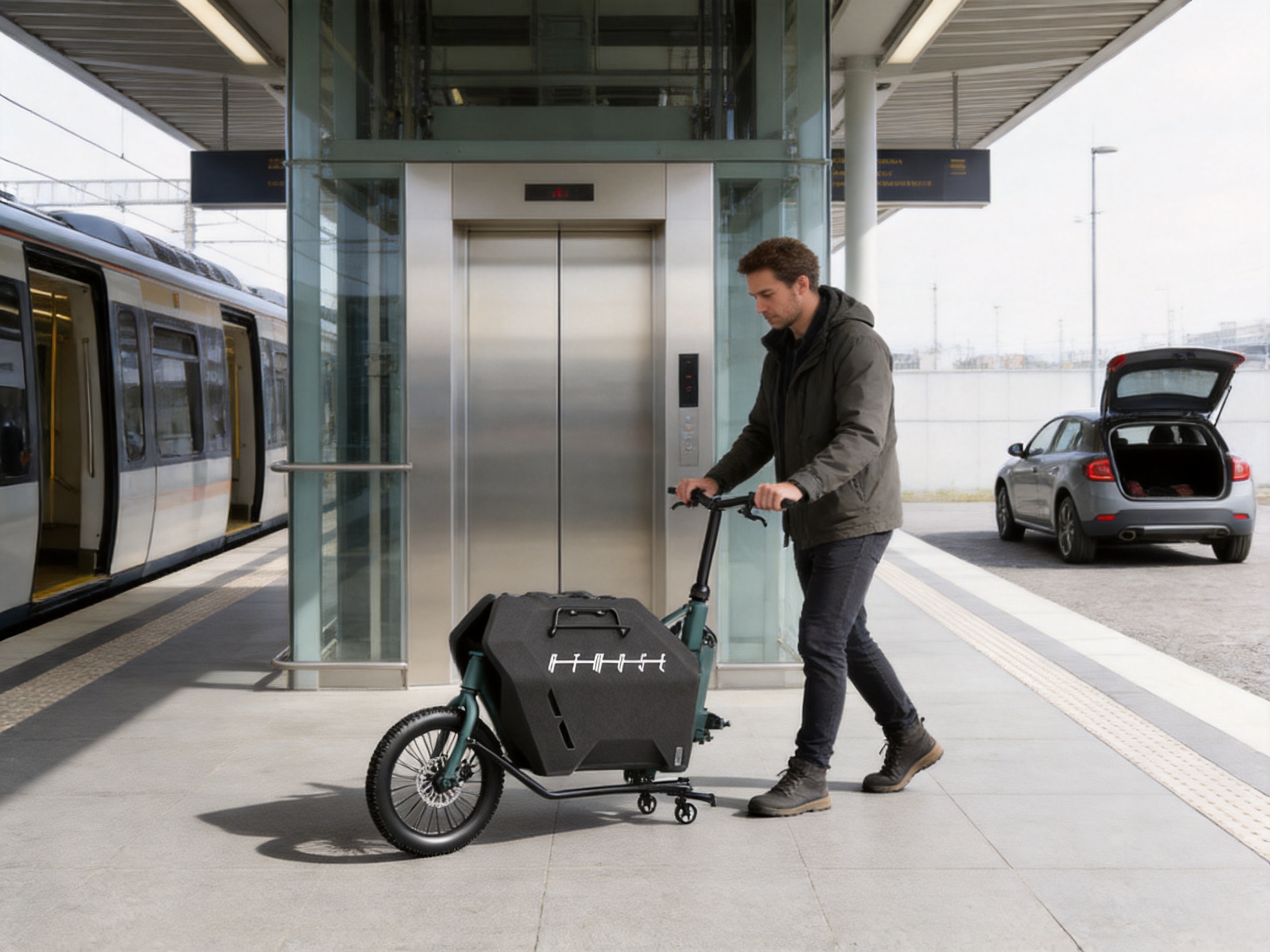
Urban transportation is becoming more complex. Many riders need the carrying capacity of a cargo bike, but they also live in apartments, commute by train, park in shared spaces, or occasionally transport their bicycle by car. A conventional long-tail or front-loading cargo bike can solve the carrying problem while creating another one: it may be difficult to store, lift, transport, or take indoors.
The Atmose Model R ESR1 addresses this conflict with a design built around folding convenience without abandoning the front-loading cargo-bike format. It is intended for riders who want to carry groceries, work equipment, deliveries, or daily essentials while retaining the ability to fold and roll the bike through urban spaces. Its central idea is straightforward: provide the practical cargo layout of a larger utility bicycle, then reduce its footprint when it is time to store or transport it.
The result is a tri-fold electric cargo bike with a 250W mid-drive motor, up to 70Nm of torque, a 720Wh Samsung battery, a Gates belt drive, a Shimano Nexus 3 internal gear hub, hydraulic disc brakes, and a front basket rated for up to 45kg. The rider capacity is listed at 100kg, making the bike suitable for substantial everyday loads while remaining focused on city mobility.
What distinguishes the Model R is not one isolated specification. Its strongest advantage comes from the way its folding structure, cargo capacity, drivetrain, braking system, and electrical assistance work together. It is a cargo bike designed not only to carry items, but also to fit into the routines of people who lack dedicated bicycle storage.
The conventional cargo-bike experience often assumes that the owner has a garage, a secure bicycle room, a ground-level entrance, or enough outdoor space for long-term storage. Many city residents have none of these. A fourth-floor apartment, narrow stairwell, compact elevator, office reception area, or crowded train platform can make a full-size cargo bike inconvenient even when the rider genuinely needs its carrying capacity.
The Model R approaches the problem from a different direction. In riding configuration, it has a length of 198cm, giving it the extended layout expected from a front-loading cargo bike. In folded form, its dimensions reduce to 120 × 44 × 85cm. With the front wheel removed, the folded package measures approximately 102 × 44 × 76cm.
These dimensions matter because storage is often determined by the tightest space in a rider’s daily routine. A bicycle does not need to fit only in a home. It may also need to pass through an elevator, enter an office, stand inside a train vestibule, fit into a station lift, or travel in a car trunk. A folding cargo bicycle has an advantage over a fixed-frame cargo bike in each of these situations.
The Model R does not attempt to become a small folding bicycle with a token luggage rack. It retains a front-loading cargo configuration and a substantial basket. This makes its folding mechanism more meaningful: the cargo function remains central before, during, and after the folding process.
For commuters, this creates a new transportation pattern. A rider can cycle from home to a railway station, fold the bike, roll it through the station, board a permitted train, and unfold it at the destination. For apartment residents, the same bike can be rolled indoors after a journey rather than left outdoors under a cover or secured to a public rack.
The tri-fold frame is one of the defining engineering features of the bicycle. Instead of requiring the rider to convert the bike into a different configuration, the folding design allows the primary front-loading layout to fold in place. The basket, steering arrangement, and drivetrain remain part of the same integrated vehicle concept.
That distinction is important. Some compact cargo solutions reduce storage size by removing a box, detaching a cargo module, or transforming the bike into a different utility format. Those systems may be practical, but they can require additional assembly, loose components, or more time before and after every trip. The Model R’s design goal is to make the cargo bicycle itself foldable rather than treating the cargo function as an accessory.
At 198cm long when ready to ride, the bike has the proportions needed for a front-loading cargo layout. Once folded, it loses a significant amount of length and becomes considerably easier to position in a hallway, elevator, storage area, or vehicle. The folded width of 44cm also gives the user a manageable profile for rolling the bike through interior spaces.
The ability to roll the folded bike is especially relevant. A cargo bike with a heavy frame, battery, motor, and basket load is not something most users will want to carry for long distances. The practical question is not whether it can be lifted briefly, but whether a person can move it through a station or building without unnecessary strain. A rolling folded configuration reduces the need for lifting and supports a more realistic multi-modal routine.
Compared with many traditional cargo bicycles, the folding system offers an advantage in storage efficiency. Compared with small folding e-bikes, the Model R offers an advantage in carrying volume and front-load integration. Its value is found between these two categories: it is more capable than a compact commuter bicycle and more space-conscious than a fixed full-size cargo bike.
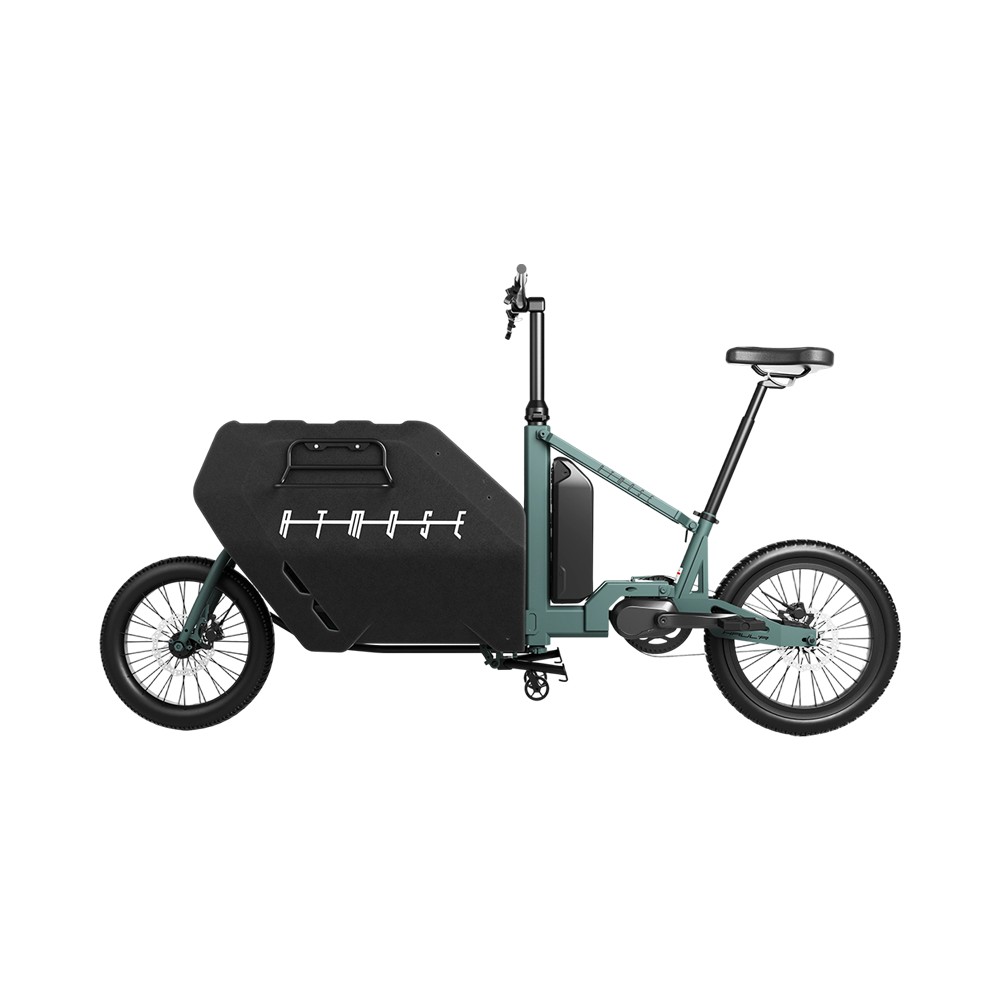
Atmose Model R ESR1 Tri-Fold Cargo E-Bike for Train Commuters and Small Apartments
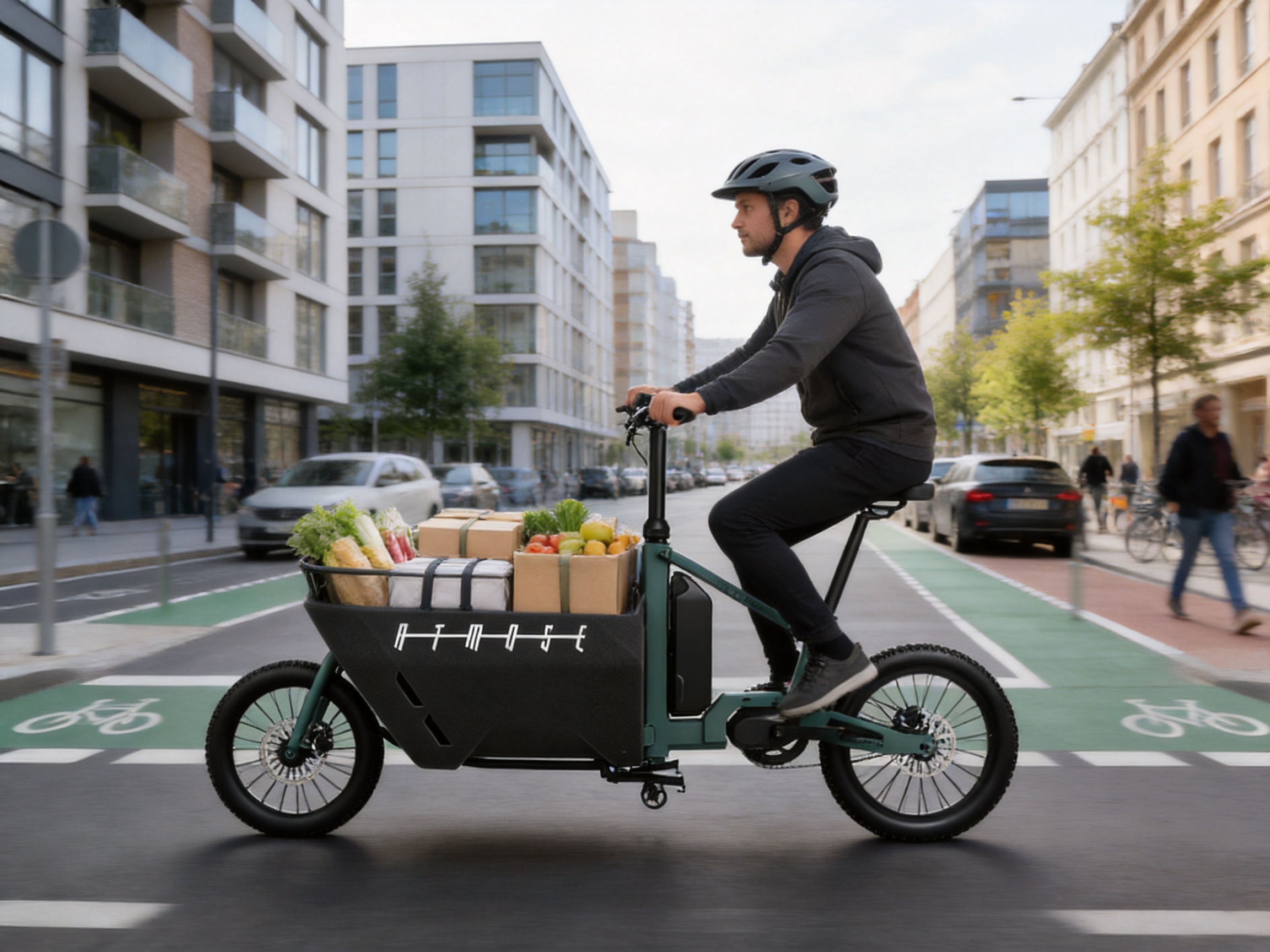
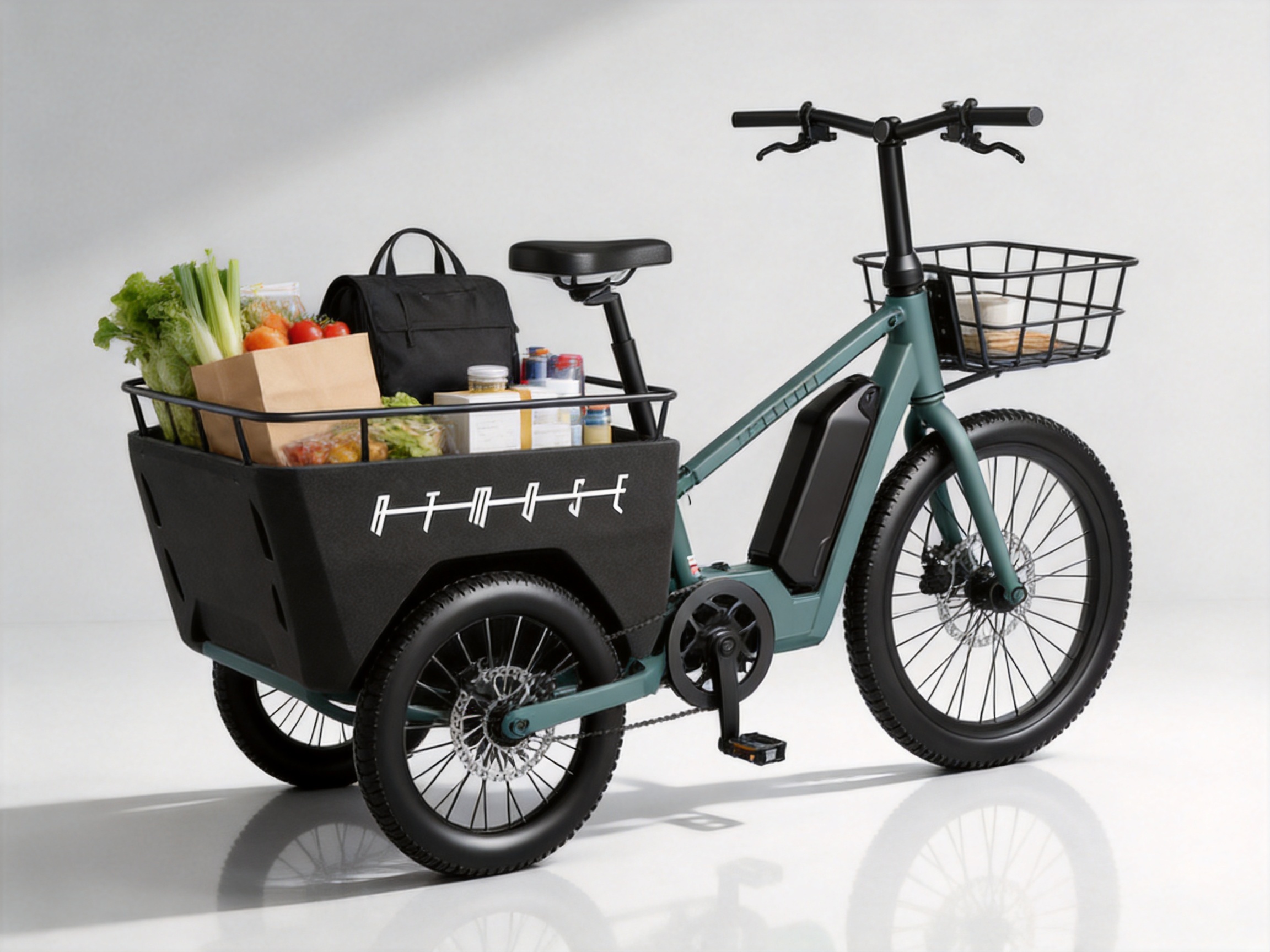
The front basket is designed to carry up to 45kg, while the rider capacity is specified at up to 100kg. The basket dimensions are approximately 70 × 50cm at the top and 50 × 36cm at the bottom. This tapered format provides a usable loading area while keeping the lower portion of the basket compact and stable.
A front-loading basket gives the rider direct visibility of the cargo. Groceries, parcels, bags, tools, or daily equipment remain in front of the rider rather than behind them. This can make it easier to monitor the load during a journey, especially when the cargo is irregularly shaped or changes from trip to trip.
The low front position also supports a stable cargo arrangement. Heavy items can be placed lower in the basket, reducing the tendency for the load to shift dramatically. Good loading practice remains essential: weight should be distributed evenly, loose items should be secured, and the rider should avoid exceeding the stated capacity. Nevertheless, the basic layout is well suited to practical city hauling.
A 45kg basket capacity places the Model R in a more useful category than bicycles intended only for a backpack or a small pannier. It can accommodate a substantial grocery shop, a workday’s equipment, delivery parcels, household supplies, or recreational gear. The bike is not limited to one narrow use case.
For families, the basket can carry shopping and daily necessities. For professionals, it can support tools, samples, or compact delivery packages. For apartment residents, it can replace short car journeys for errands. For commuters, it provides space for clothing, food, a computer bag, or equipment that would otherwise be awkward to carry on the body.
The front-loading design also separates the cargo from the rider’s back and shoulders. This is particularly valuable for heavier objects. Instead of carrying everything in a backpack, the rider can place the load in the basket and use the electric assist to manage the increased bicycle weight.
The Model R uses a 36V, 250W mid-drive motor with up to 70Nm of torque. A mid-drive motor applies assistance through the bicycle’s drivetrain rather than turning the wheel independently. In a cargo-bike application, this arrangement can provide a natural relationship between motor assistance and gear selection.
Torque is especially relevant when starting from a stop, climbing a short urban gradient, or accelerating with cargo. A maximum output of up to 70Nm gives the motor a useful reserve for these situations. The rider still controls the bicycle, selects an appropriate gear, and must adapt speed to road conditions, but the motor reduces the physical effort required.
Compared with a low-torque system designed mainly for lightly loaded commuting, a 70Nm mid-drive configuration is better suited to the additional mass of a cargo bike and its contents. This does not mean that the bike should be treated as a high-speed performance machine. Its practical advantage is controlled assistance when the bike is loaded, particularly in stop-and-go traffic or on moderate inclines.
The 250W rating aligns the motor with the intended urban e-bike category in many markets, although local regulations always determine permitted assistance characteristics, speed limits, equipment, and usage requirements. Riders should confirm the rules that apply in their area before using the bike on public roads or shared paths.
Mid-drive assistance can also preserve a balanced wheel configuration. Because the motor is located near the frame’s central area, the front wheel remains focused on steering and the rear wheel remains responsible for propulsion through the drivetrain. This can be helpful on a front-loading cargo bike, where predictable steering is important.
Motor performance is only one part of the riding experience. The Model R combines its mid-drive unit with an internal gear hub and a belt drive, creating a system designed around low-maintenance urban use. That combination is particularly relevant to riders who use the bike frequently and do not want every trip to involve drivetrain cleaning or adjustment.
The bike is equipped with a Samsung 36V, 20Ah lithium battery rated at 720Wh. Battery capacity does not translate into one universal range figure because real-world distance depends on rider weight, cargo weight, terrain, temperature, assist level, stop-start frequency, tire pressure, wind, and riding speed. However, a 720Wh battery provides a substantial energy reserve for a compact cargo bike.
For daily urban use, the battery capacity can support repeated short journeys without requiring frequent charging. A rider may use the bicycle for commuting, shopping, school-related errands, work trips, and return journeys before recharging. The actual schedule will depend on conditions, but the battery specification gives the bike a practical foundation for regular use rather than occasional recreational riding only.
The battery is also important because cargo bicycles often operate under greater load than ordinary commuter e-bikes. Carrying a rider and up to 45kg of basket cargo requires more energy, especially on hills and during frequent acceleration. A larger battery helps compensate for this higher demand.
Using Samsung battery cells is another strength in the specification. Cell quality, battery management, assembly, and protection systems all influence long-term performance, so the brand of the cells should not be viewed as the only measure of battery quality. Proper charging, storage, inspection, and adherence to the manufacturer’s instructions remain essential. Even so, the stated Samsung 720Wh pack indicates that the bicycle is designed around meaningful energy capacity rather than the smallest possible battery.
Battery placement also affects handling and serviceability. A well-integrated battery should be securely mounted, protected from ordinary road vibration, and positioned so that it does not make the bicycle feel unnecessarily top-heavy. As with all electric bicycles, owners should use the supplied charging equipment, avoid damaged batteries, and store the battery in an appropriate environment.
The Model R uses a Gates belt drive paired with a Shimano Nexus 3 internal gear hub. This combination is well matched to the needs of a city cargo bike because it reduces routine drivetrain maintenance and supports convenient shifting in traffic.
A conventional chain can accumulate oil, dust, grit, and moisture. It may require lubrication, cleaning, tension adjustment, and eventual replacement of individual components. A belt drive avoids many of these tasks. It does not require chain oil, generally runs quietly, and is less likely to transfer grease to clothing or luggage.
Reduced maintenance does not mean zero maintenance. Belt tension, alignment, sprocket condition, fasteners, and the surrounding frame hardware should still be checked according to the manufacturer’s service guidance. The belt must also be protected from improper installation and severe damage. Nevertheless, its clean operating character is a significant advantage for commuters and apartment residents who may not have a workshop or convenient outdoor cleaning area.
The Shimano Nexus 3 internal gear hub places the gears inside the rear hub rather than exposing the shifting mechanism to the same level of road contamination as an external derailleur. It offers three internal ratios for city riding. Three gears may appear simple compared with a wide-range derailleur system, but simplicity can be useful on an urban cargo bike where reliability, ease of use, and low maintenance are more important than a large number of ratios.
The ability to shift while stationary is particularly useful when riding a loaded bicycle. A rider approaching a traffic light can select a lower gear before restarting, even if the bike has already stopped. This reduces the chance of having to push a heavy load away from a standstill in an unnecessarily high gear.
Compared with a conventional chain-and-derailleur cargo bike, the belt-and-hub arrangement offers a cleaner and more enclosed drivetrain. Compared with a single-speed utility bike, it offers better adaptability for starts, inclines, and changing loads. The trade-off is that internal gear hubs and belt systems require correct frame alignment, belt tension, and compatible components. Proper servicing remains important, but the overall system is designed to make everyday ownership easier.
Braking becomes more important as cargo capacity increases. A bicycle carrying a rider, motor, battery, frame, and up to 45kg of front cargo has more total mass than a lightweight commuter bike. Hydraulic disc brakes are therefore a logical choice for the Model R.
The specifications identify Tektro or Magura hydraulic disc brakes. Hydraulic systems transmit braking force through fluid rather than a mechanical cable. They can provide consistent lever feel, strong stopping performance, and useful modulation when correctly set up and maintained.
For urban riding, modulation is as important as maximum braking force. The rider may need to slow gradually around pedestrians, manage a narrow turn, or stop decisively when traffic conditions change. A predictable hydraulic system helps the rider apply braking with greater control.
The front-loading basket makes weight distribution especially relevant. Cargo should be placed securely and should not obstruct the rider’s view, steering movement, or brake cables and hoses. Riders should also remember that stopping distance depends on speed, road surface, weather, tire condition, cargo weight, and reaction time. Even high-quality brakes cannot overcome excessive speed or an unsecured load.
The Model R’s hydraulic braking equipment complements its intended use as a loaded urban utility vehicle. It is a meaningful advantage over basic bicycles fitted with entry-level rim brakes or underpowered mechanical systems. The benefit is not simply stronger stopping; it is the confidence that comes from consistent control as the load changes.
The bike uses 16 × 2.4-inch front and 18 × 2.4-inch rear puncture-proof tires. The different wheel diameters reflect the geometry of the front-loading design, while the 2.4-inch width provides a broad contact patch and useful cushioning over ordinary urban surfaces.
City streets can include broken pavement, drainage covers, construction debris, painted road markings, tram crossings, and sharp edges. Wider tires can help absorb some of the vibration and maintain a stable contact patch. They are not a substitute for careful riding, but they contribute to comfort and control.
Puncture-resistant construction is valuable for a commuter or delivery rider because a flat tire can interrupt an entire day. No tire is completely immune to punctures, and tire pressure must still be checked regularly. Underinflation can increase rolling resistance and damage risk, while excessive pressure can reduce comfort and grip. Correct inflation should follow the tire and manufacturer recommendations.
The smaller front wheel can also support a lower and more compact front-loading structure. The larger rear wheel helps maintain efficient rolling under the rider and motor. Together, the wheel sizes contribute to the distinctive proportions of the bicycle rather than representing a simple folding-bike compromise.
The frame is made from 6061 T4/T6 aluminum alloy. This alloy family is widely used in bicycle construction because it combines relatively low weight with useful strength, corrosion resistance, and suitability for formed and welded structures.
The T4/T6 designation refers to different heat-treatment conditions used during aluminum processing. In a bicycle frame, material selection must be paired with appropriate tube design, weld quality, joint geometry, folding-hardware design, and inspection procedures. A good alloy specification alone does not guarantee a safe or durable frame. The complete structure must be engineered to manage repeated loads from the rider, cargo, motor assistance, braking, road vibration, and folding cycles.
A folding cargo frame presents more demanding design challenges than a simple rigid commuter frame. The structure must remain sufficiently rigid during riding while also allowing controlled movement at the folding points. Hinges, locking mechanisms, alignment surfaces, and fasteners must be designed to resist unwanted movement when the bike is in use.
The front-loading arrangement adds another structural consideration: cargo weight is carried ahead of the rider and steering axis. The frame and steering system must therefore maintain predictable handling as the basket load changes. Smooth steering inputs, suitable weight distribution, and correctly secured cargo remain important, but the frame architecture establishes the foundation for that behavior.
Atmose’s stated design and development background combines American product thinking with European design and research-and-development involvement in Paris. This combination supports the product’s dual emphasis on practical utility and compact urban form. The bicycle is not designed only as a transport machine or only as a lifestyle object; its specification reflects both everyday function and space-conscious design.
The company presents itself as an international cargo-bike brand with American origins, a French design and R&D presence, and access to established manufacturing expertise and a mature supply chain. These elements are relevant because cargo e-bikes require coordination across many specialized areas: frame production, welding, folding hardware, battery integration, motor systems, drivetrain compatibility, brake installation, tire selection, and final assembly.
A mature supply chain can help a manufacturer source compatible components at consistent quality levels. It can also support replacement parts, technical communication, production planning, and improvements across product generations. For a folding cargo bike, these capabilities are particularly valuable because the product combines systems that are often developed separately.
Advanced manufacturing should not be reduced to a single machine or a single material. In this product category, manufacturing strength is better understood as the ability to control the entire process from design through assembly and inspection. The frame must be accurately fabricated, folding points must align correctly, electrical components must be integrated safely, and the final bicycle must be checked as a complete system.
The use of 6061 aluminum alloy suggests a manufacturing process involving controlled forming, welding, finishing, and heat-treatment considerations. Folding frames also require close attention to tolerances because even small alignment errors may affect how the bike folds, rolls, or locks into riding position. Accurate jigs, repeatable welding procedures, and inspection of critical joints are therefore important parts of a credible production process.
Component integration is another manufacturing strength. The Model R combines a mid-drive motor, a large battery, Gates belt drive, Nexus 3 internal gearing, hydraulic brakes, puncture-resistant tires, and a folding cargo frame. These parts must operate together without compromising clearance, service access, steering movement, folding sequence, or load stability.
The company’s history also includes its connection with MOTIV, an established American beach-cruiser brand with manufacturing experience and a developed supply network. That background can contribute to knowledge in frame design, product sourcing, assembly, and consumer bicycle development. The Model R extends that experience into a more technically complex cargo-bike platform.
In practical terms, the product’s manufacturing strengths are reflected in its system-level specification. The bike is not merely a folding frame fitted with an electric motor. It is a coordinated platform that addresses cargo capacity, storage, braking, drivetrain maintenance, battery capacity, and daily urban use at the same time.
Product comparisons are most useful when they consider intended use rather than only individual specifications. The Model R occupies a distinctive position among cargo bicycles because it combines front-loading capacity with a folding structure.
| Comparison category | Typical strength | Model R distinction |
|---|---|---|
| Fixed front-loading cargo bike | Large cargo volume and stable utility layout | Offers a similar front-loading concept while folding for storage and transport |
| Long-tail cargo e-bike | Rear passenger or cargo capacity and familiar bicycle proportions | Places the main load in front and prioritizes a compact folded footprint |
| Small folding e-bike | Easy storage and convenient transport | Provides substantially greater front cargo capacity and a utility-oriented frame |
| Single-speed utility bicycle | Simple mechanical operation | Adds electric assistance, three internal gears, and a larger battery for loaded riding |
| Chain-and-derailleur cargo bike | Wide gear range and familiar service technology | Uses a low-maintenance belt drive and internal gear hub for urban simplicity |
| Car-dependent short-trip transport | High enclosed carrying capacity | Offers a lower-footprint, active alternative for many local journeys |
The Model R may not be the ideal choice for every cargo-bike user. Riders who routinely carry very large volumes, transport several passengers, or travel long distances on rough terrain may prefer a larger fixed cargo platform. Riders who need the lightest possible folding bicycle may choose a much smaller and less capable model. The Model R is most compelling for people who need meaningful cargo space and compact storage at the same time.
This balance is its primary competitive advantage. It does not ask the rider to choose permanently between utility and portability. Instead, it gives the bike two functional states: a full front-loading configuration for riding and a compact rolling configuration for storage or transport.
Train commuting often exposes the weaknesses of a conventional cargo bike. Stations may have long corridors, escalators, gates, lifts, and limited bicycle areas. Even when bicycles are permitted, a long rigid frame can be awkward in crowded environments.
The Model R is designed with these obstacles in mind. Its folding dimensions make it easier to move through a station and position in a designated train area, subject to local railway rules. The ability to roll the folded bicycle is especially useful when the rider must cover a long distance between the platform and the street.
Folding also helps protect the bike from the limitations of outdoor parking. Rather than leaving a valuable electric cargo bike locked outside during the workday, a commuter may be able to bring it inside a workplace or approved storage area. This can reduce exposure to rain, theft, vandalism, and long-term weathering.
The same advantage applies to car travel. Removing the front wheel reduces the folded dimensions to approximately 102 × 44 × 76cm, allowing the bike to fit into many vehicle trunks. Exact fit depends on the car’s opening dimensions, trunk shape, seat configuration, and interior equipment, so users should verify compatibility before purchase.
This car-compatible format can be useful for mixed travel. A rider may drive to the edge of a city, unload the bike, and complete the final section by bicycle. Families can take the bike on weekend trips without a roof rack. Service workers can carry a compact cargo bike to a job area and use it for local travel after parking.
Indoor storage is one of the clearest reasons to choose a folding cargo bike. A bicycle that lives inside the home is easier to protect and more convenient to access than one stored in a distant basement or public rack. However, indoor storage is only practical if the bike can pass through the building and occupy a manageable amount of space.
The Model R’s folded profile is suited to hallways, elevator cabins, storage rooms, and corners near an entrance. Its ability to roll means that owners may not need to lift the complete bicycle over stairs or thresholds every time. The bike’s exact maneuverability will depend on floor surfaces, doorway width, folded orientation, and the user’s strength, but the rolling concept supports daily practicality.
For apartment dwellers, this can change the ownership experience. The bike is not an object that must be hidden in a remote storage unit. It can remain close to the door, ready for shopping or commuting. The more convenient the access, the more likely the bicycle is to replace short car journeys.
Indoor storage also makes routine care easier. Owners can inspect the tires, brakes, belt, folding hardware, and battery condition without working in rain or darkness. Maintenance should still be performed responsibly, and the battery should be charged according to the manufacturer’s instructions in a safe location.
Front-loading bikes have a different handling character from standard bicycles. The rider sits behind the cargo area and must become familiar with the steering response, turning radius, overall length, and load behavior. The Model R’s front cargo position provides good visibility of the basket, but riders should practice before carrying the maximum rated load in traffic.
Starting with a light load helps the rider understand how the bike responds. Gradually adding weight allows the rider to learn how braking, cornering, acceleration, and low-speed balance change. The hydraulic brakes and motor assistance can support control, but they do not remove the need for careful technique.
The low-mounted basket can help keep cargo stable, but the shape and placement of the load remain important. Tall or loose objects may affect visibility or wind resistance. Uneven weight distribution can influence steering. Cargo should be restrained where necessary, and the basket should never be loaded beyond its stated capacity.
The Nexus 3 hub can simplify urban riding by allowing the rider to select a lower gear before stopping. Combined with up to 70Nm of motor torque, this makes the bike better suited to repeated starts than an unassisted cargo bicycle. The rider can maintain a steady pace rather than relying entirely on physical strength to move the loaded bike away from every traffic light.
Wide tires, hydraulic brakes, and the balanced central placement of the motor contribute to a reassuring city-riding platform. These features do not make the bike immune to road hazards, but they support the predictable, controlled behavior expected from a practical utility bicycle.
The sustainability value of a cargo e-bike is closely connected to how often it is used. A bicycle that is difficult to store may remain unused, while a bike that folds and rolls into a home or office can become part of everyday life. The Model R’s compact storage format supports more frequent use and may help replace short journeys that would otherwise require a car.
Its carrying capacity expands the range of trips that can be completed by bicycle. Grocery shopping, small deliveries, commuting with equipment, and local errands often fail with a standard bicycle because there is nowhere to put the load. The front basket addresses this limitation directly.
The belt drive also contributes to a cleaner ownership experience by reducing the need for oil and frequent drivetrain cleaning. The aluminum frame, internal gear hub, and replaceable service components can support long-term use when maintained correctly. Sustainable mobility is not only about energy consumption during operation; durability, repairability, and practical ownership all matter.
Battery-powered transportation does require responsible charging and eventual battery management. Owners should follow safe charging practices, protect the battery from severe temperatures and damage, and use appropriate recycling or collection channels when the battery reaches the end of its service life.
One of the Model R’s strongest ownership advantages is its relatively low-maintenance drivetrain. The Gates belt does not need chain lubrication, and the Nexus 3 internal gear hub encloses much of the shifting mechanism. This is valuable for people who use the bike in all seasons or who store it indoors.
Nevertheless, a cargo e-bike requires regular inspection. Tires should be checked for pressure, cuts, and excessive wear. Brake pads and rotors should be inspected. Hydraulic brake performance should be monitored, and any fluid service should be handled according to the brake manufacturer’s requirements.
The folding system deserves particular attention. Riders should ensure that the frame is fully unfolded, the relevant locks are properly engaged, and the hinges or fasteners show no unusual movement before riding. Dirt and damage around folding interfaces can affect operation. If the bike develops looseness, unusual noise, or difficulty folding, it should be inspected before continued use.
The belt should remain correctly aligned and tensioned. Because belt systems rely on precise positioning, incorrect adjustment may lead to noise, premature wear, or poor performance. The motor, battery connections, display, and wiring should also be checked for damage, especially after heavy use or transport.
Professional service is recommended for complex electrical, hydraulic, structural, and hub-related work. The more consistently the bicycle is inspected, the more likely it is to provide reliable performance over a long period.
The Model R is particularly suitable for urban residents who need a cargo bike but cannot accommodate a full-size fixed frame. It is a strong candidate for train commuters, apartment dwellers, small-business users, delivery riders, and families who want to carry goods without owning a car for every short journey.
It may also suit riders who already have a conventional bicycle but need more carrying capacity for regular errands. The front basket is large enough to make the bike a practical utility tool rather than merely a leisure bicycle.
People who value a clean, quiet, low-maintenance drivetrain will appreciate the Gates belt and internal hub. Riders who encounter hills or carry heavier loads will benefit from the torque of the mid-drive motor and the capacity of the 720Wh battery.
The bike is less likely to suit someone seeking a very lightweight folding bicycle, a high-speed sports e-bike, or a maximum-capacity family cargo platform. Its design is optimized for the intersection of utility, folding convenience, and urban mobility.
Potential buyers should measure the spaces that matter most: the home entrance, elevator, hallway, storage location, train-access route, and vehicle trunk. The stated folded dimensions provide a useful starting point, but doors and turning areas can be more restrictive than simple width measurements suggest.
Local regulations should also be checked. E-bike motor limits, assisted speed, equipment requirements, bicycle-train policies, and cargo-bike rules vary by location. The rider should understand where the bike may be used and how it must be transported on public transit.
Buyers should consider the intended loading pattern. A 45kg basket rating is substantial, but it is not a recommendation to carry the maximum load on every trip. Heavy items should be secured, distributed evenly, and transported at a speed appropriate to the conditions.
Finally, buyers should ask about assembly, warranty support, spare parts, battery service, brake components, belt availability, and technical support in their region. A sophisticated folding cargo bike benefits from knowledgeable after-sales service, particularly when the product includes an electric system, hydraulic brakes, an internal gear hub, and specialized folding hardware.
The Model R is designed for urban cargo transport where storage and portability are as important as carrying capacity. It provides a front-loading basket for daily goods and folds into a smaller package for apartments, trains, offices, and car trunks.
The front basket is rated for up to 45kg. The rider capacity is listed separately at up to 100kg. The load should be distributed securely, and users should follow all applicable safety guidance.
The bike is approximately 198cm long, 38cm wide, and 108cm high in riding configuration. The primary folded size is approximately 120 × 44 × 85cm. With the front wheel removed, the folded package is approximately 102 × 44 × 76cm.
Yes. The design is intended to allow the folded bike to be rolled through places such as station halls, elevators, offices, and storage areas instead of requiring the user to carry the entire bicycle.
It uses a 36V, 250W mid-drive motor producing up to 70Nm of torque. This configuration is intended to assist with loaded starts, urban inclines, and stop-and-go riding.
The bike uses a Samsung 36V, 20Ah lithium battery with a stated capacity of 720Wh. Actual range depends on rider weight, cargo, terrain, assist level, temperature, tire pressure, and riding conditions.
The Gates belt drive does not require chain oil and is generally clean and quiet. It can reduce routine maintenance, although belt alignment and tension still need to be checked.
Yes. It uses a Shimano Nexus 3 internal gear hub. The three-speed system is intended for practical city riding, and internal gearing can be shifted while the bicycle is stationary.
The specifications identify Tektro or Magura hydraulic disc brakes. Hydraulic brakes are appropriate for a loaded electric cargo bike because they can provide strong, controllable braking when properly maintained.
The front tire is 16 × 2.4 inches and the rear tire is 18 × 2.4 inches. Both are described as puncture-proof tires.
Its folding design and rolling capability are intended to make train commuting more practical. However, riders must confirm the rules of each railway operator, including requirements for folded bicycles, reservations, peak-hour travel, and storage locations.
No. With the front wheel removed, the folded dimensions are approximately 102 × 44 × 76cm, which may fit many trunks, but vehicle openings and interior shapes vary. Buyers should measure their vehicle before relying on car transport.
No. Its key advantage is compact storage combined with useful cargo capacity. Riders who need very high volume, multiple passenger seats, extreme off-road performance, or the largest possible platform may require a different category of cargo bike.
The rider should verify that the folding locks are fully engaged, the cargo is secure, the brakes work correctly, the tires are properly inflated, and the handlebar and wheels are aligned. Any unusual movement or noise should be investigated before riding.
The Atmose Model R ESR1 is built for a specific but increasingly important urban need: carrying meaningful loads without committing to the storage demands of a conventional cargo bike. Its front-loading basket, 45kg cargo rating, 250W mid-drive motor, 70Nm torque, 720Wh battery, hydraulic brakes, wide puncture-resistant tires, Gates belt drive, and Shimano Nexus 3 hub create a practical technical foundation.
Its strongest feature is the relationship between cargo capacity and compactness. The bike rides as a full front-loading cargo bicycle, then folds to a package that can be rolled through buildings, taken onto suitable trains, stored indoors, or transported in many car trunks. That flexibility gives it an advantage over rigid cargo bikes for apartment residents and multi-modal commuters, while its carrying ability separates it from ordinary folding e-bikes.
The company’s combination of American origins, European design and R&D involvement, manufacturing experience, and established supply-chain relationships supports a product approach focused on practical integration. The frame, folding structure, electrical system, drivetrain, and braking equipment are developed as parts of one urban mobility platform.
For riders who need a bicycle that can carry more, occupy less space, and adapt to a mixed transportation routine, the Model R offers a compelling alternative to both fixed cargo bikes and small folding commuters. Its promise is not simply that it folds. Its promise is that folding does not require giving up the usefulness that made a cargo bike attractive in the first place.
Atmose Model R ESR1 product specifications and technical information supplied for this article.
Atmose product-development and company background information supplied for this article.
Shimano technical information concerning Nexus internal gear hub systems.
Gates Carbon Drive technical and maintenance principles for belt-drive bicycle systems.
General bicycle engineering references concerning aluminum alloy frame construction, hydraulic disc brakes, tire pressure, and cargo-bike handling.
General electric-bicycle safety guidance concerning lithium-ion battery charging, storage, inspection, and end-of-life recycling.
Nov 11, 2026
Nov 07, 2026
Nov 05, 2026


info@atmosecargobike.com

200 rue de la Croix Nivert 75015 Paris

Custom Electric Bakfiets
 English
 Français
 Deutsch