Sep 20, 2026
Atmose Model Q ESQ1 Compact Electric Cargo Bike for Agile Urban Commuting
Urban transportation is changing quickly. Streets are becoming busier, parking is becoming more expensive, and many households and small businesses are looking for alternatives to conventional cars. At the same time, a practical cargo bike must do more than simply carry a rider. It should be easy to store, comfortable to control, adaptable to different tasks, and dependable enough for frequent use.
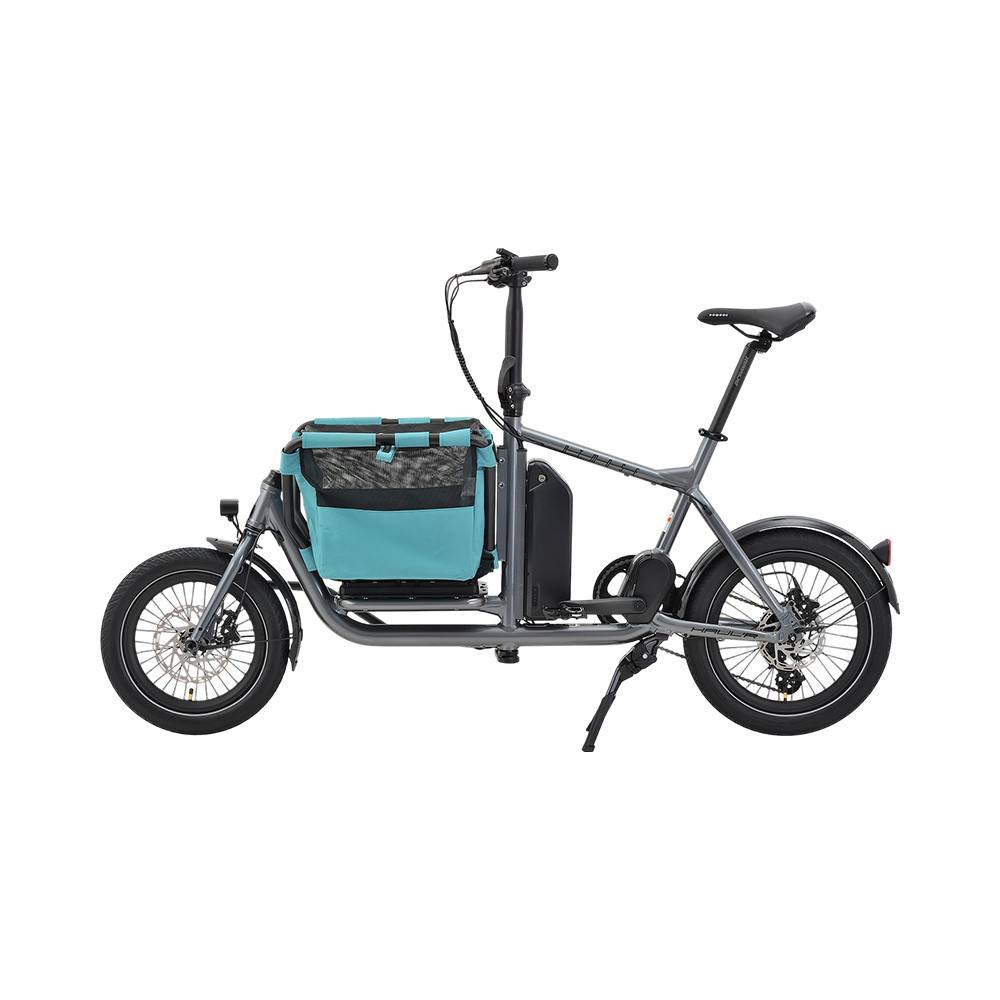
The Atmose Model Q ESQ1 is designed for this specific urban challenge. It is a compact front-loading electric cargo bike intended for commuting, shopping, light business delivery, family transportation, and general city mobility. Its design combines a short overall length, a low step-through format, responsive steering, an integrated front folding basket, hydraulic disc brakes, a mid-drive motor, and a seven-speed Shimano transmission.
Rather than treating cargo capacity and maneuverability as opposing goals, the Model Q seeks to balance both. Its front basket provides useful carrying space while its 1,780-millimeter overall length remains practical for apartment storage, elevator access, narrow bicycle rooms, and crowded urban streets. The result is a cargo bike aimed at riders who want more carrying capability than a standard e-bike without moving to the size and handling characteristics of a large family cargo bicycle.
This article examines the Model Q in detail, including its frame, electrical system, cargo configuration, braking performance, dimensions, daily applications, manufacturing approach, customization potential, and advantages in comparison with other types of urban cargo bicycles.
Many city journeys are short but inconvenient. A rider may need to transport groceries, a work bag, a package, a sports kit, or equipment for a small business. A conventional bicycle may not have sufficient carrying space, while a car can be inefficient for short trips. Public transportation may also be difficult when the journey involves bulky items, multiple stops, or irregular schedules.
Large cargo bikes can solve many of these problems, but size may limit their usefulness in dense urban environments. A long-tail or large front-loader can require additional storage space and may be difficult to maneuver in narrow lanes. It may also be unsuitable for apartments without ground-level access or for buildings with compact elevators.
The Model Q addresses this gap with a compact cargo format. It is intended for riders who need practical carrying capacity but still want the visual size, steering response, and parking convenience of a relatively small bicycle. This positioning distinguishes it from both ordinary commuter e-bikes and oversized cargo platforms.
Its design is particularly relevant to:
• Urban commuters carrying work equipment, clothing, meals, or personal belongings.
• Apartment residents who have limited bicycle storage space.
• Retailers and wholesalers seeking a compact cargo bike for their product range.
• Small businesses that need a mobile solution for light deliveries.
• Families transporting groceries, daily necessities, or compact personal items.
• Riders who value responsive handling and a lower step-through height.
• Users who want an electric bicycle that can perform multiple roles throughout the week.
The key idea behind the Model Q is adaptability. The front-loading basket can be used for shopping, deliveries, commuting equipment, parcels, or other daily cargo. Unlike a rear pannier-only setup, a front cargo area keeps the load visible and accessible to the rider. This can make it easier to check belongings during a journey and to organize items that need to be removed frequently.
The basket is designed to be removable. This gives the bicycle two practical configurations. With the basket installed, the Model Q functions as a compact cargo bike. With the basket removed, the front area becomes lighter and more open, allowing the rider to use the bicycle for simpler trips or to store it more conveniently.
The product information lists a front basket measuring approximately 470 millimeters in length, 470 millimeters in width, and 375 millimeters in height. Its stated basket load capacity is 25 kilograms, while the maximum rider load is listed as 120 kilograms. These figures make the bike suitable for a meaningful amount of daily cargo without suggesting that it is intended for oversized freight or extreme commercial payloads.
This is an important distinction. The Model Q is not designed to replace a heavy-duty delivery tricycle or a full-size family cargo bike in every application. Its strength is flexibility. It provides a manageable cargo solution for ordinary urban tasks while remaining easier to handle and store than many larger alternatives.
| Specification | Model Q ESQ1 |
|---|---|
| Product type | Compact front-loading electric cargo bike |
| Frame material | 6061 T4T6 aluminum alloy |
| Battery | Samsung 36V 15Ah lithium battery, approximately 540Wh |
| Drive system | Bafang CM2503 mid-drive motor, 36V, 250W |
| Transmission | Shimano seven-speed Sora system |
| Front basket capacity | 25 kilograms |
| Maximum rider load | 120 kilograms |
| Front wheel and tire | 16-inch wheel with 2.4-inch puncture-resistant tire |
| Rear wheel and tire | 18-inch wheel with 2.4-inch puncture-resistant tire |
| Overall dimensions | 1,780 millimeters long, 620 millimeters wide, 1,070 millimeters high |
| Braking system | Tektro hydraulic disc brakes |
| Basket design | Front folding and removable basket |
Specifications alone do not determine whether a cargo bike is effective. Geometry, component integration, load distribution, serviceability, and manufacturing consistency are equally important. The Model Q’s components are selected around its intended use as a compact urban vehicle rather than as a high-speed sporting bicycle.
The frame uses 6061 T4T6 aluminum alloy. This material is widely used in bicycle construction because it offers a useful combination of low weight, structural performance, corrosion resistance, and manufacturing flexibility. For an urban cargo bike, the frame must support the rider, the battery, the motor, and the front cargo assembly while remaining manageable in everyday handling.
The use of aluminum helps the Model Q avoid some of the unnecessary mass associated with larger steel cargo frames. Lower weight can benefit several aspects of ownership. It can make the bike easier to move into storage, easier to position in a bicycle rack, and more convenient to maneuver when the motor is not assisting. It may also help reduce the effort required when turning or walking the bike through a building.
The T4T6 designation refers to heat-treatment conditions associated with aluminum alloy processing. In a production environment, material preparation, welding, heat treatment, alignment, surface finishing, and inspection must be managed as a coordinated process. A cargo bike frame has to maintain consistent geometry because small alignment errors can influence steering, braking, wheel tracking, and basket fitment.
The compact frame geometry also contributes to the bike’s urban character. With an overall width of approximately 620 millimeters, the Model Q is intended to occupy a relatively limited amount of street and storage space. Its 1,780-millimeter length is shorter than that of many long-wheelbase cargo bicycles, which can make it easier to turn around in small areas and position inside compact storage spaces.
A frame designed for urban cargo use must also accommodate practical access. The lower step-through arrangement helps riders mount and dismount without swinging a leg over a high rear rack or cargo structure. This is useful when the rider is wearing work clothing, carrying a bag, or making repeated stops during a delivery route.
The Model Q uses a Bafang CM2503 mid-drive motor rated at 36 volts and 250 watts. A mid-drive motor is positioned near the bicycle’s crank area rather than inside one of the wheel hubs. This arrangement allows the motor to work through the bicycle’s gear system, which can be valuable when the bike is carrying cargo or climbing urban gradients.
Because the motor is located near the center of the bicycle, the system can help maintain a balanced weight distribution. This is particularly relevant for a front-loading bike. A motor placed in the front wheel would add weight close to the cargo area and could influence steering feel. A motor placed in the rear wheel would add weight behind the rider. A central motor supports a more centralized layout.
The seven-speed Shimano Sora transmission gives the rider multiple ratios for changing terrain and load conditions. Lower gears can assist with starting from a stop, climbing a slope, or moving with a heavier basket. Higher gears can support efficient cruising on flatter streets. The combination of motor assistance and mechanical gearing allows the bike to adapt to different riding conditions rather than relying on motor power alone.
For a cargo bicycle, smooth control is often more useful than maximum acceleration. Riders may be carrying fragile groceries, packages, or personal belongings. A predictable motor response can contribute to a more comfortable and controlled ride, particularly in busy areas where the rider must start, stop, and adjust speed frequently.
The 36-volt system is paired with a Samsung 36V 15Ah lithium battery, listed at approximately 540 watt-hours. Actual range depends on many factors, including rider weight, cargo weight, terrain, temperature, tire pressure, assist level, wind, riding speed, and stop-and-go conditions. It is therefore more useful to view the battery capacity as a foundation for practical urban journeys rather than as a guarantee of a specific distance.
The battery capacity is appropriate for a bike that may be used for commuting, shopping, and repeated local trips. Riders who plan long routes, frequent hill climbing, or commercial use should evaluate their expected journey length and charging routine. As with any electric bicycle, correct charging practices and appropriate storage conditions are important for long-term battery performance.
The Model Q uses a 16-inch front wheel and an 18-inch rear wheel, both specified with 2.4-inch puncture-resistant tires. Smaller wheels can contribute to a compact frame layout and a lower cargo platform. They can also support quick steering responses, which is useful when navigating narrow streets, parking areas, cycle paths, and crowded intersections.
The 2.4-inch tire width provides a larger contact area than a narrow road tire. This can help improve stability and comfort over ordinary urban surfaces such as paving stones, painted road markings, drainage covers, and uneven asphalt. Puncture-resistant construction is also valuable for a utility bicycle that may be ridden regularly through areas where glass, sharp debris, or other road hazards are present.
Small wheels can behave differently from large bicycle wheels. They may respond more quickly to steering inputs and road irregularities. For this reason, riders should become familiar with the bike gradually, especially when carrying cargo. The compact dimensions are an advantage in tight spaces, but the rider should still maintain appropriate speed and allow extra attention for uneven surfaces.
The different front and rear wheel sizes reflect the bike’s practical geometry. The smaller front wheel helps keep the front cargo structure compact, while the slightly larger rear wheel supports the rider and drivetrain. Together, the configuration contributes to the product’s distinctive combination of cargo function and agile handling.
The bicycle is equipped with Tektro hydraulic disc brakes. Hydraulic braking systems transmit lever pressure through fluid rather than a conventional mechanical cable. This can provide consistent braking control with relatively low hand effort, a useful characteristic when a bike is carrying cargo or when the rider is making many stops throughout the day.
Disc brakes are positioned away from the wheel rim, which can help preserve braking performance in wet conditions and reduce dependence on rim surface cleanliness. Hydraulic systems can also provide a progressive lever feel that allows the rider to modulate braking more precisely.
Brake performance is especially important on a cargo bike because total system weight changes according to the load. A rider may use the bicycle empty one day and carry a full basket the next. Before riding with cargo, the user should confirm that the items are securely positioned, that the basket does not obstruct steering, and that braking distance is appropriate for the conditions.
As with all bicycle components, hydraulic brakes require periodic inspection. Brake pads, rotors, hoses, and fluid condition should be checked according to the maintenance schedule recommended by the dealer or service provider. Professional service may be appropriate if the lever feels spongy, braking power changes significantly, or fluid leakage is visible.
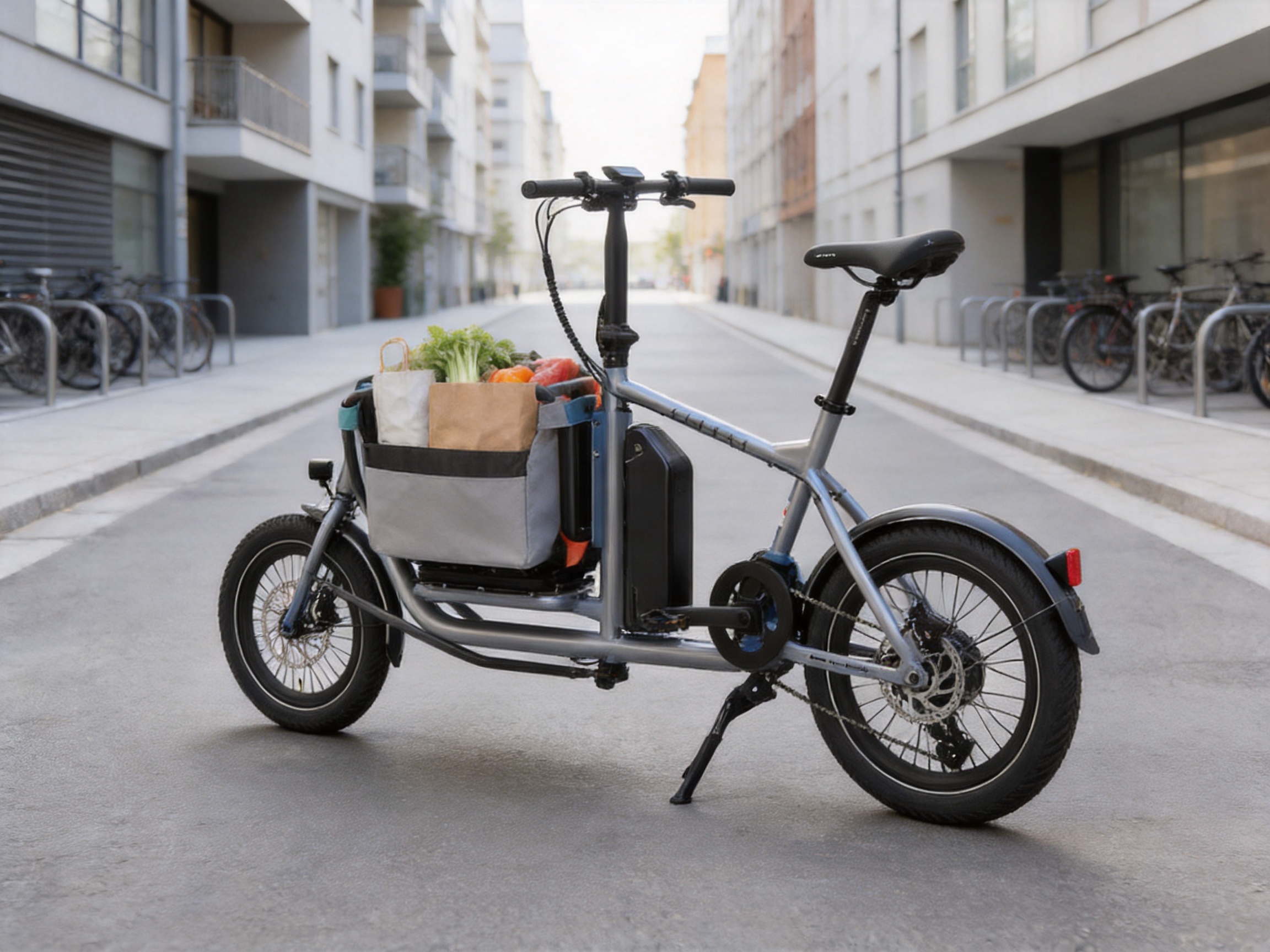
The front basket is one of the Model Q’s most important functional components. It provides an elevated front-loading area without requiring a long cargo box. The basket can be used for groceries, parcels, office materials, shopping bags, sports gear, or other items that fit within its dimensions and load rating.
The folding and removable design increases the bike’s versatility. A rider can install the basket for a shopping trip, remove it for a lighter commute, and fold or store it when the bicycle is placed in a confined area. This is a practical advantage over fixed cargo structures that permanently increase the bicycle’s footprint.
The installation process is designed around three basic actions. First, the user aligns the basket base with the pre-installed mounting holes on the handlebar assembly. Second, the basket is lowered vertically until the clips contact the mounting points. Third, the basket is pushed backward toward the saddle until it clicks into place.
A clear click is intended to indicate that the basket has engaged with the mounting structure. Even when a quick-release system is used, the rider should verify that the basket is fully seated before every journey. The basket should not be loaded beyond its stated capacity, and cargo should be distributed so that it does not shift during braking or turning.
Removal involves releasing the lower pin, pushing the basket forward along its track, and lifting it away after it reaches the end position. This process allows the user to configure the bicycle without specialized tools for ordinary basket changes. Tool-free adjustability can be particularly valuable for households and businesses that use the same bike for different purposes.
Many cargo bikes are purchased by people who want an immediately useful transportation tool rather than a complex mechanical project. The Model Q’s basket system is designed to reduce installation difficulty. The three-step fitting sequence provides a straightforward procedure that can be understood by a new owner after reviewing the instructions.
Simple installation also supports retail distribution. Wholesalers and retailers can present the bicycle as a practical product with a manageable setup process. Dealers may still need to complete professional assembly, safety checks, brake adjustments, drivetrain inspection, and electrical-system verification before delivery. However, the removable basket itself is designed to be user-friendly.
A compact product is also easier to display in a showroom. Retailers can demonstrate the bike with and without the basket, helping customers understand its dual role as a cargo bicycle and a lighter urban e-bike. For international buyers, this flexibility can make the model suitable for different retail markets and user groups.
A standard commuter e-bike is often optimized for personal transportation. It may include a rear rack or small pannier mounts, but its carrying capacity can be limited. The Model Q provides a more substantial front loading area and a stated 25-kilogram basket capacity.
This difference is valuable for tasks that are awkward with a normal bicycle. A grocery bag can be placed directly into the basket rather than hung from the handlebar. A small delivery package can remain visible and stable. A gym bag, briefcase, or equipment case can be carried without occupying the rider’s back.
The front-loading configuration also keeps the load close to the rider’s field of view. This can help the user monitor cargo during a trip. The rider should nevertheless avoid placing items so high or wide that they block visibility or interfere with steering.
Compared with a standard e-bike, the Model Q offers greater role flexibility. It can function as a personal commuter during the week, a shopping vehicle on weekends, and a compact delivery platform for a small business. The removable basket prevents the bike from being limited to a single use case.
Larger cargo bikes generally provide greater capacity, but they also require more storage area and may be less agile in dense urban settings. A long-wheelbase bike can be difficult to turn inside a small courtyard, maneuver through a narrow doorway, or store in an apartment building.
The Model Q’s compact dimensions provide an alternative for riders whose cargo needs are moderate. At approximately 1,780 millimeters long and 620 millimeters wide, it is designed to remain relatively manageable in environments where a larger cargo bike may be inconvenient.
The shorter layout may also make parking easier. A rider may be able to use standard bicycle parking arrangements, although local regulations and available space should always be checked. The bike’s compact form can be especially useful for city residents who cannot dedicate a large garage area to bicycle storage.
The trade-off is that the Model Q’s basket is not intended for the same volume as a large family box or heavy-duty platform. Buyers should select the product according to their actual transportation needs. Its advantage is not maximum payload; it is the balance between useful cargo space and everyday maneuverability.
The Model Q’s mid-drive layout offers a different engineering approach from a front-hub motor. A front-hub motor adds drive weight directly to the steering wheel, which may affect steering feel, especially when the front area is also carrying cargo. The central drive system keeps the motor near the bicycle’s bottom bracket and crank area.
Using the bicycle’s Shimano seven-speed transmission can also help the motor work across different gradients and load conditions. The rider can select a lower gear for climbing or starting and a higher gear for more efficient travel on flat roads.
This arrangement can be beneficial for an urban cargo bicycle that may face frequent stops, ramps, bridges, and moderate hills. It does not remove the need for proper riding technique or maintenance, but it supports a more integrated relationship between motor assistance and human pedaling.
The performance of a cargo bike depends not only on its visible components but also on the processes used to develop and assemble them. Atmose combines an American product concept with a design and research-and-development presence in Paris. The company describes its background as combining American product thinking, European design aesthetics, manufacturing expertise, and an established supply chain.
For the Model Q, these strengths can be understood through several development priorities: compact urban geometry, component integration, practical user interaction, supply-chain coordination, and quality consistency.
Effective product development begins by identifying how the bicycle will be used. The Model Q is not simply a smaller version of a large cargo bike. Its design choices indicate a focus on urban living, including compact storage, quick maneuverability, low step-through access, removable cargo equipment, and moderate but useful load capacity.
This user-centered approach helps ensure that features work together. A compact frame would be less useful if the basket were permanently oversized. A removable basket would be less practical if its mounting system were difficult to operate. A powerful motor would be less suitable if braking and load distribution were not considered at the same time.
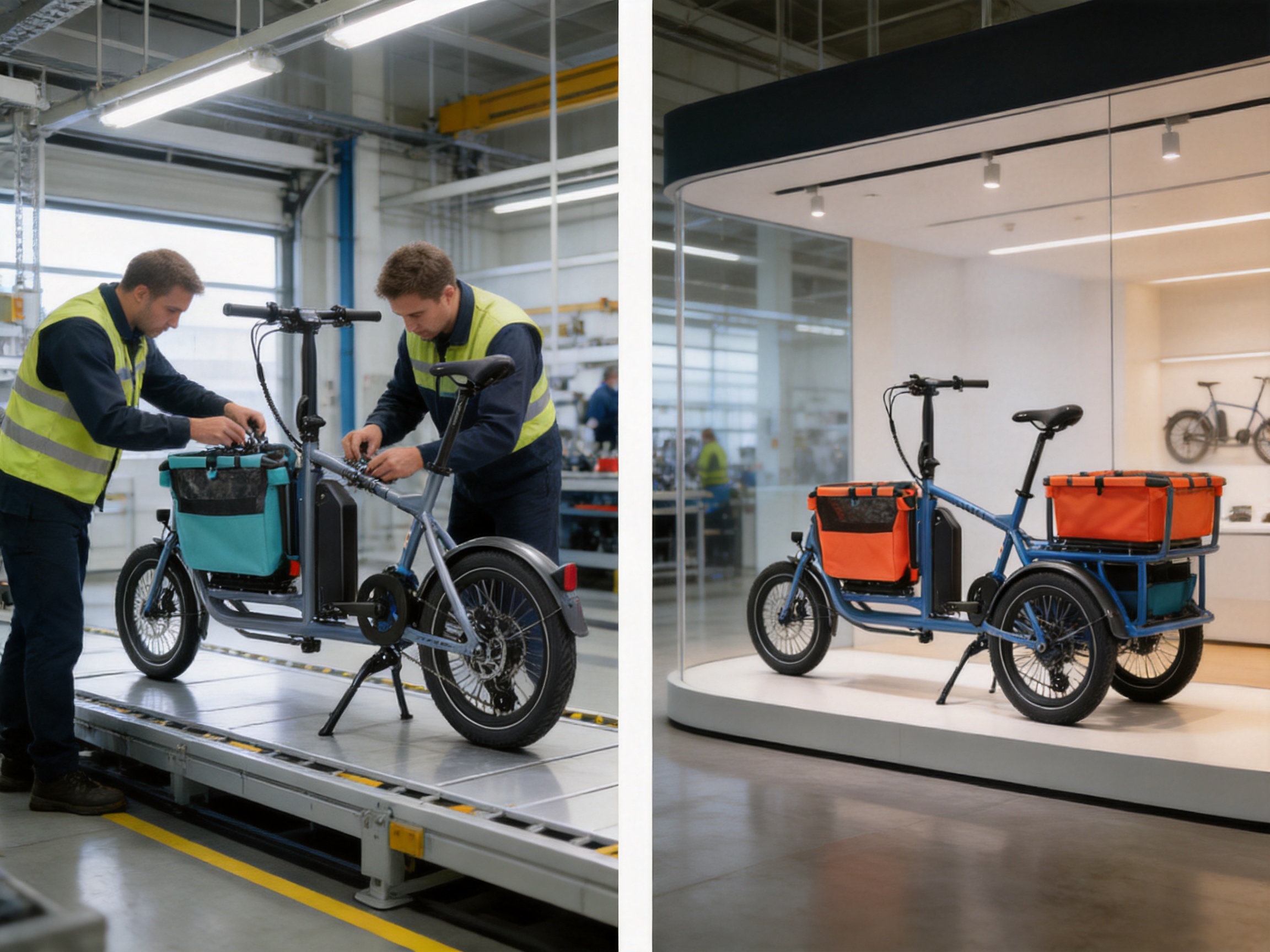
Manufacturing a cargo e-bike requires coordination between the frame, fork, basket supports, motor, battery mount, drivetrain, wheels, brakes, and electrical components. The parts must fit together with correct clearances and alignment. The front basket must remain secure without making steering unnecessarily heavy or awkward.
The use of a dedicated frame design allows these systems to be planned as one platform. The battery must be positioned so that it is accessible for charging and protected during regular riding. The motor must be supported by an appropriate frame structure. Brake routing and cable paths should be managed to avoid interference with moving parts. These details are part of the difference between simply combining components and developing a coherent cargo bicycle.
The 6061 T4T6 aluminum frame requires controlled preparation and fabrication. Important manufacturing stages may include material inspection, tube cutting, fixture alignment, welding, heat treatment, surface preparation, finishing, and dimensional inspection. The specific factory process can vary, but the objective is consistent: produce frames with reliable geometry and repeatable structural quality.
Welding quality is particularly significant in a cargo frame because the structure experiences repeated loads from the rider, motor assistance, braking, road impacts, and cargo movement. Proper fixtures help control alignment during assembly. Post-weld treatment and inspection help identify issues before final assembly.
For international wholesale customers, process consistency is as important as individual product performance. A mature supply chain and established manufacturing relationships can help support repeat orders, component coordination, and production planning across different batches.
An electric cargo bike requires careful integration of the battery, motor, controller, display or control interface, wiring harness, charging connection, and protective mounting points. These components must operate as a complete system. Cable routing should protect wiring from abrasion, water exposure, and mechanical interference during normal use.
The Model Q pairs a 36V Samsung battery with a Bafang mid-drive motor. Using recognized component suppliers can support system availability, service familiarity, and replacement-part planning. Retailers and distributors should still confirm regional specifications, warranty arrangements, charger compatibility, and service procedures before placing large orders.
Electrical quality control should include inspection of connectors, battery mounting, charging behavior, motor operation, assist response, and cable security. These checks are important because an electric bicycle combines mechanical and electronic systems that must remain reliable together.
Final assembly is more than attaching the wheels and adjusting the brakes. A cargo bicycle requires verification of the steering system, basket mount, drivetrain, hydraulic brakes, motor, battery, tire installation, fastener torque, and overall alignment.
A systematic inspection process can help identify problems before the bicycle reaches the customer. Typical checks may include confirming that the wheels are centered, the headset is correctly adjusted, the brake rotors run true, the gear changes are smooth, the basket locks securely, and the electrical connections are properly seated.
Quality control is also relevant to the customer experience. A bike that arrives correctly adjusted is easier for the retailer to demonstrate and easier for the user to trust. Consistent assembly reduces the time required for dealer preparation and can help lower the risk of early service complaints.
Atmose was developed by MOTIV, an American beach cruiser brand with industry experience. The company states that Atmose benefits from manufacturing knowledge, a mature supply chain, and continuous innovation. The later establishment of ATMOSE SASU in France and the creation of a Paris-based design and research-and-development team add an international dimension to the product-development structure.
This combination can support continued refinement of frame geometry, component selection, visual design, user interfaces, accessories, and production methods. For a compact cargo bicycle, feedback from dealers and riders can be especially valuable because small changes to basket mounting, storage convenience, steering response, or cable placement may have a meaningful effect on daily use.
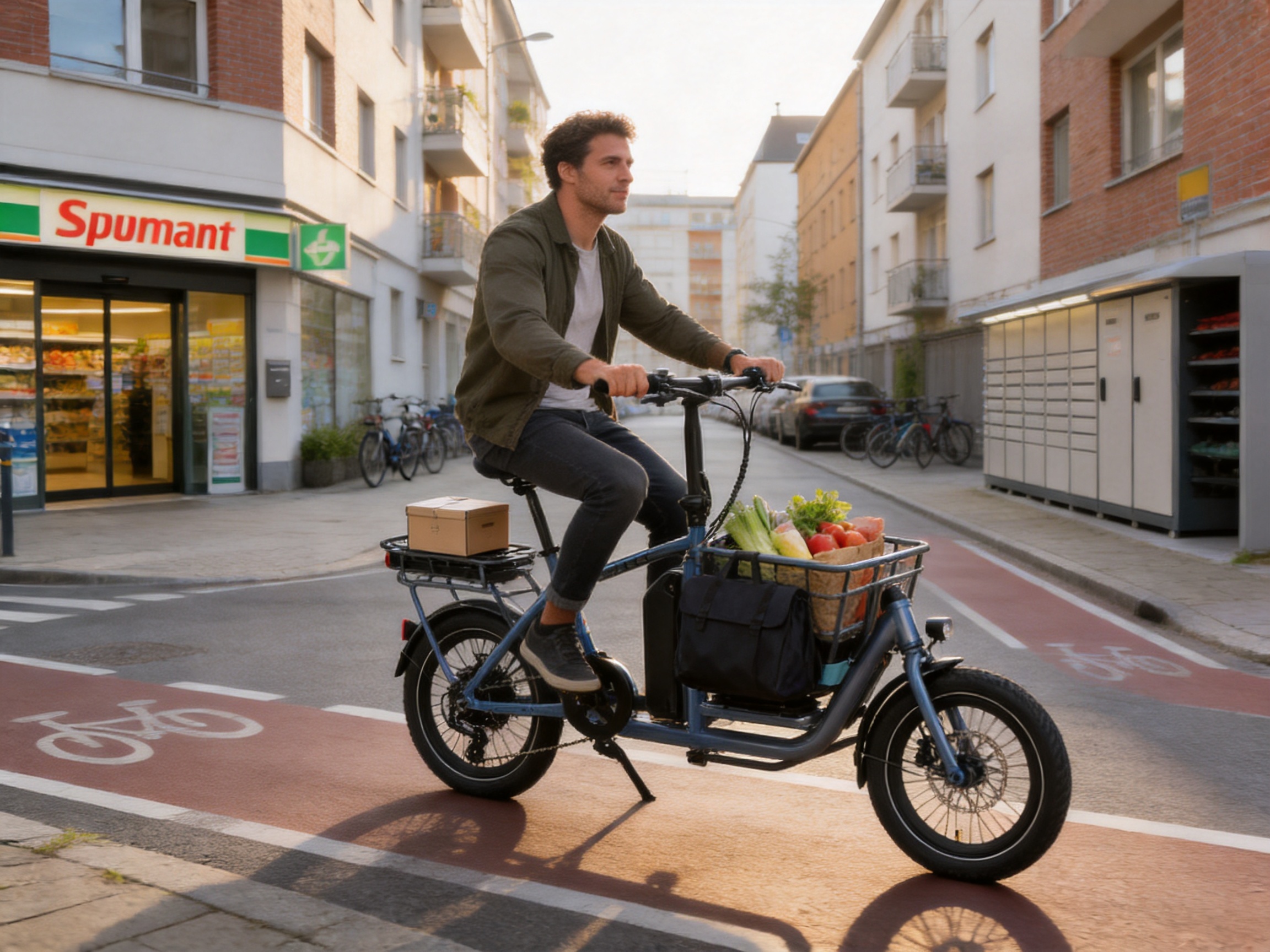
For commuting, the Model Q can carry a work bag, lunch, clothing, documents, or small equipment in the front basket. The electric assistance can help reduce the physical effort of longer urban journeys and repeated stops. The compact frame is also relevant for commuters who need to store the bicycle in a small workplace or apartment.
Grocery shopping is a natural use for a front-loading cargo bike. The basket can accommodate items that may be inconvenient to carry on a conventional bicycle. Riders should distribute weight evenly and keep fragile products away from the basket edges. Heavy items should be secured so they do not shift during braking.
Small retailers, florists, cafés, repair services, and local sellers may use the Model Q for short-distance deliveries. Its compact size can be helpful when stopping near storefronts or navigating busy commercial districts. The basket can also be adapted to a business’s workflow, subject to safe mounting and the stated load limit.
The Model Q can support everyday household tasks such as transporting school materials, personal belongings, or compact shopping loads. It is not presented as a large child-transport platform, so families should confirm that any intended passenger or child-carrying configuration is specifically approved and properly equipped. The standard basket should not be used as an improvised passenger seat.
When the basket is removed, the bicycle can provide a simpler configuration for recreation, exercise, or personal transportation. The seven-speed drivetrain allows the rider to select a suitable effort level, while the electric assistance can be adjusted according to terrain and personal preference.
Regular maintenance helps preserve safety and performance. Before each ride, users should check tire pressure, brake operation, wheel security, handlebar stability, basket engagement, and battery condition. Cargo should be kept within the stated 25-kilogram basket capacity and should not obstruct the rider’s view or interfere with the front wheel.
The chain and gears should be kept clean and lubricated as appropriate. Hydraulic brake pads and rotors should be inspected for wear. Tires should be checked for embedded debris and signs of damage. Puncture-resistant tires reduce risk but do not eliminate the possibility of punctures.
The battery should be charged with the correct charger and stored in a dry, moderate environment. Users should follow the supplied charging instructions and avoid using visibly damaged batteries or chargers. If unusual heat, odor, swelling, or charging behavior occurs, charging should stop and qualified service personnel should be contacted.
The removable basket should be inspected periodically, particularly at the mounting clips, lower pin, and contact points. If the basket does not click securely into position or shows excessive movement, it should not be used until the mounting system has been checked.
The Model Q has characteristics that may be attractive to international wholesalers and retailers. Its product category is easy to explain: a compact electric cargo bicycle for urban use. It addresses a visible need in cities where consumers want cargo capacity but do not have room for a large bicycle.
The removable basket gives retailers a useful demonstration feature. A sales consultant can show how the bike changes from a cargo configuration to a lighter everyday configuration. The compact dimensions can also simplify showroom placement and transportation planning compared with larger cargo models.
The product can be positioned across several customer segments without requiring a completely different platform for each one. Commuters, shoppers, small businesses, and apartment residents may all recognize a relevant use case. For distributors, this multi-purpose positioning can support a broader retail message.
Wholesale buyers should evaluate regional requirements before ordering. These may include electrical regulations, labeling, charger standards, packaging, warranty policies, spare parts, dealer assembly procedures, and local restrictions governing electric bicycles. The stated specifications should also be confirmed in the final commercial documentation.
| Design priority | Model Q response | Practical benefit |
|---|---|---|
| Urban storage | Compact 1,780-millimeter length and 620-millimeter width | Easier positioning in limited storage areas |
| Carrying capacity | Front basket with a stated 25-kilogram capacity | Useful for shopping, commuting, and light delivery |
| Handling | Compact wheel arrangement and responsive steering concept | Suitable for narrow urban routes and frequent turns |
| Assistance | 36V, 250W Bafang mid-drive motor | Supports pedaling across everyday urban terrain |
| Energy storage | 36V 15Ah Samsung lithium battery | Provides a practical battery platform for local journeys |
| Braking | Tektro hydraulic disc brakes | Controlled braking with low hand effort |
| Adaptability | Folding and removable front basket | Allows cargo and non-cargo configurations |
| Frame construction | 6061 T4T6 aluminum alloy | Balances structural performance and manageable weight |
The Model Q is intended for urban riders who need a compact electric bicycle with practical front cargo capacity. It is suitable for commuting, shopping, small deliveries, errands, and personal transportation. It is particularly relevant to people who have limited storage space or who prefer a more agile alternative to a large cargo bike.
The stated maximum basket load is 25 kilograms. Cargo should be distributed evenly, secured against movement, and kept within the basket’s physical dimensions. The basket should not be used to transport passengers unless a separate, approved passenger system is provided and the bicycle is specifically configured for that purpose.
No. The front basket is designed to be installed and removed. It can be fitted by aligning the mounting points, lowering the basket, and pushing it backward until it clicks into place. Removal requires releasing the lower pin, moving the basket forward, and lifting it away.
The mid-drive motor is positioned near the center of the bicycle and works through the bicycle’s gear system. This can support balanced weight distribution and allow the rider to use the seven-speed transmission to adapt to hills, starts, and different load conditions.
Its compact wheelbase and overall dimensions are intended to make it more convenient for tight storage spaces and standard urban access points. However, users should measure their own elevator, doorway, hallway, and storage area before purchasing, because building dimensions vary.
The battery is specified as a 36V 15Ah unit with approximately 540 watt-hours of capacity. Actual range depends on rider weight, cargo, terrain, assist level, temperature, wind, tire pressure, and riding style. A precise distance should therefore be confirmed through local testing and the final technical documentation.
The 16-inch front and 18-inch rear wheels help support the compact frame and front-loading design. Smaller wheels can contribute to responsive steering and a lower cargo structure. The wide 2.4-inch puncture-resistant tires are intended to support stability and comfort on ordinary city surfaces.
Yes, it can be considered for light urban delivery work within its stated load limits. It may suit local shops, service providers, and small businesses that need a compact delivery vehicle. Businesses requiring very large payloads should consider a heavy-duty cargo platform instead.
The product benefits from an American-origin brand concept, Paris-based design and research-and-development activity, manufacturing experience, and an established supply chain. The frame and component systems require coordinated engineering, assembly, inspection, and quality control to ensure consistent fit and operation.
Users should check the tires, brakes, wheels, handlebar, basket engagement, cargo security, battery mounting, and general electrical operation. Any unusual noise, movement, brake weakness, or electrical fault should be addressed before riding.
The Atmose Model Q ESQ1 occupies a useful position between a standard commuter e-bike and a large cargo bicycle. Its compact dimensions, front-loading basket, removable configuration, mid-drive motor, seven-speed transmission, hydraulic disc brakes, and aluminum frame are designed around the realities of urban mobility.
Its principal advantage is balance. The bike provides more carrying capability than a conventional commuter e-bike while avoiding much of the size and storage burden associated with larger cargo models. The basket supports shopping and light delivery, while its removable design allows the bicycle to return to a simpler configuration for commuting or leisure.
The technical package also reflects a practical engineering approach. A 6061 T4T6 aluminum frame supports manageable weight and structural performance. The 36V electrical system combines a Samsung battery with a Bafang mid-drive motor. Shimano seven-speed gearing helps the rider adapt to changing terrain and load conditions. Tektro hydraulic disc brakes provide a control-focused braking system, and wide puncture-resistant tires are suited to regular city use.
Behind these visible features is a broader product-development structure involving American product origins, European design and research-and-development activity, manufacturing experience, and supply-chain coordination. For retailers and wholesalers, this combination supports a product that can be positioned across several urban customer groups.
The Model Q is not intended to be the largest or highest-capacity cargo bicycle. Its purpose is different. It is a compact, adaptable, and practical electric cargo platform for people who want to carry more without giving up the convenience of an agile city bike.
1. Product specification sheet for the Model Q ESQ1 compact electric cargo bike.
2. Technical information for the 6061 T4T6 aluminum alloy frame construction.
3. Component information for the Bafang CM2503 mid-drive electric motor.
4. Battery specification information for the Samsung 36V 15Ah lithium battery system.
5. Shimano bicycle drivetrain product information relating to seven-speed systems.
6. Tektro hydraulic disc brake technical and maintenance guidance.
7. General bicycle industry guidance concerning cargo loading, braking inspection, tire maintenance, and electric bicycle battery safety.
8. Product assembly and basket installation instructions for the removable front cargo system.
Nov 11, 2026
Nov 07, 2026
Nov 05, 2026


info@atmosecargobike.com

200 rue de la Croix Nivert 75015 Paris

Custom Electric Bakfiets
 English
 Français
 Deutsch